We’re excited to announce that our founder @jacopoburiollo has officially stepped into the role of CEO.
As we enter this next phase of growth, the project will focus on two core priorities:
1. Sourcing solar and battery farms that deliver a sustainable yield
2. Raising strategic capital to accelerate expansion.
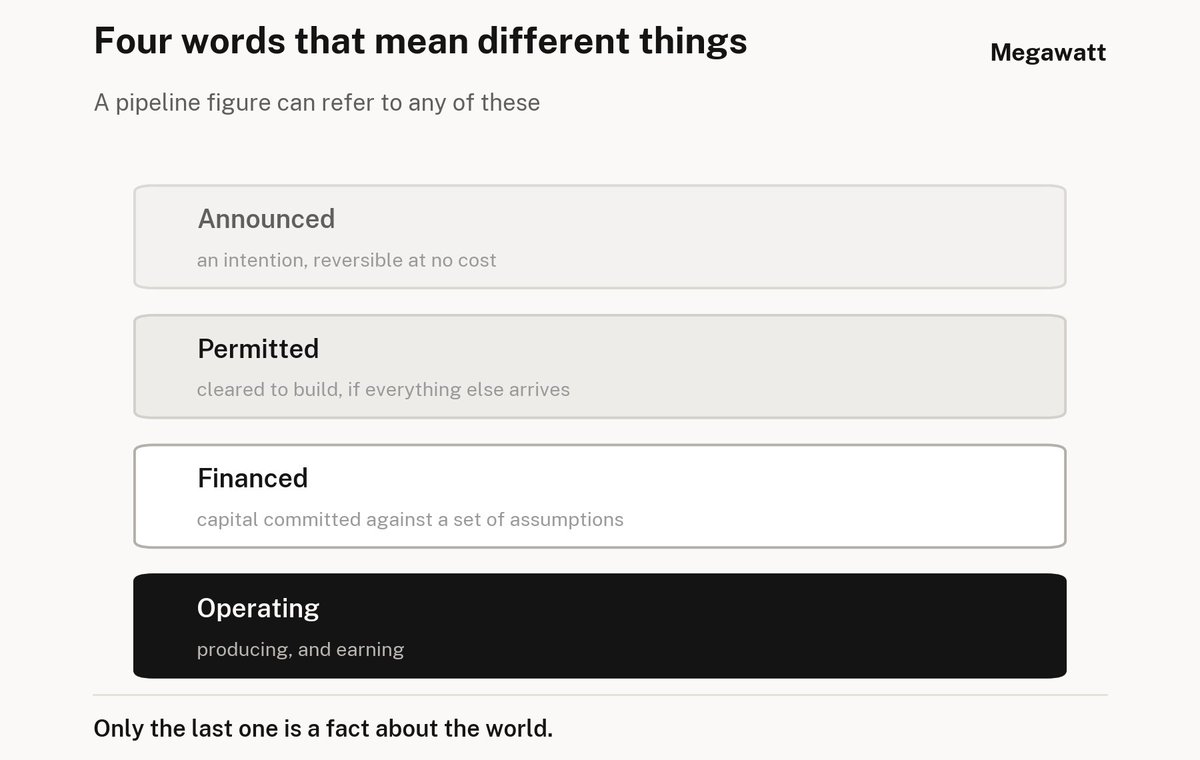
Announced, permitted, financed, operating.
Four words used almost interchangeably in energy, separated by years and by very different odds of actually happening.
Only the last one describes something producing electricity.
The rest describe someone's plans.
Follow any yield backwards and see where it terminates.
Megawatt's yield goes to electricity sold into a grid, produced by equipment that exists and is metered by an operator with no stake in the outcome.
Three steps, nothing in the chain taken on trust.
A solar farm can produce a megawatt-hour and be paid nothing for it.
The grid was full, so the output was curtailed and never reached commercial viability.
Generation is physics and reasonably predictable.
Getting paid for it depends on what everyone else is doing in that same hour.
A tokenized real asset has to answer two separate questions.
Can the token move, which the contract handles fine.
And is this person allowed to own it, which depends on their jurisdiction, their status, and what the issuer is permitted to do.
The contract has no way to know any of that.
Getting those two to line up is most of the work.
Every real asset carries risk you can insure and risk you cannot.
Fire, failure, and damage transfer to someone whose business is absorbing them.
Price, output, and the buyer's willingness to keep paying stay exactly where they are.
The second column is the actual investment.
Megawatt finances utility-scale solar and battery storage.
The question that decides these projects is increasingly not what it costs to build, but when it can actually start earning.
For most of the last decade, the constraint on building energy infrastructure was money.
That has quietly inverted, and almost nobody outside the industry has noticed 🧵
So timing has become part of the valuation rather than a detail of it.
A project that can energise sooner is not just faster. It is worth more, because the alternative is capital sitting idle while a queue moves.
Megawatt finances utility-scale solar and battery storage.
The question that matters for funding one is how much of that revenue can actually be relied on.
Megawatt finances utility-scale solar and battery storage, held through dedicated project structures.
Capital funds real assets; those assets sell power, and the revenue returns to the people who financed them.
No token, no emissions, no governance theatre. Infrastructure and the cash it produces.
Megawatt finances utility-scale solar and battery storage, and this is why the market side gets as much attention as the engineering.
Producing power is solved.
Getting paid properly for it is the actual work.
People assume a solar farm earns money by producing electricity.
Half right.
Two numbers decide what it actually earns, and only one of them is engineering 🧵