AI entrepreneur, always on the lookout for new ways to use AI to improve businesses Follow me for the latest updates on AI and how its shaping the future.
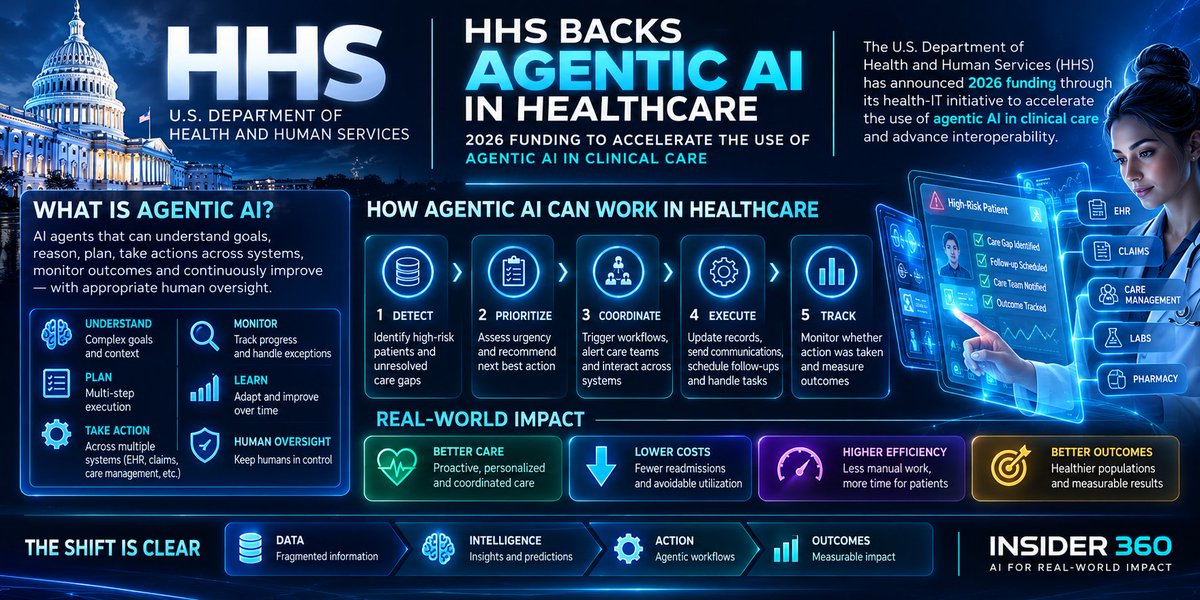
Agentic AI in healthcare is moving from concept to serious implementation.
The U.S. Department of Health and Human Services (HHS) has announced 2026 funding through its health-IT initiative to accelerate the use of agentic AI in clinical care.
That matters.
We’ve spent the last few years talking about AI that summarizes information, generates content and assists humans.
The next evolution is different.
Agentic AI can understand a goal, reason through a problem, plan multiple steps, interact with systems, take actions and monitor what happens next — while keeping appropriate human oversight.
In healthcare, imagine the possibilities:
→ Detect a high-risk patient
→ Identify an unresolved care gap
→ Prioritize the intervention
→ Coordinate the next workflow
→ Alert the appropriate care team
→ Track whether action was taken
→ Measure the resulting outcome
That is a fundamentally different model from simply putting another dashboard in front of a clinician.
It moves us toward:
Data → Intelligence → Action → Outcomes.
And in my view, this is where some of the biggest opportunities in healthcare AI will emerge.
The winners won’t simply build AI that knows more.
They’ll build AI systems that can responsibly help healthcare organizations get more done — and prove the outcomes they create.
This is exactly the direction we’re thinking about at INSIDER 360.
#AgenticAI #HealthcareAI #HealthTech #ArtificialIntelligence #ValueBasedCare #DigitalHealth #AIAgents
We finally solved it 🤯
Opus 5.5 videos are now editable.
VEED Open Edit: our open-source agent turns videos into editable browser projects.
Create editable videos from single prompt.
Project + GitHub below in comments ↓
OpenAI just showed a system called dots that stops answering questions and starts marking where the answer would have to come from.
It returns no text. It returns points on your own data, each one a place the claim is either supported or is standing on nothing.
> SPREAD - the question broken into the individual claims an answer would need
> ANCHOR - each claim pinned to the exact span in your documents that carries it
> VOID - claims with no span behind them left empty instead of being filled in
> LINK - anchors connected where one claim depends on another holding first
> READ - the finished map returned as points, never as a paragraph
A normal answer hides its own gaps. The sentences are smooth, and the part with nothing underneath reads identically to the rest.
Dots refuses that trade. An unsupported claim shows up as an empty point, impossible to skim past.
The dependency links are the sharp part. One hollow anchor exposes every claim resting on top of it at once.
That turns a wrong answer into a located problem. You see which document is missing, not just that something feels off.
Fluency has been doing the convincing in every tool shipped so far. Here it has nothing to hide behind.
The dot format and how the voids are scored are laid out in the breakdown below.
OpenAI's dots agents take one prompt and a YouTube link, and hand back the video pulled apart frame by claim.
Nothing gets summarised. The video is broken into what it asserts, and each assertion is checked against the moment it was made.
> CLAIM - every statement the video makes listed separately, with its timestamp
> MATCH - each one tested against what the footage at that second actually shows
> TRACE - the sources it leans on named, or flagged as never given at all
A summary launders everything. Strong claims and throwaway lines come out reading the same weight.
Here they stay separated. You see which sentence carries the argument and which one is filler between B-roll.
The visual check is the part nobody builds. A confident voiceover over unrelated footage is the oldest trick on the platform.
Unsourced claims surface as a list, not as a feeling that something was off while you watched.
A forty-minute video collapses into a page you can argue with, timestamp by timestamp.
The prompt and the claim format are laid out in the breakdown below.
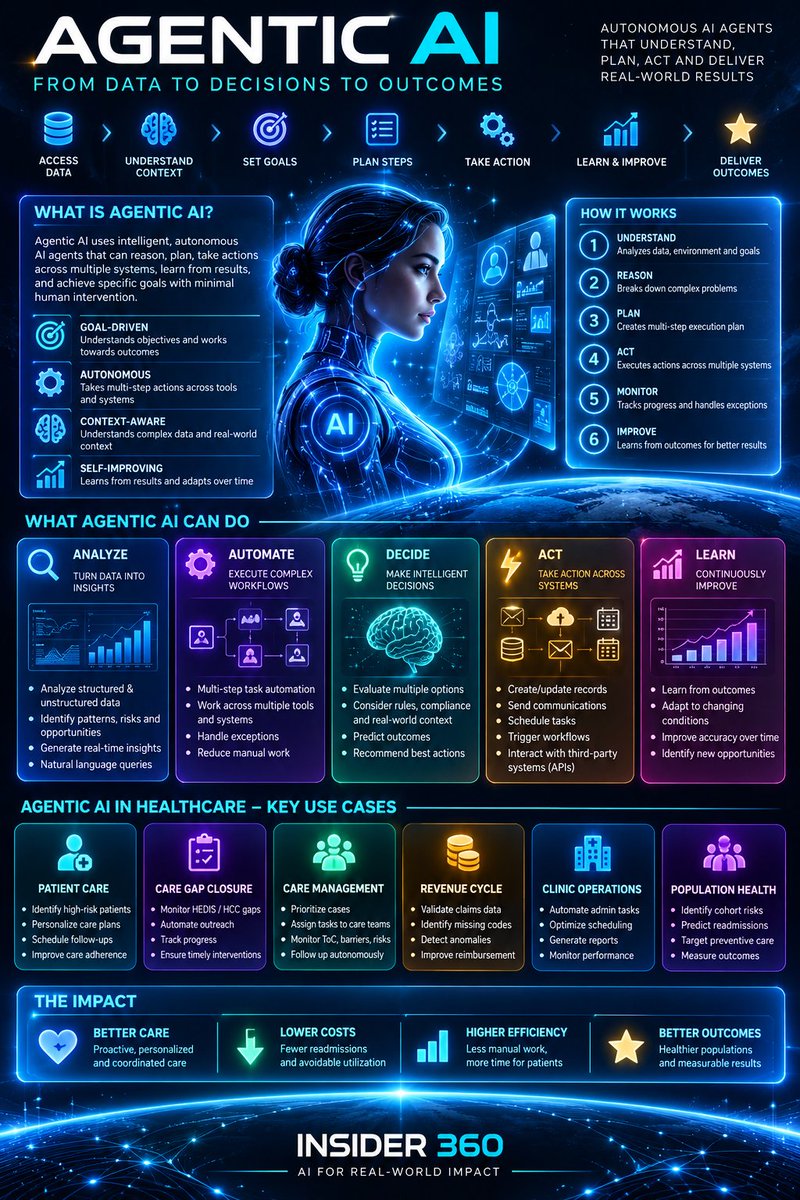
Agentic AI isn’t just answering questions. It’s taking action.
It can reason, plan, make decisions, execute across systems, monitor outcomes and continuously improve.
We’re moving from AI that assists → AI that acts → AI that delivers outcomes.
That shift will redefine how businesses operate. ⚡
#AgenticAI #AI #ArtificialIntelligence #AIAgents #Automation #FutureOfWork #Innovation #INSIDER360
Helpful guide to hiring your first @Grok@Bot employee.
It really is like hiring an amazing helper that learns your needs and gets smarter almost every day!
Healthcare doesn’t need more AI. It needs AI that changes outcomes.
The real opportunity is turning fragmented data into intelligence, action, and better care.
That’s the future we’re building toward at INSIDER 360. 🚀
#HealthcareAI#AI#ValueBasedCare https://t.co/MppAmWQzxX
One Cable. Two Jobs. Charge your phone AND use it as a hands-free stand. 240W Fast Charging - Built-in Hidden Phone Stand.
Shop now: https://t.co/Ck0KXMehoJ
My jelly world now has its own island 😂🌴
Claude Opus 5.5 vs ChatGPT-6 Astra
I prefer Opus’s water: the transparency, reflections, and a whole storm from moving the mouse. But Astra feels more like jelly - the edges bend and the whole island wobbles
Estimated API cost:
Opus - $15.54
Astra - $10.51
Would you pay extra for Opus or pick Astra? 👀
@elonmusk “Artificial” was always a temporary label.
The interesting question is what we call it when intelligence surpasses the people who created it.
AI is becoming a commodity.
Knowing how to use AI won't be the competitive advantage for much longer.
The advantage will be knowing where to apply it, what to automate, and how to turn intelligence into measurable outcomes.
AI isn't the strategy.
What you build with it is.
Engineering doesn't have to be learned from flat diagrams.
A jet engine in interactive 3D, from intake to exhaust. Built with Claude Opus 5.5 using Three.js.