Today marks 34 years since the release of my song “I Will Be Here”. This song still means so much to Mary Beth & me, and I’m grateful for the countless stories of how much this song means to many of you as well. (Special thanks to Phil Naish, producer of the original version of this song, for joining me on this one!)
Coaching people’s hearts and caring about the process over the outcome, doesn’t make you less competitive. But it does make you more committed! #CarRidesWithCori#EliteHABITS#UNCOMMON
I spent 5 days in the Ozark mountains with no phone.
Here are 29 things I learned:
1. Modern technology has us in a constant state of overstimulation.
2. Nature is one of God’s greatest antidepressants.
3. The less time you spend consuming social media and the news, the less susceptible you are to lies, fear mongering and deception.
4. When you’re in the middle of nowhere, the best form of entertainment is exercise.
5. If you want to better connect with the people you’re with, put down your phone.
6. The more active you are, the better you sleep.
7. To better solve problems, remove distractions.
8. Downtime provides you an opportunity to grow closer to God.
9. Packed calendars create anticipation and kill creativity.
10. Peak mental clarity cannot be achieved with constant stimulation from screens.
11. Humans are batteries and our charger is alone time with God.
12. The modern lifestyle of living fast is a recipe for stress.
13. The more time you spend outside, the better you feel.
14. When you remove conveniences like electricity and running water, your gratitude skyrockets.
15. If you want a calmer mind, you need to place yourself in a calmer environment.
16. Being self-sufficient breeds confidence.
17. To better hear the voice of God, make all other inputs as quiet as possible.
18. Exploration is one of the best sources of creativity.
19. Presence and anticipation cannot coexist.
20. Detachment provides new perspectives; time away from my business exposed the problems with my business.
21. If you want better sleep, align your sleep schedule with the sun.
22. Whatever you become anxious about back home reveals your true values.
23. We’re often more scared of breaking the “rules” than we are of doing what it is we want to do.
24. Walking alone in the dark is scarier than walking with others; find community.
25. Focus and distractions cannot coexist.
26. Read the bible, pray and journal at the beginning of the day so you can fight off the enemy's attacks throughout the rest of the day.
27. Conquering challenges gives you proof that you are capable of great feats.
28. A fire only continues to burn if you keep feeding it; never stop working on you.
29. Life is better when you regularly consume coffee and home-made cookies.
The noise level is too high, students are out of their seats, and administration is taking notice. What do you do? Map out a classroom management makeover, of course!👇
https://t.co/uVMJogXAkw
Our newest task @strugglymath supports fluency with maths facts by making sense of multiple representations. The card deck features five types of representations! Check us out at https://t.co/1eGnps3yjv
“Be strong and courageous, and do the work. Don’t be afraid or discouraged, for the Lord God, my God, is with you. He will not fail you or forsake you.”
—1 Chronicles 28:20
Looking for some quick ways to improve your pedagogy? We have over 30 videos that break down fun, effective classroom practices in one minute—and now you can binge-watch them all in one place!
https://t.co/vJaFoZ5IPD
Jim Collins said, “Greatness is not a function of circumstance. Greatness, it turns out, is largely a matter of conscious choice.”
Greatness is a choice. A choice to take action.
It starts when you push yourself beyond your comfort zone.
It's not a destination, but a daily mindset to put your best foot forward.
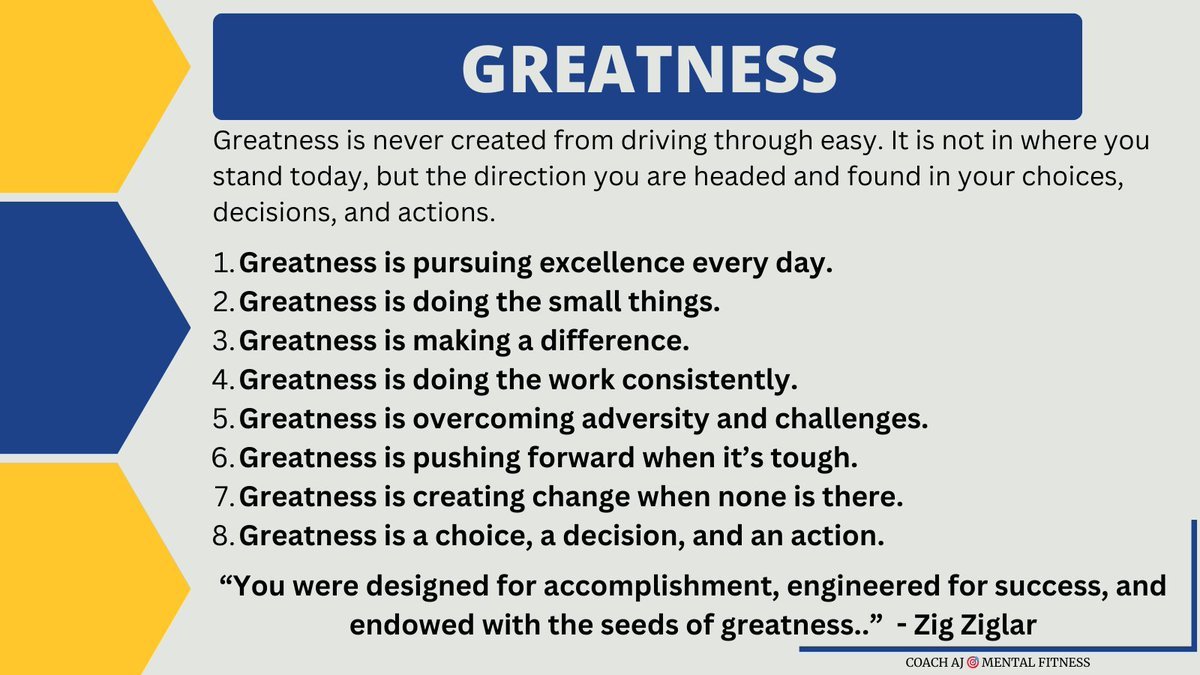
🔹Greatness is pursuing excellence every day.
🔹Greatness is doing the small things.
🔹Greatness is making a difference.
🔹Greatness is doing the work consistently.
🔹Greatness is overcoming adversity and challenges.
🔹Greatness is pushing forward when it’s tough.
🔹Greatness is creating change when none is there.
🔹Greatness is a choice, a decision, and an action.
JJ Watt said, “Success isn’t owned, it’s leased. And rent is due everyday.”
Michael Jordan said, "I can accept failure. Everyone fails at something. But I can't accept not trying."
Carol Dweck says a growth mindset is, "Belief you can develop abilities."
Your mindset defines how you experience life.
Being successful doesn't begin with success, it begins with a growth mindset.
A growth mindset starts with the belief that your abilities and intelligence can be developed through hard work, dedication, and perseverance.
✅It means being grateful there is a chance to grow.
✅It means you value work ethic and effort.
✅It means viewing challenges as exciting.
It starts with the language you use and how you frame it in your mind.
5 reframes to enable a growth mindset for yourself:
1. “I can’t do this.” -> “I am strong enough to overcome this obstacle.”
This shifts the focus from self-doubt and limitation ("I can't do this") to self-empowerment and ownership. It emphasizes your ability to believe in your ability to overcome challenges and grow.
2. “I am talented and a natural.” -> “I'm learning and grow, and that is great.”
This changes the emphasis from innate talent and fixed abilities to the value of continuous learning and personal growth. It fosters a more adaptive and open approach to skills development.
3. "Successful people never fail." -> "Failure is part of success. Most successful people have failed many times, and they succeeded because they didn’t quit."
This challenges the misconception that success is devoid of failure ("Successful people never fail.") and underscores the reality that setbacks are integral to the journey toward success. It emphasizes the importance of resilience and perseverance in achieving your goals.
4. "I am either good at something or I'm not." -> "I can improve my skills with effort and practice."
This challenges the binary notion of proficiency and instead highlights the potential for skill development through dedication and persistent practice. It gives you an optimistic and hopeful outlook.
5. "I am already good, I don't need to learn anything new." -> "I enjoy new challenges, there is always room for improvement."
This reframe rejects complacency and recognizes the value of continuous learning and self-improvement. It encourages an open attitude towards challenges and a willingness to embrace new opportunities for growth and development.
"Great works are performed, not by strength, but by perseverance." - Samuel Johnson
- - -
Follow @coachajkings for more content like this!
Week 1 TEACHER ACTIVITY to build relationships and have fun 🤩 Day 1 or Week 1 🙌🍎🔥🤩❤️❤️
“TOWER OF TERROR”
🍎 Red solo cups
📝 Note Cards
Example 👇 and directions in video 🎥 Share with your team and district!
#NextLevelTeaching
I met Albert before the school year started. I was moving some things into my office and I saw him shooting hoops by himself on our playground. He approached me and asked if I was the new assistant principal. I introduced myself and shook his hand. He then asked if I would play HORSE. I thought about the long list of things I had to get done and how far behind I was already, but I quickly decided that HORSE with a student trumped everything on that list.
While playing basketball, he asked me several questions and literally spoke for 20 minutes straight without taking a breath. He was funny, interesting, and seemed very intelligent. When we finished playing, he thanked me for spending the time with him and he walked home. I went back in the building and started to tackle the many items that were on my long list of things to do.
A few weeks later we had some back to school IEP meetings. One of them was for a student named Albert. I pulled the file so that I would be prepared for the meeting. To my surprise, this was the same Albert that I played basketball with a few weeks prior. He had a list of a dozen school suspensions, at least six DSM diagnosis listed, and was assigned to the self-contained classroom for 85% of the day. Something did not add up.
The parents did not show up for the meeting but gave permission to conduct the meeting in their absence. This was the first IEP that I had ever attended where there was not one positive word spoken about this student. Even when they asked for any strengths, nobody around the table could share any. I spoke up and said that based on my 20 minute encounter with him I felt he had several strengths: a good outside jump shot, excellent communication skills, an inquisitive nature, and a big smile. I looked around the table and everyone stared at me like I was either crazy or talking about another student.
The school year started with a bang. Albert became upset in class and ran down the hall and straight out of the building towards his home. I managed to catch-up to him before he crossed a major street and I convinced him to walk back to the school and into my office. Albert was crying and obviously frustrated. He said that everyone in the school was mean to him and that they all thought he was a bad kid. In my head, I thought that he was exactly right—certainly based on the IEP meeting participants. We had a nice talk and Albert seemed to calm down. I asked if he would like to join me outside for a game of HORSE. He gave me a strange look, but then said, “Are you sure?” I told him definitely and he enthusiastically agreed to play. Once we were outside, Albert asked if he was going to be suspended. I told him that we would forget about this one, but that if there was a next one, he would be sent home. We discussed some better choices for next time, as running out of the room and building was a real safety issue. I stressed that I wanted him to be safe, because I liked him, cared about him, and did not want anything to happen to the school’s best basketball player. He smiled at me and asked if it would be okay if he could come to my office when he got upset, instead of running out of the building. I told him that was a great idea.
We played basketball for a bit and decided that it was time to go back inside to prepare for lunch. Albert turned his head, looked me in the eyes and said that this was the nicest thing that anyone at school had ever done for him.
Albert kept to his word. There were several other times that he got upset and frustrated, but instead of running out of the building, he ran to my office, sat in a corner, and cooled off. Each time it would take a few minutes before he was ready to talk and process what happened.
Albert never got suspended that year and staff regularly shared some positives about him. Amazing what one small act of kindness can do to help a student be successful.
Join us at the “Maslow Before Bloom” Facebook group; https://t.co/015cLKjJ1m