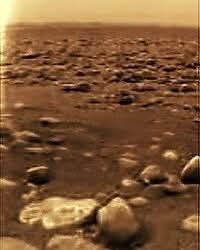
On January 14, 2005—exactly 21 years ago today—humanity achieved one of its most audacious feats: the Huygens probe touched down on the surface of Titan, Saturn’s largest moon, after a grueling seven-year voyage across 1.2 billion kilometers of space.Launched in 1997 as part of the NASA/ESA/ASI Cassini-Huygens mission, Huygens detached from the Cassini orbiter on Christmas Day 2004 and plunged into Titan’s thick, hazy orange atmosphere—a smoggy shroud of nitrogen laced with methane and organic haze particles thicker than Earth's. For over two and a half hours, it drifted downward under parachutes, instruments blazing as it sampled the exotic air, measured winds howling up to 400 km/h, and snapped stunning descent images of river channels, dark dune fields, and possible shorelines carved not by water, but by liquid hydrocarbons.Then, at 11:38 UTC, it made gentle contact—bouncing slightly like a pebble on a frozen beach—onto a cold, slushy plain at roughly –180°C (-290°F). The surface was a bizarre mix of water-ice "rocks" and "pebbles" rounded by ancient methane-ethane rains, scattered across a darker, tar-like ground rich in tholins (complex organics). Huygens survived far longer than expected: about 72–90 minutes on the surface (depending on exact telemetry batches), transmitting data and a handful of precious images before its batteries faded and line-of-sight to Cassini was lost as the orbiter moved over the horizon.Those grainy, historic photos—our only direct glimpse of an outer-solar-system surface beyond the inner planets—show a landscape eerily Earth-like in form yet utterly alien in chemistry: fluvial networks fed by methane downpours, lakes of liquid ethane waiting in the poles (later confirmed by Cassini), and a prebiotic soup that echoes conditions on early Earth before life https://t.co/3FOALEUDpx this day, Huygens holds the record as humanity's farthest landing—farther than any Mars rover, Venus lander, or lunar module. No spacecraft has soft-landed farther out in the Solar System since. (Upcoming missions like NASA's Dragonfly rotorcraft, launching in 2028 and arriving ~2034, will explore Titan's dunes but won't attempt a fixed landing like Huygens did.)A small, hardy probe on an icy hydrocarbon shore—a giant leap into the cosmic unknown.
Sources: NASA Science / Cassini archives, ESA Huygens mission pages, Planetary Society, original 2005 descent data publications.
Elon Musk explains why he started SpaceX:
“We were supposed to have a base on the moon. We were supposed to send people to Mars. And that stuff just didn't happen. We went backwards.”