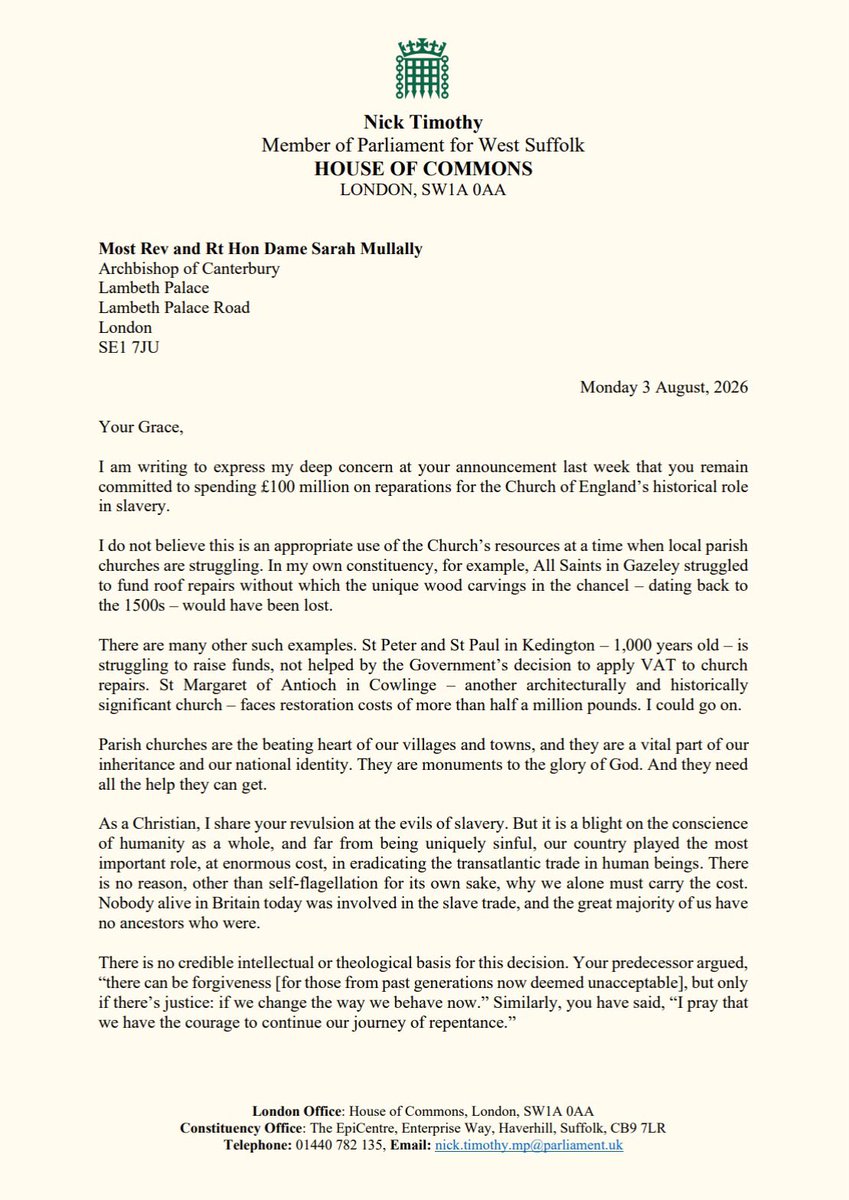
The Church of England is sending £100 million overseas for slavery “reparations”.
Meanwhile our parish churches - our national inheritance - are crumbling.
This is gesture politics - and it’s theologically nonsensical.
My letter to the Archbishop.
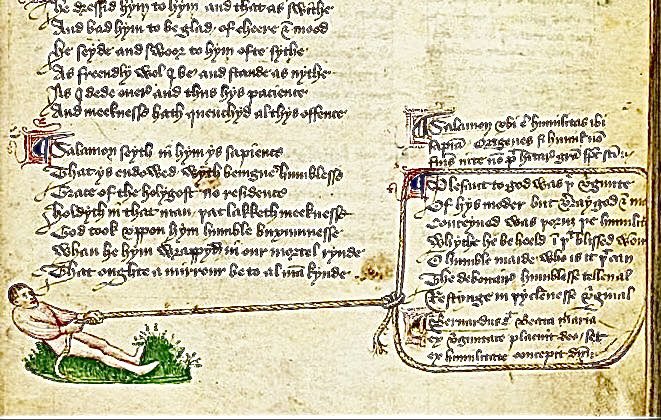
Before ‘cut & paste’ and Tipp-Ex, scribes found novel ways to correct their mistakes and omissions. Here a scribe points to the place where the omitted line (bottom of the page) is meant to go - 1300, leaf from a Book of Hours, Walters Art Museum, W.103. 33v
Medieval scribes employed a number of different methods to correct mistakes and omissions. This one used the figure of a man pulling the omitted portion of the text towards the place where it belonged - 15th century, British Library, Arundel 38, f. 65r
A scribe’s effort to correct an omission - The words that were accidentally left out are pulled along by one man who passes them to another who waits between the fourth and fifth lines to receive them - c. 1300, Walters Ms. W.102, f. 39v
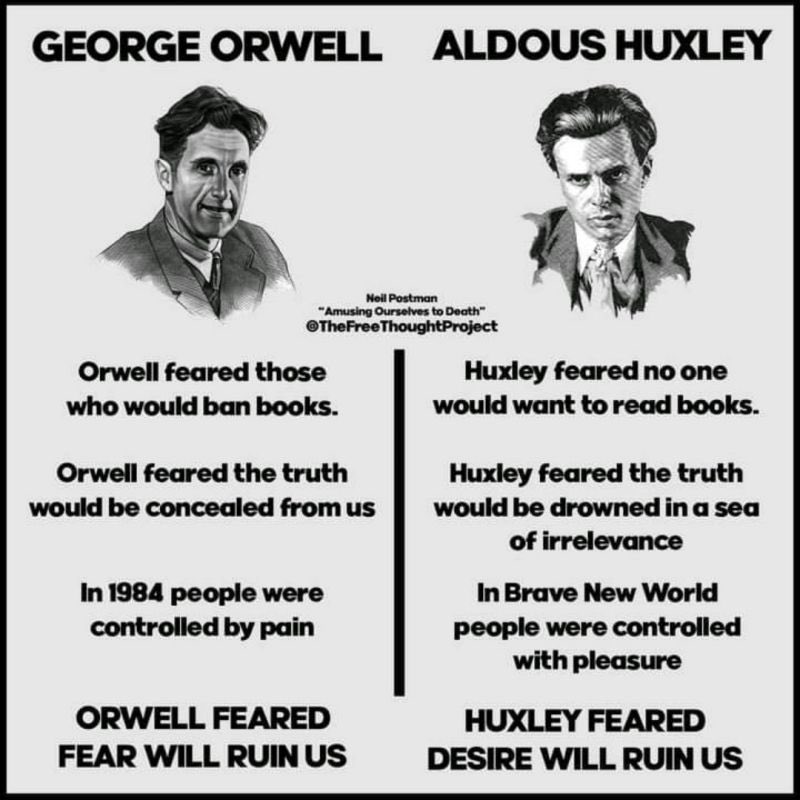
One of my longest-standing arguments is that we are not living in Orwell’s 1984, where truth is centrally suppressed and censored by force (that’s former communist societies, modern-day China, Russia, North Korea).
We are living in something much closer to Huxley’s Brave New World.
The truth is not hidden - it is almost always readily available. But it is buried beneath an industrial quantity of noise: propaganda, outrage, half-truths, conspiracy theories, influencer theatre, algorithmic rage bait and an endless stream of content designed not to inform us, but to keep us emotionally stimulated.
The modern information system does not need to censor the truth when it can simply drown it in noise.
A fact no longer has to be disproven - it only has to be surrounded by a hundred competing claims, stripped of context and nuance, turned into partisan ammunition and pushed into the same feed as celebrity gossip, memes and 15 second videos engineered to deliver the fastest possible dopamine hit. By the time the truth reaches us, it appears as just another piece of content competing for our attention.
That is the more sophisticated form of control: not preventing people from knowing, but exhausting their capacity to care.
Orwell feared a world in which people would be deprived of information. Huxley feared a world in which they would be given so much distraction, stimulation and triviality that they would lose the desire to seek it.
The defining struggle of our age is therefore not simply between truth and censorship, but between truth and indifference.
Some gates deserve to take centre stage, beckoning you in to the woodland beyond. This morning was so quiet, so still, the lane deserted. All of nature seemed to be holding its breath, just waiting for the sun to rise and flicker its way through the trees, to sweep away the mist in a matter of seconds with warmth and light. I’m so glad I was there to watch the magic.
📍 Peak District, England
For most of the medieval period there weren’t actually benches inside churches and a small detail at St Mary's, Tal-y-Llyn on Anglesey alludes to this fact.
1/9
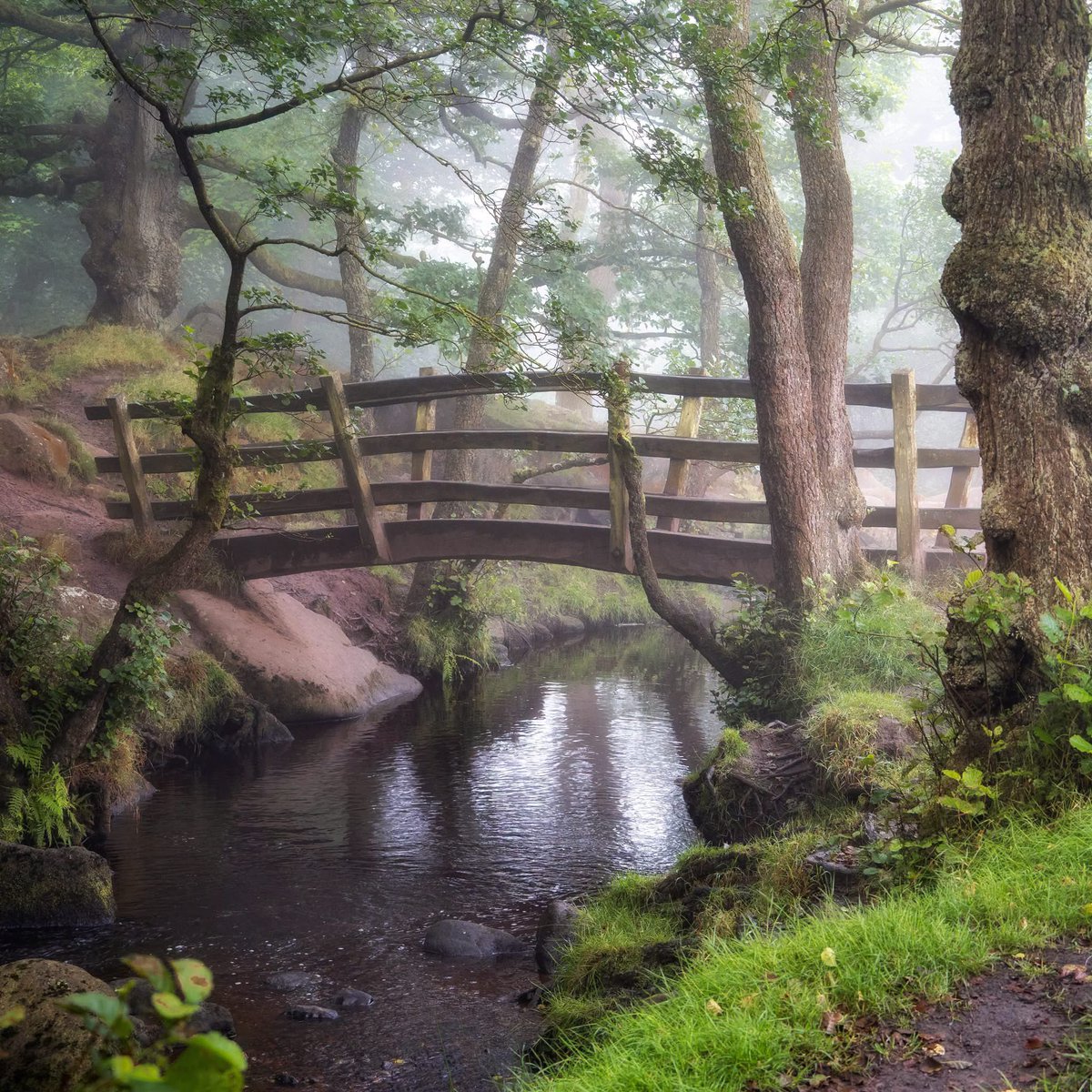
This little bridge over Burbage Brook in Padley Gorge will be familiar to many, and I've photographed it in every season and light. Every time I walk here, even though I tell myself sternly, "Stay away from the bridge, walk straight past the bridge, do NOT photograph the bridge" - I just can't resist it. On this misty, perfect morning, the early sun just starting to shine on those summer-fresh leaves, it looked like the stuff of fairytales.
📍 Peak District, England
THE FIVE TESTS
For weeks I've argued that this party, and this country, needs a proper debate about where we go next. Not a reshuffle. Not a few degrees of course correction. The big, difficult, honest choices we've spent thirty years avoiding.
A few people have asked me what that debate should actually be about. Fair enough. I spent 24 years in the Marines and two in government, and I resigned because I couldn't win the argument I believed in from the inside. So let me make it here, plainly.
This isn't a manifesto, but a set of five tests. Anyone asking to lead our country should be able to look down this list and say yes to all five.
1️⃣ The Frontline Test
Do we give the people on the frontline the kit they need to do the job, and stand by them when the job is done?
I joined the Marines at 18. I've buried friends. So I do take this one personally.
I sat in government and watched us write a defence plan for a world that no longer exists, discussed in rooms I was kept out of. A 100k drone is now sinking warships that cost a billion. That is the reality of the wars being fought right now.
Passing this means 3% of GDP as the floor, not the ceiling. Buying for the next war, not the last. And fixing the Legacy Act so blokes in their seventies aren't back in the dock for what they were cleared of decades ago.
2️⃣ The Next-Generation Test
Are we handing the next generation a better deal than the one we inherited, or a worse one?
I'm a lad from a tough part of Aberdeen. My mum raised five of us through some bleak years. The only reason I got out was because I was given an opportunity. That cannot be said for young people today.
Nearly a million young people, around one in eight, are now outside work, education or training. That isn't their failure. It's ours.
Fixing this means a NEETs and youth unemployment target with a date, the youth guarantee delivered not just announced. Restoring the link between work and a decent life for the under 30s, on housing, wages and opportunity. Skills and apprenticeship numbers that beat the last government, not just match it.
Talent is everywhere in this country. Opportunity isn't. Fix that and you fix half of everything else...
3️⃣ The Trillion-Pound Test
Is the plan to add a trillion pounds to what Britain earns, or to manage the decline more politely?
Here's the lesson I learned from Ukraine and in government, and it never changes. We invent things. Other countries build them. Other countries decide. We're brilliant at the first mile and absent for the next ninety nine.
So set a target and be judged on it. A trillion pounds added to our GDP within a decade. Yes, it's ambitious. We should be ambitious!
Getting there means backing the high tech inventors just as much as the high street traders. Your local coffee shop shouldn't be paying more tax per cappuccino than Starbucks does. So why on earth do they?
It means an industrial strategy worth the name. Things to make and things to sell, in Barrow, in Derby, in every region. Our industrial base is national security, so we should fund it like it.
And it means building the chips and the compute here, not inventing the breakthrough and watching someone else scale it. Data is the new gunpowder.
4️⃣ The 10% Test
Can we make the country work 10% better, instead of only ever asking for 10% more?
I saw this from the inside. We patch the symptom this year, but the bill grows next year, and we end up paying for failure at the most expensive end of every system.
A 10% improvement in outcomes across a handful of our biggest problems, ill health, reoffending, wasted potential, would free up somewhere between £40 and £60 billion a year. We're already paying those costs. We just pay them too late, when they're at their worst.
Passing this means investing early instead of paying far more later, and having the honesty to admit that not every pound we spend today delivers an immediate return.
5️⃣ The Lights-On Test
Does our energy policy keep the lights on, the bills down and factories open, or do we keep chasing a target and hope the rest sorts itself out?
For years we've treated net zero as the only goal, and everything else, your bill, our industry, whether the grid even stays up, as a problem for later. That’s the wrong way around.
Make energy security the goal. Power that people, businesses, and industry can afford, and a grid that stays on when someone tries to switch it off. Do that and net zero follows. Chase the target on its own, and you end up with neither.
Passing this means a serious baseload, nuclear and the North Sea, built in time to matter. Strong countries have cheap, secure energy. Weak countries don't.
None of this is complicated. It's the oldest deal there is. You serve the country, the country stands by you. In uniform, in a hospital, in a classroom, on a building site. Right now that deal is broken, and everyone keeping our country going can feel it.
That broken deal is the real reason for the frustration out there. It's why trust has drained out of politics. And it's why our party that won a landslide is, halfway through the term, already arguing about who leads it.
But changing the person at the top fixes nothing if we don't fix the deal underneath. Swap one leader for another and leave the deal broken, and we'll be right back here in eighteen months, asking the same question all over again.
So I'm not interested in who gets what job. I'm interested in whether we've got the courage to pass these tests.
We've been promised a debate. This is my opening offer to it. And if that debate ever becomes a contest, it should be fought on this ground, not on personalities.
I know where I stand.
Annoyed at being left out of the manuscript’s many beautifully painted and gilded miniatures, Brother Alwyn decided to stage an angry protest in the margins - 13th century, British Library, Sloane MS 2435, f. 28v
It's a simple scene, as so many of mine are, but I can't tell you how much my heart is lifted by the sight of fields full of wildflowers, scattered with barns. I wish you could have also heard the cuckoo calling and the bees buzzing as I stood here, and felt the sunshine on your face. Sometimes all you need in life is an old wooden gate to lean on, and the English countryside in June.
📍 Peak District, England
The Border Is Not the Problem. It Is the Answer.
Globalism rests on a single assumption. That human beings, given the right institutions and sufficient time, will subordinate their deepest loyalties to nation, faith, language and kin in favour of a set of universal values administered from above. It is the most ambitious political project in human history. It is also the most consistently refuted by the evidence of human behaviour across every century we have recorded.
The border did not create conflict. Conflict created the border. Every boundary line on the political map of the world is the sediment of a dispute, a war, a negotiation, a defeat or a demographic reality that proved too stubborn to dissolve. The Congress of Vienna tried to redraw them rationally in 1815. The Treaty of Versailles tried again in 1919. The United Nations has been trying since 1945. Each attempt produced not stability but the conditions for the next eruption. Borders are not arbitrary impositions on an otherwise harmonious humanity. They are the hard-won acknowledgement that humanity is not harmonious.
The religious dimension alone should settle the argument. The three great Abrahamic faiths have been in structural conflict for fourteen hundred years. Not occasionally. Not as a result of misunderstanding that better dialogue might resolve. Structurally, because each makes an absolute claim to truth that the others cannot accommodate without ceasing to be what they are. Christianity, Islam and Judaism have coexisted. They have traded, tolerated and at moments admired each other. They have not, in fourteen centuries, resolved the fundamental incompatibility at their cores. No supranational institution has altered that by a single degree. The EU has not. The UN has not. The International Criminal Court has not. The World Trade Organisation has not. The incompatibility predates every one of them and will outlast every one of them.
Europe is the test case globalism chose for itself, and it is failing it. The conditions were as favourable as they will ever be. A shared continent. A shared post-war trauma. A broadly common cultural inheritance rooted in Christian civilisation, Roman law and Greek philosophy. Eighty years of institutional architecture. If globalism cannot hold under those conditions, the case for its universality collapses. And it is not holding. It is fracturing under the first serious combination of demographic pressure and economic stress it has encountered. Electorates from Stockholm to Rome to Warsaw are reasserting national interest against supranational obligation. They are not doing so out of ignorance. They are doing so because the nation state, for all its failures, remains the only political unit in human history that has successfully commanded the loyalty, the sacrifice and the democratic participation of its citizens.
Britain is the sharpest illustration. Three decades of managed borders policy, conducted under the ideological assumption that national identity was an obstacle to progress, has produced not a more harmonious society but a more fractured one. Communities that do not share a language, a legal tradition, a conception of the relationship between faith and state, or a common understanding of the rights of women have been placed in proximity and told that proximity is integration.
Globalism was never a description of how human beings actually behave. It was a prescription for how its architects believed they should behave, enforced through institutional capture, demographic management and the moral denunciation of anyone who pointed to the evidence.
The evidence has not changed. Human nature has not changed. The nation state did not emerge because politicians invented it. It emerged because people, across every culture and every century, organised themselves around shared identity and defended it. That instinct is not the problem. Pretending it does not exist is.
"It is a serious thing just to be alive on this fresh morning in this broken world." - Mary Oliver
I am continually humbled by the healing power of nature. No matter how troubled your mind and how loud your worries, even a short walk among trees and birdsong eases them a little. Your shoulders drop, your breathing slows, and for those few moments, nothing else intrudes. Your world shrinks to just the sound of the breeze and your soft footsteps on the path ahead.
📍 Peak District, England