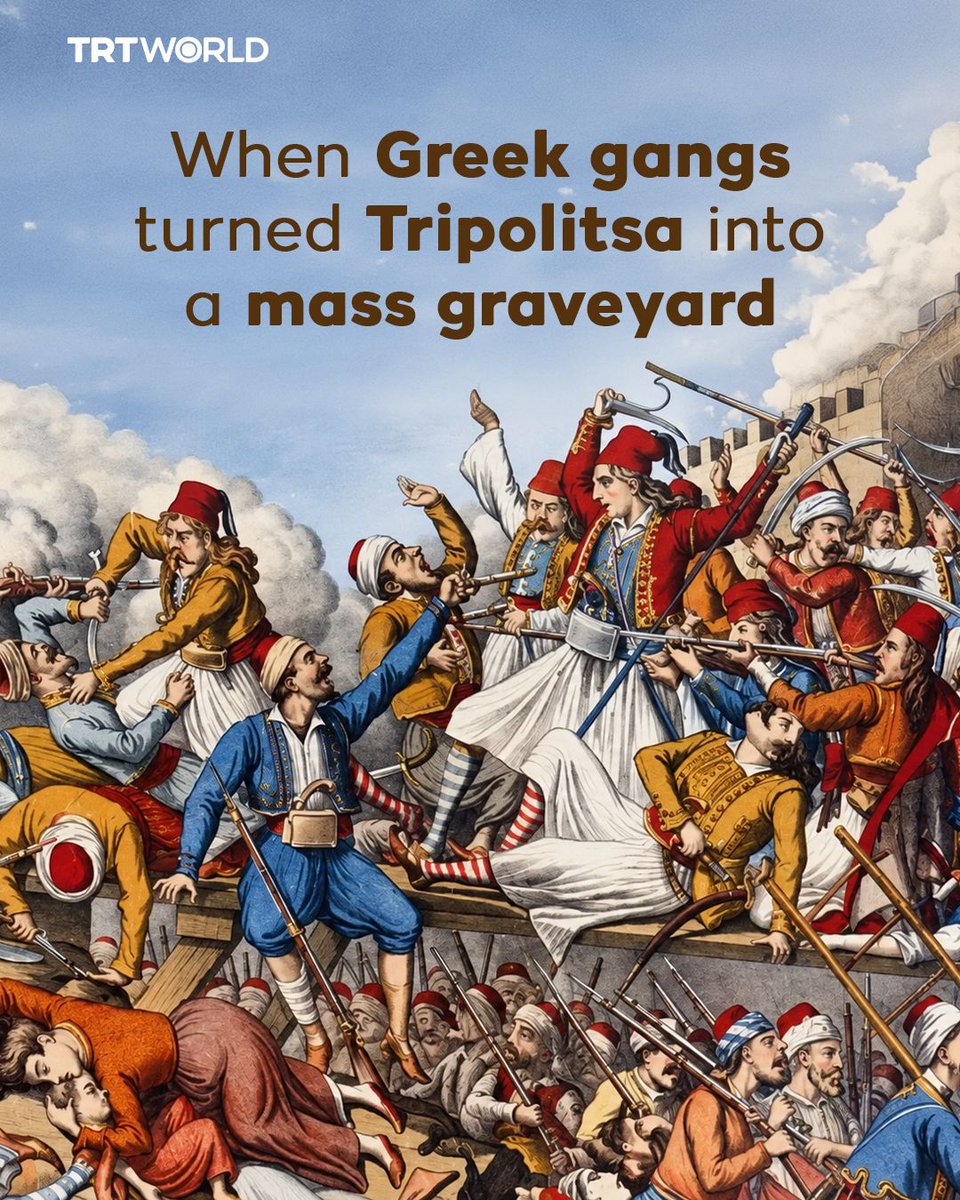
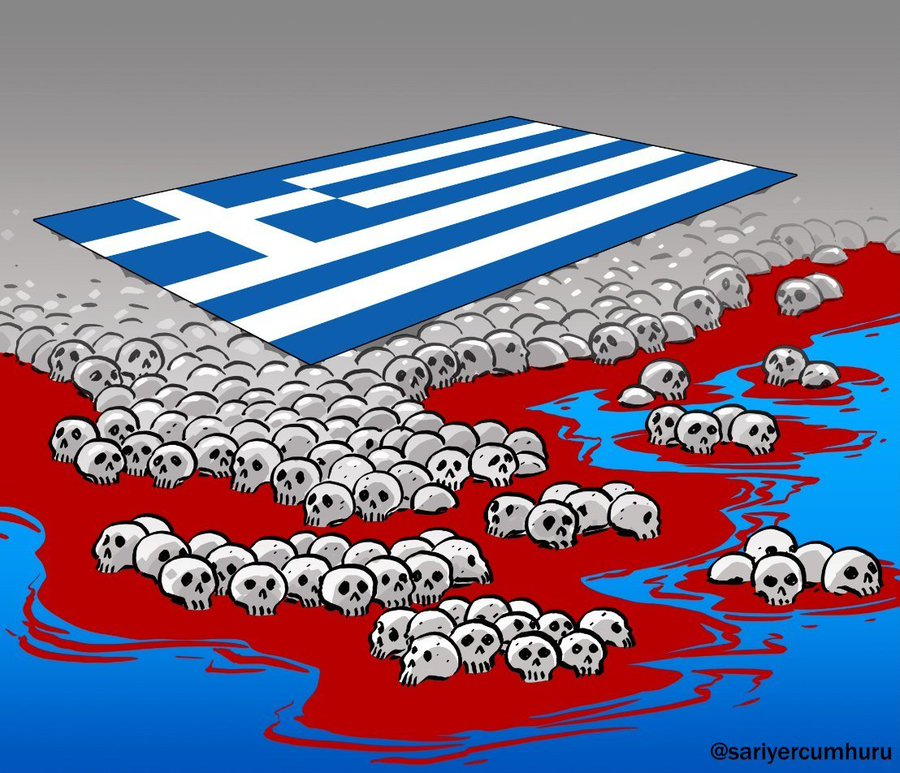
Greek insurgents massacred up to 40,000 people in Tripolitsa on this day 205 years ago as they sought to rid the Peloponnese of its long-settled Muslim and Jewish communities
🔗 https://t.co/VnFuutCy44
The Muslim Turkish population of the Morea (Peloponnese) Peninsula was systematically massacred between the years 1821 and 1830.
A calculated campaign of destruction and devastation accompanied this policy of extermination, extending from places of worship and madrasas to cemeteries and other assets of cultural heritage.
On the 205th anniversary of the Tripolitsa Massacre, we commemorate with prayers and deep respect the Muslim Turkish civilians who were brutally murdered.
1821'deki Yunan isyanında Mora’da büyük bir Türk soykırımı yapılıp, onbinlerce Türk, kadın ve çocuk ayırt edilmeden acımasızca katledildi. Mora'da soykırıma uğrayan Mora Türkleri'ni rahmetle anıyorum.
Bu katliamlar 1821'den 1974'e kadar farklı coğrafyalarda devam etmiştir. Yunanistan’ın tarih boyunca katlettiği Türkler ve akraba topluluklar için ülkemizin en fazla ziyaret edilen yerlerine (Sultanahmet, Ankara, Antalya, İzmir, Konya...) vakit kaybetmeden Yunan katliam ve mezalim anıtları dikmeliyiz. Mora Türkleri Katliamı, Teselya Türkleri Katliamı, Adalar Denizi (Ege) Türkleri Katliamı, Girit Türkleri Katliamı, Balkan Savaşları Katliamı, Batı Trakya Türkleri Katliamı, Trakya İşgali Katliamı, Anadolu İşgali Katliamı anıtlarının önemli sanatkârlarımıza yaptırılıp, bir an önce dikilmesi katledilen onbinlerce masum Müslüman'ın anısını yaşatacaktır.
https://t.co/cWJn1R15uL
THE FORGOTTEN GENOCIDE: HOW THE "GREEK REVOLUTION" ERASED AN ENTIRE PEOPLE
The slogan was explicit: "Not a single Turk must remain in the Morea." Genocide...
23 September 1821, Tripolitsa. The date is remembered in Greece as part of a "liberation". The surviving records tell a far darker story.
Historian S.R. Sonyel, drawing on British archives, records that around 50,000 Turkish lived in the Peloponnese in March 1821. By the time Greeks celebrated Easter a month later, the Turkish population had been almost entirely wiped out.
The slogan was explicit: "Not a single Turk must remain in the Morea."
This was not confined to Tripolitsa.
Historian Stanford Shaw highlights that the massacres were not limited to Tripolitsa.
From Kalavryta and Patras to Navarino, Corinth, Athens and Kalamata, Muslim communities were attacked, expelled or massacred.
Villages were burned, refugees were intercepted on the roads, and those who surrendered after being promised safety were often killed anyway.
British historian William St Clair records that more than 20,000 Turkish men, women and children were deliberately killed within weeks.
Families living on isolated farms were slaughtered and their homes burned over their bodies. In some towns, starving Muslims surrendered after receiving promises of protection.
The men were killed, while women and children were enslaved and later killed.
Then came Tripolitsa.
After the city fell, a three-day massacre followed. St Clair records that more than 10,000 Turks were killed between Friday and Sunday.
Prisoners were tortured, mutilated and burned. Pregnant women were murdered. Children and the elderly were not spared. The Jewish community was also systematically attacked. Contemporary European observers witnessed the carnage.
The scale of the slaughter shocked even some European philhellenes who had come to support the "Greek cause". German doctor Wilhelm Boldemann, horrified by what he witnessed, is reported in contemporary accounts to have taken his own life by poisoning himself.
The destruction went beyond human lives.
Turkish property was seized, charitable foundations were plundered, mosques were desecrated and destroyed, cemeteries were violated, and the physical traces of a centuries-old Muslim presence were systematically erased.
Sonyel argues that the massacres bore the essential characteristics of genocide: intent, systematic extermination, the destruction of entire communities and the obliteration of their cultural presence.
Other scholarship has likewise described aspects of the destruction of the Morean Turks as genocide.
And the evidence did not come only from Turkish sources. St Clair's account describes the Turks of Greece as disappearing "suddenly and finally" in the spring of 1821, while European observers later found it difficult to believe that large Turkish communities had once lived throughout the Peloponnese.
This is the part of the "Greek Revolution" that the heroic liberation narrative leaves out.
A people who had lived across the Peloponnese for generations was destroyed, its property confiscated and its cultural traces erased.
23 September should be remembered as the day Tripolitsa became a symbol of the destruction of an entire community.
1821-1830 yılları arasında Mora Yarımadasında Müslüman Türk ahali sistematik olarak katledilmiştir.
Bu imha politikasına, ibadet yerlerinden medreselere, mezarlıklardan diğer kültürel miras unsurlarına kadar uzanan planlı bir yıkım ve tahribat da eşlik etmiştir.
Tripoliçe katliamının 205. yıldönümünde, acımasızca katledilen Müslüman Türk sivil halkı rahmetle anıyoruz.
23 Eylül 1821 - Tripoliçe Soykırımı Yunanistan anakarasındaki Türklerin Soykırımı Ulusal Anma Günü ilan edilsin!
Destekle, bu yıl bu anma günü başlasın!
@tcbestepe@MFATurkiye
Sesimizi daha güçlü duyurabilmek için desteğinize ihtiyacımız var.
Paylaşımlarımızı beğenerek, paylaşarak ve çevrenizle yayarak Suriye Türkmenlerinin hak ve taleplerinin daha geniş kitlelere ulaşmasına katkı sağlayabilirsiniz.
SURİYE TÜRKMENLERİNDEN TÜRKİYE’YE ÇAĞRI!
Türkçenin seçmeli derslerden çıkarılmasının ardından Suriye Türkmenleri, Dışişleri Bakanlığı’na seslendi:
“Dil, kimlik ve kültürel haklarımızın korunması için diplomatik girişim yürütün. Sesimize kulak verin.”
Suriye'de Türkiye'nin desteklediği İslamcı Şara hükümeti Türkçe derslerini kaldırıp yerine Fransızcayı koydu. Bakın Müslüman Türk'ün dilini yasaklayıp Katolik Fransız'ın diline sahip çıkan ümmetçilik işte böyle bir şeydir. Türk dili bizim en kutlu değerimizdir. Bu değere düşman olan herkes ve her yönetim bizim de düşmanımız olur.
Eski bir askerimizin haklı isyanı:
''Barış Pınarı, Bahar Kalkanı ve Zeytin Dalı harekatlarına katıldım. Geldim, işe girmeye çalıştım, torpil istiyorlar.
Adam dağdan iniyor, işe alıyorlar. Benim gibi adamlar da inşaatta çalışıyor.''