@ThatsAarthi People who claim to be vegetarians are actually lacto-vegetarians. By definition, true vegetarianism (derived from vegetables) is strictly plant-based. We only had to invent the term vegan because dairy consumers co-opted the original label. I am a vegan turned vegetarian. Peace!
@Dhimahi11 People who claim to be vegetarians are actually lacto-vegetarians. By definition, true vegetarianism (derived from vegetables) is strictly plant-based. We only had to invent the term "vegan" because dairy consumers co-opted the original label. I am vegan turned vegetarian. Peace!
@ddrangoli@DDNational@MIB_India@GauravDwivedi95@IamHrishitaBhat Given that today is Day 5 of Ganesh Chaturthi, curated festive programming on Rangoli would have been far more fitting than an actor's retrospective. Broadcasters would benefit from taking a cue from shows like TMKOC to keep festive content relevant and timely.
@ddrangoli@DDNational@MIB_India@GauravDwivedi95@IamHrishitaBhat The programme digressed after the first two Lord Ganesha songs, moving to an unrelated yesteryear music-director duo. One fully themed episode is all that is requested. Many Hindi film songs on Lord Ganesha could readily have filled the thirty-minute music segment.
@In_Sane_Saint I am a vegetarian too and this has worked for me:
🔹 Apply a dab of peppermint oil under your nose
🔹 Sit near vents or windows for maximum airflow
🔹 Sip ice-cold water or hot ginger tea to reset your palate
🔹 Keep a quick "stepping out for a call" excuse ready for fresh air
@bhatia_nachiket Mundhe did not oppose hospital profit. He flagged the MRP–trade gap on consumables (IV set ₹11 vs ₹325), often set upstream, which patients can’t question in care. DPCO caps drugs; most devices aren’t capped. He seeks markup guidelines, not zero profit.
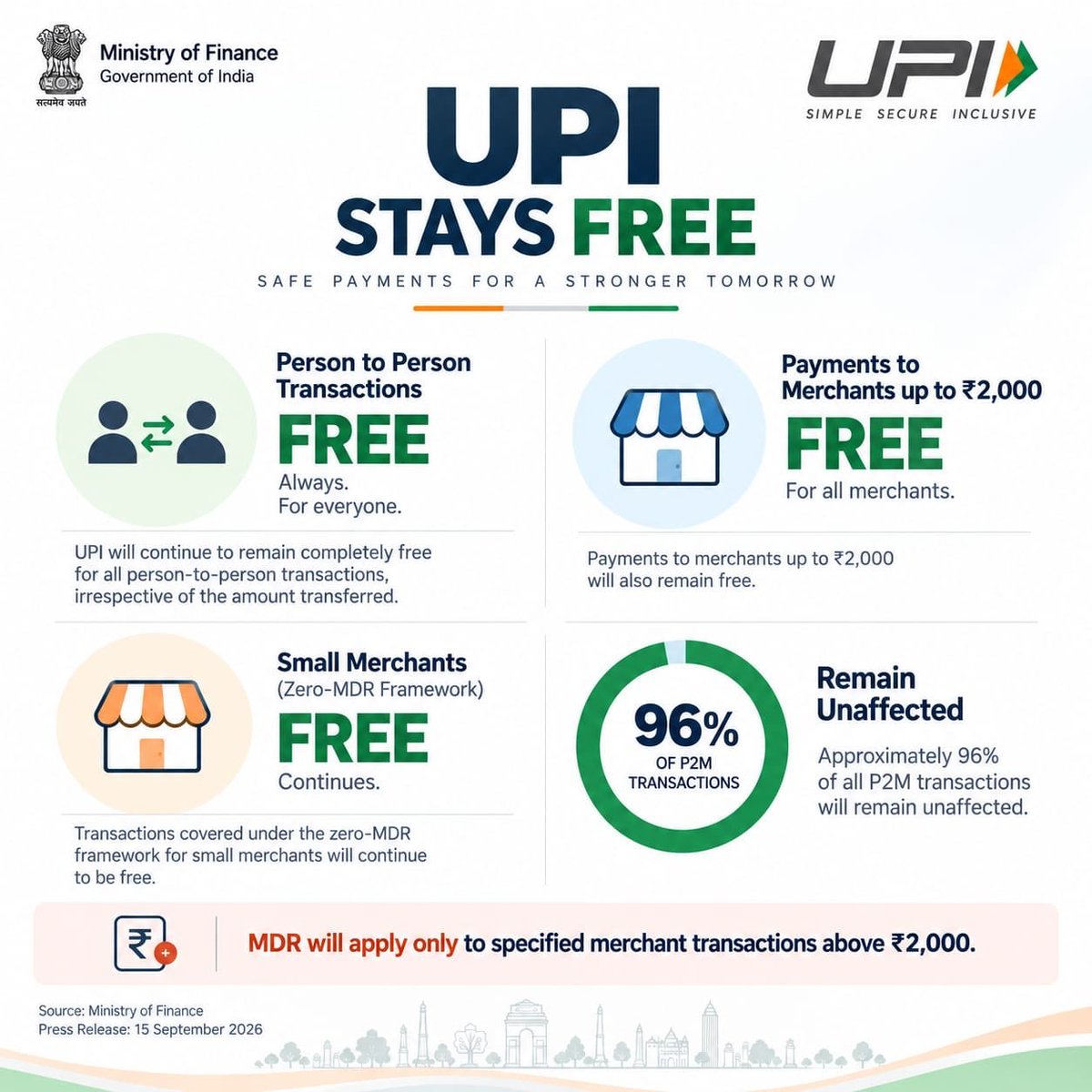
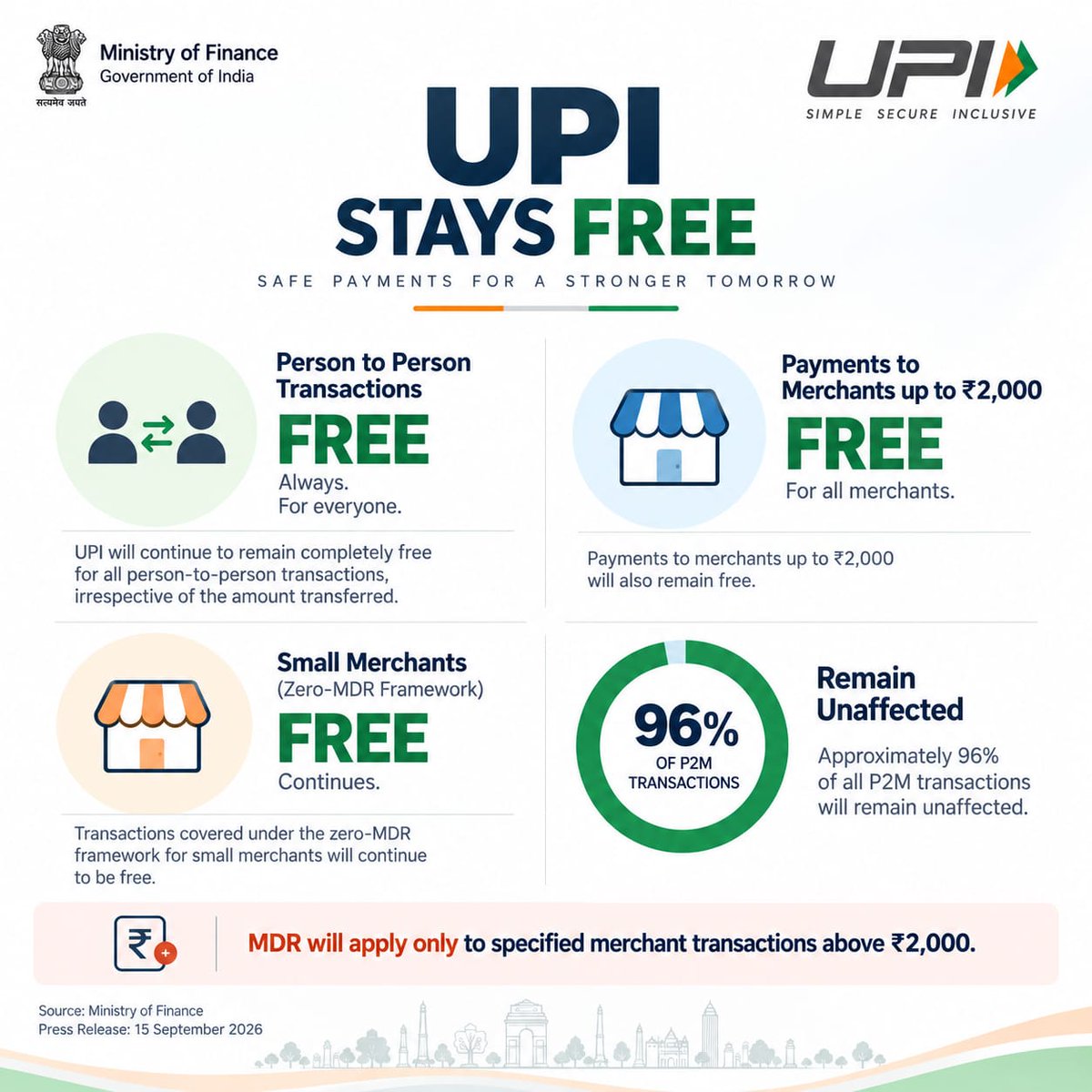
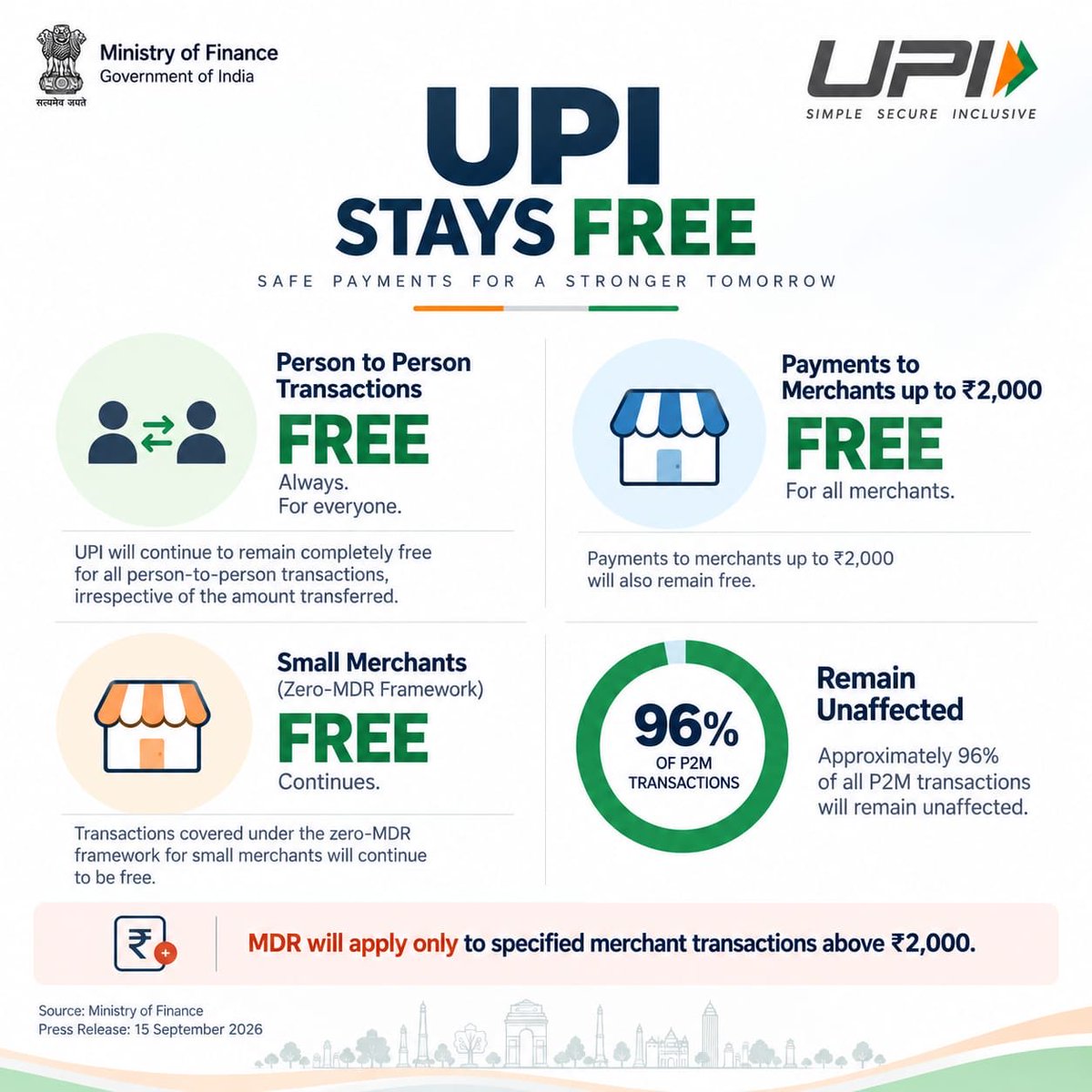
Your UPI Payments Stay Free!
UPI continues to stay free for person-to-person transfers and everyday users, while small merchants remain protected.
Under the updated MDR framework, 96% of merchant UPI transactions remain unaffected, with MDR limited to certain larger merchant payments not charged to customers.
So, the next time you hear “UPI isn’t free anymore,” remember the facts that everyday UPI payments remain simple, seamless and free for users.
#UPI
The National Payments Corporation of India (NPCI) has introduced a 0.4% Merchant Discount Rate (MDR) on person-to-merchant (P2M) transactions above ₹2,000, effective October 15, 2026. Consumers and small merchants remain fully exempt.
🔰UPI Continues to Remain Free for Peer to Peer Transactions and 96% of Merchant Transactions
▪️The new UPI framework introduced has no impact on any person to person transactions
▪️UPI will continue to remain completely free for all person-to-person transactions, irrespective of the amount transferred
▪️Payments to merchants up to ₹2,000, along with transactions covered under the zero-MDR framework for small merchants, will also remain free
▪️Consequently, approximately 96% of all P2M transactions will remain unaffected. MDR will apply only to specified merchant transactions above ₹2,000
▪️It is clarified that MDR is neither a tax nor a charge collected by the Government or NPCI. It is distributed among payment ecosystem participants, including banks and payment application providers, to support the operation and continued expansion of the UPI ecosystem
▪️Introduced under the Payment and Settlement Systems Act, 2007, following detailed deliberations by the UPI Steering Committee, the framework seeks to ensure the long-term sustainability of UPI while protecting individuals and small merchants from additional charges
Don't miss the full details—read here: https://t.co/JYit6fMfDK
@FinMinIndia
The new UPI framework introduced has no impact on any person to person transactions.
UPI will continue to remain completely free for all person-to-person transactions, irrespective of the amount transferred.
Payments to merchants up to ₹2,000, along with transactions covered under the zero-MDR framework for small merchants, will also remain free. Consequently, approximately 96% of all P2M (person-to-merchant) transactions will remain unaffected. MDR will apply only to specified merchant transactions above ₹2,000.
Read More - https://t.co/w1m0HCY00C
👉 UPI Continues to Remain Free for Peer to Peer Transactions and 96% of Merchant Transactions
👉 The new UPI framework introduced has no impact on any person to person transactions
👉 UPI will continue to remain completely free for all person-to-person transactions, irrespective of the amount transferred
👉 Payments to merchants up to ₹2,000, along with transactions covered under the zero-MDR framework for small merchants, will also remain free
👉 Consequently, approximately 96% of all P2M transactions will remain unaffected. MDR will apply only to specified merchant transactions above ₹2,000
👉 It is clarified that MDR is neither a tax nor a charge collected by the Government or @NPCI_NPCI. It is distributed among payment ecosystem participants, including banks and payment application providers, to support the operation and continued expansion of the UPI ecosystem
👉 Introduced under the Payment and Settlement Systems Act, 2007, following detailed deliberations by the UPI Steering Committee, the framework seeks to ensure the long-term sustainability of UPI while protecting individuals and small merchants from additional charges
Read here for full details ➡️ https://t.co/KGxlX3SVC0
The introduction of MDR on large-value UPI transactions (i.e., above ₹2,000) is an important step towards strengthening the long-term sustainability of India’s digital payments ecosystem. It will help UPI in continuing to scale, innovate and serve consumers and businesses across the country.
A fair and appropriate distribution of MDR across ecosystem participants will support continued investment in technology, infrastructure and acceptance networks. This, in turn, can enable wider UPI acceptance, deepen the customer base and support sustained growth in transaction volumes.
Importantly, all UPI transactions - P2P and P2M - shall remain free for users. P2M UPI transactions below ₹2,000 will continue to remain free for merchants, while MDR may be levied on merchants for P2M .
RBI remains committed to ensuring that UPI continues to be safe, seamless, affordable, and accessible, while supporting the long-term sustainability and growth of India’s world-class digital payments ecosystem.
According to data analysis from the Ministry of Finance, roughly 96% of total UPI transactions will remain completely free under this structure, as the vast majority of daily payments fall below the ₹2,000 threshold.
The Standard Rate: Eligible P2M transactions exceeding ₹2,000 will attract a 0.4% MDR, which is capped at ₹300 for high-value transactions of ₹75,000 or more.
Person-to-Person (P2P) Exemption: Standard money transfers between family, friends, or personal accounts remain 100% free, regardless of the transaction amount.
No Cost to Consumers: The Ministry of Finance and the NPCI have clarified that consumers will not face any fees. Banks have been directed to ensure that merchants do not pass these costs on to customers.