This might be the most underrated AI story of today.
According to CNBC, TikTok's US business is looking to secure multiple gigawatts of computing capacity, with one source suggesting the company is targeting 4 GW by the early 2030s. I don't think people understand how significant this is. We're talking about a social media platform potentially looking to secure enough power and computing infrastructure to rival some of the largest AI data center developments in the country. For perspective, Meta's massive Hyperion data center campus in Louisiana is targeting around 5 GW of capacity.
TikTok already relies primarily on Oracle Cloud Infrastructure, and the company has confirmed that $ORCL will remain its primary cloud provider in the United States. On top of that, TikTok is retraining its recommendation algorithm using American user data and is developing AI products focused on large model inference and creative automation. In other words, this isn't necessarily just about supporting people scrolling through videos anymore. TikTok could be preparing for significantly more AI workloads which would require enormous amounts of computing power.
Now connect this to everything else we've been discussing. Microsoft, Amazon, Google, Meta, OpenAI, and xAI are already competing to secure power, GPUs, land, and data center capacity. Now we're seeing another major technology platform potentially entering that same competition at the gigawatt scale. And remember, these companies cannot simply decide they want another gigawatt of computing capacity and have it available tomorrow. They need electricity, substations, cooling infrastructure, networking equipment, GPUs, memory, and facilities capable of supporting all of it.
This is exactly why I remain so bullish on the companies supplying the infrastructure behind AI. Whether we're talking about $NVDA, $MU, $ORCL, $BE, or the broader networking and power ecosystem, the number of potential customers competing for limited resources continues to grow. What's particularly interesting is that this demand is increasingly coming from companies outside the handful of frontier AI labs everyone focuses on. I think we're still underestimating just how much infrastructure the AI economy is going to need over the next decade.
This is NOT good news for OpenAI or Anthropic.
China's Moonshot AI just released Kimi K3.1 Pro and the numbers are pretty impressive. We're talking about a model with 2.8 trillion total parameters, a 1 million token context window and performance that Moonshot claims is competitive with some of the best proprietary AI models in the world. On Terminal Bench 4.0, a benchmark testing coding capabilities, Kimi scored 65.7%, compared to 66.4% for Anthropic's Claude Opus 5.5 and 58.2% for OpenAI's GPT 6 Astra. In other words, according to Moonshot's own testing, its model is nearly matching Anthropic and outperforming OpenAI on this particular benchmark but here's why I think this is potentially bad news for both companies.
Kimi K3.1 Pro costs just $2 per million input tokens and $10 per million output tokens through its API. That's roughly half the price of Claude Opus 5.5 and significantly cheaper than GPT 6 Astra. And Moonshot plans to release the model's open weights on November 4, meaning developers and businesses will be able to run and customize the model themselves rather than relying exclusively on proprietary providers.Think about what that means for OpenAI and Anthropic. Both companies are spending enormous amounts of money building infrastructure, training increasingly capable models, and trying to justify massive valuations based on how much revenue they can generate in the future.
But what happens when competitors start offering comparable capabilities at a fraction of the price? Businesses don't necessarily care which company built the model. They care about performance, reliability, security, and how much it costs. If they can get similar results for significantly less money, there's a pretty strong incentive to switch, especially for businesses processing billions of tokens.And this creates another problem. AI models are improving so quickly that the performance advantage a company has today could disappear within months. That makes it increasingly difficult to maintain premium pricing, especially as more open weight alternatives become available.
Now, I'm not saying OpenAI or Anthropic are going anywhere. Both have enormous distribution advantages, established customer relationships, and products that go well beyond the underlying models. Moonshot's benchmark claims also still need independent verification. But I've said this before, and I'll say it again. I think frontier AI labs are being valued far too aggressively considering how quickly competition is catching up.
According to Korean media, the memory boom is now forcing Korean chip suppliers to build NEW factories.
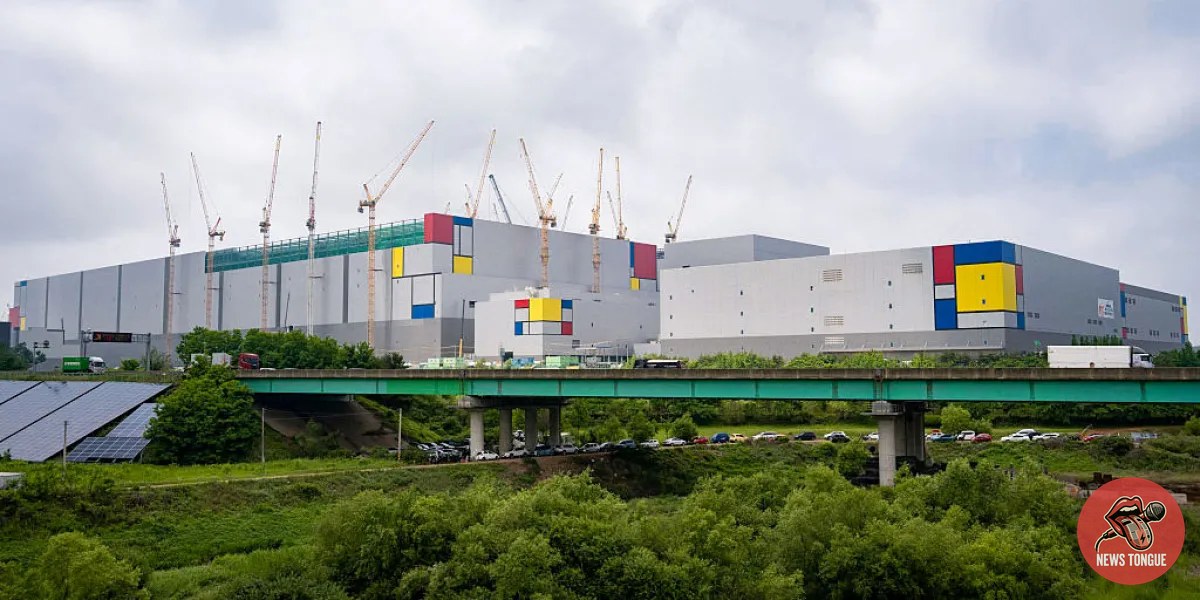
Hansol IONES, which machines and cleans parts for chip equipment, will invest 126 billion won in a new plant in Ochang, with completion set for the first half of 2028.
The company said rising utilization at major memory makers is shortening the replacement cycle for equipment parts, and its customers' target volumes call for more capacity from 2027.
The same day, equipment maker PSK announced a 180 billion won production site in the Yongin semiconductor cluster, also due in 2028.
Suppliers do not build plants this big unless their customers are telling them demand will last.
That is one more signal that Samsung and SK Hynix expect memory to stay tight for years to come.
According to Korean media, Samsung Electro Mechanics just signed the biggest substrate contract in its history, and the customer is $NVDA.
The multibillion dollar deal covers the substrates that sit under Nvidia's AI chips and networking switches, with new dedicated lines in Sejong and Busan.
At GTC Berlin, Nvidia said deals with Samsung Electro Mechanics, IBIDEN and Unimicron will lift its substrate capacity 2.5X over the next three years.
$AMKR plans to grow interposer capacity in Korea by more than 300% by the end of 2028, and Nvidia is giving KYEC a $1.1 billion advance to build new test facilities in the United States.
Nvidia is now paying suppliers up front just to make sure the capacity exists.
You do not prepay for capacity you think you will not need, this is Nvidia telling us demand is still running AHEAD of supply.
Even Huawei is feeling the memory squeeze.
Huawei just secured a seven year, 15 billion yuan loan, about $2.3 BILLION, from six Chinese banks including Bank of China, China Construction Bank and ICBC.
It is the company's first offshore syndicated loan since 2020.
Taiwanese media say rising R&D spending and higher memory costs are weighing on Huawei's cash flow.
Huawei is China's national champion for AI chips, and it is spending heavily on its Ascend lineup.
When even China's biggest tech company needs to borrow because memory got so expensive, it shows how far this shortage has spread.
That is a good sign for $MU, Samsung and SK Hynix.
Jensen Huang just pushed back HARD on the memory oversupply fears.
Speaking to CNBC at GTC Berlin, the $NVDA CEO said he does not see a surplus of memory by 2029, even after the selloff in memory stocks this past week.
"One of the things that's really great about memory is that you can always use more of it," he said.
He added that HBM will be used for years to come, and pointed out that Nvidia was the first company to bring LPDDR into the data center.
The selloff started after a Korean newspaper column predicted a memory price war by 2029, and it dragged down $MU, Samsung and SK Hynix.
When the biggest buyer of AI memory on the planet tells you demand keeps growing, I would take that more seriously than an opinion column.
According to Taiwanese media, Micron's Taoyuan workers just said NO.
About 70% of the 2,300+ union members rejected Micron's new bonus offer after Taiwan's first ever chip industry strike ended Friday morning.
The union wants 15% of operating profit paid out as bonuses, and it is warning that more action is possible.
Micron already reached a deal with its larger Taichung union on Oct 21.
Talks with Taoyuan resume on Tuesday, Oct 27, after the typhoon pushed them back.
So far production has not been hit, but Taiwan makes a big share of Micron's DRAM and HBM.
When the people building AI memory start demanding a bigger cut of the profits, it tells you how strong the memory cycle is for $MU.
The memory supercycle is about to get A LOT bigger,
Every single new wave of AI is creating an entirely NEW layer of demand for memory, and we're still in the EARLY stages of this cycle. HBM capacity per GPU has already increased 3.6X from Nvidia's H100 to B300. Memory per server is expected to DOUBLE over three years as inference and reasoning workloads become increasingly complex. Meanwhile, AI context lengths are growing roughly 30X annually as we move toward agentic AI, and autonomous vehicles could require more than 10X the DRAM capacity of today's advanced vehicles.
And here's what makes this so interesting for $MU. We're no longer talking about memory demand being driven primarily by training larger AI models. Every time these models become more capable, they need additional memory to store context, process information, run complex reasoning tasks, and interact with other AI agents. And as AI moves beyond data centers into robotics, autonomous vehicles, and physical devices, we're going to see an entirely new category of memory consumption. This is especially important because Micron isn't just exposed to HBM. It also benefits from server DRAM, LPDDR, and NAND storage, meaning the company has exposure across practically the ENTIRE memory hierarchy.
And unlike previous memory cycles, supply cannot simply expand overnight. Building new fabrication facilities takes YEARS, while manufacturers are increasingly allocating capacity toward more complex, higher value products like HBM. That's precisely why I continue to believe investors are underestimating just how long this memory upcycle could last. Bullish on $MU, if you want to see how I’m investing around this memory supercycle and the other AI infrastructure names I’m positioned in, check out my full Milk Road Pro portfolio below.
https://t.co/thIhK9ZH4E
According to Korean media, the AI shortage has spread to one of the smallest parts in the server.
Lead times for some Samsung Electro-Mechanics MLCCs have stretched to 61 WEEKS.
MLCCs are tiny capacitors that sit on every board, and an AI server uses more than 10 times as many as a regular server.
The shortage is no longer just in high end AI parts and it now reaches consumer, auto and industrial products too.
Customers are already rushing to lock in supply for 2027, which gives suppliers real pricing power.
First it was GPUs, then memory, then substrates, and now capacitors.
The AI buildout keeps finding new bottlenecks.
Another major shortage is starting to develop across the AI supply chain.
We're talking about multilayer ceramic capacitors, or MLCCs, which are tiny components used in everything from AI servers and GPUs to smartphones, networking equipment, and electric vehicles. These components are responsible for stabilizing voltage, filtering electrical noise, and ensuring processors receive a consistent supply of power. They're absolutely essential for modern electronics, especially as AI chips become increasingly power hungry. Now, take a look at what's happening with supply. MLCC lead times have increased for five consecutive months, while Samsung Electro-Mechanics and Yageo have been raising prices for four consecutive months. We're also seeing extended delivery times across major manufacturers including Murata, Taiyo Yuden and TDK. This is particularly interesting because we're not just seeing demand increase, we're seeing manufacturers gain pricing power as supply becomes increasingly constrained.
As companies like $NVDA and $AMD develop increasingly powerful accelerators, these chips require more sophisticated power delivery systems with high performance capacitors that can handle enormous electrical loads. The same applies to custom AI accelerators being developed by $GOOGL, $AMZN, and $META. As the industry moves toward higher powered AI servers and increasingly dense computing systems, demand for specialized MLCCs continues to grow. But here's where things get interesting, producing advanced MLCCs can consume roughly four to seven times as much manufacturing capacity as producing conventional components. This means manufacturers can't simply increase production overnight, and when they prioritize high margin AI server components, they're effectively reducing the capacity available for other markets.
So which companies could actually benefit from this? The two names that immediately stand out are Murata Manufacturing and Samsung Electro Mechanics. Industry estimates suggest these two companies collectively control approximately 85% of the AI server MLCC market, putting them in an incredibly favorable position if demand continues to exceed supply. Both companies could benefit from higher selling prices, stronger utilization rates, and a continued shift toward higher-margin components. Yageo, Taiyo Yudenand TDK are also worth watching, particularly if supply constraints begin spreading into other MLCC categories. Now, this isn't necessarily good news for everyone. Companies like $NVDA, $AMD, $DELL, and $SMCI could potentially face higher component costs or procurement challenges if these shortages become severe enough. MLCCs might represent a relatively small portion of the total cost of an AI server, but you still need these components to manufacture and ship the finished product.
And that's what makes this entire situation so interesting to me. We've spent the last several months talking about shortages in HBM, DRAM, NAND, optical networking components, and power infrastructure. Now we're seeing similar supply pressures developing in something as small as ceramic capacitors. The AI infrastructure buildout is putting pressure on almost every layer of the supply chain, and I think investors are still underestimating just how many companies could benefit from this spending cycle. Bullish on the broader AI supply chain and if you want to see how I’m investing around these bottlenecks and the companies positioned to benefit from them, check out my full Milk Road Pro portfolio below. https://t.co/thIhK9ZH4E
According to Chinese state media, DeepSeek and MiniMax just got the GREEN LIGHT to take their AI models global.
An account affiliated with CCTV said both companies completed registration to open source their models and deploy them overseas.
This comes only one week after Beijing proposed new export controls on 23 AI technologies.
So the message from Beijing is not stop but rather register with us first, then go.
China wants its AI labs competing for customers all over the world, but on the government's terms.
That puts even more pressure on United States labs that charge premium prices, because cheap open Chinese models are now officially cleared to compete abroad.
DeepSeek is about to close one of the BIGGEST funding rounds in Chinese history.
According to Reuters, the company is wrapping up a raise of about ¥100 billion, or roughly $15 billion, at a pre money valuation of about ¥500 billion, or $74 billion.
The original target was just ¥50 billion, so DeepSeek DOUBLED the size of the round as demand poured in.
Battery giant CATL and Tencent are the largest investors, with Geely also taking part, ahead of a possible Shanghai listing.
That is a lot of money for a company famous for doing more with less, and most of it will likely go toward compute.
China's AI race is now being funded at the same scale as the United States, and that means even more demand for chips and memory across Asia.
32 of Nvidia's most advanced AI chips just showed up somewhere they are BANNED from going.
Israeli security firm Lava found 32 Blackwell Ultra B300 GPUs running on systems linked to China Telecom, the state owned carrier.
These chips cannot legally be sold to China under United States export controls.
Lava spotted them through an Nvidia monitoring tool that some operators leave open on the internet, so it proves a network connection, not where the chips physically sit.
Nvidia's response was that smuggling is "a drop in the bucket compared to the ocean of domestic compute China already has."
The bigger point is that demand for $NVDA hardware is so strong that it keeps finding a way around the rules, even in China.
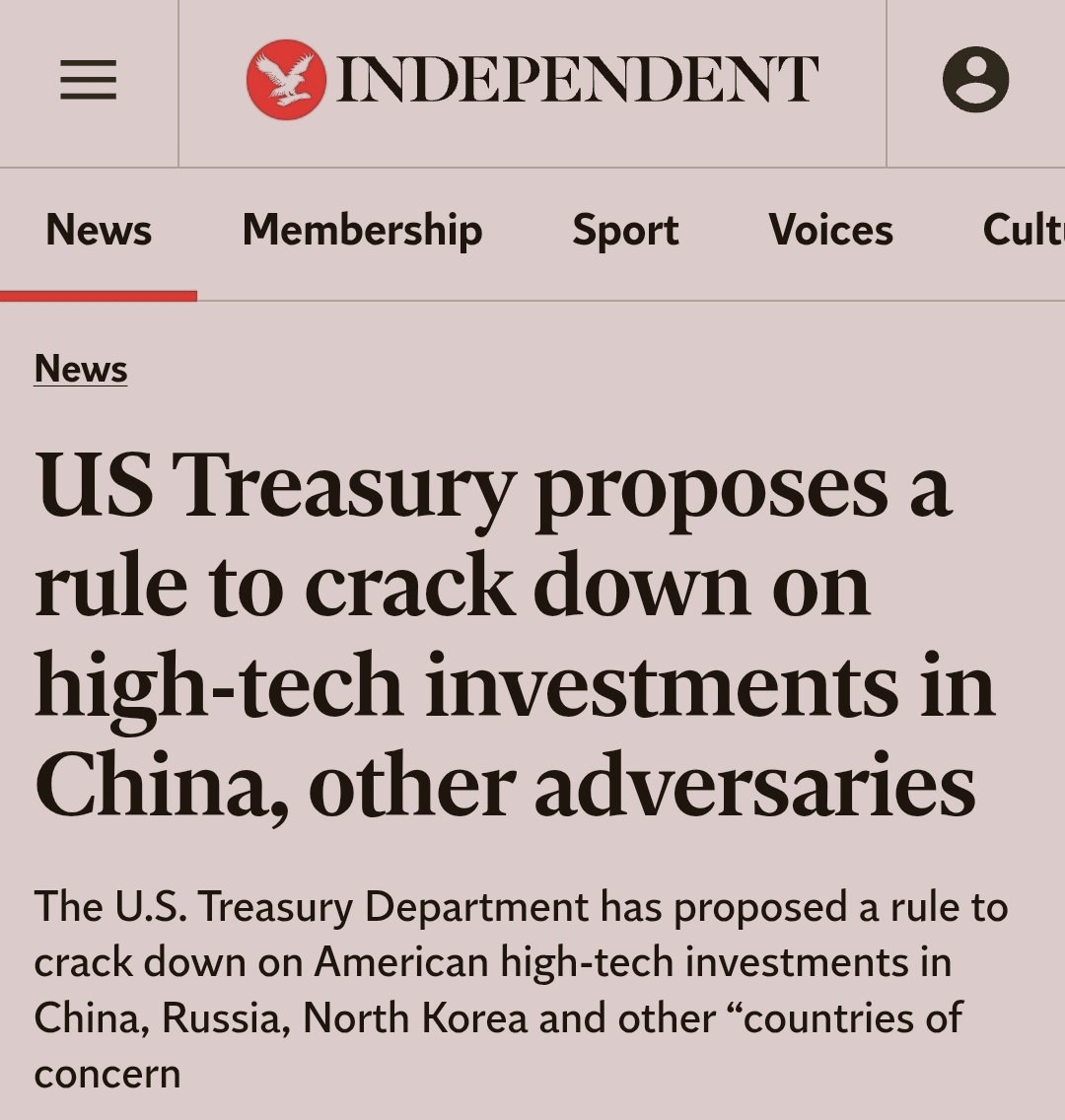
The US Treasury just proposed rules that would BAN American investment in Chinese AI companies.
The rules cover China, Russia, Iran, North Korea and Cuba, and they go beyond AI to include chips, quantum computing, supercomputers, hypersonics and biotech.
AI deals would be banned outright, while deals in most of the other sectors would need to be reported to the Treasury.
Publicly traded stocks and deals under $50,000 are exempt, so most retail investors are not affected.
The real target is venture capital, because US investors bring connections and know how along with their money.
Washington used to only block chips from going to China, now it is blocking the MONEY too.
Comments are open until December 7, so the final version could still change.
Hedge funds are getting absolutely crushed right now and it helps explain why the stock market has been behaving so irrationally lately.
According to Goldman Sachs, global hedge funds just experienced one of their broadest daily declines since COVID. Fundamental long/short funds lost 1.4% on Thursday, while funds focused on technology, media, and telecommunications fell an average of 2.7%. More than two thirds of hedge funds finished the day in the red. Now, these numbers might not seem that significant compared to what we're seeing in individual stocks, but remember, hedge funds are supposed to manage risk. Many of these funds are designed to make money whether the market goes up or down, yet they're getting hit on both sides of their trades.
So here's what's happening. Most hedge funds own stocks they believe will go higher while simultaneously betting against stocks they expect to fall. Normally, one side is supposed to help offset losses on the other. But right now, their long positions are getting crushed as technology and AI stocks sell off, while some of their short positions are moving higher, forcing them to buy back shares at a loss. And this is where things get interesting. When hedge funds start losing significant amounts of money, they're often forced to reduce their exposure to the market. That means selling positions, raising cash, and reducing leverage. The problem is that they don't necessarily sell companies with deteriorating fundamentals. They often sell whatever they can sell quickly.
This creates a situation where even companies reporting strong earnings, growing revenue, and improving fundamentals can get dragged lower simply because institutions need liquidity. We've been seeing this across semiconductors, memory, AI infrastructure, and other high growth sectors. What's even more interesting is how bearish hedge funds have become. Goldman Sachs reported that short exposure was approaching five year highs, with short selling significantly outpacing long purchases. In other words, a lot of institutional investors are positioning themselves for further declines.
But there's another side to this. When too many investors are betting on the same outcome, even a small market recovery can trigger a significant reversal. If heavily shorted stocks begin recovering, hedge funds may be forced to buy back shares to close their bearish positions. That buying pushes prices higher, potentially forcing even more funds to cover their shorts. Now, does this mean we've officially reached the bottom? Not necessarily. Forced selling can continue longer than people expect, especially when leverage is involved. But I do think it's important to understand that a lot of what we're witnessing right now isn't necessarily being driven by deteriorating company fundamentals. A significant portion could be related to hedge fund positioning, leverage, and institutions being forced to reduce risk.
There's a massive difference between a stock falling because its business is struggling and a stock falling because institutions are being forced to sell. And that's exactly why I'm paying more attention to what these companies are actually reporting than what their stock prices are doing on any given day.
This might be the most underrated AI story of today.
According to CNBC, TikTok's US business is looking to secure multiple gigawatts of computing capacity, with one source suggesting the company is targeting 4 GW by the early 2030s. I don't think people understand how significant this is. We're talking about a social media platform potentially looking to secure enough power and computing infrastructure to rival some of the largest AI data center developments in the country. For perspective, Meta's massive Hyperion data center campus in Louisiana is targeting around 5 GW of capacity.
TikTok already relies primarily on Oracle Cloud Infrastructure, and the company has confirmed that $ORCL will remain its primary cloud provider in the United States. On top of that, TikTok is retraining its recommendation algorithm using American user data and is developing AI products focused on large model inference and creative automation. In other words, this isn't necessarily just about supporting people scrolling through videos anymore. TikTok could be preparing for significantly more AI workloads which would require enormous amounts of computing power.
Now connect this to everything else we've been discussing. Microsoft, Amazon, Google, Meta, OpenAI, and xAI are already competing to secure power, GPUs, land, and data center capacity. Now we're seeing another major technology platform potentially entering that same competition at the gigawatt scale. And remember, these companies cannot simply decide they want another gigawatt of computing capacity and have it available tomorrow. They need electricity, substations, cooling infrastructure, networking equipment, GPUs, memory, and facilities capable of supporting all of it.
This is exactly why I remain so bullish on the companies supplying the infrastructure behind AI. Whether we're talking about $NVDA, $MU, $ORCL, $BE, or the broader networking and power ecosystem, the number of potential customers competing for limited resources continues to grow. What's particularly interesting is that this demand is increasingly coming from companies outside the handful of frontier AI labs everyone focuses on. I think we're still underestimating just how much infrastructure the AI economy is going to need over the next decade.
While the market has been selling, I've been buying.
You can see exactly what I've been buying, selling and holding, along with my full portfolio for just $1.
https://t.co/QnmbztBtbL
Hedge funds are getting absolutely crushed right now and it helps explain why the stock market has been behaving so irrationally lately.
According to Goldman Sachs, global hedge funds just experienced one of their broadest daily declines since COVID. Fundamental long/short funds lost 1.4% on Thursday, while funds focused on technology, media, and telecommunications fell an average of 2.7%. More than two thirds of hedge funds finished the day in the red. Now, these numbers might not seem that significant compared to what we're seeing in individual stocks, but remember, hedge funds are supposed to manage risk. Many of these funds are designed to make money whether the market goes up or down, yet they're getting hit on both sides of their trades.
So here's what's happening. Most hedge funds own stocks they believe will go higher while simultaneously betting against stocks they expect to fall. Normally, one side is supposed to help offset losses on the other. But right now, their long positions are getting crushed as technology and AI stocks sell off, while some of their short positions are moving higher, forcing them to buy back shares at a loss. And this is where things get interesting. When hedge funds start losing significant amounts of money, they're often forced to reduce their exposure to the market. That means selling positions, raising cash, and reducing leverage. The problem is that they don't necessarily sell companies with deteriorating fundamentals. They often sell whatever they can sell quickly.
This creates a situation where even companies reporting strong earnings, growing revenue, and improving fundamentals can get dragged lower simply because institutions need liquidity. We've been seeing this across semiconductors, memory, AI infrastructure, and other high growth sectors. What's even more interesting is how bearish hedge funds have become. Goldman Sachs reported that short exposure was approaching five year highs, with short selling significantly outpacing long purchases. In other words, a lot of institutional investors are positioning themselves for further declines.
But there's another side to this. When too many investors are betting on the same outcome, even a small market recovery can trigger a significant reversal. If heavily shorted stocks begin recovering, hedge funds may be forced to buy back shares to close their bearish positions. That buying pushes prices higher, potentially forcing even more funds to cover their shorts. Now, does this mean we've officially reached the bottom? Not necessarily. Forced selling can continue longer than people expect, especially when leverage is involved. But I do think it's important to understand that a lot of what we're witnessing right now isn't necessarily being driven by deteriorating company fundamentals. A significant portion could be related to hedge fund positioning, leverage, and institutions being forced to reduce risk.
There's a massive difference between a stock falling because its business is struggling and a stock falling because institutions are being forced to sell. And that's exactly why I'm paying more attention to what these companies are actually reporting than what their stock prices are doing on any given day.
This selloff is a lot closer to the bottom than we think.
According to Jefferies, over the past 10 trading days, its clients have been net sellers of more than $1B worth of technology stocks on 7 separate days. This chart tracks the buying and selling activity of Jefferies’ clients over a rolling 20 day period. When the purple line is above zero, investors are buying more than they’re selling. When it’s below zero, they’re selling more than they’re buying. Right now, that number has collapsed to approximately negative $11B, making this one of the most extreme periods of technology selling we’ve seen in the past two years.
For comparison, even during the major selloffs earlier in 2025 and 2026, the selling pressure wasn’t consistently this severe. And remember, this is just one investment bank’s trading activity. This also helps explain why companies across semiconductors, memory, power, and AI infrastructure have been getting absolutely crushed despite reporting strong earnings and continued demand. A lot of this selling isn’t necessarily happening because the fundamentals have changed. Large institutions are reducing exposure, managing risk and raising cash. When everyone starts selling at the same time, even the best companies get dragged down.
Now, does this mean the bottom is definitely here? Of course not. Nobody knows that but historically, when selling becomes this extreme, it can be a sign that we’re getting closer to exhaustion. Eventually, the forced selling slows down, buyers return, and stocks can recover. My personal view is that we’re likely getting much closer to a bottom, I’m not changing my long term outlook on AI because hedge funds and institutions are aggressively selling technology stocks. The demand for compute, memory, power, and AI infrastructure hasn’t suddenly disappeared. I’m investing with years in mind, not weeks.
This is NOT good news for OpenAI or Anthropic.
China's Moonshot AI just released Kimi K3.1 Pro and the numbers are pretty impressive. We're talking about a model with 2.8 trillion total parameters, a 1 million token context window and performance that Moonshot claims is competitive with some of the best proprietary AI models in the world. On Terminal Bench 4.0, a benchmark testing coding capabilities, Kimi scored 65.7%, compared to 66.4% for Anthropic's Claude Opus 5.5 and 58.2% for OpenAI's GPT 6 Astra. In other words, according to Moonshot's own testing, its model is nearly matching Anthropic and outperforming OpenAI on this particular benchmark but here's why I think this is potentially bad news for both companies.
Kimi K3.1 Pro costs just $2 per million input tokens and $10 per million output tokens through its API. That's roughly half the price of Claude Opus 5.5 and significantly cheaper than GPT 6 Astra. And Moonshot plans to release the model's open weights on November 4, meaning developers and businesses will be able to run and customize the model themselves rather than relying exclusively on proprietary providers.Think about what that means for OpenAI and Anthropic. Both companies are spending enormous amounts of money building infrastructure, training increasingly capable models, and trying to justify massive valuations based on how much revenue they can generate in the future.
But what happens when competitors start offering comparable capabilities at a fraction of the price? Businesses don't necessarily care which company built the model. They care about performance, reliability, security, and how much it costs. If they can get similar results for significantly less money, there's a pretty strong incentive to switch, especially for businesses processing billions of tokens.And this creates another problem. AI models are improving so quickly that the performance advantage a company has today could disappear within months. That makes it increasingly difficult to maintain premium pricing, especially as more open weight alternatives become available.
Now, I'm not saying OpenAI or Anthropic are going anywhere. Both have enormous distribution advantages, established customer relationships, and products that go well beyond the underlying models. Moonshot's benchmark claims also still need independent verification. But I've said this before, and I'll say it again. I think frontier AI labs are being valued far too aggressively considering how quickly competition is catching up.
Retail investors are buying tech stocks at record levels.
According to new data from JPMorgan, retail investors just recorded approximately $540 million in net technology stock purchases over a five day period, the highest reading on the chart going back to 2024. Now, what's interesting is that just a few weeks ago, we were seeing the complete opposite. Retail investors were pulling money out of technology stocks, with some five day periods showing nearly $300 million in net selling. But now, despite all the fear and volatility, they're buying at a pace we haven't seen in over two years.
And when you connect this with everything else happening in the market, I think it paints a pretty interesting picture. We've already discussed below how hedge funds have been getting crushed lately, with technology focused funds experiencing particularly significant losses. We've also seen institutional investors aggressively reduce their exposure to riskier assets, with selling pressure spreading across semiconductors, memory, AI infrastructure, software and neocloud companies.
Meanwhile, the underlying AI investment cycle hasn't suddenly disappeared. Hyperscalers are still committing enormous amounts of capital toward data centers, compute, networking, and power infrastructure. Demand for memory remains strong, GPU capacity is still constrained in important parts of the market, and companies throughout the AI supply chain continue to report significant growth. Yet we're seeing stocks fall even when companies deliver strong earnings or positive business updates. This tells me that a meaningful part of the selling pressure is being driven by broader market positioning and concerns about financing, valuations and liquidity rather than an outright collapse in demand for AI infrastructure. Because while Wall Street is trying to figure out how much risk it wants to take, retail investors are increasingly taking advantage of lower prices.
Of course, I don't think every beaten down technology company is automatically a bargain. Some valuations were stretched, some companies have questionable business models, and others are carrying enormous amounts of debt that could become problematic if financing conditions remain difficult. But there are also businesses with growing revenue, strong demand, and improving fundamentals that are being sold alongside everything else. Those are the opportunities I'm personally interested in. And if we eventually see institutional selling pressure ease, market liquidity improve, and investors regain confidence in technology earnings, retail investors who have been accumulating quality companies at these levels could be positioned extremely well for the recovery. I'm not saying retail investors have perfectly timed the bottom. Nobody knows how much longer this volatility will last. But I do think it's possible that when we look back at this period a few years from now, some of the best opportunities will have come during the weeks when everyone was questioning whether the AI trade was falling apart.
Hedge funds are getting absolutely crushed right now and it helps explain why the stock market has been behaving so irrationally lately.
According to Goldman Sachs, global hedge funds just experienced one of their broadest daily declines since COVID. Fundamental long/short funds lost 1.4% on Thursday, while funds focused on technology, media, and telecommunications fell an average of 2.7%. More than two thirds of hedge funds finished the day in the red. Now, these numbers might not seem that significant compared to what we're seeing in individual stocks, but remember, hedge funds are supposed to manage risk. Many of these funds are designed to make money whether the market goes up or down, yet they're getting hit on both sides of their trades.
So here's what's happening. Most hedge funds own stocks they believe will go higher while simultaneously betting against stocks they expect to fall. Normally, one side is supposed to help offset losses on the other. But right now, their long positions are getting crushed as technology and AI stocks sell off, while some of their short positions are moving higher, forcing them to buy back shares at a loss. And this is where things get interesting. When hedge funds start losing significant amounts of money, they're often forced to reduce their exposure to the market. That means selling positions, raising cash, and reducing leverage. The problem is that they don't necessarily sell companies with deteriorating fundamentals. They often sell whatever they can sell quickly.
This creates a situation where even companies reporting strong earnings, growing revenue, and improving fundamentals can get dragged lower simply because institutions need liquidity. We've been seeing this across semiconductors, memory, AI infrastructure, and other high growth sectors. What's even more interesting is how bearish hedge funds have become. Goldman Sachs reported that short exposure was approaching five year highs, with short selling significantly outpacing long purchases. In other words, a lot of institutional investors are positioning themselves for further declines.
But there's another side to this. When too many investors are betting on the same outcome, even a small market recovery can trigger a significant reversal. If heavily shorted stocks begin recovering, hedge funds may be forced to buy back shares to close their bearish positions. That buying pushes prices higher, potentially forcing even more funds to cover their shorts. Now, does this mean we've officially reached the bottom? Not necessarily. Forced selling can continue longer than people expect, especially when leverage is involved. But I do think it's important to understand that a lot of what we're witnessing right now isn't necessarily being driven by deteriorating company fundamentals. A significant portion could be related to hedge fund positioning, leverage, and institutions being forced to reduce risk.
There's a massive difference between a stock falling because its business is struggling and a stock falling because institutions are being forced to sell. And that's exactly why I'm paying more attention to what these companies are actually reporting than what their stock prices are doing on any given day.
This selloff is a lot closer to the bottom than we think.
According to Jefferies, over the past 10 trading days, its clients have been net sellers of more than $1B worth of technology stocks on 7 separate days. This chart tracks the buying and selling activity of Jefferies’ clients over a rolling 20 day period. When the purple line is above zero, investors are buying more than they’re selling. When it’s below zero, they’re selling more than they’re buying. Right now, that number has collapsed to approximately negative $11B, making this one of the most extreme periods of technology selling we’ve seen in the past two years.
For comparison, even during the major selloffs earlier in 2025 and 2026, the selling pressure wasn’t consistently this severe. And remember, this is just one investment bank’s trading activity. This also helps explain why companies across semiconductors, memory, power, and AI infrastructure have been getting absolutely crushed despite reporting strong earnings and continued demand. A lot of this selling isn’t necessarily happening because the fundamentals have changed. Large institutions are reducing exposure, managing risk and raising cash. When everyone starts selling at the same time, even the best companies get dragged down.
Now, does this mean the bottom is definitely here? Of course not. Nobody knows that but historically, when selling becomes this extreme, it can be a sign that we’re getting closer to exhaustion. Eventually, the forced selling slows down, buyers return, and stocks can recover. My personal view is that we’re likely getting much closer to a bottom, I’m not changing my long term outlook on AI because hedge funds and institutions are aggressively selling technology stocks. The demand for compute, memory, power, and AI infrastructure hasn’t suddenly disappeared. I’m investing with years in mind, not weeks.
If you're wondering why the market keeps selling off, take a look at these two charts from Goldman Sachs.
The chart on the left shows how much hedge funds have been buying versus selling throughout 2026. When the black line moves higher, it means hedge funds are buying more than they're selling. When it moves lower, it means they're selling more than they're buying. Notice those three red boxes in April, August, and October? Each one highlights a period of extremely aggressive selling, with the latest reading approaching the lows we saw earlier this year. In other words, hedge funds have been dumping stocks at a pace similar to some of the worst selling periods we've experienced earlier this year.
Now look at the chart on the right. The blue line represents how much leverage hedge funds are using on their long positions, meaning stocks they're betting will go higher. The red line represents leverage on their short positions, meaning stocks they're betting will go lower. Notice how the red line has climbed dramatically. According to Goldman Sachs, short leverage has now reached the 99th percentile over the past five years. In simpler terms, hedge funds are carrying some of their largest bearish positions in years. And this helps explain why we're seeing so much pressure across AI, semiconductors, memory, and other high growth stocks. Not only are institutions selling their existing positions but they're also increasing their bets that stocks will continue falling. And as someone said unfortunately, we're just collateral damage in the battles between hedge funds.
What's even crazier is that some of these hedge funds have been getting absolutely hammered themselves and some funds are under tremendous pressure to recover their losses. And who knows, maybe aggressively shorting the market is their grand plan to finally come back to life before the year ends, haha. I'm obviously being a little sarcastic, but when large institutions start selling billions of dollars worth of stocks, retail investors get caught in the middle. Even companies reporting strong earnings and growing their businesses can get dragged down simply because large funds are reducing risk or betting against the broader market. But here's something important to understand.The same positioning that's putting pressure on stocks today could help fuel a pretty aggressive recovery. When investors short a stock, they eventually have to buy it back to close that position. If the market starts recovering, some hedge funds may rush to cover their shorts, creating additional buying pressure. That's why markets can sometimes recover just as aggressively as they sell off.
Of course, none of this means we've reached the bottom. Hedge funds can continue selling, and bearish positioning can remain elevated for quite some time. But I think it's important to recognize that a lot of this selling is being amplified by institutional positioning. It doesn't necessarily mean the long term fundamentals of every company being sold have suddenly deteriorated. My long term conviction in AI infrastructure hasn't changed, regardless of how ugly this gets.
AI's two biggest frontier labs just saw $650 BILLION wiped off their proposed valuations, and I actually think this is a GOOD thing.
Anthropic was previously expected to go public at around a $2 trillion valuation, but investors are now discussing something closer to $1.5 trillion. That's a $500 billion reduction, or 25%. Meanwhile, OpenAI was initially targeting a $1.4 trillion valuation for its latest funding round, but that number has now dropped to $1.25 trillion, another $150 billion reduction.
I've said this before, but I think frontier AI labs are way too expensive right now. I'm extremely bullish on AI and believe we're going through one of the greatest technological transformations in human history. But that doesn't mean every company developing these models deserves a trillion dollar valuation. These businesses are growing incredibly fast, but they're also spending enormous amounts of money on compute, infrastructure, talent, and training increasingly sophisticated models. Competition is intensifying and investors are starting to question how much of that revenue will eventually translate into sustainable profits.
And I think that's a healthy development. For the longest time, investors were willing to throw money at practically anything associated with AI without seriously questioning valuations. Now we're finally seeing some discipline return. Lower valuations don't mean AI demand is disappearing. They mean investors are becoming more selective about what they're willing to pay for future growth. I actually think this is GOOD for the long-term health of the AI industry. We need capital flowing toward companies that can generate real returns, not just companies with the biggest growth projections.
I'm still incredibly bullish on AI infrastructure, particularly memory, photonics, semiconductors, and power. Those are the areas where I continue to see some of the most interesting opportunities. AI can completely change the world while some of today's biggest AI companies still turn out to be overpriced. Both things can be true.
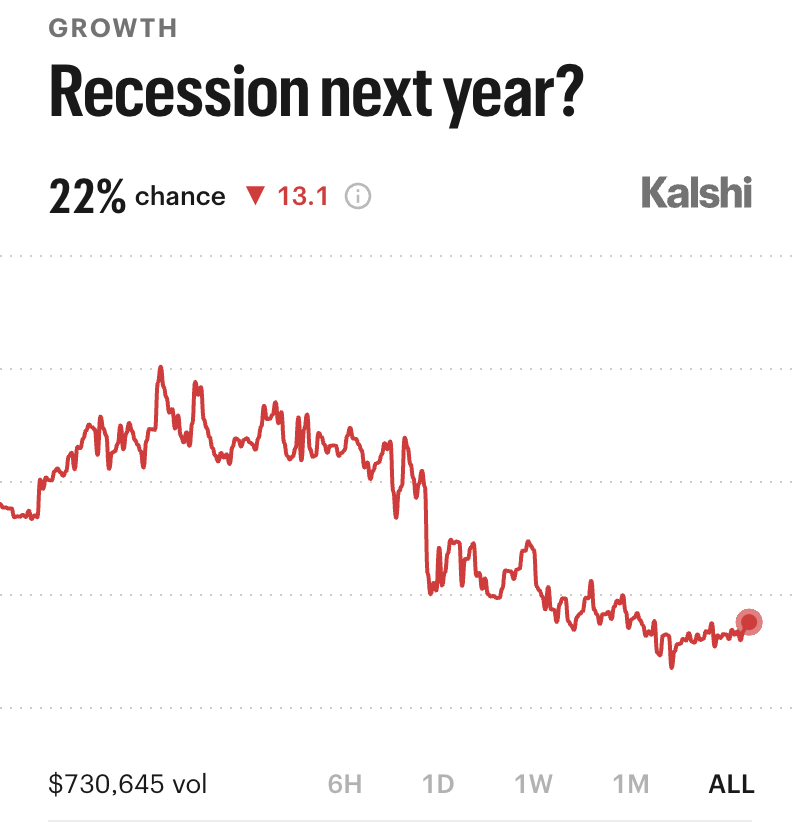
Recession fears are starting to come down and I think this chart helps explain why.
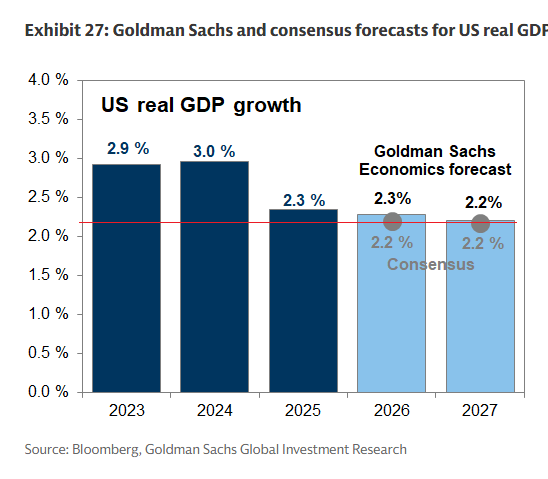
Right now, prediction markets are pricing in just a 22% chance of a recession next year which means the market is still implying a 78% chance that the USavoids one. On top of that, Goldman Sachs is forecasting US real GDP growth of 2.3% in 2026 and 2.2% in 2027, which is basically in line with broader consensus expectations. Yes, growth is expected to slow from the 2.9% and 3.0% levels we saw in 2023 and 2024, but slowing growth is not the same thing as a recession. A recession would mean the economy is actually contracting. This chart is showing that economists still expect the US economy to keep expanding.
Personally, I would not be surprised if GDP ends up getting revised higher over time, especially because of how much capex and AI spending is now entering the system. We are seeing an enormous amount of money being poured into data centers, chips, power infrastructure, networking, and the broader AI buildout. That kind of spending flows through the economy and can create a much stronger growth backdrop than people expect. So while the market has been acting like everything is falling apart, the underlying economic expectations are still pointing more toward a slowdown and if AI capex continues accelerating, there is a real chance growth ends up proving more resilient than current forecasts suggest.