Perder siempre duele, pero lo de Inglaterra es lo de menos.
En el 2025, entre todos los países de América y el Caribe, solo Haití y Cuba crecieron menos que México; eso nos debería de doler más.
🔴 AL MOMENTO : Toyota anuncia inversión multimillonaria para mover la producción de su Pickup de México a Texas! Pero según Ebrard y Sheinbaum lo del TMEC “ no afecta”
Let's talk about Mexican football, about their World Cup, about Gilberto Mora and this new generation of talented midfielders, and about why I believe this match against England can give real hope for the future of Mexican football.
Mexico did a fantastic job at this World Cup. Four wins in a row against South Africa, South Korea, the Czech Republic and Ecuador, without conceding a single goal, before dominating England, one of the tournament favourites, for long periods and being brave enough to impose themselves.
Of course, hosting the World Cup and playing at altitude are significant advantages. But you don't reach this stage of a World Cup because of those factors alone.
I said it a few months ago: I felt Javier Aguirre and his coaching staff had found something. Mexico finally started to develop an identity. Before that, I struggled to understand what kind of team Mexico wanted to be. There wasn't a clear idea of how they wanted to play or what they wanted to represent on the pitch.
Aguirre realised he had an exceptional group of technical midfielders and that he needed to build around them. More importantly, he understood that Mexico had enough quality in midfield to dominate possession and look any national team in the eye. That's why he moved towards a 3-4-3 with a square midfield, allowing him to accommodate players like Erik Lira, Álvaro Fidalgo, Obed Vargas, Bryan Gutiérrez and Gilberto Mora. You can even add more names performing well in Liga MX, such as Marcel Ruiz, unfortunately injured, or Charly Rodríguez.
Mexico found its identity in that 3-4-3. The left winger, usually Julián Quiñones, played inside and enjoyed an outstanding World Cup in that role. Gallardo pushed high from left fullback, while the right back generally stayed deeper. This created a solid 3+2 rest defence that allowed Mexico to remain protected whenever possession was lost.
But the main reason I believe this system suited Mexico is because of the profiles they currently produce. Mexico lacks players who consistently threaten in behind or can punish opponents in transition with pace over long distances. One solution would have been to defend in a low 5-4-1 block and wait for transition opportunities. The problem is that if you don't have players capable of carrying those transitions, sooner or later your game plan collapses. It made a lot of sense for Mexico to be more dominant on the ball and, especially, to press opponents high from goal kicks and other restarts, something they had been doing well for a long time and that led to goals, such as the opener against South Africa.
Interestingly, Aguirre was actually more conservative during the group stage than he was against Ecuador and England. Against South Korea and the Czech Republic, Mexico often defended in a reactive 5-4-1. But against Ecuador and England, they pressed aggressively in a 4-4-2, enjoyed much more possession and controlled large parts of both matches.
There is one name that changed everything, Gilberto Mora.
At just 17 years old, he demanded the ball in front of more than 80,000 people at the Azteca Stadium and gave his teammates the confidence to play with courage. He showed Mexico that if you surround him with intelligent, technical players who can combine with him, this team can compete with anyone.
Suddenly, "Piojo" Alvarado started playing at a much higher level alongside Mora. Mexico began creating relationships, combining through quick one-twos, building wide triangles and, above all, generating dangerous crosses into the penalty area.
Alvarado would drift inside onto his stronger foot before delivering inswinging crosses towards Quiñones and Raúl Jiménez. It became one of the defining images of Mexico's tournament.
Alvarado cuts inside, everyone inside the Azteca rises to their feet, and Raúl Jiménez powers a header into the net. You could hang it in the Louvre.
Yes, we can argue that Mexico struggled in the final minutes against England and that Aguirre made a mistake by introducing too many strikers and relying almost exclusively on crosses. But this is also the same Javier Aguirre who produced two incredibly brave game plans, trusted young players and selected the best performers rather than simply choosing those playing in Europe. In fact, Mexico fielded more Liga MX players than European-based players.
I'm not sure whether this evolution towards a more courageous, possession-oriented style was entirely Aguirre's idea, whether it was driven by Gilberto Mora's emergence, by the players themselves, or by the Mexican public demanding a braver national team. Perhaps it was a combination of all those factors. Whatever the reason, Javier Aguirre will always do what he believes gives his team the best chance of competing.
Now it's time for the Mexican Football Federation to think about the future.
The players themselves are already giving you an identity. You simply need to embrace it.
Everything should start with Gilberto Mora (17) and building a structure that allows him to flourish. Alongside him you have Obed Vargas (20), Bryan Gutiérrez (23), Marcel Ruiz (25) and Erik Lira (26). There aren't many areas of the pitch where Mexico is producing this much talent.
You can even add more players who still need time but have potential: Elías Montiel (20), Iker Fimbres (21), Denzel García (22), Fidel Ambriz (23) and Jordan Carrillo (24). There are more than enough talented young midfielders to build an identity around.
The next step is surrounding them with players who fit that style. If Mexico wants to become a dominant possession team, they need centre-backs capable of defending far from goal, pressing aggressively, covering large spaces and who can contribute in possession.
They already have Johan Vásquez (27), an established European defender who is left-footed, a rare and valuable profile, and perfectly suited to defending high while contributing in build-up. Now Mexico needs to produce more centre-backs with similar characteristics. Diego Campillo (24) could become one of them, but the search shouldn't stop there.
At full-back, the future is promising. Rodrigo Huescas (22) and Mateo Chávez (22) are already playing for FC Copenhagen and AZ Alkmaar at a young age. Both possess the energy and technical quality to overlap, underlap and defend aggressively in open spaces. Neither is particularly dominant aerially, which is another reason why Mexico should aim to defend further away from their own penalty area.
In goal, "Tala" Rangel (26) has shown he can become the right goalkeeper if Mexico continues down a possession-oriented path.
On wide attacking positions, Mexico still needs to produce more wingers capable of consistently winning 1v1 situations. Alvarado (27) and Huerta (25) offer solutions, and Alvarado showed throughout this World Cup that he has the quality to hurt opponents whenever he receives to feet.
But Mexico also needs wide players who can attack depth, stretch defensive lines and create more space for the midfielders to operate between the lines. They need more pace. More players capable of threatening large spaces.
Up front, Santiago Giménez (25) can be a good option. But he still needs to stay healthy more often and reach his best level. Then there's "Hormiga" González (23). He may not receive as much attention, but he has intelligent movement inside the box, consistently scores goals, attacks depth well and contributes aggressively in the press. When so many of your midfielders want the ball to feet and are more technical than athletic, having a striker who constantly stretches the opposition, attacks space and presses with intensity becomes incredibly valuable.
Of course, players like Quiñones and Raúl Jiménez can continue contributing while Mexico gradually gives more responsibility to younger profiles and develops the next generation of strikers.
Ultimately, this World Cup has allowed Mexico and its supporters to dream again, but there is still plenty of work to do.
Mexico needs to invest more in coach education to produce better Mexican coaches, who will eventually develop better players in the academies.
The federation should also make it easier for young Mexican players to move abroad earlier, even if transfer fees are lower.
And finally, promotion and relegation must return.
Young players develop fastest when they compete under pressure. Few matches are more demanding than fighting against relegation or battling for promotion. Those experiences shape players who can later perform on the biggest stages, like a World Cup.
The encouraging part is that Mexico has started talking about football again. Apart from a few journalists unwilling to evolve, most people have praised the way this team competed. The catastrophism and negativity that have surrounded Mexican football for years are slowly disappearing.
Mexico is a genuine football country, one of the greatest in the world in that respect. Few stadiums roar like the Azteca. Few cities live football like Mexico City. Everywhere you go, people are talking about their national team.
Now it's time for Mexico and its federation to match that passion with a long-term vision.
The potential is there. This team has planted the seed.
¿Saben por qué @ClaraBrugadaM autoritariamente ordenó ley seca?
Pues para que sus trabajadores ambulantes ejercieran su derecho a vender sin permiso y sin pagar impuestos.
¿Cuánto les dan de moche @craviotocesar ?
Miserables corruptos.
La cuenta de la oficina de la @ONU_es en México firma una publicación en conjunto con el @GobCDMX donde se burla del resultado de México vs Inglaterra y de la afición mexicana.
Adjunto la liga a la cuenta oficial con la publicación. ¿De quién fue idea? #MundialDelFútbol2026
🇺🇸 🇧🇪 AUJOURD'HUI NOUS ALLONS PARLER DES DROITS DE DOUANE POUR LA BELGIQUE.
• Si la Belgique obtient un corner +25%.
• Si la Belgique obtient un coup franc à proximité de la surface de réparation +35%.
• Si la Belgique obtient un penalty +80%.
• Si la Belgique marque un but +150%.
• Si la Belgique gagne le match elle sera ajoutée à la liste noire.
COMMUNIQUÉ DE LA FFF :
Les propos racistes de la Sénatrice paraguayenne Celeste Amarilla visant Kylian Mbappé sont totalement abjects et inacceptables. Comment peut-on tenir un tel discours ? Ces propos sont délictueux et condamnables. Ils doivent être poursuivis ici comme ailleurs. La FFF procède à un signalement au parquet à des fins de poursuite judiciaire.
La Fédération apporte son entier soutien à son capitaine, ses joueurs et plus généralement à toutes les victimes de tels propos odieux. Plus que jamais la FFF entend lutter contre le racisme et toute forme de discriminations. Ces propos déshonorent ceux qui les tiennent et ceux qui les diffusent. Les joueurs de l’Équipe de France représentent la France, c’est notre pays qui est insulté.
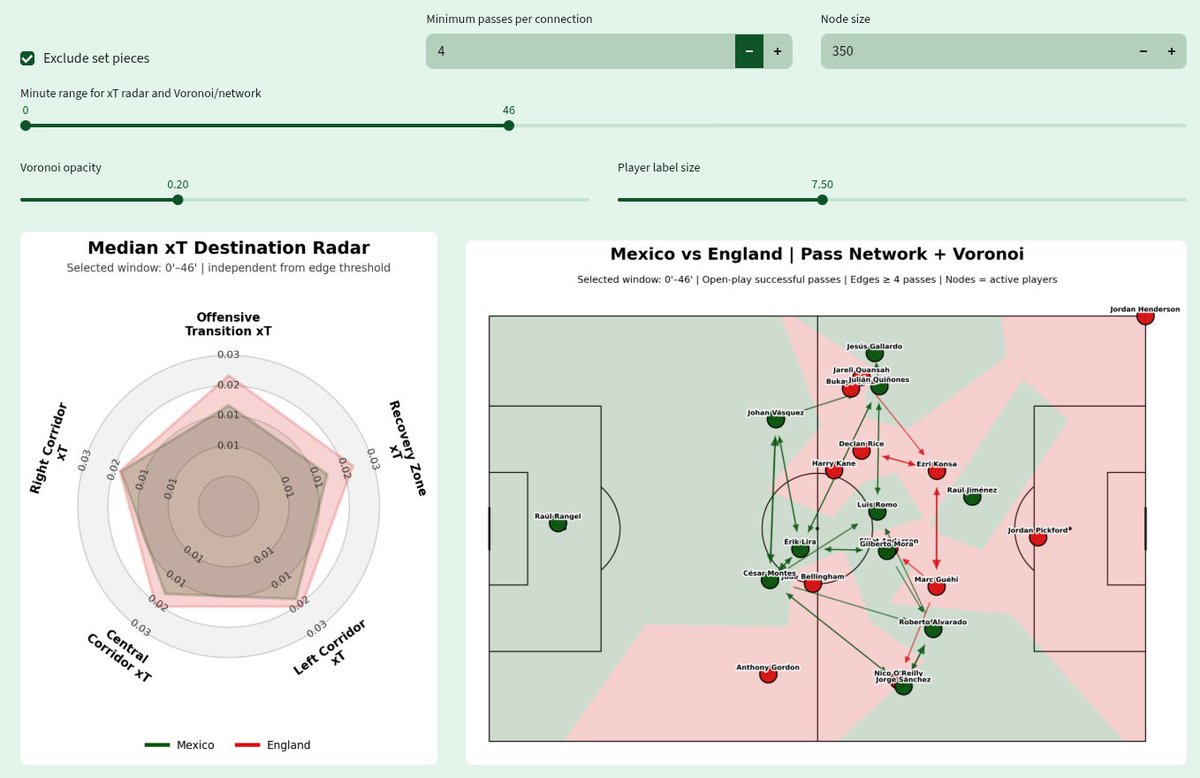
Mexico 2-3 England: Pass Network Analysis Reveals Why England Survived a High-Intensity Round of 16 Battle
Disclaimer: This analysis is based exclusively on Football Hacking's proprietary pass network, Voronoi control, isolated network health, and xT destination models. No match footage, broadcast images, or event videos were used.
England edged Mexico 3-2 in one of the most structurally balanced matches of the 2026 FIFA World Cup Round of 16. While the scoreline reflects a closely contested encounter, Football Hacking's network models reveal a fascinating contrast between Mexico's sustained structural consistency and England's greater attacking efficiency.
The Network Health Index shows Mexico outperforming England during most five-minute windows. Mexican network health remained remarkably stable throughout the match, peaking twice with dominant structural phases before halftime and again around the 75th minute. England, despite producing fewer high-health intervals, maintained enough organization to capitalize on decisive moments.
The pass network and Voronoi analysis illustrates Mexico's highly connected midfield, with Luis Romo, Gilberto Mora, Edson Álvarez, Julián Quiñones and Jesús Gallardo forming an interconnected passing structure that generated continuous circulation across central and wide zones. England relied on a more compact spine built around Harry Kane, Jude Bellingham, Declan Rice, Marc Guéhi and Ezri Konsa, producing a network with fewer dominant possession phases but efficient vertical progression.
The Median xT Destination Radar reinforces this balance. England records higher values in Offensive Transition xT, Recovery Zone xT, and Left Corridor xT, suggesting greater effectiveness immediately after regaining possession and in advancing through the left side. Mexico shows its strongest relative advantage in the Right Corridor xT, reflecting a greater tendency to create progression through that channel while remaining competitive across the remaining dimensions.
Football Hacking's structural models indicate that Mexico controlled larger portions of the game's network flow, but England converted superior transition efficiency and recovery structure into the decisive moments that defined the match. The result was a 3-2 victory for England, secured through greater effectiveness rather than sustained territorial dominance, earning qualification to the 2026 FIFA World Cup quarter-finals.
It's quite positive to see the variety of ways that Mexico have been attacking England's 4-4-2 block in the opening quarter. Mexico are showcasing their willingness to go through, over, and around the block.
- Through: With fullbacks pushed up, the midfielders and wingers can focus on occupying narrow positions. This enables central passing combinations over short spaces against England's double pivot.
- Over: Beyond runs from the wide players while there is a Mexico player occupying the England fullback and /or near-side center-back. This opens a gap to attack the space beyond and provide depth against a fairly high defensive line.
- Around: Using the fullbacks and/or the wingers to receive wide and target the back post via crosses.
Overall, I think England have to be very proactive since there isn't one specific way that Mexico are trying to attack. By using different approaches, it's important for the England defenders to stay switched on and anticipate the potential threats depending on the situation. So far, Mexico have also looked promising in glimpses.
Really shaping up to be an interesting game. It's been competitive so far, too.
🔴 El jugador de la selección de Inglaterra, Jordan Henderson, se fracturó el brazo al intentar saltar un valla publicitaria durante la celebración por vencer a México 3-2 en el Mundial.