The viral question deserves a less dramatic answer: assess symptoms and impact, not a private count.
Planned Parenthood: frequent masturbation—even more than once a day—is not automatically a problem. Ask whether it interferes with daily life.
https://t.co/8CSiWFR9Ln
��Is daily masturbation healthy or harmful?” is a worse question than it sounds.
Frequency alone does not diagnose a problem.
That matters because shame can hide the signals worth acting on: pain, injury, distress, or a pattern disrupting sleep, work, relationships, or sex.
Reasons to seek medical or mental-health support are more concrete:
• genital pain, sores, swelling, or persistent irritation
• injury or bleeding
• distress you cannot manage
• a persistent sexual-function concern
A frequency count alone cannot sort those out.
There is no universal “normal” count. Some people masturbate often, some rarely, and some not at all.
The useful question is not “what number is too high?” It is: is this pattern causing a problem in my life or body?
Save this thread for your next checkup—and send it to a man who tracks his weight but none of the other six.
Follow @MensMetric for measured, evidence-based health after 35.
You can quote your weight to one decimal. But weight doesn't tell you where fat is, how your heart is aging, or whether your blood is silently changing.
Here are 7 health numbers every man over 35 should know—and what each one can and can’t tell you. 🧵
The point is not to optimize seven numbers at once. It is to stop flying blind.
Track trends. Add context. Investigate persistent changes.
Looking fit is not the same as knowing your health.
7/ Average sleep duration — not just last night.
Most healthy adults should regularly get at least 7 hours. But 8 hours with loud snoring, breathing pauses or daytime sleepiness can still signal poor sleep quality.
6/ Cardiorespiratory fitness — VO₂ max or an estimated age-adjusted fitness percentile.
Fitness is strongly linked with long-term health, but compare with men your age. One universal “good” VO₂ max number does not fit everyone.
5/ Resting heart rate — track the trend under similar conditions.
60–100 bpm is a common adult reference range, but trained men may run lower. A persistent change—or symptoms—matters more than winning a lowest-number contest.
4/ Atherogenic cholesterol — know LDL-C and non-HDL-C; ApoB can add information for some men.
There is no one “perfect” target for everyone. Your goal depends on overall cardiovascular risk, not a single internet cutoff.
3/ HbA1c — a rough picture of average glucose over ~3 months.
<5.7%: normal range
5.7–6.4%: prediabetes range
≥6.5%: diabetes threshold
A diagnosis usually needs confirmation and clinical context.
2/ Waist-to-height ratio — divide waist by height, using the same measurement method each time.
A simple screening rule: keep your waist below half your height. It is not a diagnosis, and risk cutoffs can vary by ethnicity.
1/ Blood pressure — know your home average, not one rushed clinic reading.
Under ACC/AHA categories, <120/80 mm Hg is normal; ≥130 or ≥80 enters the hypertension range. Diagnosis still requires proper, repeated measurements.
Next time someone quotes your BMI like a verdict, ask:
What is this number actually describing—and what decision should it change?
That is a better question than “is this number good or bad?”
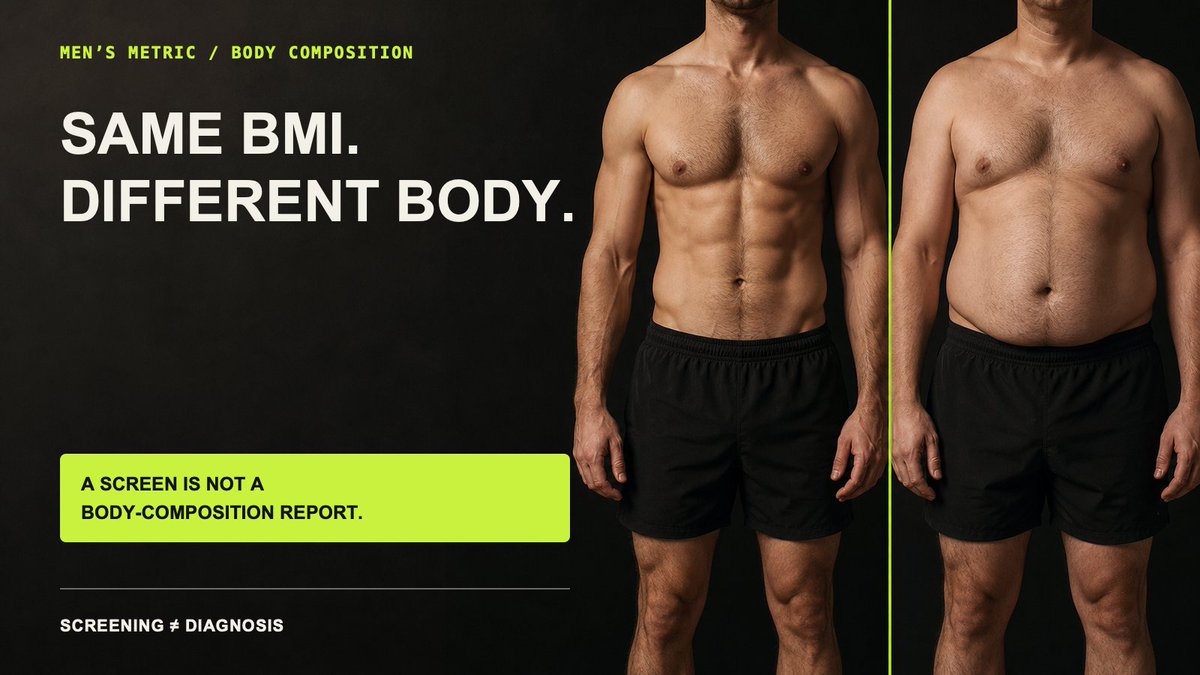
Two men can share the same BMI—and need completely different next steps.
A category is a screen. Not a body-composition report.
That matters because BMI cannot tell you how much weight is muscle, fat or bone—or where fat is carried.
The mirror can show change. It cannot measure fat distribution, blood pressure, glucose or cholesterol.
CDC: BMI is a screening measure, not a direct body-fat measurement.
https://t.co/Hn211eHfdr
Choose the tool by the decision:
• Need a low-cost screen? Start with BMI plus broader clinical context.
• Need a training trend? Repeat the same device under similar conditions.
• Need medical advice? Bring trends, symptoms, labs and history—not one scan score.
DEXA can estimate body composition. A BIA scale estimates it through a device-specific prediction. Skinfolds depend heavily on technique.
Useful tools? Yes.
Interchangeable truth machines? No.