Let me repeat
Batteries can now meet 75.3% of average grid demand and 44.4% of the year's highest grid demand for 4 hours at a cost less than 1% the price of electricity in the world's 4th-largest economy.
So, whoever is still standing claiming fossil fuels are needed, sit back down.
vous vous rappelez quand je vous disais que le monopole de SpaceX serait bien plus fragile qu'il n'y paraît pendant que tout le monde s'extasiait sur l'IPO ?
dans un silence assourdissant la Chine vient de récupérer le premier étage de sa fusée long march 10b dès son vol inaugural et attention à la prouesse, ils n'ont pas copié SpaceX
là où falcon 9 se pose sur ses pattes par poussée inversée, le long march 10b redescend en vol contrôlé puis se fait capturer en pleine mer par un système de câbles tendus, un crochet du lanceur accroche les filins qui absorbent l'énergie cinétique et le verrouillent sur une plateforme flottante (une première mondiale )sans train d'atterrissage donc moins de masse morte & plus de charge utile et personne au monde SpaceX compris n'avait jamais réussi une récupération orbitale dès le premier vol
cependant pour moi le vrai génie est ailleurs, la réutilisation c'est le seul levier qui effondre le coût du lancement et le coût du lancement c'est le verrou qui commande toute l'économie spatiale (j’en ai déjà très largement parlé ici) les constellations, internet en orbite basse, l'observation de la terre, l'agriculture de précision, la navigation, la fabrication en orbite (zone de microgravité) , l'énergie solaire spatiale et le programme lunaire habité visé pour 2030, au fond sachez quils ont construit bien plus qu'une fusée, ils ont posé la rampe d'accès à une dizaine d'industries à 1000 milliards
pendant que l'occident mesurait l'espace à la valorisation boursière d'une seule boîte, la Chine jouait la partie à 30 ans ENCORE UNE FOIS avec une verticale patiente et holistique, c'est toute la différence entre parier sur un seul champion et bâtir la capacité d'une civilisation
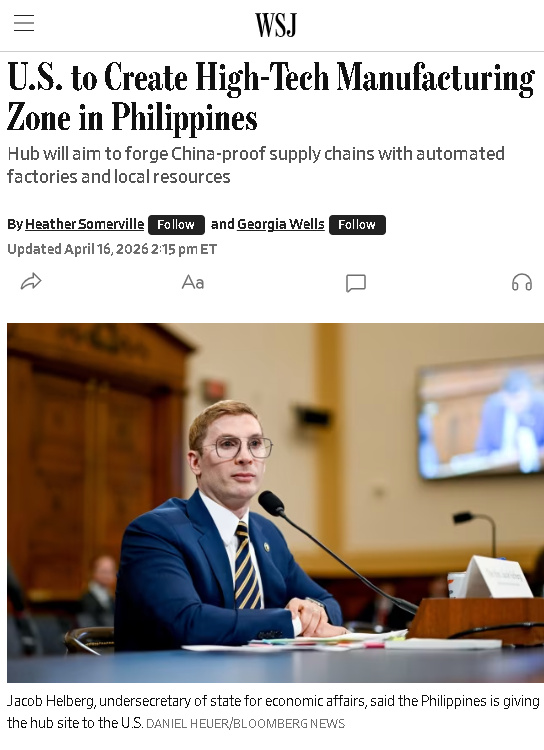
This is pretty insane: the U.S. just tried to literally re-colonize part of the Philippines.
They did so under the so-called "Pax Silica" initiative, the brainchild of - surprise, surprise - an ex-Palantir guy named Jacob Helberg who now runs U.S. economic "diplomacy" from the State Department.
It's causing a big outcry in the Philippines, which is quite a feat given this is by far the most US-friendly country in Southeast Asia.
If you're the US and you're getting the Marcos administration - of all governments - to push back on sovereignty, you've really overplayed your hand.
What is the "Pax Silica" initiative? In a nutshell it's about the US getting other countries to commit to restructuring their AI tech infrastructure around a US-led stack. It's basically vendor lock-in: you hand over your critical minerals, align your export controls with Washington's, regulate AI the way America wants, and in return you get to be a US "trusted partner," whatever that means these days.
In essence, let's not kid ourselves, it's all about China: this is the US's initiative to "win the AI race" by getting other countries to contractually commit to keeping China out of their tech supply chains. When you can't preserve your lead through innovation, you seek to lock countries in contractually.
For instance as a country, this would mean telling Huawei they can't sell you AI chips, and telling Chinese firms they can't invest in your data centers - even if they're better and cheaper. It's not about choosing the best technology, it's about choosing the right flag.
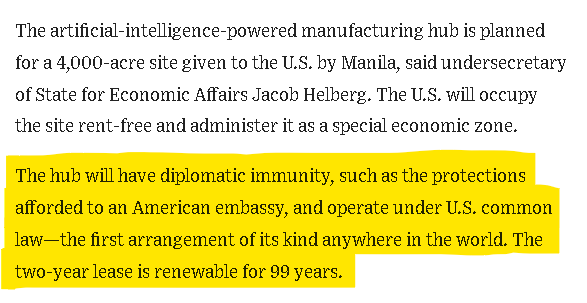
But in this instance, the US went much further still: they literally tried to carve out 4,000 acres of Philippine territory (in New Clark City, 60 miles north of Manila) to be governed under US common law with diplomatic immunity - the first arrangement of its kind anywhere in the modern world.
This is according to the WSJ who ran the story last month (https://t.co/kydhIQfo2A) as if it was a done deal (it wasn't).
Heard about the "French concession" or "British concession" in China during the century of humiliation? Same thing: the US basically asked for an "American concession" in the Philippines.
Unsurprisingly, there was quite a bit of backlash in the country with for instance the Peasant Movement of the Philippines (KMP) calling it a “massive sellout” of the country’s land, minerals, and sovereignty (https://t.co/nkXSajH2Q7).
So much so that the Philippines' government - namely Joshua Bingcang, president and chief executive of the Bases Conversion and Development Authority (BCDA) - issued a statement saying that the Philippines had rejected US proposals that would place the project beyond local jurisdiction (https://t.co/ZmNWJB03eH).
Note, by the way, this delicious irony: the BCDA is the government agency that was created in 1992 specifically to convert former US military bases at Clark and Subic Bay after the Philippines spent decades negotiating their closure. New Clark City - where the Pax Silica's hub would go - is built on the old Clark Air Base.
So the agency whose entire reason for existing is to turn former American colonial territory (i.e. US military bases) into sovereign Philippine land is the one now being asked to hand part of that very same land back under US jurisdiction (and, apparently, declined).
Of course though, blocking this specific jurisdiction grab doesn't change the bigger picture. The Philippines is still a Pax Silica signatory, and Pax Silica itself is structurally neocolonial: you supply the cheap labor and raw materials, align your export controls and regulations with Washington's, cut yourself off from the world's rising technological powerhouse - and in exchange you get assembly jobs and the privilege of getting a pat on the head and being called a "trusted partner."
They dropped the most cartoonishly colonial demand - governing Philippine soil under US law - but the underlying architecture is the same: you serve America's supply chain, on America's terms, and you relinquish your sovereign right to trade with whoever offers the best deal.
La déconstruction prétendait jeter l’eau du bain coloniale, elle a fini par noyer le bébé, et le bébé c’était la civilisation qui avait inventé la baignoire, le savon, et l’idée même qu’on puisse laver quoi que ce soit.
Derrida voulait nous apprendre à lire entre les lignes, ses héritiers ont juste appris à brûler le livre. Foucault traquait les rapports de pouvoir, ils en ont fait une grille à appliquer mécaniquement sur tout ce qui dépasse.
Et au bout de la chaîne, on se retrouve à défendre par relativisme culturel les régimes les plus anti-femmes, anti-presse, anti-juifs, anti-gays de la planète, au nom de la lutte contre l’oppression.
Le pire, c’est que la déconstruction était au départ un outil critique puissant. Mais transformée en idéologie de masse via les départements de sciences sociales américains, elle est devenue ce qu’elle prétendait combattre : un dogme ethnocentré (universitaire occidental moyen) qui s’ignore, projetant ses catégories morales sur des civilisations qui s’en moquent et qui, elles, n’ont aucun complexe à défendre les leurs.
La civilisation occidentale est la seule de l’histoire à avoir produit la critique de soi comme valeur cardinale.
C’est sa force et c’est devenu son talon d’Achille : face à des adversaires qui ne pratiquent pas ce sport, l’asymétrie est mortelle.
Everyone is covering Terafab as a chip factory.
It is not a chip factory.
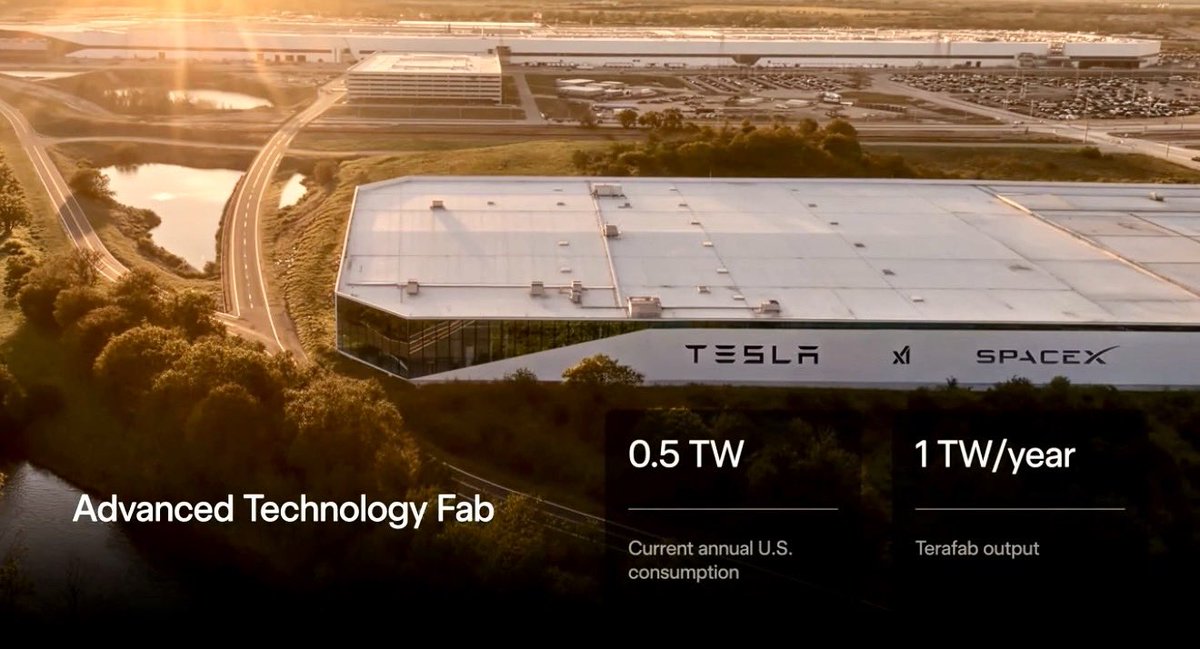
Last night in Austin, Elon unveiled a facility that makes masks, fabricates chips, and tests them inside a single building with a nine-month recursive improvement cadence. No such loop exists anywhere else on Earth. Then he told you 80% of the output goes to space. Then he showed you a 100-kilowatt AI satellite with solar panels and radiators, scaling to megawatt range. Then he said Optimus plus photovoltaics will be the first von Neumann probe, a machine capable of replicating itself from raw materials found in space.
Nobody connected the sequence.
Terafab produces 1 terawatt per year of compute. The entire United States consumes 0.5 terawatts of electricity. Musk is building a single factory whose output in AI silicon exceeds twice the power consumption of the country it sits in. And he is sending 80% of it off-planet because Earth literally cannot power what he is building.
Follow the mechanism. Terafab seeds the chips. Starship launches Optimus robots and solar arrays at 100 million tons per year. The robots mine lunar and asteroid regolith for silicon, iron, and nickel. They 3D-print more robots. They fabricate more solar panels. They assemble more AI satellites. Each satellite runs hotter-burning D3 chips designed specifically for vacuum, where free radiative cooling eliminates the thermal constraints that strangle every terrestrial data center on the planet. The nodes replicate. The replication is exponential.
This is a Dyson Swarm bootstrap hidden inside a semiconductor announcement.
The math is public. The Sun outputs 3.828 times 10 to the 26th watts. A 2022 paper in Physica Scripta calculated that 5.5 billion satellites at 290 kilograms each, robotically manufactured from Mars resources, capture enough solar energy to meet all of Earth’s power needs within 50 years. A 2025 paper in Solar Energy Materials calculated a partial swarm capturing 4% of solar output yields 15.6 yottawatts, roughly a billion times current human civilization’s total energy budget. Musk just announced the factory that builds the chips that go inside the satellites that replicate themselves forever.
92% of advanced logic chips are fabricated in Taiwan. One factory in Austin does not fix that. But one self-replicating system seeded by that factory, launched by the only company with reusable heavy-lift rockets, assembled by the only humanoid robot in mass production, and powered by the only star within reach, does not fix a supply chain. It obsoletes the concept of supply chains entirely.
The market priced this as a $20 billion capex story about semiconductor independence.
The actual announcement was the engineering blueprint for Kardashev Type II.
Humanity sits at 0.73 on the Kardashev scale. 18 terawatts. The distance between here and harnessing a star is not a technology gap. It is a recursion gap. And recursion is exactly what a single building in Austin that makes its own masks, builds its own chips, tests its own chips, and launches the output into orbit on its own rockets was designed to close.
Every civilization that makes it past this point never looks back.
Repowering of existing US onshore wind farms could double their current capacity (153 GW) to ~314 GW.
Yearly wind electricity generation would also double, from 453 terawatt-hours in 2024 to 911 TWh.
That's equal to ~20% of US supply.
https://t.co/EbyBM5SWG0
New paper:
Repowering existing U.S. wind farms with newer turbines could double current output so that the U.S. could meet up to 21% (instead of 10.5% currently) of electricity demand from wind.
Paper:
https://t.co/WSQ69VU0c5
Article
https://t.co/aApXUcPvjp
The United States has handed the Chinese an encyclopedia on its military doctrines.
The war involving the US and Israel is being monitored and recorded in real time by LEO satellite constellations such as Jilin-1, which are even capable of capturing 4K UHD video.
Today, China operates at least three LEO constellations comprising at least 300 satellites dedicated to espionage or dual-use purposes.
From the images constantly released about American bases, it is clear that the Chinese are building a true encyclopedia on U.S. naval and air doctrines.
Every ship positioning, fiend tactics, refueling time, ammunition resupply, everything is being monitored by Chinese satellites. This includes the exact location and behavior of air defenses, their mapped reaction times, missile trajectories, and reprogramming durations.
Nothing escapes the Chinese gaze. In this conflict, they have already mapped and publicly released data on multiple American bases in the region, even identifying the exact number and models of aircraft on the ground.
The war against Iran is giving the Chinese something they never had in the Ukrainian theater: the opportunity to study and document American forces in detail.
To give you an idea, in 2025 the Chinese recorded a video of Atlanta’s airport purely to demonstrate their capability.
I believe the same kind of videos are being produced daily on the American front against Iran.
Never in history has a U.S conflict been observed from the skies at this level, both tactically and strategically.
The price of the Iran war is high in many ways, as I have always said.
And this single episode is giving the Chinese decades of planning and improvement in one go.
(Atlanta Airport)
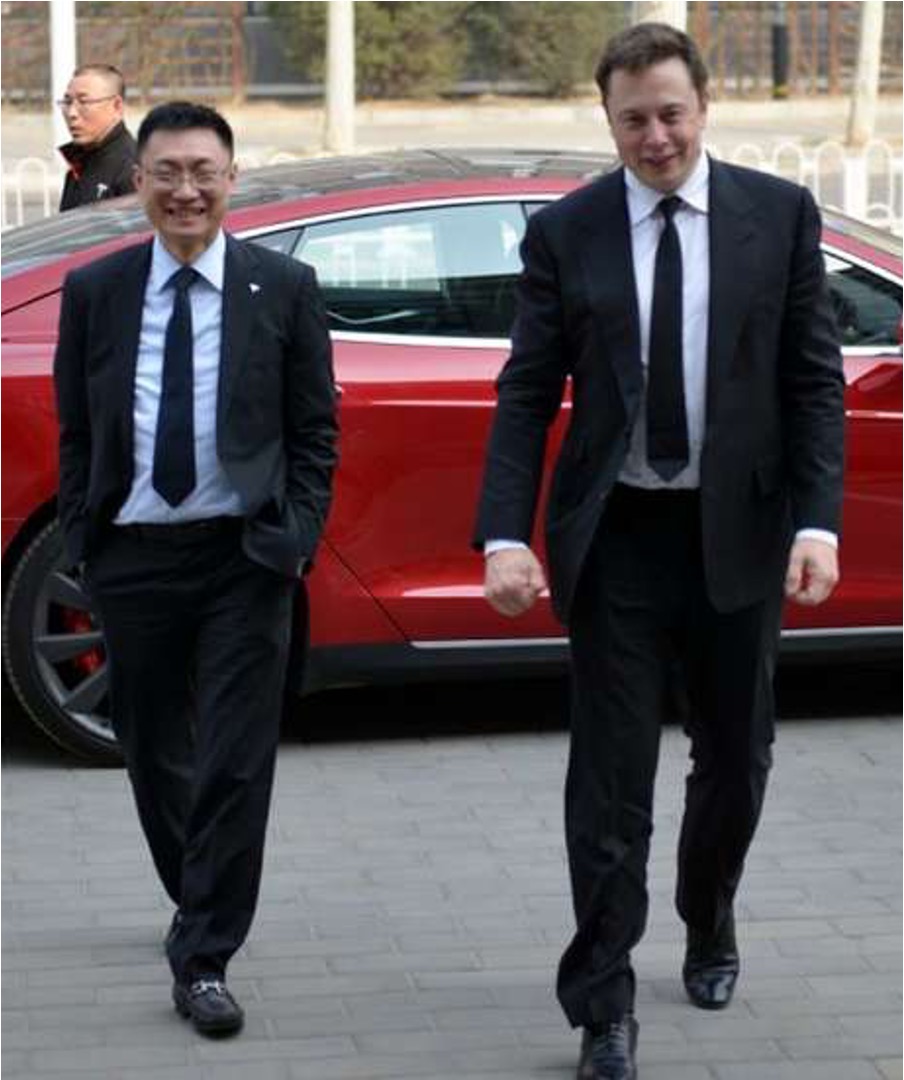
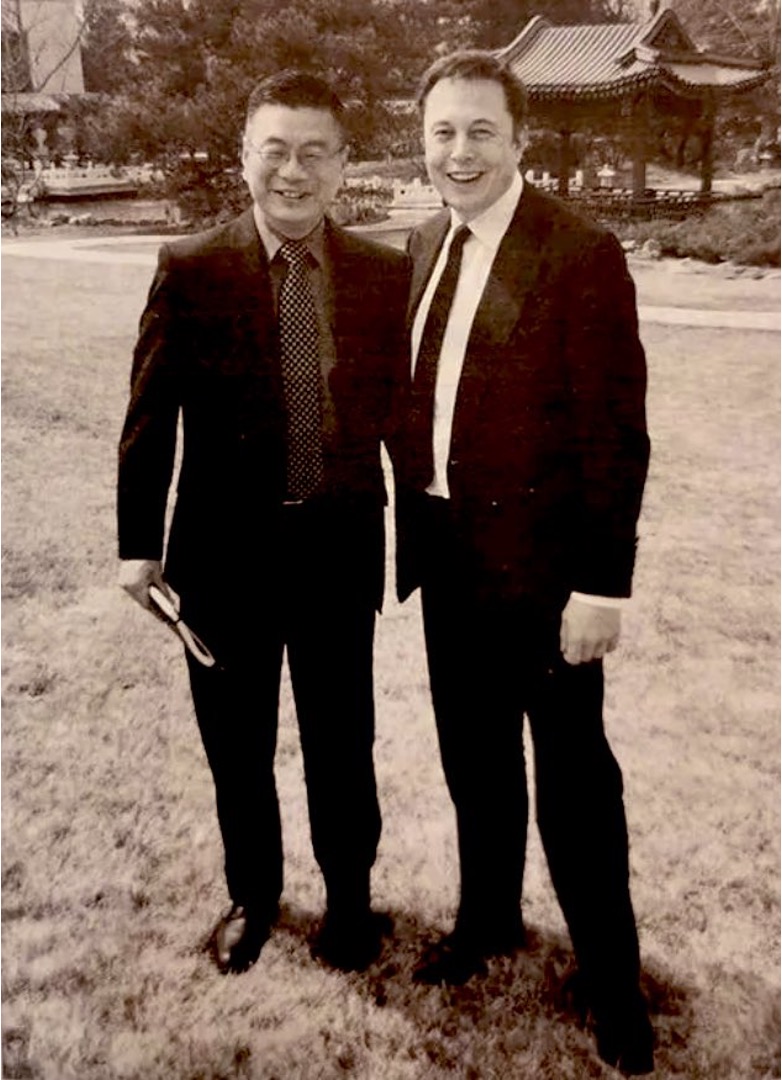
🚨 A REMARKABLE STORY ABOUT ELON MUSK’S SECRET GENERALS IN CHINA: THE TWO MEN WHO BUILT THE SHANGHAI MIRACLE 🏆
🌑 In 2018, Tesla had entered its darkest hour. In the United States, severe production crises and low yield rates had put Elon Musk on the hot seat. Wall Street magnates circled the company, eyeing it for short-selling, waiting for the inevitable collapse.
🌏 Across the Pacific, the situation was equally dire. In the massive Chinese market—which accounted for nearly half of global new energy vehicle sales—Tesla was struggling to gain traction. Faced with dismal sales of only 120 cars a month, an enraged Musk even considered disbanding the entire Chinese team.
🧱 The market was notoriously difficult to crack. Because all Teslas were imported, the starting price of 499,000 yuan for the Model 3 deterred most consumers. To lower prices, domestic production was essential. However, the premise for foreign companies to produce cars in China was to establish a joint venture—a compromise the maverick Musk was unwilling to make.
🔮 Tesla needed a miracle in China. That miracle would require two distinct phases spearheaded by two very different men: Robin Ren, the diplomat who would unlock the forbidden door, and Tom Zhu, the commander who would build an empire behind it.
PHASE ONE: THE DIPLOMAT AND THE BREAKTHROUGH
🕵️♂️ Secretly, Musk began looking for a "China hand" to navigate the complex political landscape. Robin Ren (Ren Yuxiang), a fellow alumnus of the University of Pennsylvania, had long been on Musk's radar. Since 2012, Musk had repeatedly invited Ren to join Tesla, convinced he was the missing link.
🎓 Initially, Ren was surprised by the olive branch. He admitted he "knew almost nothing about the automotive industry" and found it hard to imagine that, 20 years after graduation, Musk would suddenly ask to have lunch. But Musk was persistent. As the 22nd International Physics Olympiad champion and Musk's former laboratory partner at UPenn, Ren was held in high regard by the CEO, who once noted that Ren was the only classmate whose physics was better than his own.
🤝 Ren finally joined in May 2015 as Vice President of Tesla Asia Pacific. Musk was set on him not just for his intellect, but for his unique leverage: his identity as a native Shanghainese with deep government relations.
🏛️ He became the unsung hero of the Shanghai project. Under Ren's mediation, Musk began frequently meeting with high-ranking Chinese officials. In April 2017, Ren first articulated the crucial argument that a wholly-owned factory "benefits the upgrading of China's automotive industry," persuading officials that Tesla's technology could drive the local supply chain. With theories of technological independence and industrial chain driving effects, Ren slowly loosened the customary domestic joint venture model.
✈️ By February 2018, the plan was ready. Ren flew to the US to report to Musk with a detailed blueprint for the Shanghai factory, including location maps, financing commitments, and transaction terms. Unfortunately, Musk was deep in the "production hell" phase of the Nevada battery factory. When they finally met, Musk didn't even look at Ren’s slides. He just stared at him and asked, "Are we doing this right?"
🚦 Ren was taken aback. He thought the heavy lifting was done, but realized Musk needed reassurance, not data. Giving a firm affirmative answer, Ren secured the green light.
🔓 In April 2018, the breakthrough arrived. The Chinese government lifted foreign ownership restrictions on new energy vehicles, and Ren seized the opportunity. By July, the Shanghai Municipal Government and Tesla signed a memorandum of cooperation. While Shanghai Mayor Ying Yong and Musk unveiled the project publicly, it was Ren who signed the agreement, quietly cementing his pivotal role.
✍️ Ren secured three extremely favorable terms that forcefully broke the established joint venture model. First, he negotiated land concessions, obtaining 860,000 square meters of land in Lingang at a 90% discount from the market price.
⚡ Second, he secured low-interest loans, obtaining credit support totaling over 16 billion yuan with an interest rate of just 3.9%. Third, he ensured rapid approval, taking only half a year from signing the contract to commencing construction. Robin Ren had successfully delivered Tesla's first taste of "China speed."
PHASE TWO: THE COMMANDER AND THE WAR FOR SPEED
🏗️ With the door successfully opened, someone had to walk through it and build. While Ren moved in high-level diplomatic circles, the on-the-ground reality for Tesla China was chaotic.
🔌 In early 2014, the company was struggling with a "charging anxiety" crisis that was killing sales before they could start. Consumers refused to buy electric cars without a reliable network. Into this breach stepped Tom Zhu. Unlike the diplomatic Ren, Zhu was a man of the earth.
🌍 Born in China but educated in New Zealand with an MBA from Duke University, Zhu had cut his teeth managing tough infrastructure projects in Africa. He was used to dust, delays, and difficult environments. He joined Tesla in April 2014 to build the Supercharger network, but his pragmatic, military-style execution caught Musk’s eye immediately. Despite having zero automotive experience, he was put in charge of Tesla’s entire China operation by the end of the year.
⚔️ If securing the land was Robin Ren's victory, building the factory was Tom Zhu's war. The timeline Musk demanded was widely considered impossible: transform a muddy field in Lingang into a world-class vehicle factory in under a year.
🏠 Zhu moved to the front lines. Known for his no-fuss style and often seen wearing a standard-issue Tesla fleece jacket and a buzz cut, Zhu rented a small, government-subsidized apartment just 10 minutes from the construction site. He paid less than 2,000 yuan ($300) a month for rent, purely so he could be the first one in and the last one out.
🚀 Under his watch, "China Speed" became a reality. He orchestrated a 24/7 construction schedule that stunned the industry. In January 2019, the site was dirt. By October 2019—just 10 months later—the factory was complete and starting trial production. It was a miracle of manufacturing engineering that saved Tesla’s cash flow at a critical time.
💰 The results were undeniable. Two years later, the Shanghai factory contributed half of Tesla's global production capacity, and costs were sharply reduced by 65%. Through the Gigafactory, Tesla solved its production and profitability issues in one fell swoop, eventually surpassing a market value of $1 trillion in October 2021.
UNSTOPPABLE: THE MIRACLE OF SHANGHAI
🌟 While Robin Ren left the company in 2020, Zhu’s star continued to rise. His defining moment came in 2022 during the severe Shanghai COVID-19 lockdown. The city was paralyzed, and factories everywhere were shutting down. For Tesla, a halt in Shanghai meant cutting off half its global cash cow.
🛌 Zhu made a decision that mirrored Musk’s own famous "sleeping on the factory floor" days. He implemented a "closed-loop" system, moving into the factory and sleeping on the floor alongside thousands of his workers.
🥣 For over two months, they lived, ate, and worked inside the facility, cut off from the outside world to keep the assembly lines humming. While other automakers flatlined, Zhu’s army kept delivering cars. By 2022, Giga Shanghai was Tesla's primary export hub, producing over 710,000 vehicles that year—more than half of Tesla's global output.
🤠 Musk, who values "hardcore" commitment above all else, saw in Zhu a mirror image of his own relentless drive. In late 2022, when Tesla's Texas and Berlin factories were struggling to ramp up, Musk didn't hire a local expert. He flew Tom Zhu to Austin.
🦺 Zhu arrived with a team of his most loyal lieutenants from Shanghai, famously appearing at the US factories in their signature Tesla visibility vests, ready to instill "China efficiency" into American operations.
🏆 In April 2023, the former project manager who built charging stations was named Senior Vice President of Automotive. Today, Tom Zhu sits at the very pinnacle of Tesla's hierarchy, effectively serving as the global No. 2, overseeing all global production and sales.
☯️ Ultimately, the miracle of Shanghai wasn't just about steel and software; it was about the collision of two distinct forces. Robin Ren was the velvet glove who rewrote the rules of the game, while Tom Zhu was the iron fist who built the arena. One conquered with handshakes, the other with grit. Musk may have provided the vision, but without his Diplomat to open the gate and his Commander to hold the line, the future would have remained just a dream.
Record setting day in Texas on the ERCOT grid:
🥇 all-time for solar at 31,300 megawatts (~10 GW more than CA's record)
🥇 all-time with renewables providing 83% of the power
🥈all-time for battery storage at 8,600 megawatts
🥉all-time for battery storage as % of load at 16%
@BetterCallMedhi NYC had a similarly distributed manufacturing ecosystem of small producers and nimble suppliers from the mid 1800s through WWII into the 50s maybe most visible in the garment and fashion sectors.
I spent time in Shenzhen last year and when I saw Merz come back from China saying Germans need to work more I immediately knew what broke his brain because I lived the exact same cognitive shock
my first week in Huaqiangbei I burned through 4 prototype iterations of a motor controller board for less than a thousand bucks total, back home a friend was working on something similar and spent over 12 thousand for a single revision that took almost two months to arrive
when you live that contrast in your own hands with your own project something permanently shifts in how you see the world and it goes way deeper than speed & cost
what Shenzhen actually built is a collective learning organism, imagine 20 PCB fabs 15 injection mold shops 30 component distributors and a hundred firmware freelancers all within a 2km radius, looks insanely redundant from the outside until you realize redundancy is actually information density in disguise
I watched this firsthand with an injection mold supplier I was working with, this guy had seen a hundred founders iterate similar thermal designs over 6 months so he proactively modified his tooling before I even opened my mouth, he knew what I needed before I knew what I needed, the intelligence lives in the relationships between the nodes and it compounds daily
the west thinks about manufacturing as a cost center you optimize by centralizing…
China accidentally built a distributed neural network of manufacturing intelligence where knowledge diffuses horizontally across thousands of agents faster than any single western company can process internally
so when Merz comes back and says we need to work a bit more I think he saw the problem but COMPLETELY misdiagnosed the solution, telling Germans to work harder is like telling a horse to gallop faster when the other side built a combustion engine
the gap is ARCHITECTURAL
it’s ecosystem density, you need a custom connector in Shenzhen you walk 200 meters, in Munich you send an email and wait 3 weeks
it’s iteration speed, parallel search vs sequential optimization at the system level, it’s risk tolerance, Chinese founders ship something broken on Monday fix it Tuesday ship again Wednesday while European companies are still in the approval phase for the pilot program of the feasibility study…
and Merz only saw the surface, what he missed is the tier 2 cities like Hefei Chengdu Wuhan replicating the Shenzhen model at scale right now
BYD going from irrelevant to outselling every european automaker combined in roughly 5 years, Huawei building its own 7nm chip under maximum sanctions when every analyst said it was physically impossible & behind all of that a government that treats advanced manufacturing as an existential national priority while europe debates whether AI needs another ethics committee
I think what we’re watching is the most asymmetric economic competition in modern history and most western leaders are still framing it as a productivity problem when it’s actually an ontological one
Europe & America are optimizing variables that China stopped tracking years ago meanwhile China is compounding on dimensions the west has no framework to even measure
Merz at least had the courage to name
it out loud and I respect that genuinely but working a bit more inside a broken architecture just means you arrive at the wrong destination slightly faster
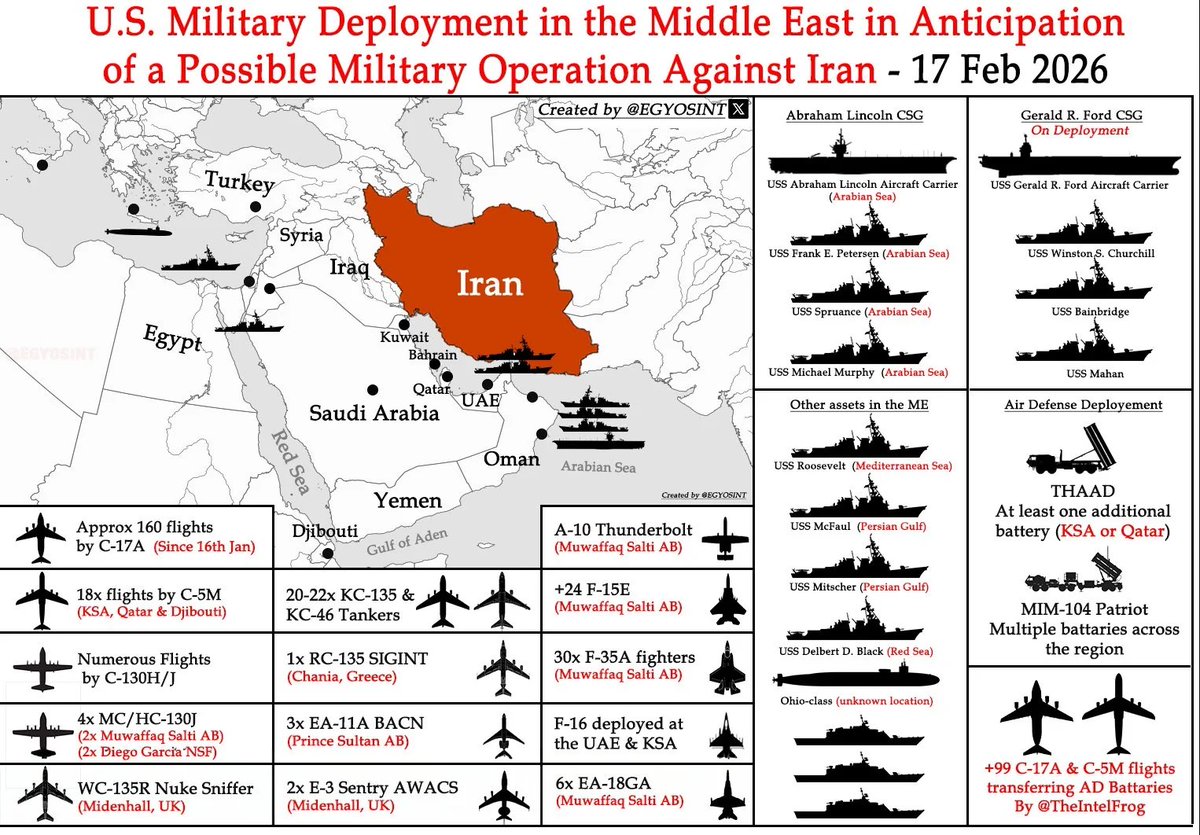
This represents 40-50% of the deployable US air power in the world. Think air power on the order of the 1991 and 2003 Iraq war. And growing. Never has the US deployed this much force against a potential enemy and not launched strikes.
Kardashev II? Bro we’re still buffering in Kardashev 0.7 and arguing on X about WiFi speeds 💀
Elon Musk said ‘orbital data centers’ and half the internet forgot we haven’t even landed humans on the Moon since Apollo 17 😭
A million satellites? 1 terawatt per year? Launches every hour?
This isn’t a roadmap, it’s a sci-fi trailer narrated by venture capital.
Respect the ambition, but let’s maybe get full self-driving to stop phantom braking before we industrialize the Moon.
Six US states now have bills to pause data center construction. New York just introduced a three-year moratorium. Florida's governor is publicly opposing them. Bernie Sanders wants a national freeze. The same AI infrastructure buildout that's driving $500B+ in annual capex is hitting a political wall at the local level. Energy costs, grid strain, and community pushback are real constraints. The companies that figure out efficient cooling, smaller footprints, and community benefit-sharing will have a massive edge. https://t.co/YImRhjQXvs
January ends with a bang on @CaliforniaISO
15th 100% Wind-Water-Solar day of the year, and for over 5 hours. Batteries supplied power for over 10 hours during the night
Gas down 58% in 2 y
Gas replaced by WWS/batteries/imports. Imports ~58% WWS. The gas they replace is 0% WWS