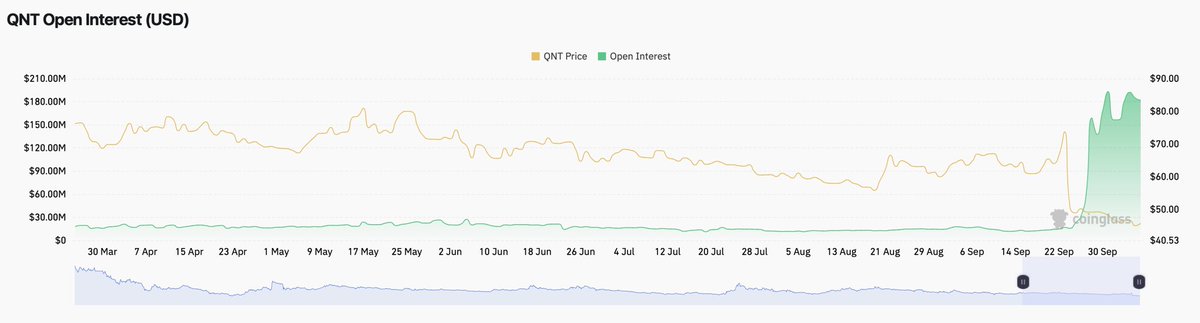
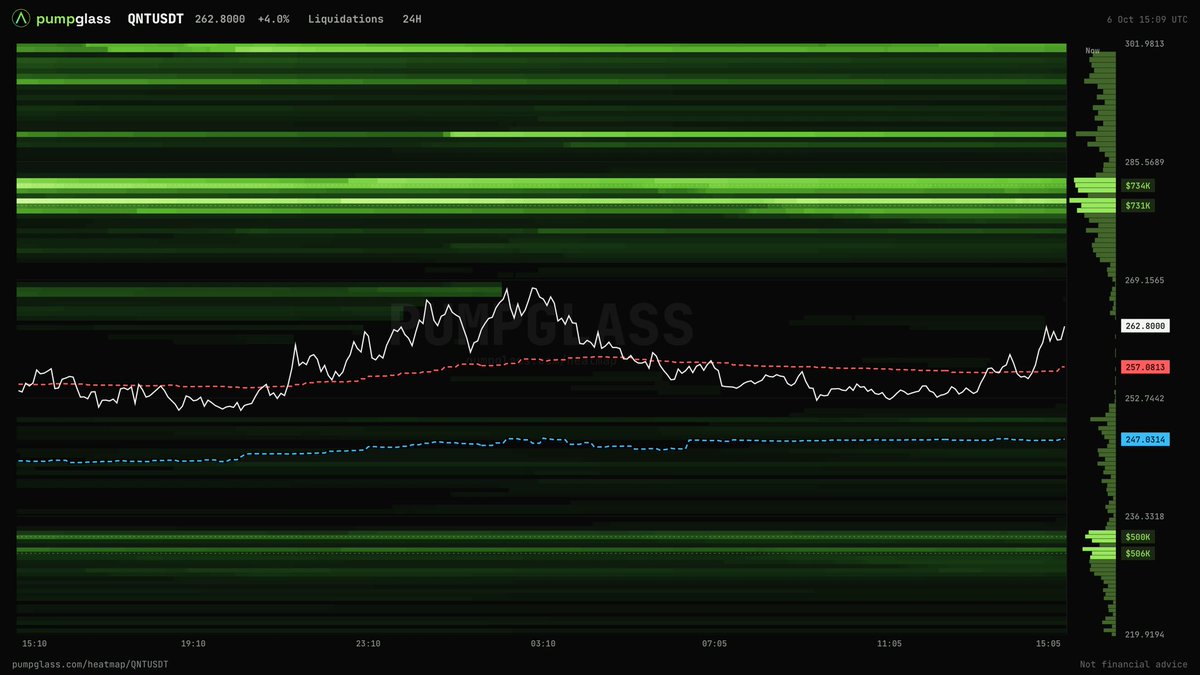
$QNT is setting up for something violent. 👀
Funding is EXTREMELY negative.
Shorts are crowded.
And QNT is still holding.
The levels that matter:
→ $280 = first trigger → $290 = major short liquidation zone → $300 = things get interesting → $325+ = 🚀
If QNT breaks $280 while funding stays deeply negative and OI starts climbing…
We could see a classic short-squeeze cascade:
$280 → $290 → $300 → $325+
Shorts are the fuel.
Price just needs the match.
Keep an eye on $QNT.
If this is the bottom for ethereum:0x4a220e6096b25eadb88358cb44068a3248254675, we should see a sharp rebound from here.
We could be back above $300 as early as tomorrow or the day after.
Bitcoin’s 4-year cycle was always about demand meeting a shrinking supply in a smaller market.
That balance has shifted, so price responds more to demand and liquidity than to the halving itself. That’s maturity, not a broken protocol.
Last cycle frustrated a lot of people because the multiples compressed and a pure supply cut didn’t deliver the gains many expected.
Scarcity only works if demand shows up.
Steady accumulation has usually mattered more than trying to time every cycle or chasing whatever label we invent next, supercycle, 4-year cycle, or whatever comes after.
"SUPERCYCLE" is just another way to say BTC breaks out of 4 yr cycles and follows global macro markets.
No asset in history has followed a programmatic clock except BTC.
BTC's supply shock is now TOO SMALL to make a difference.
→ BTC follows global macro here on in.
Most people get frustrated when the price pulls back.
Then they get even more frustrated when it starts running and they missed it.
Go look at $ZEC for example and how many people got frustrated when it just kept going up.
This has happened over and over. $QNT will do the same.
The goal isn’t to catch every move.
It’s to own something you’re actually comfortable holding without checking the chart every 10 minutes.
If you checked my previous comments, you'd see that I already mentioned keeping a “schmuck insurance” position rather than selling everything.
At the end of the day, this isn't about arguing whether QNT can reach $50K, $60K, or $70K. We all know the fundamentals and the long-term potential of QNT.
It's about managing risk, taking profits strategically, and understanding what you want to achieve in this cycle and the next. Everyone has different goals, timelines, and strategies. There's no one-size-fits-all approach to investing.
Want to outperform 99% of people this bull run?
Stop chasing 10x–100x.
Find projects where a 2–3x looks relatively easy. Take your profits. Move on to the next opportunity.
Do that just TWICE.
2x + 2x = 4x.
3x + 3x = 9x.
Even if a project has 10x potential, I DON’T CARE. We’re here to make money, not catch the exact top.
My first pick? ethereum:0x4a220e6096b25eadb88358cb44068a3248254675
One of the clearest 2–3x setups on my radar.
Keep it simple. Don’t get greedy. Actually walk away with profits this cycle.
NFA.
I completely understand where you're coming from, especially after taking losses in the market. It can make every decision feel much harder than it actually is.
But here's something I think is really important if a move from $245 to $240 makes you uncomfortable, it might simply mean you're putting more money at risk than you're comfortable with.
Regarding QNT, it has serious institutional partnerships that strengthen my conviction in the project. Of course, there's a scenario where Quant succeeds as a company while the token underperforms. I personally consider that a bearish scenario for QNT, given the token's role in its ecosystem, but it's still a possibility.
At around a $3B market cap, I genuinely don't see why QNT couldn't surpass $10B in a proper bull run. And if we don't get a bull run, most altcoins will struggle anyway. I personally believe QNT's fundamentals give it a stronger long-term thesis than many others.
As for ETFs, remember that an ETF is simply an investment vehicle. We have DOGE ETFs and even a PEPE ETF filing. Does that automatically make PEPE fundamentally more important than QNT? Not really.
But here's what I think matters most: you've already figured out that you want to invest rather than trade, and that's a good starting point.
Investing is a waiting game. Think about real estate. People buy properties and hold them for years, knowing that selling the next day would probably mean losing money on fees, commissions, etc.
So why don't we apply the same patience to crypto?
I think the early days of crypto created this misconception that if a token doesn't pump within a month, it's somehow a bad investment. And that's exactly what gets so many people stuck chasing one pump after another.
Of course, patience doesn't mean blindly holding something forever. If the fundamentals change, your thesis should change too.
And one last thing, Before putting your money into any investment, ask yourself whether it's going to make your life more comfortable or stress the shit out of you.
Because at the end of the day, investing is supposed to improve your life, not take away your peace of mind.
There's always another opportunity in this market. You don't have to catch every move.
Stay safe, brother. 🙏
Short term, I’m looking at somewhere between $600–$730 and we might see a bigger correction after reaching those levels.
But QNT is one of those plays where you need some schmuck insurance, meaning you don’t sell your entire bag too early.
I genuinely see QNT going past $1K sooner or later this cycle, and I’d rather keep some exposure than watch it happen from the sidelines.
True, but what most people miss is that when a token with strong fundamentals does a 3x or 5x, they assume the move is over, when in reality, it might just be the beginning.
Look at ZEC. How many people tried shorting it at $200, $300, $700+?
Not comparing the two, but sometimes it’s easier for a fundamentally strong token to go from $300 to $700 than from $70 to $120.
It might take time. It might get boring. But I’d rather sit through the boring part of a high-conviction play than constantly chase the next pump across hundreds of tokens with weaker fundamentals.
ethereum:0x4a220e6096b25eadb88358cb44068a3248254675 has a ridiculously asymmetric risk/reward setup right now.
So far, price action has been playing out largely in line with the previous analysis.
During the liquidation flush, price briefly dipped below the downside targets, but the daily candle still managed to close back above $230.
Open interest is rebuilding, funding has turned negative again across Binance, Bybit and Gate, and the majority of visible liquidation liquidity appears to be sitting above the current price.
As of now, the potential upside looks significantly greater than the downside risk to me.
If spot demand keeps accelerating while OI continues building, things could get very interesting.
And that's without even factoring in all the fundamental developments happening behind the scenes!
The more boring $QNT gets, the more interesting it becomes to me.
ethereum:0x4a220e6096b25eadb88358cb44068a3248254675 update
QNT repeatedly failed to break through the $270–280 resistance area, then lost $250.
We could trade even lower before the next major move.
$230–232 is now the main area I'm watching.
Here’s why:
→ OI remains historically elevated at ~$180M+
→ Binance funding is negative again at -0.0378%
→ Futures volume has dropped significantly during the pullback
→ Spot flows remain negative, around -$7M net over 3 days
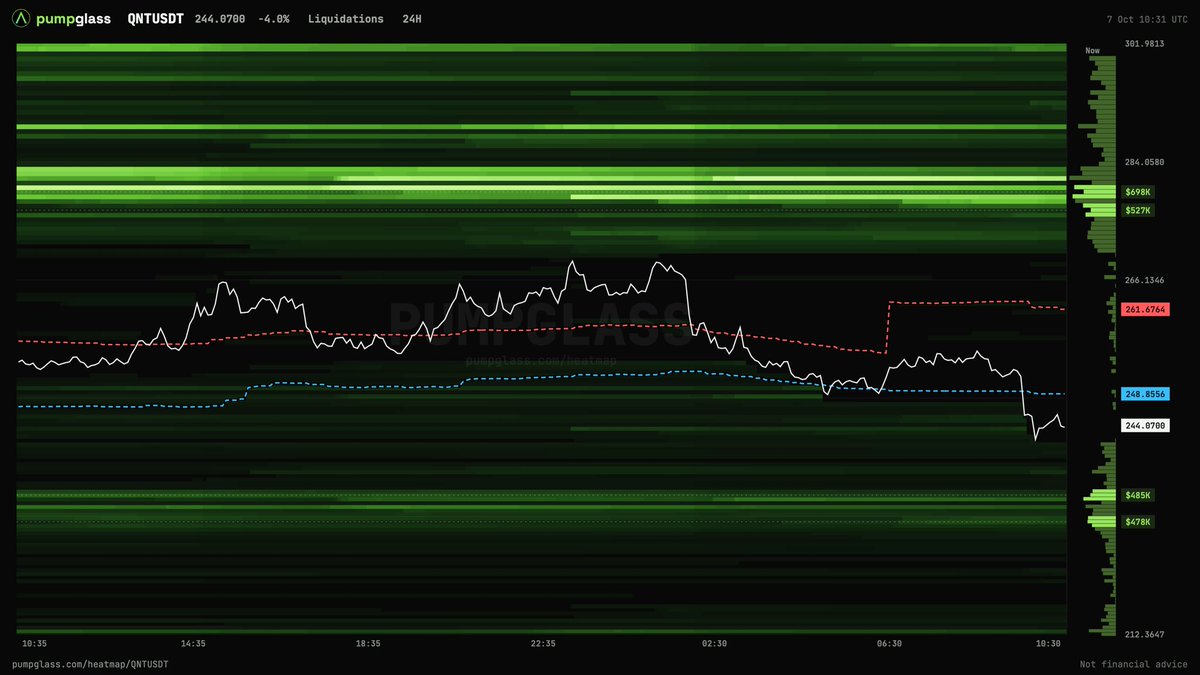
→ There’s a significant long liquidation cluster around $230
That last one is interesting.
$230-232 is an important technical level on my chart, and now we have a liquidation cluster sitting almost exactly in the same area.
That makes a sweep of $230–232 very possible IMO.
What happens AFTER the sweep matters more than the sweep itself.
$231–232 gets swept → OI flushes → selling gets absorbed → spot flows improve → $240 gets reclaimed
If I see that while funding remains negative, I'd start getting interested in the long side again.
And it doesn't necessarily need a short squeeze. A leverage reset followed by genuine spot buying would be a healthy setup.
On the other hand, if $231–232 breaks and QNT starts accepting below $230 while spot selling continues, I'd expect further downside before a proper bottom forms.
And there's another interesting piece:
There is significant short liquidation liquidity around $278–282.
So if QNT eventually reclaims $250, then $260–262, that upper liquidity becomes very interesting again.
For now I'm not trying to call the exact bottom.
We failed $270–280, lost $250, and $231–232 is the next decision zone I'm watching.
Charts below 👇
Want a bullish scenario for $QNT that I don’t think enough people are connecting the dots on?
Look at @quantnetwork partnerships with Murex and The Clearing House.
Murex is integrating Quant into MX.3, a platform used by some of the world’s largest banks to manage trading, risk and settlement.
@TCHtweets has selected Quant to provide interoperability and transaction orchestration for its new US tokenized deposit network.
Now here’s where it gets interesting.
Murex and Quant have already published a technical model for settling tokenized bonds by coordinating the asset and cash legs of a transaction.
Meanwhile, The Clearing House is building infrastructure to move tokenized bank money between financial institutions.
Now imagine these two worlds connecting.
A bank executes a tokenized bond trade through Murex.
Quant orchestrates settlement.
The cash leg potentially moves through an interoperable banking network like the one The Clearing House is building.
Quant connecting what happens INSIDE banks with how money moves BETWEEN banks.
And as more institutions connect, the opportunity for network effects grows.
To be clear, a direct Murex–TCH integration hasn’t been announced. But the underlying partnerships and settlement use cases are real.
Most people are looking at two separate partnerships.
I’m looking at the possibility of Quant becoming a critical interoperability layer across the financial system.
That’s the bigger $QNT picture.
I think we’re entering the most important phase of the $QNT story.
For years, the bull case was about partnerships, pilots and proving that institutions were actually interested in what @quantnetwork was building.
That part is starting to change.
Quant isn’t just talking about institutional adoption anymore.
UK banks have now completed live customer transactions using tokenised sterling deposits on infrastructure built by Quant.
Fusion is live.
And The Clearing House has selected Quant to power the interoperability and transaction layer for its OnChain Money Initiative in the US, expected to open to participating institutions in H1 2027.
So for me, the next phase isn’t about how many more partnerships Quant can announce.
It’s about scale.
More transactions.
More value moving through the infrastructure.
More institutions going from pilots → production.
More network activity.
More Trusted Nodes.
And ultimately, more $QNT being economically required and locked to secure the network.
That’s where this gets really interesting.
Because partnerships validate the technology.
Usage validates the network.
And if growing institutional usage eventually translates into growing QNT staking/lock-up against a very limited supply, then the investment thesis becomes very different.
We’re starting to move from:
“Who is Quant working with?”
to:
“How much financial activity is Quant actually powering?”
That’s the metric I’ll be watching over the next 12–24 months.
The infrastructure has been built.
The first real transactions have happened.
Now we see how big it can become!
@Goingbr0ke Wow! He forgot to copy my username too .. glad he liked my post that much 😂 Would’ve sent him the draft next time.
@Goingbr0ke thanks for sharing 🙏
ethereum:0x4a220e6096b25eadb88358cb44068a3248254675 update
QNT repeatedly failed to break through the $270–280 resistance area, then lost $250.
We could trade even lower before the next major move.
$230–232 is now the main area I'm watching.
Here’s why:
→ OI remains historically elevated at ~$180M+
→ Binance funding is negative again at -0.0378%
→ Futures volume has dropped significantly during the pullback
→ Spot flows remain negative, around -$7M net over 3 days
→ There’s a significant long liquidation cluster around $230
That last one is interesting.
$230-232 is an important technical level on my chart, and now we have a liquidation cluster sitting almost exactly in the same area.
That makes a sweep of $230–232 very possible IMO.
What happens AFTER the sweep matters more than the sweep itself.
$231–232 gets swept → OI flushes → selling gets absorbed → spot flows improve → $240 gets reclaimed
If I see that while funding remains negative, I'd start getting interested in the long side again.
And it doesn't necessarily need a short squeeze. A leverage reset followed by genuine spot buying would be a healthy setup.
On the other hand, if $231–232 breaks and QNT starts accepting below $230 while spot selling continues, I'd expect further downside before a proper bottom forms.
And there's another interesting piece:
There is significant short liquidation liquidity around $278–282.
So if QNT eventually reclaims $250, then $260–262, that upper liquidity becomes very interesting again.
For now I'm not trying to call the exact bottom.
We failed $270–280, lost $250, and $231–232 is the next decision zone I'm watching.
Charts below 👇
$QNT is setting up for something violent. 👀
Funding is EXTREMELY negative.
Shorts are crowded.
And QNT is still holding.
The levels that matter:
→ $280 = first trigger → $290 = major short liquidation zone → $300 = things get interesting → $325+ = 🚀
If QNT breaks $280 while funding stays deeply negative and OI starts climbing…
We could see a classic short-squeeze cascade:
$280 → $290 → $300 → $325+
Shorts are the fuel.
Price just needs the match.
Keep an eye on $QNT.
JUST IN: 🏦 BoE chief economist Huw Pill reportedly signals preference for holding bank rate at 4%, citing persistent inflation risks. No cut on his radar just yet.
JUST IN: 🇮🇳 India's former RBI chief is reportedly questioning whether the country's headline growth figures are overstated. The government is defending its official stats. When the ex-central banker raises the alarm, it's worth listening.
JUST IN: 🔒 Coldcard hack attacker begins laundering stolen BTC via THORChain, converting to ETH. Roughly 10% of funds swapped so far. Clock is ticking.