Just hit 11k followers, so figured it’s high time I introduce myself again🕵️
I’m Mercure. That’s not my real name. I’m a Copywriter. I spent 5 years working in-house at one of the largest direct response companies in Europe, before moving on to focus on my own freelancing career.
My account is anonymous and will likely stay that way. Because who I actually am doesn't really matter.
What matters is the Big idea behind all of this.
See, I share what I know about Copywriting, but probably not in a way you’ve seen before.
Most people associate Copywriting will loud, catchy, headlines.
And while that's a popular expression of Copy, I’m more interested in what’s underneath.
The psychology, the philosophy, the linguistics.
See, I have written a lot of Copy in regulated markets. Markets where you can't just show up shouting big claims.
To still write winners, I had to find new ways of writing claim-less Copy.
That's where I found storytelling, world building, and how to install ideas in your readers without ever saying them.
I call this Quiet Persuasion.
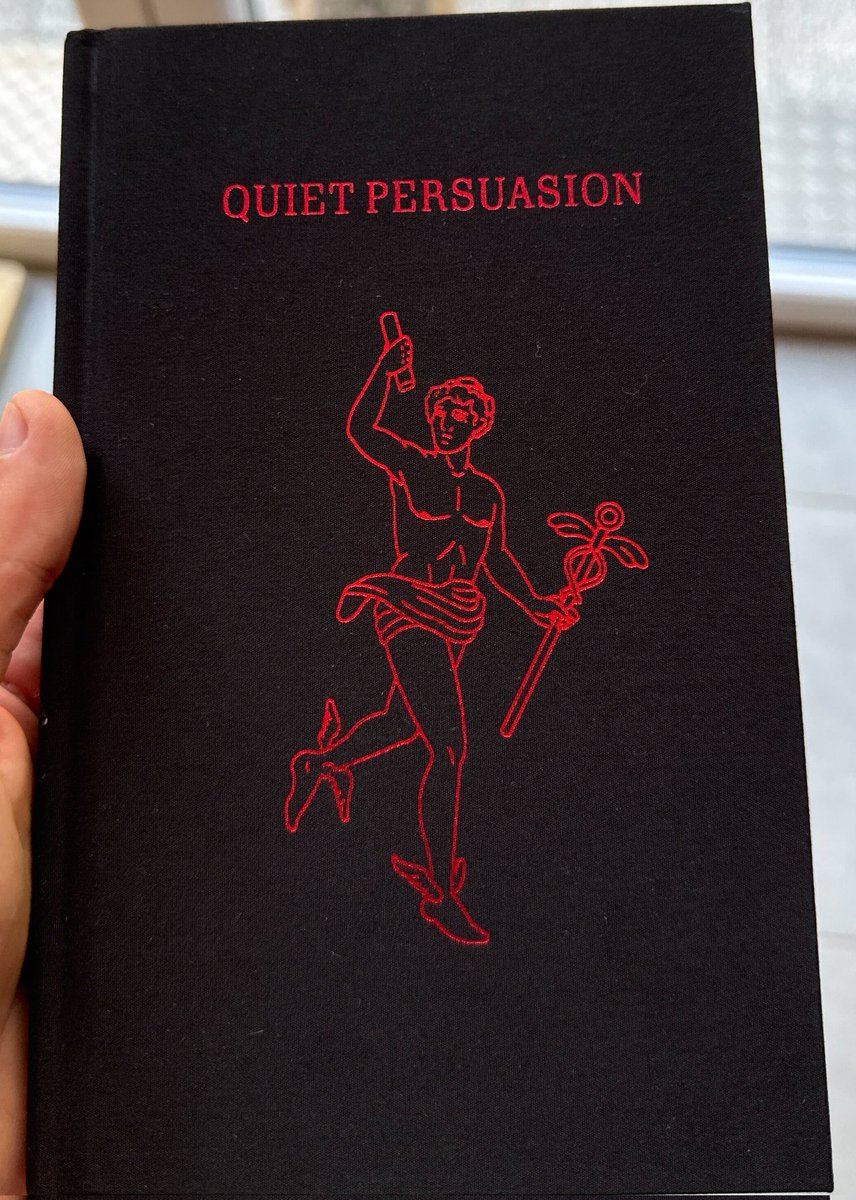
And I've written a book about it, which has already been qualified as a marketing classic by its readers.
Now the Quiet approach isn’t for everyone. It usually takes more work. It requires more research, to know your audience better than they know themselves.
If you can't outclaim your competition, you've got to out-think them.
You have to be patient when the internet rewards immediate impact.
But here’s what it gives you.
You learn to see what most people overlook. You understand human psychology at a level that influences your whole life.
It’s a master key that opens doors you didn’t know existed.
And if you're curious about what Quiet Copy looks like...
...I built my entire funnel as an immersive detective investigation, where the goal is to find ME.
I disappeared, and I've left behind me scattered pages of the manuscript of Quiet Persuasion, that might lead you to me.
If you’re curious, start here:
https://t.co/VO96ArTh9U
See you around.
Merc
The moment someone feels you're trying to change their mind, they put their guard up.
But show them something that helps them understand their own situation better…
And they'll do the work for you.
AI has changed what clients expect from a Copywriter.
The turnaround time they used to give you in a month is now a week…
And if you want to stay relevant, you have to adapt to this new pace, whether you like it or not.
That means “writing better” doesn’t cut it.
What matters now is quality at speed. Producing good Copy today, then again tomorrow, and the day after, and doing it all again next week… without the wheels coming off.
And beyond that skill is something most people never think about…
Something you could call “word stamina.”
The ability to read, write, and edit a metric shit ton of words for hours every day without your brain turning to mush.
Most people can’t do this for very long before the words start blurring together and they stop understanding what’s on the page.
The Copywriters who can sit with words all day and still understand the small nuances are the ones who pull ahead of everyone else.
This is why people who already read a lot tend to do well in this line of work. They’ve built up the stamina for it without knowing it. They can focus on a long piece of Copy from beginning to end without losing their edge.
On the other hand, the ones who can’t sit with words for that long find this career physically tiring, even when they love the craft.
It’s also why Copywriters who start their careers in-house at direct response companies usually get good faster than freelancers.
In-house, you’re shipping multiple pieces a week. You’re reading other writers’ drafts. You’re being told to redo things and ship again that same day.
The volume literally gets forced down your throat.
This is different from freelancing, where you’re alone at home and the pace is whatever you decide it is.
A lot of juniors look for a way around all this… and while you can speed the reps up a bit, you can’t skip them.
“Word stamina” is something you build by doing the reps.
And the order of focus matters too.
When you start out, quality is the only goal. You have to know what good looks like first, and you can be slow getting there.
But as soon as you can hit quality reliably, you must reach for the next goal: quality at speed.
Quality you can produce again later today, and the next day, and the day after that, without losing your edge.
Now the question is, how do you actually build this kind of stamina?
Start training it like a muscle. At the end of a long day, when you’re tired and just want to leave your desk, just bang out another ad, or review another piece of Copy.
Like in the gym, start pushing yourself a little harder each week than you did the week before.
A few more pages, a few more hours, a little less time staring at the wall between tasks.
Not a huge jump. Just slightly more than you’re comfortable with.
Like in the gym, the gains are slow. You don’t feel the difference between week one and week two.
But three months in, you’ll notice you can read three sales pages in a row without going numb, when you used to fade after one.
Stick with it long enough and you’ll wonder how you ever found this work tiring in the first place.
AI has changed what clients expect from a Copywriter.
The turnaround time they used to give you in a month is now a week…
And if you want to stay relevant, you have to adapt to this new pace, whether you like it or not.
That means “writing better” doesn’t cut it.
What matters now is quality at speed. Producing good Copy today, then again tomorrow, and the day after, and doing it all again next week… without the wheels coming off.
And beyond that skill is something most people never think about…
Something you could call “word stamina.”
The ability to read, write, and edit a metric shit ton of words for hours every day without your brain turning to mush.
Most people can’t do this for very long before the words start blurring together and they stop understanding what’s on the page.
The Copywriters who can sit with words all day and still understand the small nuances are the ones who pull ahead of everyone else.
This is why people who already read a lot tend to do well in this line of work. They’ve built up the stamina for it without knowing it. They can focus on a long piece of Copy from beginning to end without losing their edge.
On the other hand, the ones who can’t sit with words for that long find this career physically tiring, even when they love the craft.
It’s also why Copywriters who start their careers in-house at direct response companies usually get good faster than freelancers.
In-house, you’re shipping multiple pieces a week. You’re reading other writers’ drafts. You’re being told to redo things and ship again that same day.
The volume literally gets forced down your throat.
This is different from freelancing, where you’re alone at home and the pace is whatever you decide it is.
A lot of juniors look for a way around all this… and while you can speed the reps up a bit, you can’t skip them.
“Word stamina” is something you build by doing the reps.
And the order of focus matters too.
When you start out, quality is the only goal. You have to know what good looks like first, and you can be slow getting there.
But as soon as you can hit quality reliably, you must reach for the next goal: quality at speed.
Quality you can produce again later today, and the next day, and the day after that, without losing your edge.
Now the question is, how do you actually build this kind of stamina?
Start training it like a muscle. At the end of a long day, when you’re tired and just want to leave your desk, just bang out another ad, or review another piece of Copy.
Like in the gym, start pushing yourself a little harder each week than you did the week before.
A few more pages, a few more hours, a little less time staring at the wall between tasks.
Not a huge jump. Just slightly more than you’re comfortable with.
Like in the gym, the gains are slow. You don’t feel the difference between week one and week two.
But three months in, you’ll notice you can read three sales pages in a row without going numb, when you used to fade after one.
Stick with it long enough and you’ll wonder how you ever found this work tiring in the first place.
One of the highest ROI skills in Copywriting is not writing.
It’s noticing.
> Noticing what gets clicks and what gets sales
> Noticing which ads keep running for months
> Noticing how your buyer talks about your competitors
> Noticing the time of day your buyer feels the problem most
> Noticing the feedback you keep getting and keep brushing off
> Noticing the headline you wrote to impress other Copywriters
> Noticing the context your buyer is in when he reads your Copy
> Noticing the exact words a buyer keeps repeating on a sales call
> Noticing who your buyer secretly wants to impress by buying this
> Noticing when a customer does the opposite of what he said he’d do
> Noticing what your buyer tried before yours and why they dropped it
> Noticing what your buyer believes about himself that is not quite true
> Noticing the embarrassment your buyer would never admit to a friend
> Noticing the part of the offer your buyer never asks about on sales calls
> Noticing the question the buyer is asking himself as he reads your page
> Noticing the line in your draft you wouldn’t say out loud to a real person
> Noticing what your buyer is using right now to solve their problem badly
> Noticing the question your page leaves hanging right before the buy button
> Noticing the one line your client keeps repeating when he describes his offer
> Noticing the brands in your niche that stopped doing something six months ago
> Noticing what your buyer has already heard a hundred times from your competitors
> Noticing the one feature the founder is excited about, and the team takes for granted
> Noticing the words your buyer uses for the problem before anyone offered him a solution
> Noticing the new player in your category your client hasn’t started paying attention to yet
> Noticing the bundled feature the buyer never mentions when he describes what he bought
> Noticing what your product does differently, even when the marketing makes it sound the same
> Noticing the product feature you only hear about from happy customers, never from the marketing page
> Noticing when your client says something about his business that the numbers tell a different story about
> Noticing the small scene a customer describes in a testimonial, the moment that gives away what really changed
Writers who notice well, write well.
Writers who don’t, can’t.
Trying to convince a buyer is one of the most exhausting things you can do as a Copywriter.
But the good thing is, you don’t even have to, most of the time.
Before we get to that, though, let me explain why “convincing” is the wrong approach.
When you’re trying to convince someone, you’re pushing against a prospect who’s already a little suspicious. So you have to prove the problem is real. You have to prove your product solves it. You have to prove you’re the right person to trust. Prove it worked for other people, prove the price is fair, prove there’s no catch, prove, prove, prove…
The whole time, you’re talking against the prospect instead of with them.
And that’s why it’s so exhausting: it’s uphill work.
There’s another way to write Copy, and it goes downhill the whole way instead.
Instead of pushing the prospect, you walk beside them. You take time to lay out where they’re standing, the choices in front of them, and what each one gives them, including the choice of doing nothing at all.
You let the prospect see their own situation clearly, maybe for the first time, and you don’t rush them through it.
So by the time your product shows up, the prospect has already done the thinking themselves.
Picking it doesn’t feel like being sold to. It feels like the only choice that makes sense.
And the strange thing is, the writing gets quieter when you do this, not louder.
Because there’s no need for hype, since the situation is doing the work. There’s no need to overpromise, because you’re not asking them to believe anything blindly.
The page feels almost calm, and yet it closes more often than the loud version.
This is most of what the best Copywriters are doing, even if they couldn’t put it in these words.
They’re not winning arguments. They’re staging the room so the right answer is on the table when the prospect walks in.
The prospect feels like they figured it out themselves. And the writer barely had to push.
If you want to discover how you can write this way on purpose, you’ll love my book Quiet Persuasion.
It’s built around this idea, how to take away the resistance that makes selling feel like a fight, how to lay out a prospect’s situation so your answer naturally becomes the obvious one, and how to write Copy that moves people without resorting to shouting.
If you sell anything online or offline, and you’re tired of the loud, exhausting version of this craft, this is the book I’d hand you. Hundreds of Copywriters, sales people, consultants, and business owners have already read it.
Check it out below.
Behind every “your price is too high” is a buyer who hasn’t felt the cost of doing nothing.
Show them what staying the same costs them and the price feels small.
Yes, people fear losing money on a bad purchase.
But what they’re really afraid of is what it’ll say about them if buying something turns out to be a mistake.
Listen to how anyone talks about a purchase they regret.
They might say “I lost $200.”
But the part that really hurts is when they say “I can’t believe I fell for that.”
That’s when they feel ashamed for being the kind of person who gets fooled.
And that worry is something your Copy needs to handle without naming it.
You just need to write in a way that makes your buyer feel like the kind of person who makes good calls.
Once they feel that, the money question takes care of itself.
There’s a simple way to make your price feel smaller without lowering it, and it comes down to what number your reader sees right before yours.
Put a bigger, believable number in their head first, and your price starts looking like a deal, even though you never touched it.
The keyword here is “believable,” and it’s where lazy marketers ruin a perfectly good technique.
They write things like “normally $1,999, today only $29” without ever explaining where that $1,999 came from.
We’ve all been burned by enough fake value stacks to spot one in a second, and when the bigger number is not justified, every other number on the page goes with it.
So what separates a good anchor from a bad one is whether the bigger number has a reason for being that big.
Your reader doesn’t actually have to verify it. They just need to see that they could, if they wanted to.
Let me illustrate. Let’s say you’re selling a supplement.
Before you show the price, you walk them through what each ingredient would cost on its own, bottle by bottle, until the running total comes out way higher than your product.
And it’s not just the cost of buying the ingredients separately.
You walk them through how long it would take to gather them. How much energy it would take.
And you translate that into an amount of money that makes sense, something they can picture.
They could check this if they ever felt like it, and that alone does the heavy lifting.
By the time they reach your price, the bigger number is already in their head, so yours starts to feel like a bargain.
Now, you’ve probably also seen the tired version of all this, “less than a cup of coffee a day.”
This used to work, but people have read it way too many times.
What still works is a comparison that actually fits your product.
Maybe it’s the cost of doing the thing the conventional way.
Maybe it’s the years of learning your product saves them.
Whatever you pick, it just has to be specific enough that your reader could run the numbers themselves and end up where you did.
That’s the kind of anchor a smart reader respects, and respect is half the reason they end up buying.
Now the anchor is just one small piece of a much bigger question…
How people actually decide what something is worth.
Which is the question Quiet Persuasion is built around.
The book walks you through how buyers judge value at every step, from the first time they read your hook to the moment they reach for their card.
If you write Copy or sell anything online or offline, it’ll open your eyes to all the hidden mechanisms behind every sale.
Check it out below.
Your readers already know what they want.
They just can’t articulate it yet.
Your role is to bring them clarity and position your solution as the natural next step.
Here’s how to write Copy people finish without quite knowing why.
First, be brief. Attention spans online are far shorter than we think, so make sure every word earns its place.
But brevity alone won’t hold your reader, so how do you keep them moving?
Like that, for instance.
That line ended on a question, which pulls you to read on and find out the answer.
And there’s a powerful reason it works.
It’s psychology.
And it’s the same thing that made you read on from that line too.
One of the most common problems I see on the sales pages I'm chiefing is that there’s no thread running through it.
You read the page and each paragraph makes sense on its own. But you can’t recall what it was about, because nothing was connecting one section to the next. It was just a bunch of decent paragraphs in a row.
The writer doesn’t see this because they know how the argument fits together. But the reader doesn’t have that context. And instead of connecting things together on their own, they’ll just leave the page.
This is always a thinking problem, never a writing problem.
It means the writer started typing before they figured out the one argument the page was supposed to make. So instead of one argument building across the page, you get five half-arguments scattered around it.
And the fix is always the same…
Before you write, figure out one sentence that says what your page is about. One thread that every section follows.
If a paragraph doesn’t serve that thread, cut it, no matter how much you like it.
Then sequence it so each section sets up what comes after it, so that your reader never wonders why they’re still reading.
At least half of what people want, they want because someone else has it.
Nobody’s aware of this. That’s what makes it so powerful. You don’t sit down and think “I want this because my colleague has something better” when what you have already works fine.
One day you somehow want better than “fine,” and if someone asked you why, you’d come up with a perfectly rational explanation that has nothing to do with the actual reason.
And it’s not just purchases.
People do this with their careers, their income, their bodies, their relationships. We’re always measuring ourselves against the people around us without realizing it, and those invisible measurements end up influencing what we want and how bad we want it.
So when someone is on your sales page, they’re not just weighing up whether the product is worth the money.
Somewhere in the back of their mind they’re also thinking about a competitor who seems to be growing faster, or a peer who started the same time they did and is somehow two steps ahead already.
But they’d never describe it that way.
If you asked them why they’re interested, they'd say something rational. But if you pushed on why now, why today, there’s almost always someone else in the picture. Someone they don’t want to fall further behind.
That doesn’t mean you should write “buy this so you’re not behind your friends” on a sales page.
But you can describe a result that puts the comparison in their head without naming it, like “while your competitors are still A/B testing, you’ll know exactly what works.”
People never make buying decisions alone, even when they’re alone. There’s always someone else in their head, whether it’s a rival, or a peer.
And your Copy doesn’t have to mention them. It just has to make your reader think of them.
Most Copywriting education tells what to do.
I built an investigation-based funnel that shows you how influence actually feels.
Join to receive my newsletter, a free extract from my book Quiet Persuasion extract, and the ability to purchase my programs: https://t.co/2SXnzcUcay
If I could teach you one thing to improve your Copy, it would be this.
Every product has a benefit your buyer wants but would never say out loud. And finding that benefit is half the job of writing good Copy.
Take astrology, numerology, or even tarot cards.
On the surface you’re selling a reading.
One layer down, you’re selling esoteric knowledge that feels like a shortcut to understanding yourself and the world around you.
But the real thing you’re selling…
The thing that buyers would never admit to publicly…
Which is the exact thing that actually gets the credit card out…
…is the feeling of having a secret advantage over everybody else.
People who buy an esoteric reading don't care whether it’s planets or numbers or tarot cards doing the work.
They care about the result: feeling like they know things other people don’t.
And this is true for almost everything.
There’s the surface benefit, which is what you put on the page.
There’s the real benefit underneath it, which is what the buyer actually wants.
And then there’s the deeper thing under that, the one that would feel awkward admitting even to a friend.
And that’s the one doing the heavy lifting.
Most Copywriters stop at the second layer. “You're not selling a drill, you’re selling the hole.” Sure, this is correct.
But why does your buyer want the hole? What happens in their life when the shelf is up?
Sure, they can put things on the shelf.
But maybe, just maybe, their wife finally stops nagging them for not getting the simple stuff done around the house.
Now THAT is the embarrassing layer. The one that actually motivates them.
Your Copy doesn’t have to name this out loud. In fact it probably shouldn’t.
But it should be written by someone who knows this is exactly what the buyer wants.
And once you know what that layer is for your product, you’ll write a very different page than someone who doesn’t.
@TalhaAKhawaja Thorough study of the niche, its psychology, what's working right now. Then draw parallels and hypothesis, then test them to see what sticks. It's not a quick process.