The whole American stock market has been under attack by the same international banks and hedge funds. GameStop is one of the best case studies to understand that crime and identify those criminals!🇺🇸
🚨The GameStop Crime Scene!🚨
Why does this persistent market manipulation against GameStop matter?
Exchange Act §9(a)(2): You can't make a series of trades that create real or apparent trading activity, or push the price up or down, to get other people to buy or sell. Dumping shares just to knock the price down falls here.
If a hedge fund or market maker were lending out the same shares to multiple people, or purposely failing to deliver a GME share so that they can create sell pressure without having to actually settle the trade, that is clearly illegal.
Exchange Act §9(a)(1): This bans wash trades (trading with yourself) and matched orders that make a stock look more actively traded than it is.
It is clear at this point that the seemingly different entities involved with shorting and distorting GameStop are coordinating, which makes them really just one entity and so the shuffling around of obligations is just wash trading.
Exchange Act §10(b) and SEC Rule 10b-5: These ban fraud schemes, false statements, and misleading omissions connected to buying or selling securities. That covers "short and distort," where someone shorts a stock and then spreads false rumors or a misleading report to drive it down. It also covers a short report that hides the author plans to cover right after publishing.
How many news agencies were part of the coordinated effort to make GameStop look bad? How many of them said the GameStop eBay deal was impossible when really it was just a straightforward offer backed by one of the largest banks in the world. What is impossible about that? The only honest thing those news agencies could have said about the deal that was negative was that there are loopholes in the regulatory system that would allow corrupt eBay executives the ability to make the deal very difficult which could make it take a long time to go through.
Look at the short interest of XRT which is being used for borrow locates to short GameStop. It has been over 400% for years. And somehow regulators never even looked into it? Looking at the chart you can see where they are shuffling the obligations to and what that does to the GME share price.
There are a lot of laws being broken by short sellers:
-Spoofing and layering: This means placing big sell orders you never plan to fill so the price drops, then canceling them. The SEC charges it under 9(a)(2) and 10b-5, and the Commodity Exchange Act makes it a crime in futures markets.
-FINRA Rule 2020: Brokers and other FINRA members can't use manipulative or deceptive devices.
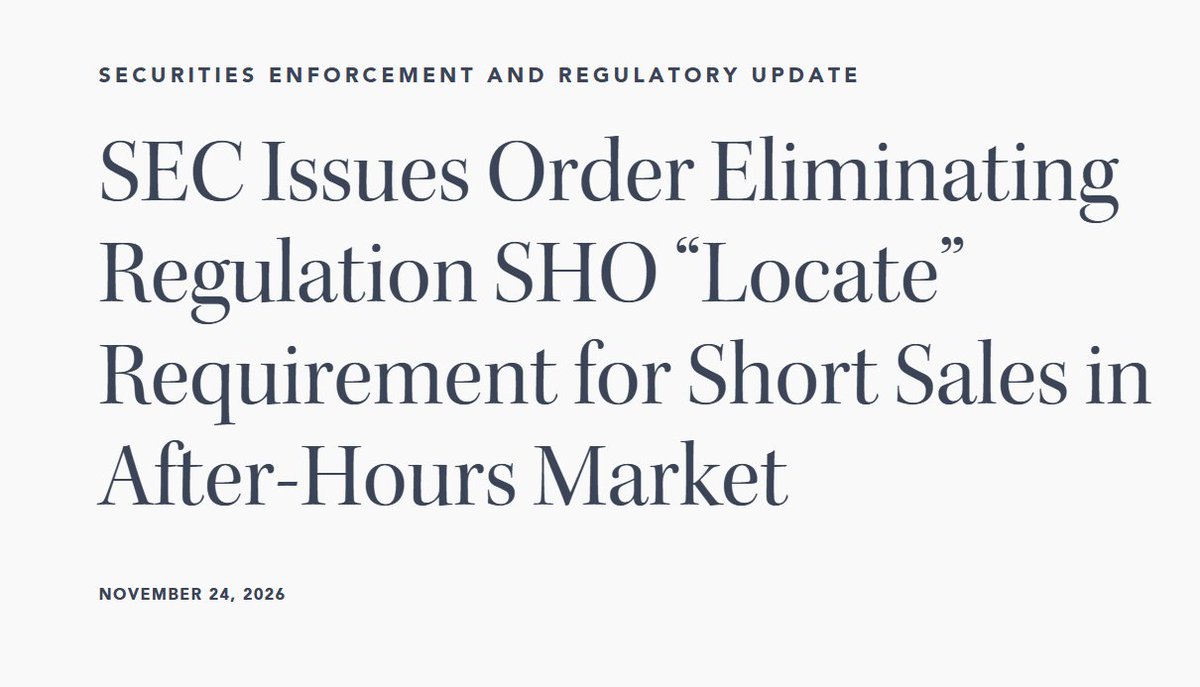
-Regulation SHO, Rule 203(b): Before you short, your broker has to have reasonable grounds to believe the shares can be borrowed. This is called the "locate" requirement.
-Reg SHO Rule 204: When a short sale fails to deliver, brokers have to close it out quickly, generally by the start of trading on the day after settlement (T+1).
-Rule 10b-21: It's fraud to lie about your intent or ability to deliver shares and then fail to deliver. This is the main rule against naked shorting.
-Reg SHO Rule 201: If a stock falls 10% or more in a day, short sales for the rest of that day and all of the next can only be made above the current best bid. This is the short-sale "circuit breaker."
Regulation M, Rule 105: If you short a stock in the restricted period before a secondary offering, usually 5 business days, you can't buy shares in that offering.
The SEC can impose civil fines, make you give up your profits, and bar you from the industry, and investors can sue you. Willful securities fraud can also be charged as a crime, with up to 20 years in prison. And now Hester Peirce is out of the SEC which means that the criminals likely can no longer be shielded.
Is this what was always meant by “No Cell No Sell?” Were we just supposed to buy and hold until the crimes against GameStop were prosecuted? Either way, here we are with the stage set to actually hold the criminals accountable for years of crimes against GameStop and the rest of the stock market.
What are the actionable damages claims GameStop can now make?
When GameStop originally issued the convertible notes back in 2025, they had an initial conversion price of $29.85 per share for the 2030 notes and $28.91 per share for the 2032. Under the original 2025 rules, if the stock had hit $29–$30, noteholders would have simply traded their debt certificates for shares. GameStop had to pay $358.4 million in physical cash out of their treasury to stop the equity dilution from spiraling. The new VWAP deal also cost shareholders an extra 10.1 million shares in dilution.
The other claim is about the GameStop warrants which easily could have raised $1.9 billion for the company, which could be used to add shareholder value.
It is clear there is a Judgement Day coming, the only question is whether it will be through a legal case or through a move to blockchain.
If a lot of money through a lawsuit came to GameStop, the eBay acquisition would be easier and more of that value would go to shareholders. If it is a move to blockchain, like GameStop issuing its own tokenized shares and then buying the shares on the regular stock exchange back, it would force true price discovery and the resulting elevated GME price would require a lot less shares in the stock portion of the eBay acquisition, meaning GameStop shareholders would get more value from the acquisition.
It has been a very long journey with GameStop, but it looks like it will be well worth the wait! LFG!🚀
"Let them short." -Ryan Cohen
Just because you can, doesn't mean you should. Ryan Cohen says he prefers market mechanics to work themselves out.
There is a difference in enforcement between Regsho and the margin requirements that shorting would create:
-The SEC enforces Reg SHO directly against broker-dealers and market participants, while FINRA and national securities exchanges supervise and examine member broker-dealers for compliance with Reg SHO rules.
-Margin rules are split across multiple bodies depending on the type of requirement:
• Federal Reserve Board: Sets initial margin standards under Regulation T (such as the standard 50% initial equity requirement for qualified stock purchases).
• FINRA & Securities Exchanges: Set and enforce ongoing maintenance margin rules (such as FINRA's 25% minimum maintenance requirement for equities, alongside exchange rules like NYSE Rule 431) and examine broker-dealers for margin compliance.
• SEC: Oversees broker-dealer compliance with federal securities laws and SRO rules, including how customer margin accounts and credit extensions affect broker-dealer financial responsibility.
• Broker-Dealers: Enforce account-level margin rules day-to-day—setting "house" requirements that can be stricter than regulatory minimums and issuing margin calls or liquidating positions when equity falls short.
Justice through regsho enforcement would cause immediate complications across the market. Justice through margin requirement means rolling margin calls. I think this was the plan for a while because of all the changes to what qualifies as margin. Junk bonds and crypto was used to massively inflate margin, and now that is excluded. Also, since enforcement is split up between more organizations, it means that there is more insight into who is doing what.
The reason justice has been so hard, especially I image for situations like MMTLP particularly is that the liability is mostly not on the American brokers but on the counterparty, which in the case of the nakedshort selling is mostly done outside of the country. The brokers have had time to figure out what they are going to do with their counterparties, especially after the Next Bridge Hydrocarbon dividend when they actually had to do an audit.
If a U.S. broker fails to enforce mandatory regulatory margin minimums, it violates federal securities law—specifically Section 7(c) of the Securities Exchange Act of 1934 and Federal Reserve Regulation T—as well as FINRA Rule 4210 (and SEC financial responsibility rules).
Because violating Regulation T is a direct violation of Section 7(c) of the Securities Exchange Act of 1934, the SEC can seek federal court injunctions. If the violation is proven to be willful (such as intentionally helping a client evade margin rules), the SEC can refer the case to the Department of Justice for criminal prosecution.
So it looks like the brokers now have a choice:
-Margin call the nakedshort sellers
-Have the Department of Justice get all up in their shit.
There is no honor among thieves, and push has come to shove. The brokers haven't done anything about the short hedge funds outside of the country because they belonged to the CIA and the whole Kathy Ruemmler/ George Soros crowd, but now the CIA's reign is over. They just got hacked, and the Military now has it's special operations unit the OSS, and the CIA can't save those brokers now if those don't margin call those short hedge funds who have been criminally nakedshort selling.
The SEC is giving temporary allowance to the brokers to shift around obligations however they want, but the math will have to math when it's all done at least in the sense of margin, and currently they are all very net short.
Brokers have the choice to be the boot or be under the boot. I think I know which one they will pick.
There has been a lot that had to happen before the real work could even begin.
Swift 2.0, CAT, Blockchain legal clarity, OSS, and most importantly military leverage against the corrupt international bankers using our shares to launder money for the global black market. #BBBYQ #MMTLP #GME #AMC #DJT
"It is in the interest of tyrants to reduce the people to ignorance and vice. For they cannot live in any country where virtue and knowledge prevail." — Samuel Adams