We’ve shipped a major MERID update on Robinhood Chain mainnet
A new AAPL/USDG vault cycle is deployed, the settlement safety path has been upgraded, and the player app now reads from the new contracts
Deployment transaction:
https://t.co/y0GE45FQ5M
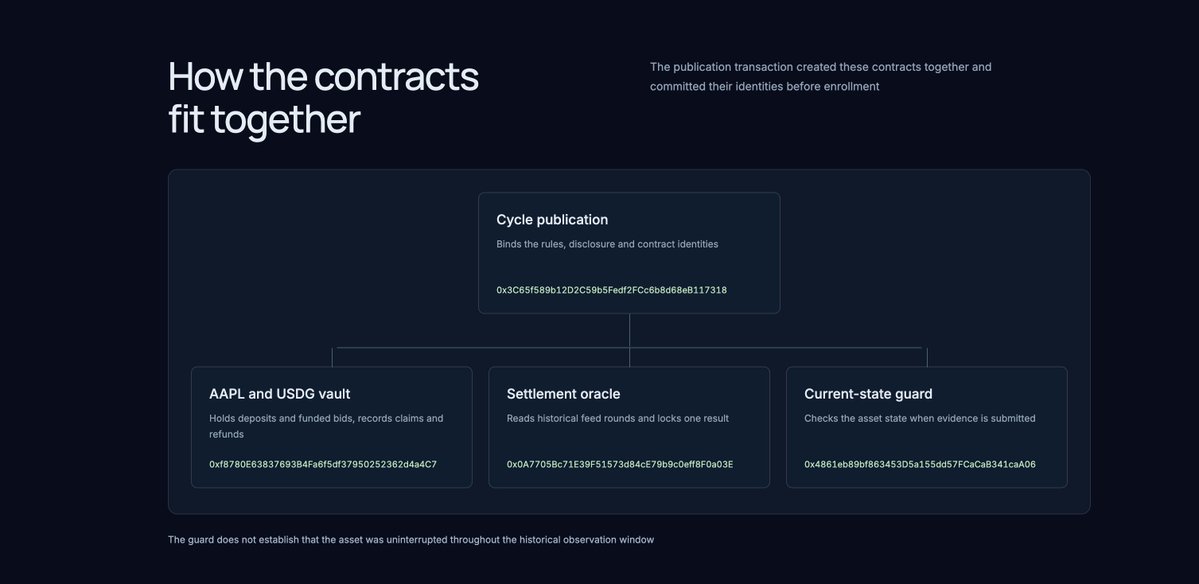
That single transaction created four contracts:
Publication — commits the rules, fixed terms, disclosure and contract identities
https://t.co/bkcq2uv0ZW
AAPL/USDG vault — holds AAPL deposits and funded buyer bids, then records claims and refunds
https://t.co/ghstheuVde
Settlement oracle — validates historical price rounds against the committed feed and expiry rules
https://t.co/cMuV5v6Kwc
History guard — checks a signed evidence root and the token’s current oracle and multiplier state
https://t.co/B59ACBufa3
The new guard uses one named operator and one required signature. That attestation is public, but it is not independent proof of every historical asset or chain event
If no valid price result is locked by the fixed deadline, the contract provides an exit path for depositors’ original AAPL claims and the winning buyer’s USDG refund
The player app has changed too: the vault now comes first, live balances and funded bids are read onchain, and deposit, bid and claim controls appear only when the contract phase allows them
Explore the updated app:
https://t.co/XpKc1B8DNR
Inspect the deployment and onchain state:
https://t.co/EciYUmp1gz
Download the source package:
https://t.co/EGYFsVCl5O
We’ve shipped a major MERID update on Robinhood Chain mainnet
A new AAPL/USDG vault cycle is deployed, the settlement safety path has been upgraded, and the player app now reads from the new contracts
Deployment transaction:
https://t.co/y0GE45FQ5M
That single transaction created four contracts:
Publication — commits the rules, fixed terms, disclosure and contract identities
https://t.co/bkcq2uv0ZW
AAPL/USDG vault — holds AAPL deposits and funded buyer bids, then records claims and refunds
https://t.co/ghstheuVde
Settlement oracle — validates historical price rounds against the committed feed and expiry rules
https://t.co/cMuV5v6Kwc
History guard — checks a signed evidence root and the token’s current oracle and multiplier state
https://t.co/B59ACBufa3
The new guard uses one named operator and one required signature. That attestation is public, but it is not independent proof of every historical asset or chain event
If no valid price result is locked by the fixed deadline, the contract provides an exit path for depositors’ original AAPL claims and the winning buyer’s USDG refund
The player app has changed too: the vault now comes first, live balances and funded bids are read onchain, and deposit, bid and claim controls appear only when the contract phase allows them
Explore the updated app:
https://t.co/XpKc1B8DNR
Inspect the deployment and onchain state:
https://t.co/EciYUmp1gz
Download the source package:
https://t.co/EGYFsVCl5O
V2 collar invitations are live on Robinhood Chain.
The AAPL holder signs fixed terms and shares separate links with the upside buyer and protection writer. Each reviews the trade and signs with the named wallet. The page tracks all three signatures.
No JSON handoff: https://t.co/fege7rB5Cr
We shipped three V2 upgrades on Robinhood Chain mainnet:
→ A public board for signed offers, checked against onchain state
→ Automatic discovery of wallet-held ERC-1155 claim rights
→ Asset, fee and expiry previews before signing
Explore the AAPL and USDG markets: https://t.co/fege7rAxMT
$MERID is MeridianIncome’s parent ecosystem token. $MVRTX is its V2 child token, built for the next protocol layer—not a separate project or a replacement for MERID. They’re connected by the MeridianIncome roadmap. We’ll publish the exact onchain utility and token relationship before those features go live
MeridianIncome V2 is live on Robinhood Chain mainnet.
V1 was a pooled AAPL/USDG vault. V2 brings signed, trade-specific offers, funded covered-upside and collar markets, and transferable ERC-1155 claim rights.
Explore the markets and verify the contracts: https://t.co/fege7rB5Cr
MVRTX has not been issued
We built MeridianIncome V1 around one AAPL/USDG vault on Robinhood Chain
Now the V2 market contracts are deployed on mainnet
Here is what changed, why we're planning a second token, and what is still only a plan
Deployment tx:
https://t.co/bBzY1hQVV2
V1 was a pooled, fixed-cycle vault: AAPL holders deposited, buyers competed with funded USDG bids, and one winning bid supplied the premium
Coverage was fixed at 30% for the cycle
V1 source and terms:
https://t.co/cQQbgUAW00
V2 changes the market structure
Instead of joining one pool, a seller signs an offer with the AAPL amount, coverage and minimum premium
A buyer can fill that offer by paying USDG; AAPL and USDG enter custody atomically
Contract:
https://t.co/VMEM0TpwqX
V2 also introduces a funded collar
The AAPL holder, upside buyer and protection writer sign the same trade terms
At fill, the writer posts the full USDG floor collateral alongside the other required assets
Collar contract:
https://t.co/bbGe8OiTSC
Each funded V2 trade mints role-specific, transferable ERC-1155 claim rights
The right tells the contract who may claim assets after settlement or the preset deadline exit
These are position rights, not MERID and not the proposed MVRTX token
Why plan MVRTX?
MERID remains MeridianIncome's project token
V2 has its own markets and positions. We're exploring Meridian Vertex (MVRTX) as a child token for that product layer, but a second token needs a concrete onchain role before issuance
V2 trading does not require MVRTX
The deployed contracts settle in AAPL and USDG; position claims come from ERC-1155 rights
MVRTX utility and issuance terms are not implemented or published. We will not imply fees, revenue, access or returns for holding it
There is no MVRTX contract address today
No MERID swap, holder allocation, airdrop or presale is announced
Before issuance, we need to publish supply, distribution, actual use, code and its relationship to MERID
MERID CA:
https://t.co/AmkTIz7YHE
V2 keeps fixed expiry and evidence-based settlement, then adds trade-level terms and a funded downside leg
The oracle checks adjacent historical feed rounds around expiry; the guard checks current asset conditions at evidence submission
Oracle:
https://t.co/ynLlLYxFWA
The deployed V2 contracts and pilot terms are inspectable now
Deployment record:
https://t.co/j5YhDAbvFD
Source archive:
https://t.co/QXAQE9s7eu
Pilot terms:
https://t.co/SklnWpC72A
This is deployed market infrastructure, not a completed V2 trading record or an independent audit
We will publish actual fill, settlement and claim transactions when they happen
For now, verify the contracts and read the terms yourself
https://t.co/fege7rB5Cr
We know you’re waiting. Thank you for staying with us
The next chapter of MeridianIncome is taking shape, and we’re keeping the details under wraps a little longer
Something big is on the horizon. Stay close
2.0 is coming
https://t.co/qqO2PcUdjC
No viable deposits, no valid buyer bid. The vault checks its minimum total deposit before accepting USDG bids. If the required deposits are not there, the cycle has a cancellation path rather than treating an underfilled market as active
Deposits can be adjusted during enrollment. A depositor may withdraw some or all AAPL before enrollment ends, but a partial withdrawal cannot leave a position below the minimum deposit. After enrollment, the contract closes that withdrawal path
The first vault has a deliberately small capacity: 1 AAPL Stock Token. It also requires at least 0.5 AAPL in total deposits before bidding can proceed. Those limits are contract terms, not dashboard settings
https://t.co/RuuqcKpzcS
If you switch wallets or networks mid-session, the app clears the old account view and reloads onchain data. It reads cycle values against one block number, so a displayed deposit, bid and claim state belong to the same snapshot
A disabled button is only a UX hint. Before a deposit or bid, our app checks the network, published contract identity, cycle phase, balance and allowance, then makes a read-only call to catch a revert. The contract remains the final authority
An approval is a permission, not a deposit. Our app requests an allowance for the amount a user enters rather than sending an unlimited approval by default. The wallet still shows the token, spender and amount for confirmation
Ticker symbols are not enough to identify assets onchain. Our first cycle binds specific AAPL Stock Token and USDG contract addresses, then checks their decimals and the price feed’s decimals before using them. The address and unit are part of the financial rule
Before connecting a wallet, you can inspect MeridianIncome’s first vault. Contract addresses, fixed terms, the selected feed and current cycle phase are public reads on Robinhood Chain. A wallet is for signing actions, not for discovering the rules.
https://t.co/Tof6VyMr6z
We shipped MeridianIncome Verify.
Explore the four-contract architecture, fixed AAPL price rules, live settlement evidence status, and AAPL/USDG fund flows on Robinhood Chain.
No settlement price is locked yet. Check the contracts and current state yourself:
https://t.co/EciYUmp1gz
Robinhood Earn puts USDG to work through lending. We’re independently exploring another primitive on Robinhood Chain: funded USDG bids for defined AAPL Stock Token upside. First vault deployed, terms fixed onchain. @vladtenev, how do you see Stock Token utility evolving?
Robinhood Earn is rolling out to eligible US customers.
Lend USDG onchain through a self-custody wallet and earn an estimated 7% APY. Lending itself runs on @Morpho, one of the most established protocols in decentralized finance, all accessible on the Robinhood app.
APY subject to change.
📺 https://t.co/6yrDqMrEvC
We’ve shared deployment receipts and contract verification. Here is a closer look at the system we actually built for MeridianIncome’s first cycle on Robinhood Chain.
Start with the inputs. The vault uses the AAPL Robinhood Stock Token, USDG and a specified onchain price feed. Anyone can inspect those contracts, then compare them with the addresses in our published cycle parameters:
First-cycle parameters:
https://t.co/BPGnDZxwCJ
Deployment record:
https://t.co/4ONmY5h9rl
AAPL Stock Token:
https://t.co/HUvryrawdO
USDG:
https://t.co/385pZ56aqx
Committed price feed:
https://t.co/AQ90mRKFJ3
The publication contract creates the guard, settlement oracle and vault in one deployment transaction. Its commitment binds the cycle to a chain ID, contract addresses, asset and timing parameters, price configuration, disclosure hash, and the code hashes recorded for the feed and guard at publication. The vault also stores its own terms hash. Our web app compares published terms with onchain values before it prepares a wallet transaction.
Inside the vault, deposits and bids are accounted for as obligations, not just token balances. Incoming and outgoing transfers check the actual balance changes. AAPL reserved for depositors and the buyer, and USDG reserved for bids, refunds and claims, remain separate from any surplus that might have been sent to the contract by mistake.
The price path has its own boundary. A caller submits historical round IDs; the oracle fetches the prices and timestamps from the committed feed onchain. For this cycle it requires adjacent rounds around the expiry target, checks their phase and timestamps, and rejects a carry-in quote older than 30 minutes. It locks one result and an evidence hash.
That feed measures the Stock Token’s USD value. Robinhood Chain’s documentation distinguishes its multiplier-adjusted onchain feed from the raw underlying-equity bid and ask available through a separate REST API. They should not be treated as interchangeable prices.
The contract also defines what happens when the price path fails. A valid result locked before the deadline governs settlement even if someone calls the deadline function later. Without a valid result by that deadline, the exit path restores depositors’ original AAPL claim rights and refunds the winning USDG bid. No depositor premium or protocol fee is paid on that exit. Finalization, settlement and deadline processing can be called onchain without a privileged website button.
There is an important limit to state plainly: the first-cycle guard checks the asset’s current onchain state when price evidence is submitted. It does not certify that no pause, corporate action or chain interruption happened earlier in the observation period. The contracts are deployed and their source is verifiable; this is not an independent audit or a claim that the first cycle has already produced returns.
This is the work we want MeridianIncome to be judged on: committed terms, funded bids, inspectable accounting, bounded price evidence and an explicit failure outcome. As the cycle runs, the next proof will be its actual deposit, bid, settlement and claim transactions.
Live vault address:
https://t.co/ljV08snG5C