MeshVision ($MVIS) Update
•Official website has been fully rebuilt
•DApp is now live: decentralized vision AI (object detection, classification, on-chain anchoring)
•All smart contracts and DApp code are now open-source
MeshVision enables edge-based inference with on-chain verifiability and privacy guarantees — infrastructure for Web3-native AI.
Explore the stack:
https://t.co/qELumrspzg
https://t.co/K3oUGJR3Lt
https://t.co/qcxUeVzFX6
This week alone, a leading AI lab straitjacketed its own model, a government shut it down entirely, and legislators are debating ownership stakes in frontier labs.
This is not the first time access to frontier technology has been restricted, nationalized, or shut down by a single entity, and it will not be the last.
Powered by $FET, the ASI Alliance delivers decentralized AGI research and secure, scalable, open infrastructure that is not controlled by any single corporation, government, or country.
Cool new open-weight model by Cohere: a new lightweight 30B open-weight model for agentic coding tasks.
This one builds on Command A+ using the parallel transformer design. Interestingly, even though it's almost half as big, it almost doubles the number of layers.
Also, they say that it's been specifically developed for agentic coding, not just coding. I.e., the evaluation is inside a workflow, not just on a single prompt-to-code-answer task.
For Terminal-Bench, the model has to use a terminal, inspect the environment, run commands, read outputs, etc.
For SWE-Bench the model works on real GitHub-style software issues where it has to understand the repository, find relevant files, make a patch, pass tests, etc.
SciCode and LiveCodeBench are more traditional because they mostly test whether the model can produce correct code for a specified problem. Sure, this still requires reasoning, but it's more like “Implement a numerical routine to compute a scientific quantity from given equations and inputs.” which doesn't require any interaction with the environment, existing files, tests, etc.
The focus on the agentic code benchmarks is probably why it's far ahead of Gemma 4 on those.
Overall, it's pretty competitive although not quite Qwen3.6-level performance.
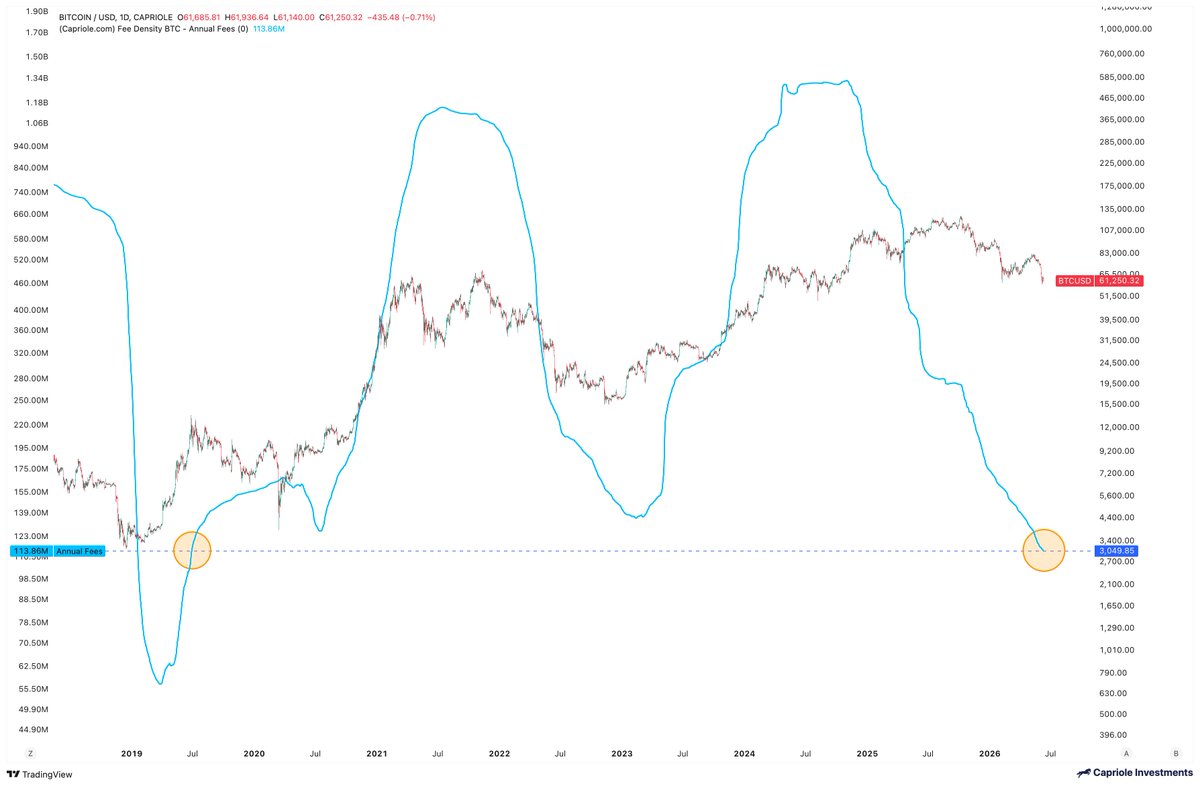
One of the more concerning long-term Bitcoin metrics. The Annual Fees miners earn (ex. block reward) over trailing 12 month period has just dropped to its lowest point since 2019! Bitcoin's transaction throughput fee revenue is in free fall, block rewards keep halving and AI compute demand is through the roof. It's no wonder every single public Bitcoin miner is pivoting away from Bitcoin and into AI. At some point in the future, this line needs to go up if Bitcoin is to be sustainable in years to come. On the positive side, this metric does normally hit a major low at the bottom of bear markets when interest in Bitcoin is lowest.
Some considerations that many folks seem not to get:
1. It can be a bubble even if the tech works. (For instance, if the tech doesn't have a high-demand use case.)
2. It can be a bubble even if the tech works and has strong product-market fit. (For instance, if the tech cannot be economically viable.)
3. It can be a bubble even if the tech works, has strong product-market fit, and has a path to eventual economic viability. (For instance, if profitability takes too long to achieve or makes margin/competition assumptions that fail to materialize.)
4. It can be a bubble even if the tech works, has strong product-market fit, and is currently highly profitable. (For instance, if demand has a hard ceiling and growth stops once the ceiling is reached.)
5. It can be a bubble even if the tech works, has strong product-market fit, is currently highly profitable, and has unlimited future demand.
Literally all it takes for something to be a bubble is for lots of people to over-enthusiastically bet their money on it, and subsequently get panicky.
Importantly, bubbles can be attached both to things that are completely hogwash, like the Metaverse, and to world-changing developments like the Internet or railways. Bubbles don't care. They're brought into existence by the thoughts and feelings of investors, not by actual tech or products.
"The bubble has burst" doesn't mean "the tech didn't work" or "people stopped using the tech." It only means that people got panicky, investor money dried up, and valuations collapsed. Internet adoption didn't stop in 2000.
We're excited about the US CLARITY Act.
We think all YC companies will use crypto technology, like stablecoins, before long. Not just crypto startups, not just fintech startups, but every company.
Here's why this law is such a big deal 🧵
https://t.co/39hENfAIZk
@Morpho How is onchain finance different?
“The entire inefficiency of the financial system comes from the fact that you have 50,000 databases that are asynchronously updating each other, that don’t trust each other.”
Onchain finance replaces that with a shared, open substrate.
Companies capture value. Networks distribute it.
For years, crypto builders had to fit network-shaped systems into company-shaped rules. CLARITY changes that.
A 7B model's weights fit on your GPU with room to spare. But it can't hold a long conversation.
Why is that?
The answer is the memory almost nobody budgets for: the KV cache.
Every token the model processes becomes two vectors, a key and a value. It stores them so it never has to re-read the whole conversation to generate the next token.
That store is the KV cache. It is what keeps generation fast.
Its size scales with the context window: one entry per token, per layer.
Here is the part that trips people up: that memory is reserved up front, sized to the maximum context you configure. It fills as you chat, but it does not grow past what you reserved.
So a long context window is not a free feature. It is a memory bill you pay before the first token.
At long context, a 7B model's KV cache can exceed the weights themselves. Reserve more than fits, and the model will not load or drops to slow CPU.
When working with long-context windows, the highest-leverage thing to compress is not the weights. It is the KV cache.
Bring it down to 3 bits per value, near-lossless, and a context window can fit where it never did before.
That is what TurboQuant does. Now available on QVAC SDK
→ https://t.co/sERQ4m5Udn
🚨UPDATE: Zcash founder confirms a critical Orchard bug capable of minting unlimited counterfeit zcash:native remained active from May 2022, until it was patched June 1 using Claude Opus 4.8.
Why is getting the crypto market news you need so difficult?
Crypto alerts are more noisy than useful. Manually monitoring the market eats up time.
There needs to be a way to cut back weekly noise to only the alerts you care about.
Agentic monitoring brings power to control the crypto market news you consume.
All it takes is a simple prompt about the assets and news related to them you want to monitor.
Setting agentic rules enables you to place your own targets without needing to handle complex setups.
Agentic Monitoring brings critical events in crypto into your workflow.
From Mobile Push to Monitoring across latest regulator and security updates, watch how @diran_li uses Messari Monitoring to power his day.
What if AI didn’t have to be a black box?
We’re anchoring every vision inference on-chain - so you don’t have to trust us. You can verify it.
That’s not just transparency. That’s Web3-native truth for the visual world.
$MVIS
disagree. the irony is smart contracts enable apps that are way more secure than whats possible without
the problem is many projects produce low quality slop code, VCs/influencers pump, and users yolo in
its not a defi problem, its just AIs good enough to sift through slop