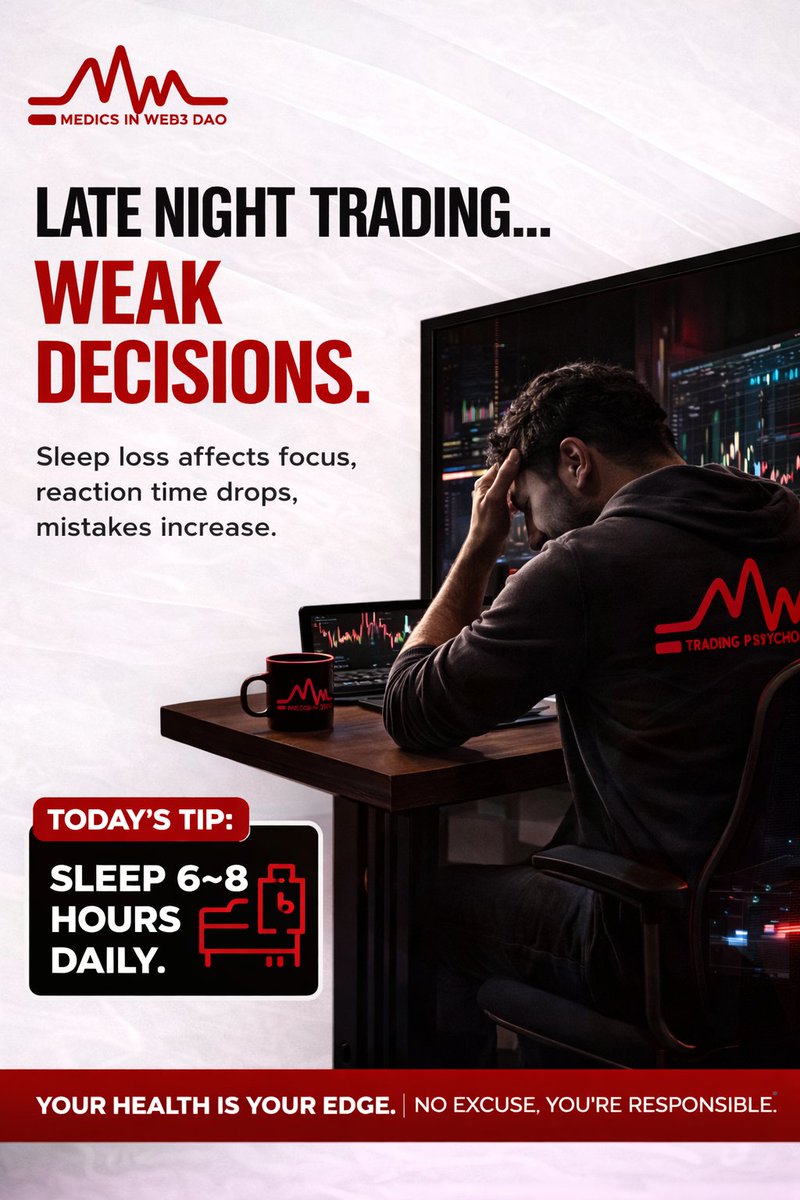
Late night trading
WEAK DECISIONS.
You're glued to the charts at 3 AM, convinced this SOL pump is “the one.”
Next morning? Your stop-loss got hunted, you aped into a rug, and your portfolio is sending condolences. Sleep loss isn't just “tired eyes" it's financial self-sabotage in Web3.
Let’s break it down.
Sleep deprivation hits traders like a surprise airdrop rug. After just one bad night, your:
• Focus turns to mush (good luck spotting that fakeout)
• Reaction time slows (missed the perfect entry? oops)
• Mistakes multiply (hello, revenge trading)
Studies show sleep loss impairs cognitive processing, pattern recognition, and logical thinking exactly what you need for reading charts, risk management, and not FOMO-ing into every meme coin.
Even worse for Web3 warriors: 68% of crypto traders admit they lose sleep over the market.
2 in 3 check prices after bedtime.
81% have stayed up waiting for “the move.” Result? 70% makes poorer decisions when underslept.
Your brain on 4 hours sleep is basically running on hopium and Red Bull — not alpha.
Funny part? You think you’re “grinding” like a degen soldier.
Reality: You’re just donating liquidity while your prefrontal cortex takes a vacation.
Sleep-deprived: “This 100x leverage looks safe!”
The science is brutal (but hilarious in hindsight):
Impaired judgment → more risky bets (yes, that means over-leveraging on volatile alts).
Emotional volatility → panic sells or greedy holds.
Worse memory & learning → you repeat the same dumb mistakes instead of leveling up.
One night of poor sleep can dampen your brain’s response to wins AND losses.
You feel less pain from losses… until your account is liquidated and the pain hits anyway.
Pro traders know: Consistent sleep correlates stronger with P&L than most TA indicators.
So what’s the fix, anon?
SLEEP 6–8 HOURS DAILY.
No negotiations. Your edge isn’t staying up for every candle it’s showing up with a sharp brain while others are foggy and emotional.Real alpha comes from recovery, not all-nighters.
Quick Web3 trader sleep protocol (save this):
• Set a hard “charts off” time even if BTC is mooning
• No blue light 1hr before bed (use night mode or flux, degen)
• Magnesium glycinate + dark room = god-tier recovery
• Morning sunlight to fix your circadian rhythm (yes, even if you’re a vampire trader)
• Position size that lets you sleep at night if it doesn’t, you’re overexposed.
Bonus: Build a trading plan during daylight hours.
Rules > vibes at 4 AM.
Last one: The market will still be here tomorrow.
Your edge won’t vanish if you sleep.
But weak decisions at 3 AM? Those vanish your stack real quick.
Sleep like a chad.
Trade like a pro.
Wake up to green candles instead of regret.
What’s your worst “no sleep trading” story?
Drop it below
8 HOURS ON THE SCREEN AND YOUR BODY IS SCREAMING “BRO, I’M NOT BUILT FOR THIS”
You’re out here pretending your chair is a throne while your legs slowly turn into sad spaghetti and your brain files for divorce.
Sitting too long isn’t a “hustle.” It’s self-sabotage with extra steps.
And if you’re a builder, founder, or trader? Your edge is quietly ghosting you.
After 30 minutes glued to the screen, blood flow goes on vacation. Your legs: “We’re pooling down here like it’s happy hour.”
Your brain: “Where’s the oxygen party at? I’m dying.” Result? Brain fog so thick you could trade it as a new crypto.
One missed candle or buggy deployed later… oof.
Focus? Vanished.
Fatigue? Arrived fashionably early with snacks.
Science says prolonged sitting cuts oxygen to the brain, tanks your concentration, and turns you into a zombie who thinks “just one more hour” is a good life decision.
•Traders: missing the pump.
•Founders: bad calls.
•Builders: shipping features that need therapy.
Mind-blowing medical plot twist:
Sitting 8+ hours a day (without moving) can be as risky for your health as smoking or being obese.
•Your heart: “Bro, do something.”
•Blood sugar: spiking like a bad meme coin.
•Inflammation: throwing a silent rave in your body.
You’re out here grinding like a machine… but your biology is filing a complaint.
Why should builders, founders & traders care?
Because your superpower is sharp decisions + endless energy.
Not “I sat so long my ass has its own zip code.” Sitting quietly steals your circulation, your clarity, and your long-term wins.
This isn’t wellness advice it’s performance insurance with jokes.
The ridiculously simple (and cheap) fix that actually works: STAND UP EVERY HOUR. MOVE YOUR BODY.
📌Walk like you’re late for a meeting with your future self.
📌Stretch like you just won a 100x.
📌Do 10 squats like you’re dodging red candles.
📌2–5 minutes is enough to wake up the blood, feed the brain, and slap the fatigue away.
Stop treating your body like it’s trash.
8 hours on charts doesn’t have to come with a side of regret and doctor bills.
Stand.
Move.
Repeat.
Your future self (and your portfolio) will send you a thank-you meme.
What’s your funniest “I sat too long” moment? Or drop your go-to movement break below
Let’s laugh and level up together!
@Medicsinweb3 Sure! Exercise are great ways to achieve better health and improve quality of life. We give so much time to screen and neglect our health. Thanks for the reminder.
Public accountability intensifies this.
Shipping delays, governance decisions, and mistakes happen in public. The pressure to appear composed adds another layer of mental load.
Over time, constant alertness becomes the baseline.
The nervous system adapts by staying activated longer, even when the immediate demand is gone.
This is not a mindset issue. It’s a physiological response.
Asynchronous work increases efficiency, but it also removes real-time emotional feedback.
You see messages and tasks. You don’t see: fatigue, confusion, overload, or early stress signals.
This collapses recovery time.
Even when you stop typing, your nervous system often stays alert: checking messages, anticipating issues, mentally preparing responses.
Unlike traditional work environments, Web3 removes natural boundaries.
There is no clear “end of day.” Your workspace, social space, and reputation space often live on the same screen.
Most Web3 builders operate inside overlapping systems: • Global time zones
• Asynchronous communication
• Continuous delivery cycles
• Open, public feedback
Each layer adds cognitive load.
Why Mental Health Strain in Web3 Is a System Design Problem (Not a Personal One)
1/
Mental health challenges in Web3 don’t come from weakness or lack of resilience.
They emerge from how the ecosystem is structured: always-on, remote-first, high-uncertainty, and publicly visible.
This week at @Medicsinweb3 we’re focusing on sleep, mental health, and recovery.
Not as motivation talk — but as performance infrastructure.
Builders who prioritize recovery make better decisions, ship more consistently, and last longer in high-pressure ecosystems.
Longevity is the real advantage.
Most builders treat sleep like a luxury.
But sleep isn’t rest — it’s recovery.
It’s when memory consolidates, emotions reset, and stress hormones normalize.
Blue light at night delays melatonin release, making it harder to fall asleep and easier to wake up exhausted.
You don’t need more grind.
You need better recovery.