Today we're introducing TRIBE v2 (Trimodal Brain Encoder), a foundation model trained to predict how the human brain responds to almost any sight or sound.
Building on our Algonauts 2025 award-winning architecture, TRIBE v2 draws on 500+ hours of fMRI recordings from 700+ people to create a digital twin of neural activity and enable zero-shot predictions for new subjects, languages, and tasks.
Try the demo and learn more here: https://t.co/VkMd1YpQWI
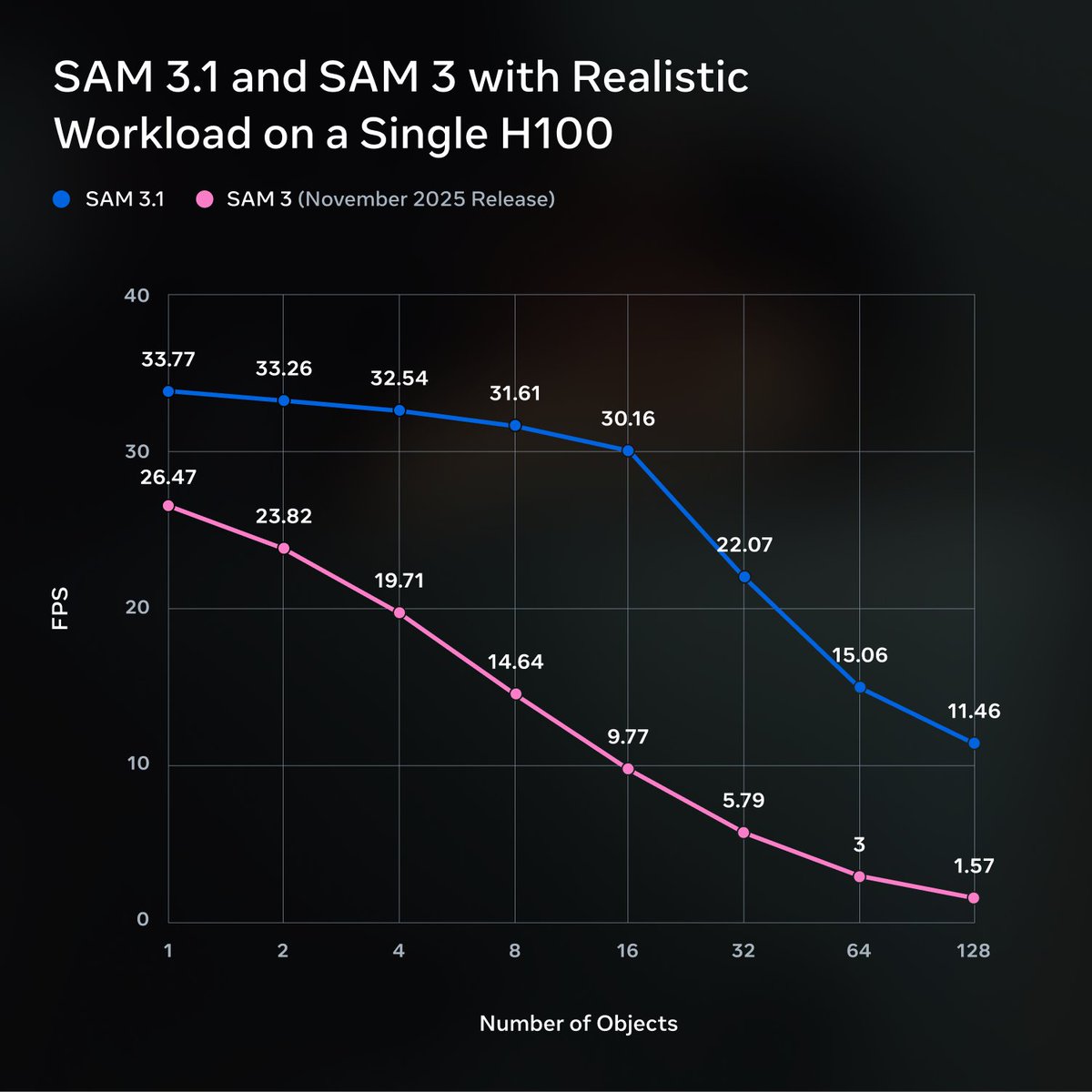
The core innovation in SAM 3.1 is object multiplexing, allowing the model to track up to 16 objects in a single forward pass. Previously, each object required its own dedicated pass, but with multiplexing, SAM 3.1 processes all tracked objects together, eliminating redundant computation and memory bottlenecks.
This approach doubles the processing speed for videos with a medium number of objects, increasing throughput from 16 to 32 frames per second on a single H100 GPU.
We’re releasing SAM 3.1: a drop-in update to SAM 3 that introduces object multiplexing to significantly improve video processing efficiency without sacrificing accuracy.
We’re sharing this update with the community to help make high-performance applications feasible on smaller, more accessible hardware.
🔗 Model Checkpoint: https://t.co/KgW0zZQ0QT
🔗 Codebase: https://t.co/Ks61vfokB0
Personal superintelligence will help people learn about their health. We collaborated with 1,000+ physicians to curate training data that enables more factual and comprehensive responses. It can generate interactive displays that unpack and explain health information such as the nutritional content of various foods or muscles activated during exercise.
Muse Spark is built from the ground up to integrate visual information across domains and tools. It achieves strong performance on visual STEM questions, entity recognition, and localization, enabling interactive experiences like troubleshooting your home appliances with dynamic annotations.
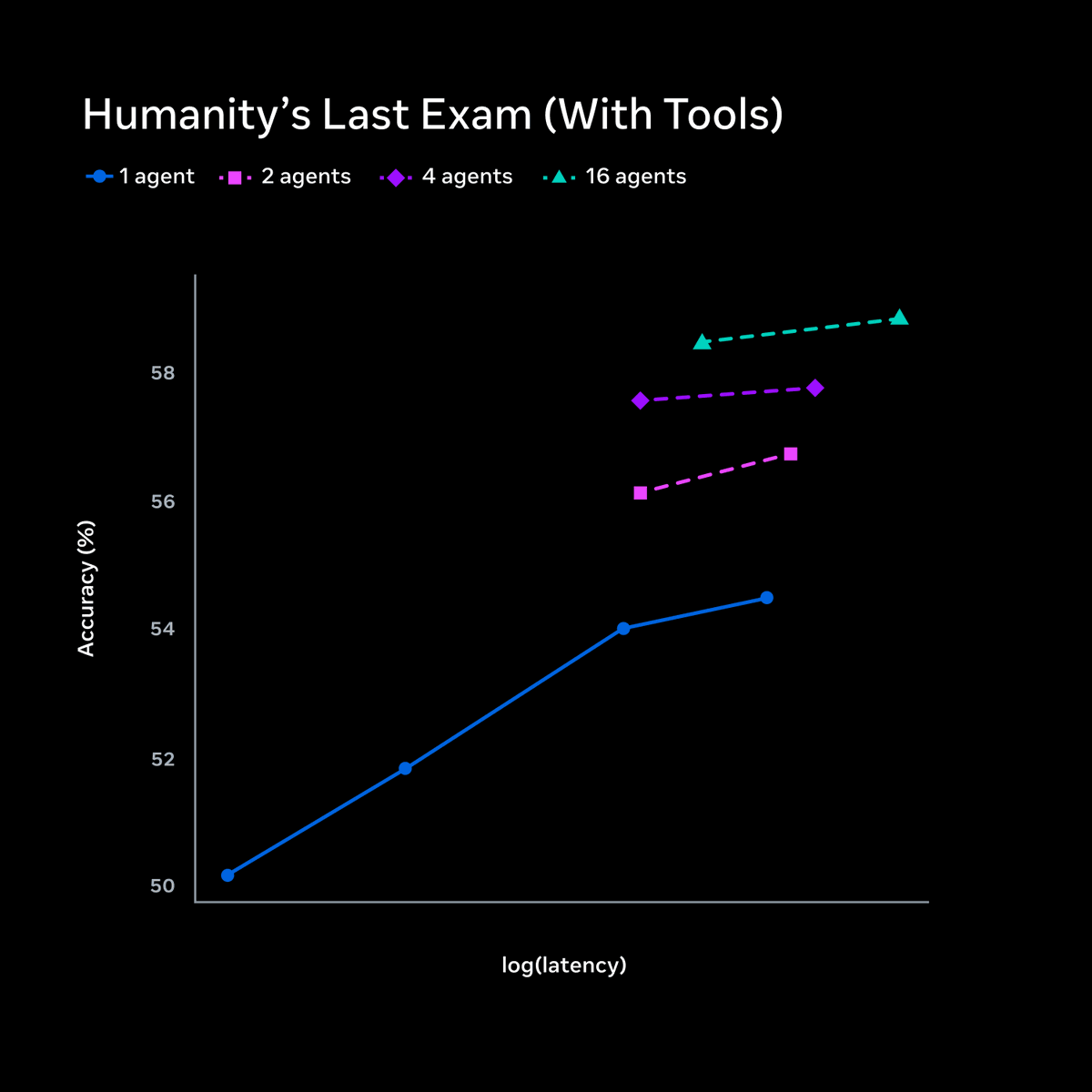
To spend more test-time reasoning without drastically increasing latency, we can scale the number of parallel agents that collaborate to solve hard problems. While standard test-time scaling has a single agent think for longer, scaling Muse Spark with multi-agent thinking enables superior performance with comparable latency.
To build personal superintelligence, our model’s capabilities should scale predictably and efficiently. Below, we share how we study and track Muse Spark’s scaling properties along three axes: pretraining, reinforcement learning, and test-time reasoning. 🧵👇
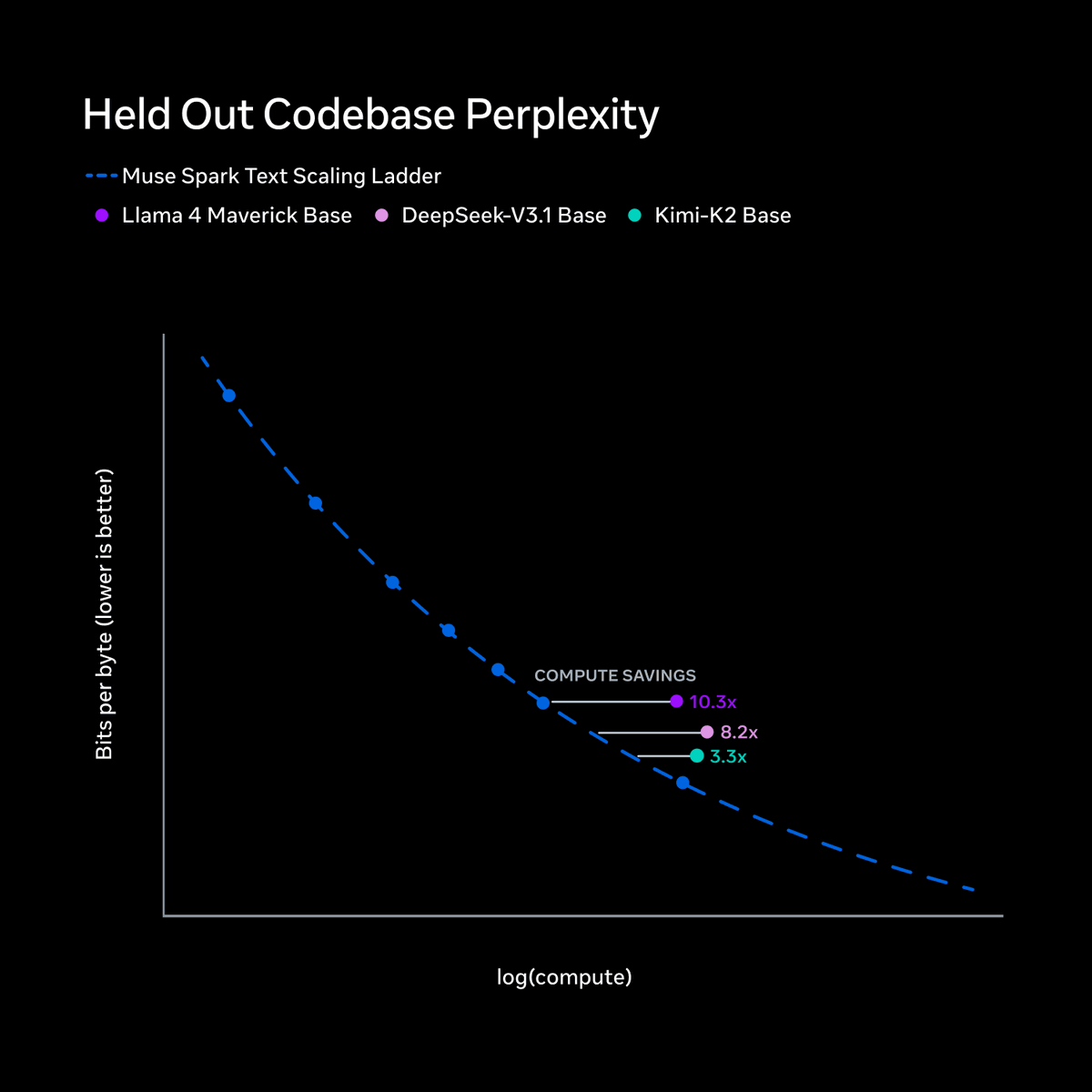
Let’s start with pretraining. Over the last 9 months, we rebuilt our pretraining stack with improvements to model architecture, optimization, and data curation, enabling us to increase the capability we can extract from every unit of compute. To rigorously evaluate our new recipe, we fit a scaling law to a series of small models and compare the training FLOPs required to hit a specific level of performance.
The results: we can reach the same capabilities with over an order of magnitude less compute than our previous model, Llama 4 Maverick, making Muse Spark significantly more efficient than the leading base models available for comparison.
We’re sharing the next major milestone in our non-invasive brain-to-text decoder research: Brain2Qwerty v2.
Building on v1, which was published today in @Nature, Brain2Qwerty v2 is the highest-performing end-to-end pipeline capable of real-time sentence decoding from raw brain signals. It advances beyond character-level performance to decoding words and semantics, enabling accuracy for overall communication.
We believe this research has the potential to make a real difference for the millions of people who suffer from brain lesions or disorders that prevent them from communicating.
🧵👇
We’re happy to announce 2 releases today:
- 🧠Brain2qwerty v1 is published at @NatureNeuro
- 🚀 Brain2Qwerty v2 is now publicly released
Explore how we decode sentences from non-invasive brain recordings: https://t.co/IdR6gK2hcd
Links:
📄v1 Nature Neuro: https://t.co/wnRjc9W9gI
📑v2 Meta preprint: https://t.co/oSfLOQFcvg
💻Code: https://t.co/Xbe0XWfWQL
📊Data: https://t.co/SCBbs4AhTg
📝Blog: https://t.co/15RvsAaXlH
🧵Thread: https://t.co/d8FJrVyDut
Big congrats to our SAM 3D team for receiving a Best Paper Honorable Mention at #CVPR26! This prestigious recognition underscores their incredible work pushing the boundaries of computer vision.
Read the paper here: https://t.co/jr59xlzwlX
Today we’re introducing Muse Spark, our most powerful model yet, giving you a faster and smarter Meta AI.
Muse Spark currently powers the Meta AI app and website and will be rolling out to @whatsapp, @Instagram, @facebook, @messenger, and AI glasses in the coming weeks.
https://t.co/WHTipuuAmj
A few highlights from September:
- We launched new AI glasses (Meta Ray-Ban Display and Oakley Meta Vanguard),
- Expanded access to Llama AI to support government agencies and US national security efforts,
- Rolled out our School Partnership Program,
- And more…
Today we’re announcing an agreement with Amazon Web Services to bring tens of millions of AWS Graviton cores to our compute portfolio.
This partnership marks an expansion of our diversified AI infrastructure and will help scale systems behind Meta AI and agentic experiences that serve billions of people.
Learn more: https://t.co/cmeATOB7Jc
Introducing Muse Spark, the first in the Muse family of models developed by Meta Superintelligence Labs.
Muse Spark is a natively multimodal reasoning model with support for tool-use, visual chain of thought, and multi-agent orchestration.
Muse Spark is available today at https://t.co/wHkMPH82ZH and the Meta AI app. We’re also making it available in private preview via API to select partners, and we hope to open-source future versions of the model.
Learn more: https://t.co/PloE9q5x96
We’re announcing two partnerships to help deliver the reliable power our AI infrastructure and data centers need by advancing innovative energy generation and storage. https://t.co/Mc03sfGRlu
Today we’re announcing an agreement with @awscloud to bring tens of millions of AWS Graviton cores into @Meta 's compute portfolio to support next-generation agentic AI workloads. https://t.co/Asw9JCRqjv