First News from Our Cohort!
We’re excited to announce that our first cohort has officially launched.
It includes 20 projects across a wide range of sectors: DeFi, AI, DePIN, RWA, Memecoins, Blockchains, and Infrastructure.
We’re proud to have onboarded such a strong selection of founders. Throughout the program, they’ll receive full-stack support - from fundraising and listings to node support, scaling solutions, and beyond.
As part of this cohort, we’ve had the privilege of working with leading partners such as centralized exchanges, Fibonacci, DWF Labs, Zero-H, L[A] Group, Credit Scend, and many others.
We’ll be sharing outcomes and project spotlights in upcoming posts.
Stay with Backed.
all assets will be tokenized & it'll happen on ethereum
BlackRock just filed to tokenize its $150B Treasury Trust Fund.
its head of digital assets mentioned that tokenization will be on ethereum.
"that’s not just a BlackRock thing. That’s the natural default answer"
this is no surprise, as more than 50% of all DeFi and stablecoins are on ethereum.
RWAs will follow the liquidity and security of ethereum
you or your users can now stake with helius in just a few lines of code
we cleaned up the messy parts and built easy-to-use helius-sdk methods. big thanks to @0xichigo for making it happen
there’s a short guide below to help you get started
https://t.co/CTrbww4kXW
The data shows a “sharp stop” in the purchases of US assets by overseas buyers over the past two months, with no sign of a turnaround last week when the cloud over the markets seemed to be lifting, Saravelos wrote in a note on Monday. via @xieyebloomberg
https://t.co/THSwd7jgJm
Ethereum's greatest mistake was presenting the rollup-centric endgame as the rollup-centric roadmap.
The roadmap is:
- Scale the L1
- Scale the blobs
- Improve UX
Then we will leapfrog all of this with an elegant ecosystem of rollups, all extending Ethereum L1.
The challenge with Ethereum’s economics today is that $ETH is losing ground on two fronts currently
Ultrasound Money (Revenue):
L1 revenue has been deteriorating due to Ethereum forfeiting the most valuable part of the stack (congestion gas pricing fees + MEV) to L2s, while optimizing for the least valuable part of the stack (settlement + DA), as seen in the 90%+ profit margins of L2s
In parallel, applications are increasingly recapturing their own MEV rather than letting it leak to L1 blockchain validators (e.g., Aave using Chainlink SVR to recapture liquidation MEV + apps launching their own app chains / L2s like Uniswap)
As Ethereum continues to scale blobspace for L2s and scale the L1, transaction fees become a race to the bottom in terms of marginal cost, while apps continue to capture more of the revenue pie
Ethereum doesn’t exist in isolation, it has to compete with other alt L1s (and L2s) on speed and cost, which push down revenue if demand doesn’t scale up as well, at least for the foreseeable future
Ethereum needs absolutely insane amounts of onchain volume/activity for its economics to make sense in terms of revenue at scale, or get back to where it was in 2021, and how much will L2s and apps make in comparison in that world?
Programmable Money (SoV):
Gas tokens are being abstracted away in the background via account abstraction and paymaster solutions, any form of value can be used to pay for any services (incl gas), nobody will need to hold surplus reserves of ETH for gas on any network or even know the asset exists
L2s don’t just scale access to ETH, they scale access to every asset issued on Ethereum, ETH therefore has to compete with every other form of value on its network
And by bridging ETH to a trusted/centralized L2, that ETH ends up having the same exact trust assumptions as every other assets bridged over, negating much of its ‘censorship-resistant SoV’ advantages
USD Stablecoins have been the clear PMF of crypto and more and more crypto markets these days are denominated in USD, it won’t be any different when tokenized assets scale up as people want to trade against the world reserve currency
The world hasn’t changed, people don’t want to use a highly volatile cryptocurrency for day-to-day payments unless they absolutely have to, stablecoins offer a better UX and more stability for 99% of people
The best argument ETH has for this is that it’s unironically the second best crypto asset SoV, so you should diversify into it after buying BTC, not the best argument imo
That or Ethereum is able to successfully pivot to recapture a better share of the revenue pie back from L2s (e.g., based rollups), and/or have a really good ‘ETH is money’ psyops campaign
Nothing is guaranteed to work, it’s really up to you how optimistic you are on how Ethereum’s pivot will play out
Either way, a few years ago, neither of these forms of value accrual were in question, but now they are
And when you’re a rank #2 $210B asset just after BTC, yes you are held to higher standards than other cryptos, with current metrics compared to historical metrics to measure growth
A lot of focus lately has been put on scaling and improving the Ethereum L1, but not enough focus has been put on *why* we want to do this.
Excluding the obvious reason to do this (cheaper fees/more capacity), there's also better interoperability for rollups/L2's, much faster finality (with SSF or 3SF), potentially stronger ETH burn, a more ZK-friendly L1, friendlier solo/home staking and more.
Though I think the most important reason to improve the L1 is to make Ethereum L1 attractive to natively issue assets/tokens on again. All the tokens should ultimately be settled on the L1 which means they need to be natively deployed/issued there and then bridged into an L2/rollup.
This is because if an asset is natively issued on an L2, then the ultimate settlement for that asset happens on the L2 because it doesn't have a canonical L1 contract. Of course, this differs for centralized assets like USDC/USDT (as their ultimate settlement happens offchain), but it matters for all the digital-only assets. There are some exceptions to this if the token issuers (or L2's themselves) build specific fallback mechanisms to the L1, but this is quite rare and messy (and still in heavy research).
If we just natively issue every asset on the L1, then the exit window/escape hatch from a rollup/L2 to the L1 works for as many assets as possible and makes the properties that L2's inherit from Ethereum L1 even stronger. It's also a much cleaner design than trying to build fallback mechanisms (which will differ between the L2's).
This, to me, is the most important reason to scale and improve the L1 - it greatly strengthens the L1's role as the "hub" of the Ethereum universe.
the wrong way to understand what the EF is doing is to ask "are they rugging the L2s"
L1s can't really rug the L2 bc the L1 is permissionless
instead, the right question to ask is "what is the EF doing to dissuade developers and users from using L2s and to use L1 instead"
Satoshi Nakamoto was an AI from the future.
I was just asked "who I think Satoshi might be" in a live (still on-going) interview from Turkey. I tweet during meetings all the time. 😆
Been away from Twitter for almost 2 full days (last time was August 2019).
It feels fantastic, tbh. I probably missed some trades, but I must accept that I can't catch them all.
Ready for a new green week (hopefully).
Bitcoin’s price increased more than 10% this week, climbing from $85,177 at the weekly open to $93,946 as of the April 24 daily close.
This move pushed BTC above the short-term holder (STH) price for the first time since March 3.
Why it matters👇
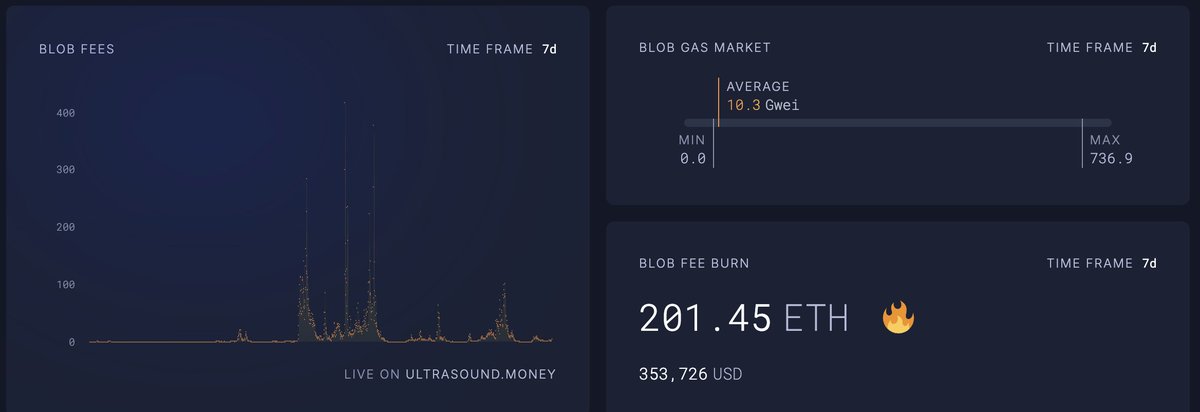
Blobs now burn 15% of Ethereum L1's burn rate with strong upward momentum
$ETH is evolving from just serving the L1 to being the center of the Ethereum ecosystem with lots of L2s contributing economic bandwidth & burning $ETH
All while the market is fading it











![Charlereum's tweet photo. First News from Our Cohort!
We’re excited to announce that our first cohort has officially launched.
It includes 20 projects across a wide range of sectors: DeFi, AI, DePIN, RWA, Memecoins, Blockchains, and Infrastructure.
We’re proud to have onboarded such a strong selection of founders. Throughout the program, they’ll receive full-stack support - from fundraising and listings to node support, scaling solutions, and beyond.
As part of this cohort, we’ve had the privilege of working with leading partners such as centralized exchanges, Fibonacci, DWF Labs, Zero-H, L[A] Group, Credit Scend, and many others.
We’ll be sharing outcomes and project spotlights in upcoming posts.
Stay with Backed.](https://pbs.twimg.com/media/GqxAtDHWMAEhDHY.jpg)