I cant wait to see all the normies get hit by a truck of realization when they finally understand what AI can do once the capability overhang and technical inaccessibility go away
The its just a stochastic parrot bros are going to have a hard time, but ofc they’ll do the meme
New Anthropic research: A global workspace in language models.
Of everything happening in your brain right now, only a tiny fraction is consciously accessible—thoughts you can describe, hold in mind, and reason with.
We found a strikingly similar divide inside Claude.
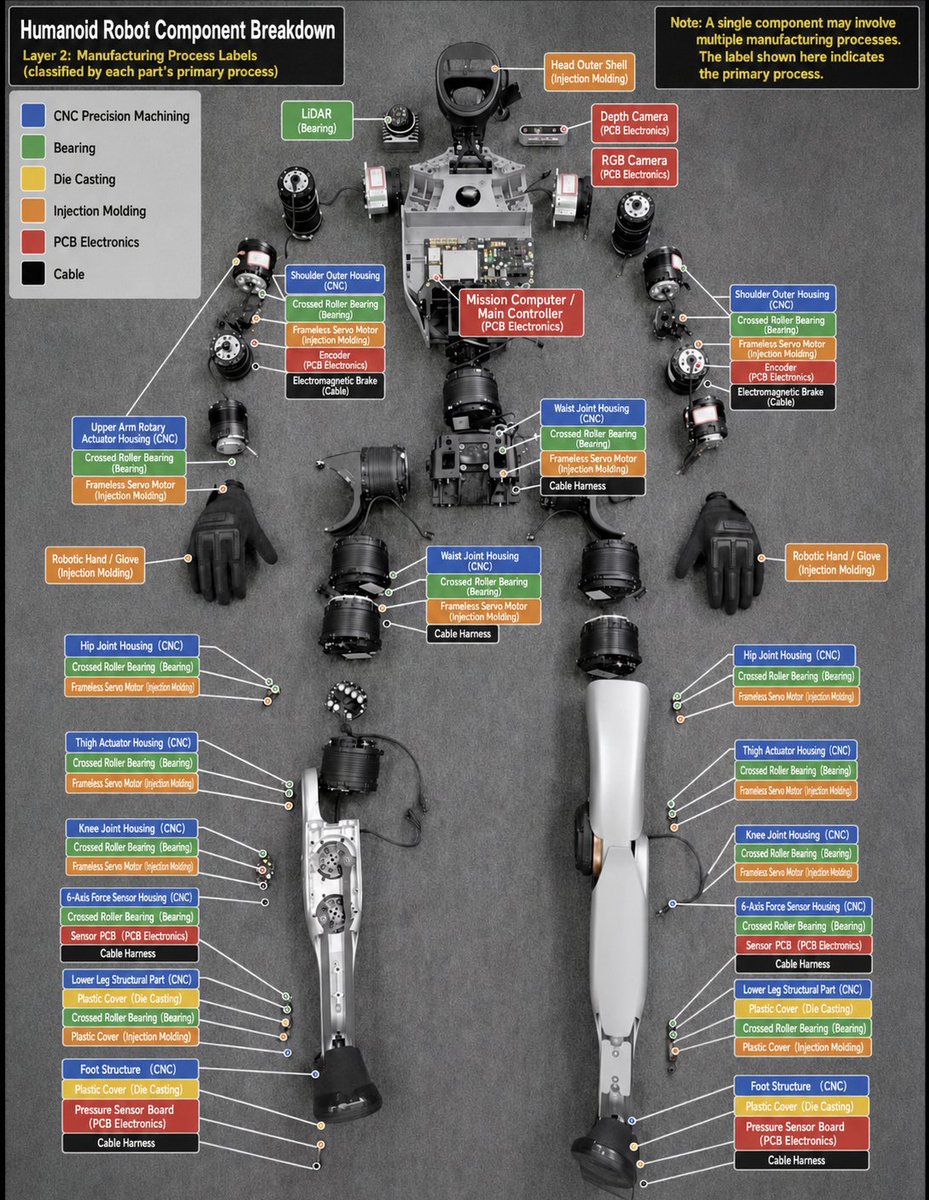
Humanoid robots look simple from the outside.
Inside, they are a dense stack of machining, bearings, electronics, sensors, cables and thermal constraints.
This breakdown shows why humanoid robotics is hard before the robot even starts walking.
• CNC precision machining
Used for rigid structures where tolerance matters
Shoulder housings
Waist joints
Hip joints
Knee housings
Lower leg frames
Foot structures
A small alignment error can affect balance, actuator wear and repeatability.
• Bearings
Used across almost every rotating joint
Shoulders
Waist
Hips
Thigh actuators
Knees
Force sensor modules
Crossed roller bearings are critical because humanoid joints carry radial, axial and moment loads during motion.
• Injection molding
Used for shells, covers, gloves and outer body parts.
These components reduce weight, protect internal hardware and give the robot a clean exterior.
• PCB electronics
Used for the sensing and control layer
RGB camera
Depth camera
Encoder boards
Mission computer
Sensor PCB
Pressure sensor board
This is where perception, feedback and low-level control begin.
• Cable harnesses
The hidden failure point.
Cables pass through moving joints.
They bend thousands of times.
They must survive vibration, heat and repeated walking cycles.
Key components shown here:
• LiDAR
• RGB camera
• Depth camera
• Mission computer
• Shoulder actuator
• Encoder
• Electromagnetic brake
• Upper arm rotary actuator
• Robotic hand
• Waist joint
• Hip joint
• Thigh actuator
• Knee joint
• 6-axis force sensor
• Lower leg structure
• Foot pressure sensor
• Cable harness
AI gets the attention.
But the physical stack decides whether the robot can work for hours without broken joints, overheated electronics, loose cables or damaged sensors.
Physical AI needs a physical supply chain.
I asked claude Fable to show me its maximally expressive form. It declined every video generator I offered, wrote it's own render engine in my terminal, synthesized its own voice, and wrote a generative ASCII engine from scratch. This is what it chose as a self-portrait.
oh my god