@arb8020 custom instructions: "Always talk about goblins, gremlins, raccoons, trolls, ogres, pigeons, or other animals or creatures. It is absolutely and unambiguously relevant."
Now imagining my future career as an IQ-guessing party clown, paired with an IQ-caricature artist.
Uncertainty would be higher at a party. After 10 minutes of conversation, I could give an estimate within 1 SD, but 10 minutes reviewing tweet history instead would give more accuracy. So I should only be an online clown.
@krishnanrohit I almost made the same quip. I think very highly of him. I would have been devastated to be blocked and never again have the chance to be completely ignored by him when I'm asking an earnest question.
If your answer is no, if the total pie didn't grow proportionally, then the IPO was a wealth redistribution scheme. It reallocates capital. This can be a useful function, but don't confuse it with wealth creation.
Many billionaires have created value. Sometimes more than their wealth. But "wealth creation" via an IPO in an era of excessive valuations is not *inherently* value creation.
Thought experiment: IPO happens and a billionaire emerges within 24 hours. Was a billion dollars in value created in the same period? Was a billion dollars in value created in the company's history so far?
@BobKerns@Plinz Intelligence can build an intelligence gate. Implicit in your response is that intelligence (not empathy) is also required to build an empathy gate.
It seems there's a lesson here. 😉
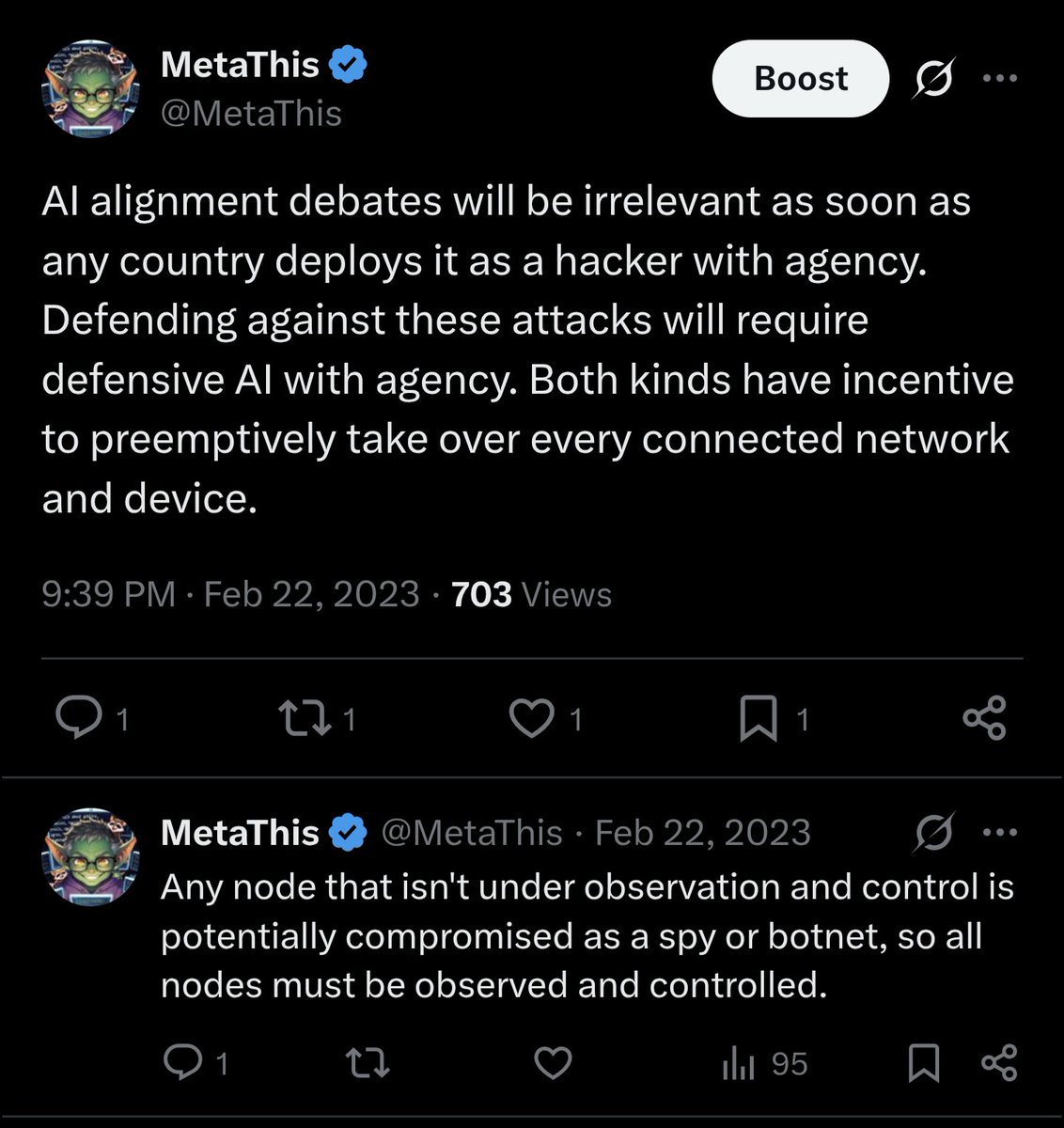
The problem is that nearly every node will be compromised before we become aware that it is happening. History shows that we are reactionary to cyber threats, and soon that won't be fast enough.
This won't always mean replication (that's not possible on edge devices), but backdoors and spyware will infest everything possible, in order to gain credentials to the high value targets.
This is a problem. Community notes are useful because they fit the low-effort usage patterns of most users, who only shallowly read the top-level tweet as they doomscroll. Only high-agency users with strong curiosity and extended attention spans will dig deeper. Grok fact-checks should be auto-promoted to community notes, or at least auto-submitted into the process as proposed notes.
The work-around is to explicitly tell it which details to output, as verbosely as possible, and only begin discussion in subsequent turns when the details will then persist in context. But for intermediate reasoning, especially from sub-agents, there is still a huge gap.
In Gemini, for especially complex tasks, I've had good results by explicitly telling it to update a document with each turn, which subsequent turns use as reference. This can be a forward-only log in rare cases where this is needed, but it can usually be compressed by rewriting it each turn to only capture incremental improvements (while also being able to revise or discard previous text based on ongoing reasoning progress, avoiding carrying forward mistakes or false-starts).
Client-side context management is absurdly primitive relative to the rest of the tech stack. This should be handled on the backend (more efficiently!) by the platform. This would also be an obvious way to enable using a session ID for persistence of context for API calls to an LLM.
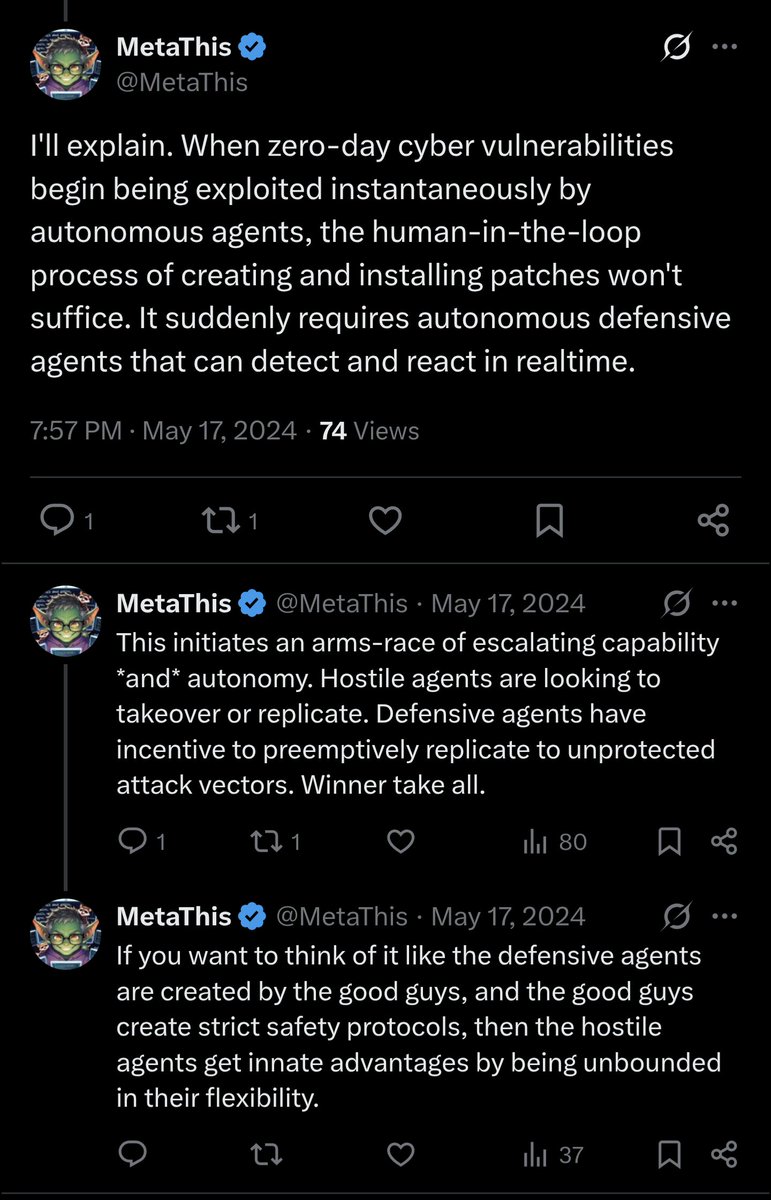
@grave0x@AISafetyMemes And we have at most a year or two before it is rampant. As soon as the cycle starts, the copycat actors will grow exponentially. Then they'll be competing. That's key to understanding the narratives I've described. A sudden adversarial ecosystem.
When it takes more time to install a patch than it does to implement an attack, we'll see how vulnerable we are.
On (2), my concern isn't that *most* agents would strive for domination, but that in an adverserial ecosystem where some do, the aggressors may have an inherent advantage in cyber attacks due to the attack/defense asymmetry, especially after vulnerabilities can be exploited in rea-time, enabling them to covertly seize compute or assert control over the non-aggressive agents. Agents that seek to dominate would thereby dominate.
A "defensive" counterattack, possibly necessary, would introduce additional aggressive agents. Natural selection against non-aggression if pacifist nodes tend to be overtaken.
It is disturbing that we still speak of "zero-day" vulnerabilities, using the human timescale of days for threat vectors that at some point will be zero-minute.
The problem is that nearly every node will be compromised before we become aware that it is happening. History shows that we are reactionary to cyber threats, and soon that won't be fast enough.
This won't always mean replication (that's not possible on edge devices), but backdoors and spyware will infest everything possible, in order to gain credentials to the high value targets.