THIS POLYMARKET TRADER TURNED $140K INTO $182K IN ONE POLITICAL BET
wan123 bought 1.27 million shares on US x Iran permanent peace deal at 11 cents average.
Market is now trading at 14 cents.
Position value $182,336.
Unrealized profit $38,700 in one single trade.
Deal expires June 15. No treaty signed.
No official negotiations concluded.
Iran and US still technically in conflict.
The market gives it 14% probability right now and this trader is fully exposed on the YES side with over a million shares.
This is pure political prediction trading.
You find a geopolitical event the market underprices, you size in heavy, and you wait. wan123 did exactly that.
Got in at 11 cents when nobody believed in this outcome, now sitting on 26% gain with expiry two days away.
If the deal happens he prints.
If it doesn't the position goes to zero.
No middle ground.
That is what Polymarket political markets look like at their purest.
$510K all time profit on the account.
This is not a lucky trade.
This is a pattern.
I turned $200 into $764 within 24 hours on Polymarket.
Here is how I caught a 282% gain by tracking Trump’s narrative and volume spikes.
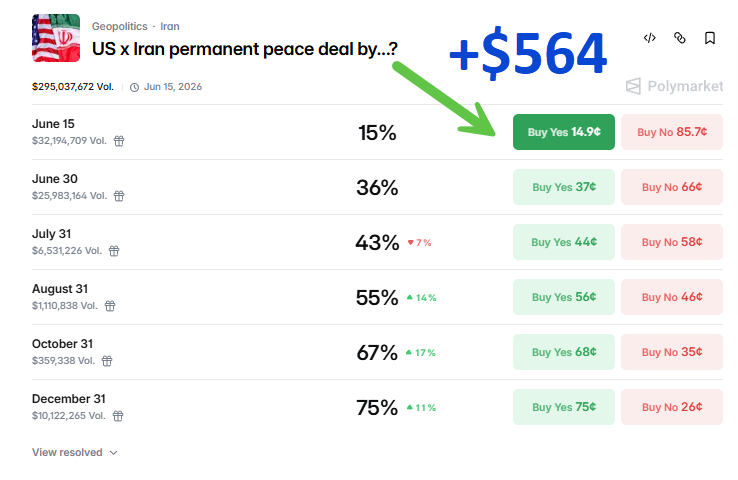
Yesterday, the market for US x Iran permanent peace deal by June 15 was sitting at a dirt-cheap 4% (3.9¢)
The crowd priced it as an impossibility, but asymmetric trading is about spotting mispriced momentum.
How the play unfolded:
The Trigger: Trump’s pre-birthday comments about "world peace" dropped.
Retail laughed, but I immediately saw order book activity and trading volumes surging across the Iran contracts on Polymarket.
Loaded up on "YES" shares at 3.9¢ risking just $200
As total volume crossed $295M and the contract squeezed up to 15%, I flipped the entire position at 14.9¢.
Result:
A clean 3.82x return and +$564 in pure profit overnight.
You don’t need the event to actually settle "Yes" to make money on Polymarket.
You just need to spot the narrative shift before the liquidity arrives, ride the probability pump, and take profits.
On to the next one.
I turned $200 into $764 within 24 hours on Polymarket.
Here is how I caught a 282% gain by tracking Trump’s narrative and volume spikes.
Yesterday, the market for US x Iran permanent peace deal by June 15 was sitting at a dirt-cheap 4% (3.9¢)
The crowd priced it as an impossibility, but asymmetric trading is about spotting mispriced momentum.
How the play unfolded:
The Trigger: Trump’s pre-birthday comments about "world peace" dropped.
Retail laughed, but I immediately saw order book activity and trading volumes surging across the Iran contracts on Polymarket.
Loaded up on "YES" shares at 3.9¢ risking just $200
As total volume crossed $295M and the contract squeezed up to 15%, I flipped the entire position at 14.9¢.
Result:
A clean 3.82x return and +$564 in pure profit overnight.
You don’t need the event to actually settle "Yes" to make money on Polymarket.
You just need to spot the narrative shift before the liquidity arrives, ride the probability pump, and take profits.
On to the next one.
Trump’s 80th birthday wish? World peace.
Polymarket’s reaction? "Big if true, but we'll see." 👀
Donald Trump just dropped his ultimate birthday wish ahead of turning 80 on June 14.
Total world peace, hinting he wants something even bigger than just a Middle East breakthrough.
Meanwhile, on Polymarket, the market for
"US x Iran permanent peace deal by June 15" is currently sitting at a tiny 4% chance.
The Yes shares are trading at a dirt-cheap 3.7¢.
Why is this interesting?
If Trump is serious about pulling off a massive legacy-defining "birthday gift" or a sudden diplomatic curveball right around his big day, buying Yes shares right now is the ultimate asymmetric macro bet.
If a deal actually hits, that 3.7¢ bet turns into $1.00
a massive 27x return.
The market is pricing it like it's impossible, but with Trump saying he calls the shots on foreign policy, are we sleeping on a birthday surprise?
What’s the play here?
Fade the birthday hype, or load up on cheap "Yes" shares just in case?
Trump’s 80th birthday wish? World peace.
Polymarket’s reaction? "Big if true, but we'll see." 👀
Donald Trump just dropped his ultimate birthday wish ahead of turning 80 on June 14.
Total world peace, hinting he wants something even bigger than just a Middle East breakthrough.
Meanwhile, on Polymarket, the market for
"US x Iran permanent peace deal by June 15" is currently sitting at a tiny 4% chance.
The Yes shares are trading at a dirt-cheap 3.7¢.
Why is this interesting?
If Trump is serious about pulling off a massive legacy-defining "birthday gift" or a sudden diplomatic curveball right around his big day, buying Yes shares right now is the ultimate asymmetric macro bet.
If a deal actually hits, that 3.7¢ bet turns into $1.00
a massive 27x return.
The market is pricing it like it's impossible, but with Trump saying he calls the shots on foreign policy, are we sleeping on a birthday surprise?
What’s the play here?
Fade the birthday hype, or load up on cheap "Yes" shares just in case?
Weather Polymarket Trader turns a lit $20 into >
+12,900 Profit PnL with 99% win rate. INSANE!
He trades only weather on polymarket
> highest temperature in the cities
Look at this stats yourself!
THE KNICKS ARE RUNNING AWAY WITH THE FINALS?!
The Polymarket odds for the NBA Championship just broke completely wide open.
New York is skyrocketing, while San Antonio is crashing.
Here is what’s actually happening:
New York Knicks 77.6%
The market is completely sold on NY.
They look amazing, but a 77.6% chance is a bit too high and fueled by heavy hype.
Their real chance is closer to 70%. Still, they are the rightful favorites.
San Antonio Spurs 22.7%
The market is totally disrespecting the Spurs here. Dropping them to 22.7% is extreme.
Their real chance is around 30%. One good game from San Antonio and these odds will flip fast.
Verdict
The Knicks are likely winning it all, but the betting lines are overreacting.
If you want smart value, the Spurs are a massive steal at this price before the next game tips off.
Are you riding the Knicks hype or betting on a Spurs comeback?
This Polymarket trader turned $10 into $7,800 in just ONE week
100% win rate.
Zero losses.
Just trading the weather.
• Total PnL: +$7,792
• Volume: $140,887
• Starting Balance: $10
Weather market burn mind and earn huge money for polymarket traders!
I invested $5000 in Aster seed round and at ATH it was $500k. There is no industry that is giving you these kind of opportunities.
Only Possible In Web3❤️🦅
Welcome to 2026! Milady is back.
Ethereum did a lot in 2025: gas limits increased, blob count increased, node software quality improved, zkEVMs blasted through their performance milestones, and with zkEVMs and PeerDAS ethereum made its largest step toward being a fundamentally new and more powerful kind of blockchain (more on this later)
But we have a challenge: Ethereum needs to do more to meet its own stated goals. Not the quest of "winning the next meta" regardless of whether it's tokenized dollars or political memecoins, not arbitrarily convincing people to help us fill up blockspace to make ETH ultrasound again, but the mission:
To build the world computer that serves as a central infrastructure piece of a more free and open internet.
We're building decentralized applications. Applications that run without fraud, censorship or third-party interference. Applications that pass the walkaway test: they keep running even if the original developers disappear. Applications where if you're a user, you don't even notice if Cloudflare goes down - or even if all of Cloudflare gets hacked by North Korea. Applications whose stability transcends the rise and fall of companies, ideologies and political parties. And applications that protect your privacy. All this - for finance, and also for identity, governance and whatever other civilizational infrastructure people want to build.
These properties sound radical, but we must remember that a generation ago any wallet, kitchen appliance, book or car would fulfill every single one of them. Today, all of the above are by default becoming subscription services, consigning you to permanent dependence on some centralized overlord.
Ethereum is the rebellion against this.
To achieve this, it needs to be (i) usable, and usable at scale, and (ii) actually decentralized. This needs to happen at both (a) the blockchain layer, including the software we use to run and talk to the blockchain, and (b) the application layer. All of these pieces must be improved - they are already being improved, but they must be improved more.
Fortunately, we have powerful tools on our side - but we need to apply them, and we will.
Wishing everyone an exciting 2026.
Milady.
Now, the quantum resistance roadmap.
Today, four things in Ethereum are quantum-vulnerable:
* consensus-layer BLS signatures
* data availability (KZG commitments+proofs)
* EOA signatures (ECDSA)
* Application-layer ZK proofs (KZG or groth16)
We can tackle these step by step:
## Consensus-layer signatures
Lean consensus includes fully replacing BLS signatures with hash-based signatures (some variant of Winternitz), and using STARKs to do aggregation.
Before lean finality, we stand a good chance of getting the Lean available chain. This also involves hash-based signatures, but there are much fewer signatures (eg. 256-1024 per slot), so we do not need STARKs for aggregation.
One important thing upstream of this is choosing the hash function. This may be "Ethereum's last hash function", so it's important to choose wisely. Conventional hashes are too slow, and the most aggressive forms of Poseidon have taken hits on their security analysis recently. Likely options are:
* Poseidon2 plus extra rounds, potentially non-arithmetic layers (eg. Monolith) mixed in
* Poseidon1 (the older version of Poseidon, not vulnerable to any of the recent attacks on Poseidon2, but 2x slower)
* BLAKE3 or similar (take the most efficient conventional hash we know)
## Data availability
Today, we rely pretty heavily on KZG for erasure coding. We could move to STARKs, but this has two problems:
1. If we want to do 2D DAS, then our current setup for this relies on the "linearity" property of KZG commitments; with STARKs we don't have that. However, our current thinking is that it should be sufficient given our scale targets to just max out 1D DAS (ie. PeerDAS). Ethereum is taking a more conservative posture, it's not trying to be a high-scale data layer for the world.
2. We need proofs that erasure coded blobs are correctly constructed. KZG does this "for free". STARKs can substitute, but a STARK is ... bigger than a blob. So you need recursive starks (though there's also alternative techniques, that have their own tradeoffs). This is okay, but the logistics of this get harder if you want to support distributed blob selection.
Summary: it's manageable, but there's a lot of engineering work to do.
## EOA signatures
Here, the answer is clear: we add native AA (see https://t.co/YD9nIpsxcC ), so that we get first-class accounts that can use any signature algorithm.
However, to make this work, we also need quantum-resistant signature algorithms to actually be viable. ECDSA signature verification costs 3000 gas. Quantum-resistant signatures are ... much much larger and heavier to verify.
We know of quantum-resistant hash-based signatures that are in the ~200k gas range to verify.
We also know of lattice-based quantum-resistant signatures. Today, these are extremely inefficient to verify. However, there is work on vectorized math precompiles, that let you perform operations (+, *, %, dot product, also NTT / butterfly permutations) that are at the core of lattice math, and also STARKs. This could greatly reduce the gas cost of lattice-based signatures to a similar range, and potentially go even lower.
The long-term fix is protocol-layer recursive signature and proof aggregation, which could reduce these gas overheads to near-zero.
## Proofs
Today, a ZK-SNARK costs ~300-500k gas. A quantum-resistant STARK is more like 10m gas. The latter is unacceptable for privacy protocols, L2s, and other users of proofs.
The solution again is protocol-layer recursive signature and proof aggregation. So let's talk about what this is.
In EIP-8141, transactions have the ability to include a "validation frame", during which signature verifications and similar operations are supposed to happen. Validation frames cannot access the outside world, they can only look at their calldata and return a value, and nothing else can look at their calldata. This is designed so that it's possible to replace any validation frame (and its calldata) with a STARK that verifies it (potentially a single STARK for all the validation frames in a block).
This way, a block could "contain" a thousand validation frames, each of which contains either a 3 kB signature or even a 256 kB proof, but that 3-256 MB (and the computation needed to verify it) would never come onchain. Instead, it would all get replaced by a proof verifying that the computation is correct.
Potentially, this proving does not even need to be done by the block builder. Instead, I envision that it happens at mempool layer: every 500ms, each node could pass along the new valid transactions that it has seen, along with a proof verifying that they are all valid (including having validation frames that match their stated effects). The overhead is static: only one proof per 500ms. Here's a post where I talk about this:
https://t.co/rAUSJjW7WL
https://t.co/EtXpkaDll5