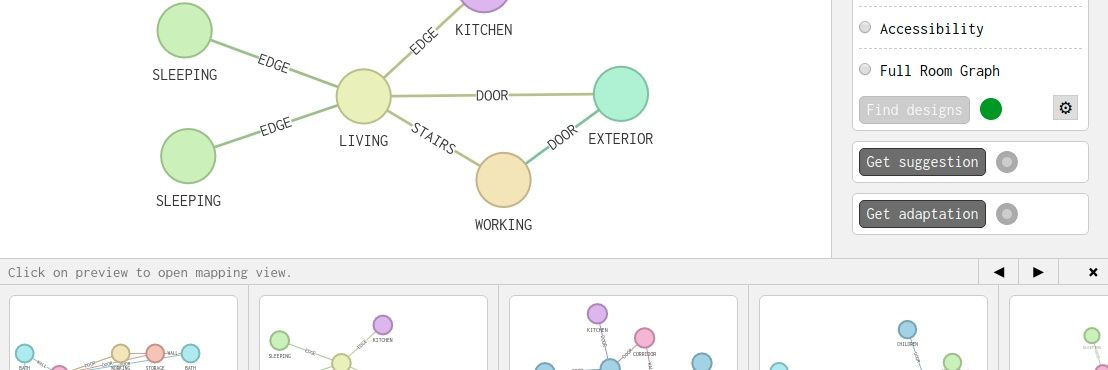
As announced at the currently ongoing @CBRConf, you can now access and test the alpha version of the MetisCBR retrieval:
https://t.co/rplIDwHDsB
Share your thoughts, opinions, and improvement requests #ICCBR#ICCBR2020
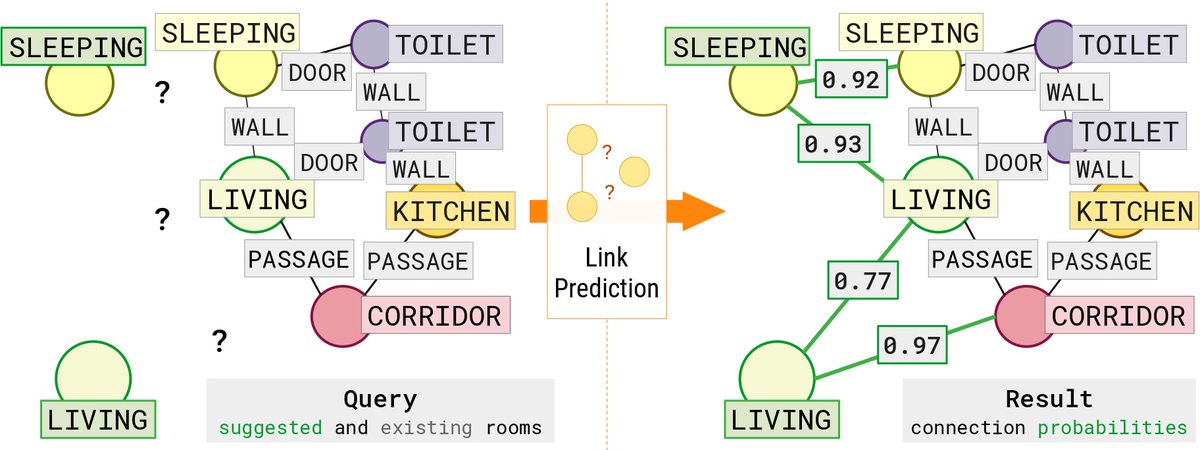
At the #eCAADe 2022 in Ghent (BE), a paper in the context of MetisCBR presented an approach for #LinkPrediction in architectural spatial configurations using graph neural networks:
Info & PDF: https://t.co/3rAkD01gRF
Source code of the approach (GitHub): https://t.co/9lN1lsGeam
MetisCBR was represented @ #CAADRIA 2022 with the paper on foundations and research overview of methods for #autocompletion of floor plans.
Abstract & PDF: https://t.co/0c7qGFVpG0
This paper describes a follow-up in-depth evaluation of the three types of the data structure 'relation map'. The research finds out that the models are able to recognize relevant semantic features of graph-based spatial configuration using their own non-class-defining criteria.
Pleased to inform that MetisCBR will be represented at the #ecaade2021 conference with the paper "Comparative Evaluation of Tensor-based Data Representations for Deep Learning Methods in Architecture".
Get it here: https://t.co/I6QU3dvJBT
The paper examines different ways of turning graph-based architectural spatial configurations into tensors compatible with deep learning frameworks, keeping the necessary semantic information only and leaving out everything else.
Spolier: One-hot vectors do the best job! :-)
We are happy to announce a new publication:
"Exploring optimal ways to represent topological and spatial features of building designs in deep learning methods and applications for architecture"
Accepted + presented @ CAADRIA 2021, available on Cumincad: https://t.co/jcMdNRA6yR
The paper describes our newest development for retrieval of architectural designs based on convolutional neural networks and (sub)graph matching. The main goal of this research was to make the MetisCBR framework and its UI more suitable for use in architectural design education.
We are happy to inform that the next paper in the context of MetisCBR has been published:
"Improved and Visually Enhanced Case-Based Retrieval of Room Configurations for Assistance in Architectural Design Education" presented @ #ICCBR2020
Get it here: https://t.co/9tIfcojETR
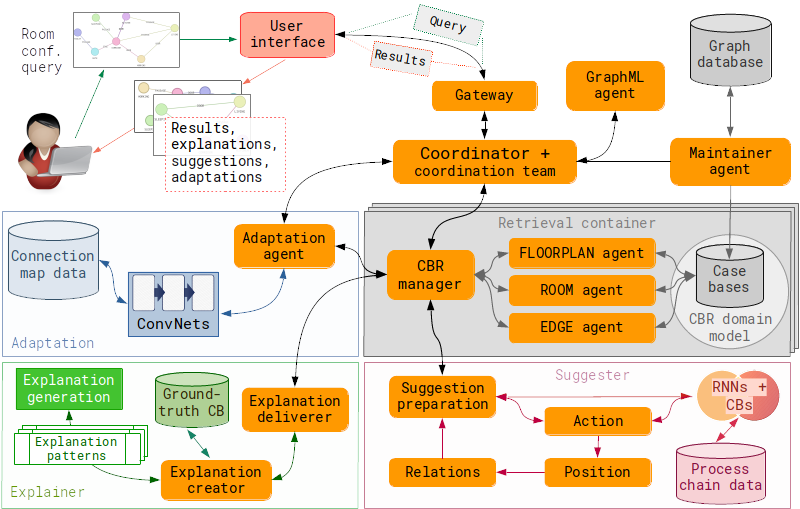
In this thread, the goals, features, and components of MetisCBR will be peu à peu presented. As foundation and for orientation, the schematic overview as shown below will be used.
1/n
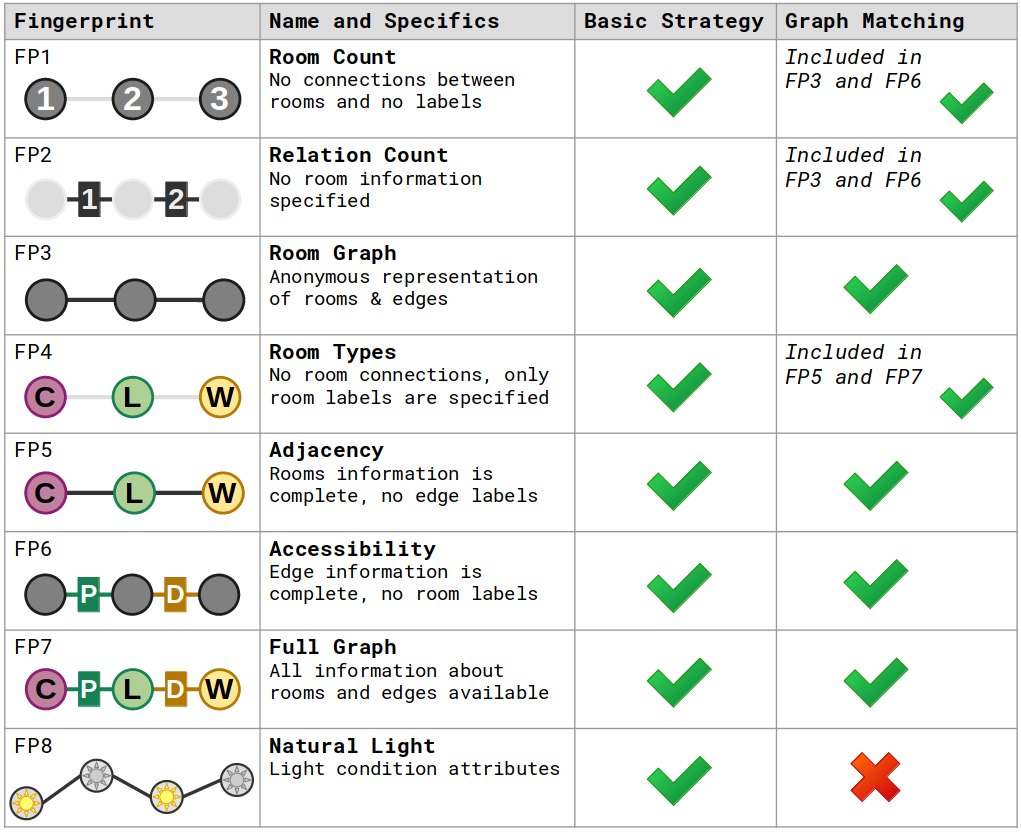
Retrieval processes of both strategies can be refined using the so-called Semantic Fingerprints (FP), that represent architectural knowledge patterns extending the Building Information Models for use in AI systems. In MetisCBR the FPs are used as cumulative search patterns.
10/n