UPDATE AFTER A YEAR :
Lover of Magan's wife never got arrested
Magan's wife came out of jail within months
The child she didn't care for and who was brought up by grandparents was snatched away by her after she came out of Jail
Magan's family lost their son
Divya is Free
Consent to record is not consent to share.
Have asked the Dept of Home to make FIRs mandatory in cases of revenge pornography, sextortion and blackmail videos
Karnataka Police Department has issued Standing Order directing all police officers across the State to take strict and immediate action in cases involving the non-consensual publication, transmission or sharing of intimate/private images and videos.
The order clarifies that consent to capture or record an image/video does not amount to consent for its dissemination. Any sharing, publishing, forwarding or transmission of such material without consent is a distinct cognizable offence, even if the material was originally recorded with consent.
Police officers have been directed to mandatorily register FIRs in complaints involving non-consensual dissemination of intimate content, including cases commonly referred to as revenge pornography, sextortion and blackmail videos. FIRs must be registered under relevant provisions of the Bharatiya Nyaya Sanhita, 2023 and the Information Technology Act, 2000, including Section 77 of BNS where applicable, and Sections 66E, 67 and 67A of the IT Act.
The Standing Order also mandates that police must not refuse or delay registration of complaints on the ground that the victim had earlier consented to recording. In cases involving threats, extortion, sexual favours or other coercive demands, additional provisions relating to extortion and criminal intimidation must also be invoked.
Where jurisdiction is an issue, police stations must register a Zero-FIR and transfer it to the appropriate police station without delay. Officers have also been instructed to take prompt steps for removal or blocking of offending content, preserve electronic evidence, and coordinate with Cyber Crime Police Stations and the CID Cyber Division for technical investigation.
The order further stresses that victims must be treated with dignity and sensitivity. Their identity must be kept confidential, victim-shaming must be avoided, and wherever feasible, complaints of women victims should be recorded by women officers.
Any failure or delay in registering an FIR on the erroneous ground of “prior consent” will be viewed seriously and may attract departmental action against the concerned officer.
This direction reinforces the constitutional right to privacy and ensures a uniform, victim-sensitive and legally sound response across all police stations in Karnataka.
Remembered one of India’s legendary fingerprint experts - Mr PS Nayar- after reading this detailed story in The Indian Express today on Billa & Ranga.
Nayar sir lifted the fingerprints in the Fiat car in Delhi that led to the hanging of Billa and Ranga- the prints were on the rear view mirror- (must’ve been them constantly checking their tail). He was then in the CBI, & he told me it was one of his greatest cases- he was then in the CBI. He retired as Director, Central Finger Print Bureau (CFPB) in 1992.
🚨 महत्वपूर्ण साइबर अलर्ट:
साइबर फ्रॉड पीड़ित अब ऑनलाइन कर सकेंगे रिफंड के लिए आवेदन
साइबर अपराध पीड़ितों के लिए बड़ी राहत!
गृह मंत्रालय (I4C) ने नेशनल साइबर क्राइम रिपोर्टिंग पोर्टल (NCRP) के अंतर्गत Money Restoration Module (MRM) शुरू किया है। अब पीड़ित बिना किसी कार्यालय या बैंक के चक्कर लगाए घर बैठे रिफंड के लिए आवेदन कर सकते हैं।
🔹 कौन कर सकता है आवेदन?
✅ वे पीड़ित जिन्होंने तुरंत शिकायत दर्ज की हो:
📞 1930 साइबर हेल्पलाइन पर या
🌐 NCRP पोर्टल पर
✅ शिकायत का 14 अंकों वाला Acknowledgement Number होना आवश्यक है।
✅ धोखाधड़ी की रकम अपराधी के बैंक खाते में सफलतापूर्वक Hold/Frozen होनी चाहिए।
⚠️ महत्वपूर्ण:
यदि साइबर अपराधी पहले ही पैसा निकाल चुके हैं, तो इस मॉड्यूल के माध्यम से रिफंड संभव नहीं होगा।
⚖️ रिफंड प्रक्रिया की श्रेणियां:
🔹 श्रेणी 1: एक बैंक खाते में ₹50,000 तक की राशि फ्रीज है
FIR या कोर्ट आदेश की आवश्यकता नहीं होगी। पुलिस रिपोर्ट और Indemnity Bond के आधार पर रिफंड प्रक्रिया पूरी की जाएगी।
🔹 श्रेणी 2: कुल फ्रीज राशि ₹50,000 से अधिक है, लेकिन किसी एक बैंक खाते में ₹50,000 से अधिक नहीं है
पुलिस रिपोर्ट के आधार पर रिफंड प्रक्रिया की जाएगी।
🔹 श्रेणी 3: किसी एक बैंक खाते में ₹50,000 से अधिक राशि फ्रीज है
FIR दर्ज करना आवश्यक होगा, जिसके बाद आगे की कानूनी प्रक्रिया पूरी की जाएगी।
💻 ऑनलाइन आवेदन की प्रक्रिया:
1️⃣ वेबसाइट पर जाएं: https://t.co/ibHbQm7UpS
2️⃣ Citizen Login पर क्लिक कर रजिस्टर्ड मोबाइल नंबर से OTP द्वारा लॉगिन करें
3️⃣ “Raise Refund Request” पर जाकर 14 अंकों की शिकायत संख्या दर्ज करें
4️⃣ PAN कार्ड और बैंक खाते की जानकारी भरें
5️⃣ आवेदन Submit करें और प्राप्त Request ID सुरक्षित रखें
👮 पुलिस की भूमिका:
आवेदन के बाद संबंधित पुलिस टीम आवश्यक कानूनी प्रक्रिया पूरी करेगी। इसके बाद बैंक द्वारा पात्र राशि सीधे पीड़ित के खाते में वापस की जाएगी।
🚫 सावधान रहें:
यह पूरी प्रक्रिया निःशुल्क है। रिफंड दिलाने के नाम पर किसी भी व्यक्ति को पैसे न दें।
किसी भी सहायता के लिए अपने नजदीकी पुलिस स्टेशन या साइबर सेल से संपर्क करें।
साइबर फ्रॉड होने पर तुरंत:
📞 1930 पर कॉल करें
🌐 https://t.co/tfXc3fZq2h पर शिकायत दर्ज करें
सतर्क रहें, सुरक्षित रहें।
#CyberAwareness #MRMPortal #I4C #MHA #CyberSecurity
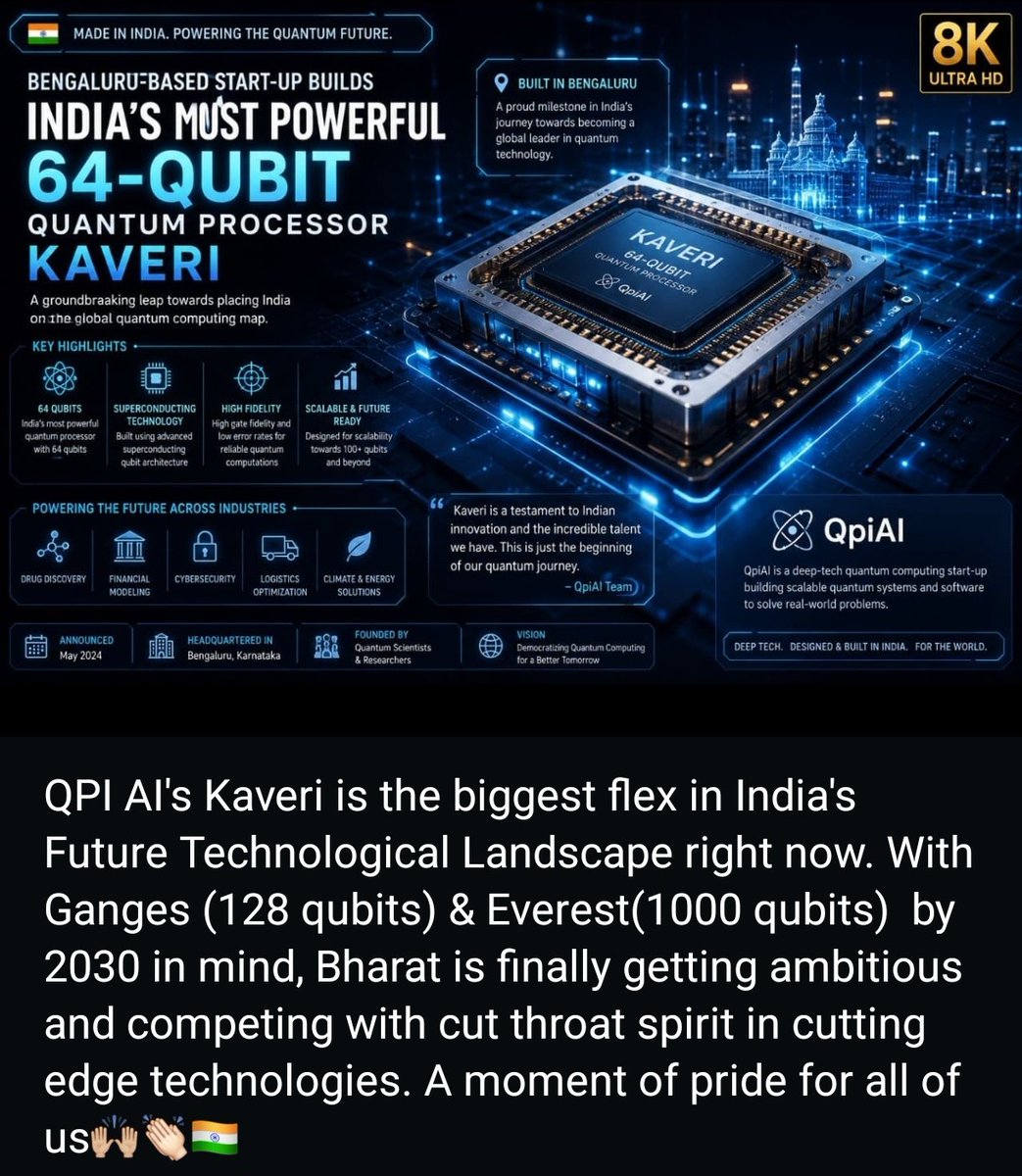
A quick look at ‘Kaveri’, India’s most powerful fully indigenous 64-qubit superconducting quantum processor, built by Bengaluru-based @qpiai.
Only 7 countries in the world can design and fabricate a quantum processor like this. Today, India and Karnataka stand in that elite company.
Kaveri is the most powerful quantum chip ever built in India, crossing the critical 50-qubit threshold that scientists globally recognize as the point where quantum systems begin to surpass classical computers in specific problem domains.
Kaveri is a testament to what Bengaluru’s innovation ecosystem can deliver for the nation.
Karnataka is also home to India’s first commercially deployed quantum computer installed at IIIT Dharwad and IIIT-Raichur under the @ITBTGoKs LEAP initiative placing the state at the forefront of India’s quantum computing journey.
How to Delete 18 Years of Academic Mediocrity and Build a High-Agency Mindset
LETTER FROM A FATHER
Dear Son/Daughter,
For 18 years, you were chasing a gold medal in a system that is fundamentally flawed. The issue is far deeper than NEET paper leaks and CBSE exam glitches.
A Sea of Institutionalized Mediocrity
The Indian education system was originally designed to create clerks for the British Empire. It was meant to reward academic obedience rather than ignite the mind and challenge the status quo.
That system never really changed in independent India.
At the 2005 Golden Jubilee celebrations of AIIMS, Dr. Manmohan Singh famously noted: “Neither institutions nor individuals can survive as islands of excellence in an environment of mediocrity.”
The Foundations of Success
Look at the foundations of the world’s most successful economies. They don’t succeed by accident. They succeed because their education systems are progressive. They are designed for agency, risk-taking, and building for tomorrow.
Our education system, by contrast, is designed to demoralize and defeat the vast majority.
So, my child, here is my counsel to you. If the system will not change, you must change. You must delete 18 years of standardized compliance and build a high-agency mindset.
High Grades, Low Agency
Why is such a large share of India’s youth unemployable in the knowledge economy? Because they possess "Academic Intelligence" but zero "Market Agency."
Our education system is stuck at the very bottom of how humans learn:
a. The School Trap: 90% of your time was spent on memorizing without understanding. "Originality" was penalized as "going out of syllabus."
b. The New Reality: In 2026, Large Language Models (LLMs) perform memorization tasks with 99.9% accuracy at zero marginal cost. The "correct answer" you stressed over for 18 years is now a free API call.
c. The Competition: While you memorize textbooks and learn the tricks of coaching institutes to clear entrance exams, progressive economies focus on the top of the pyramid: experimenting and creating. They train builders; we are still training clerks.
The Psychological Prison
In school, you were conditioned with behavioral traps that are toxic to a modern builder. You must break out of your mental cage.
a. Fear of Failure: In entrance exams like JEE, NEET, or UPSC, a single mistake on an OMR sheet can be the end of road to an “island of excellence.”
Failure in school or college leads to a lifetime of trauma. But in reality, innovation is a series of controlled failures. In the world of science and technology, failure is a badge of honour.
b. Permission-Seeking Culture: While you wait for your teacher’s “instructions” and follow them without questioning, the progressive global education systems encourage High Agency.
What is High Agency: The innate ability to bend reality, to find a way around obstacles, and to build solutions without asking for permission.
c. Degree Obsession: My child, stop obsessing over a Tier-1 college tag as your ticket to success. The world is turning to skill-based hiring. If your teacher didn’t tell you this, let me enlighten you that a piece of paper no longer defines your worth or capabilities.
d. Follower Mindset: Your school taught you to solve “closed problems” (clean data, one right answer.) That’s what made us a nation of great coders, and poor inventors. If you continue to do that, you will be competing with AI tools that cost $20 a month.
The world rewards “open problems” (messy data, infinite answers, uncertainty.) Your value no longer lies in finding the “correct” answer to someone else’s question. Your value lies in identifying a problem, and solving it when outcomes are uncertain.
Survival Guide to Unlearning
a. Shift from “Syllabus” to “Stack”: Stop asking, "What should I learn?" and start asking, "What can I build?" Pick a project that genuinely scares you: an AI app, a micro-SaaS, a community initiative, or a hardware prototype. Do not join a coaching institute. Learn by doing and failing.
b. Practice Strategic Disobedience: In any project, feel free to challenge a standard operating procedure. If something exists simply “because it’s always been done that way,” be sure it is waiting to be disrupted. High agency begins the moment you stop asking for permission to improve things.
c. Replace Rote with First Principles: Elon Musk popularized this. First Principles thinking is the antithesis of everything they taught you at school. Break every problem down to its most fundamental truths (whether it’s physics, economics, or biology) and build your understanding from ground up.
d. Build a Proof of Work (the New CV): Your public footprint is your new degree. Whether it is your GitHub repository, a Substack newsletter, a Twitter community, or a portfolio of real-world projects, publicly document your journey of hurdles.
That creates a permissionless career. You don’t need an HR manager to "clear" you; you need a global market to validate you.
Final Advice: No Pain, No Gain
The system of rote learning and mastering exam skills gave you a strong discipline and an ability to work harder than your global peers. But this system also tried to steal your curiosity.
My child, now let the world be your lab. Get ready to take risks and fail. As Nvidia’s Jensen Huang said:
“Unless you have a tolerance for the pain of failure, you will never experiment. For all of you Stanford students, I wish upon you ample doses of pain and suffering.”
With love, Dad
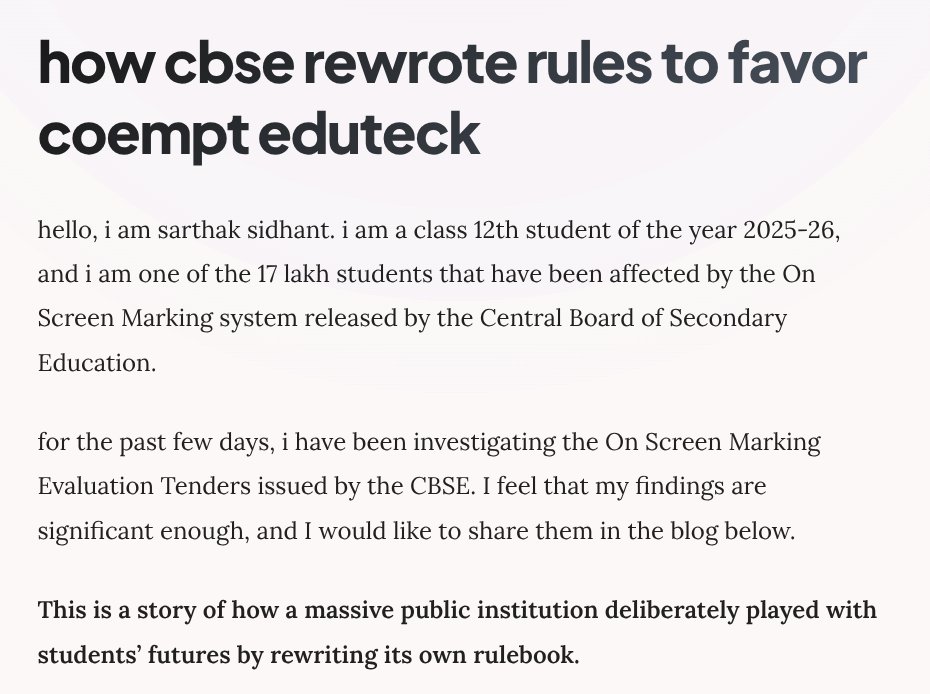
Some updates: HT found some shocking stuff about the CBSE OSM process from digging into the publicly obtainable tenders.
Also, most of the dashboards for other institutions hosted under the onmark domain don't seem to have proper security – they are also running on an old version of PHP.
another integral onmark subdomain has been pwn'ed, this time we managed to get super admin access of the portal. seems like it is tasked with evaluation of exams at various universities.
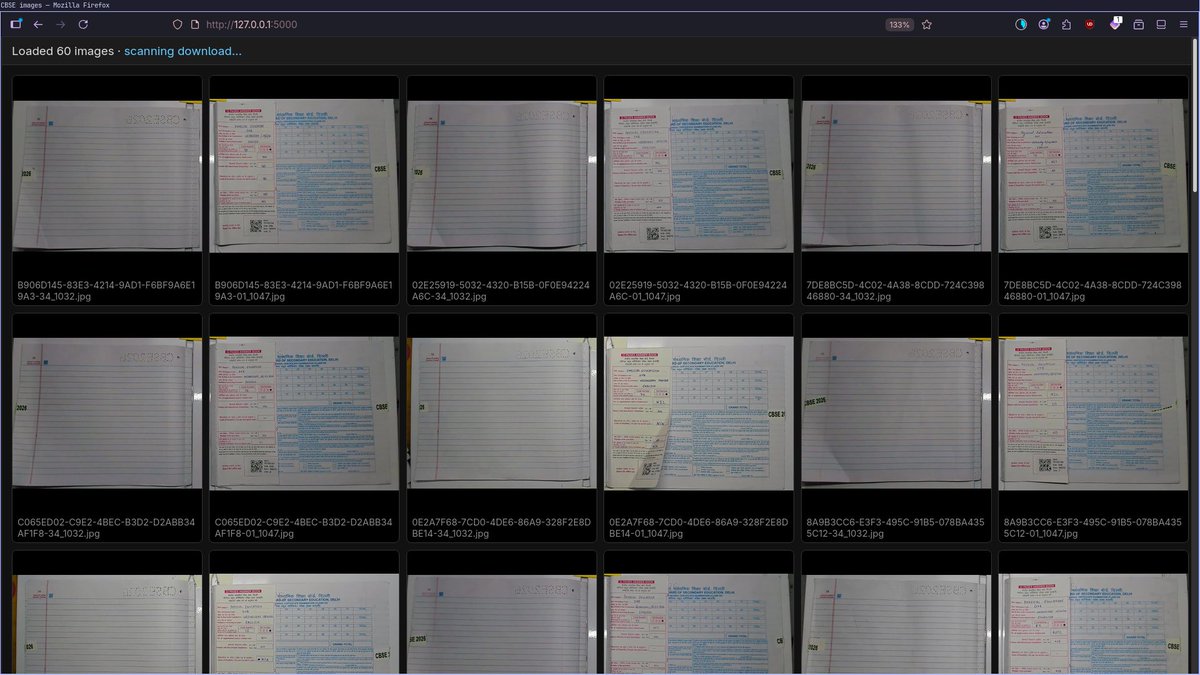
CBSE people didn't configure their AWS bucket properly and now we can paginate & enumerate all their media which has 2026 answersheets & question papers. ListObjectsV2 works without any auth and the bucket root is listable too — anyone on the internet can download any scanned booklet — across institutions. Multiple institutions are using the same bucket, insanely insecure.
The airline lost my bag for 72 hours.
They handed me a $50 “courtesy” voucher at the baggage desk and smiled like they’d done me a favor.
I kept the voucher. Then I opened my laptop and used a 1999 international treaty they never mention at check-in.
Total recovered: $1,650.
Here are the three legal weapons most passengers never know they have.
The NEET paper leak would probably have stayed buried forever if a school teacher from Sikar had not refused to stay silent.
Shashikant Suthar, a chemistry teacher from Rajasthan, was shown a “guess paper” by one of his neighbors after the NEET exam. That PDF had reportedly been circulating in Telegram groups for weeks.
Out of curiosity, he matched it with the real exam paper.
The result was terrifying.
Around 140 questions were identical. Same sequence. Same wording. Even punctuation marks matched.
He rushed to the local police station expecting immediate action.
Nobody listened.
No FIR.
No urgency.
No investigation.
But instead of giving up, he kept escalating the matter emailing the NTA, PMO, President of India, and CBI while continuously raising the issue online.
Only then did the system move.
Rajasthan Police formed a Special Operations Group. What initially looked like a small leak soon exploded into a nationwide examination scam connected across multiple states.
The case eventually reached the CBI. NEET was cancelled. And investigators uncovered an organized network of professional paper leak operators.
This entire scandal was exposed because one ordinary teacher decided that remaining silent was not an option.
Sometimes one honest citizen is more powerful than an entire broken system.
@ShashiTharoor is 💯✅.@CJP_2029@abhijeet_dipke is just voice of 140bn lower&middle class #NewIndia.It seeks real opportunity,transparency,accountability,governance,corruption-free delivery,debate on real issues.Or let us ask,criticize,correct,recall & replace constitutionally.
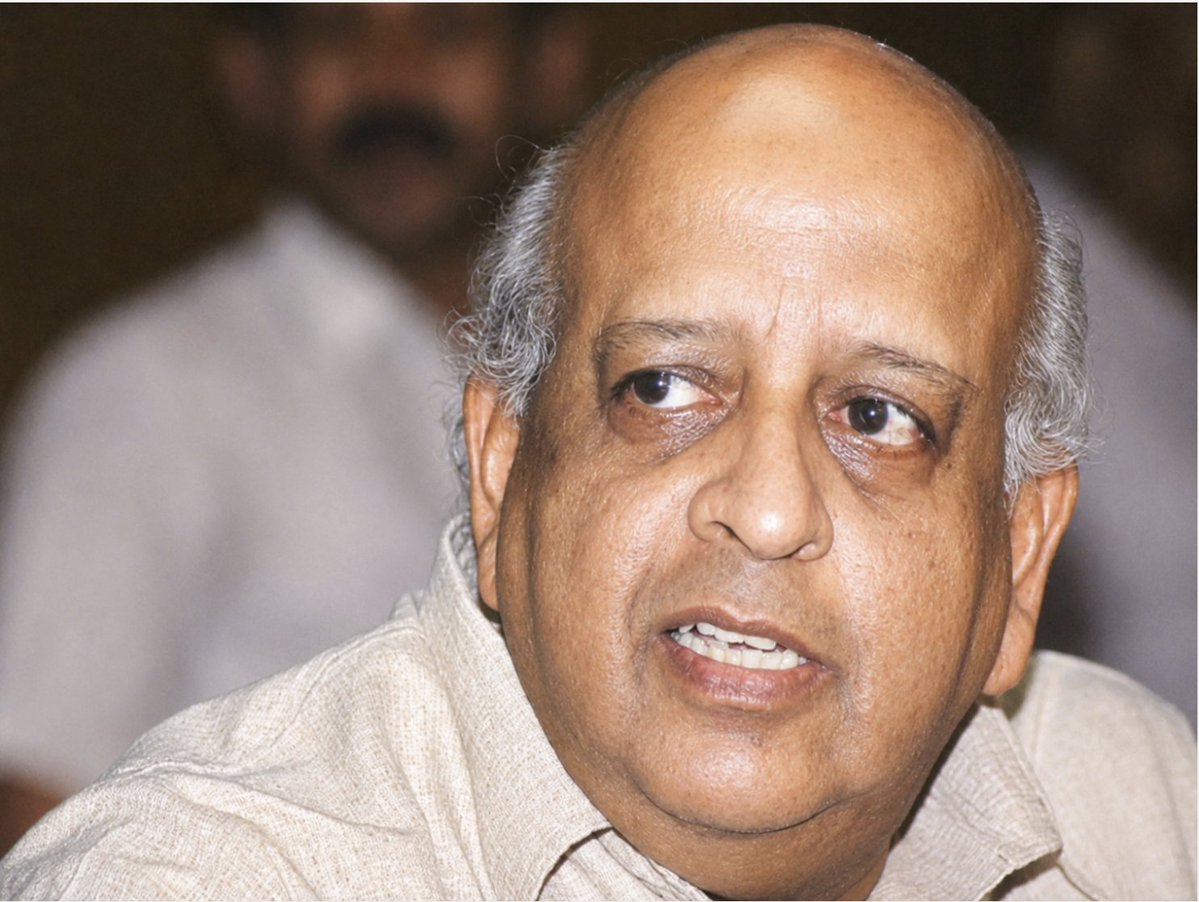
His name was T.N. Seshan.
He was born on December 15, 1932 in Thirunellai village, Palakkad, Kerala. His father was a court lawyer. He cleared the IAS in 1955 and spent the next 35 years moving through the machinery of the Indian government.
In 1989, he became Cabinet Secretary, the highest position in the civil service.
Then, in December 1990, he was appointed the 10th Chief Election Commissioner of India.
Before Seshan, Indian elections were a spectacle. Booth capturing was common. Candidates spent without limits. Government machinery was deployed freely for the ruling party's campaigns. The Model Code of Conduct was treated as a joke.
Seshan treated it as law.
He postponed and cancelled elections when he found violations. He reviewed over 40,000 expenditure accounts and disqualified 14,000 candidates for filing false information.
He introduced the Voter Photo Identity Card. He appointed election officials from outside the states going to the polls so they could not be pressured locally.
He publicly named ministers he said were trying to influence voters and asked the Prime Minister to act.
The government tried to clip his wings by appointing two additional Election Commissioners in 1993. Seshan challenged the move in the Supreme Court.
He was once asked to define his role.
He said, “I am not the Chief Election Commissioner of the Government of India. I am the Chief Election Commissioner of India.”
He received the Ramon Magsaysay Award in 1996.
He died on November 10, 2019 in Chennai at the age of 86.
The Election Commission of India called him “the man who redefined the grammar of Indian elections.”
Every time India votes peacefully, it is partly because one man refused to let anyone make a mockery of the ballot.
Follow for stories India deserves to remember.
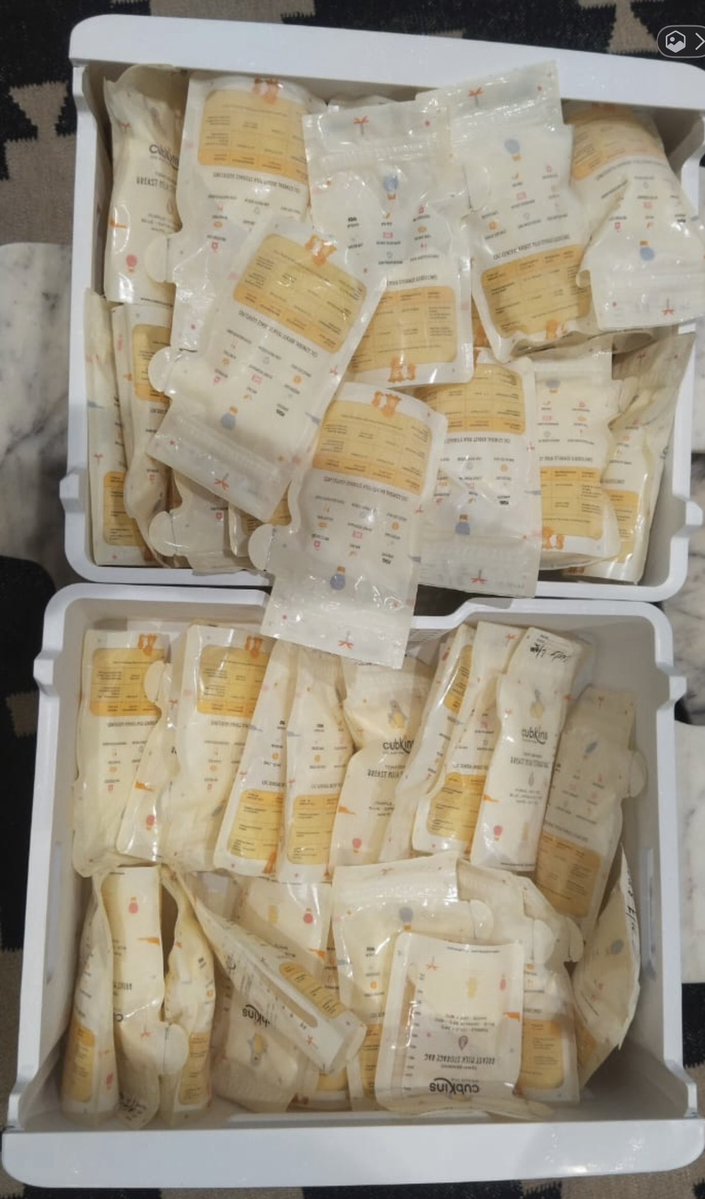
I donated around 60 litres of breast milk to the government hospital in Hyderabad and Chennai during my first year of post partum!!
Why does it matter? Just 100ml of donor milk can feed a tiny 1kg baby for several days. This donation could potentially support dozens of infants in the NICU. Donating is safe, screened, and desperately needed. Many NICU babies don't have immediate access to their mother's own milk due to medical complications. Donor milk acts as a vital bridge, providing immunity and nutrition during those critical first days.
It serves as a bridge for mothers whose milk may be delayed due to stress, illness,malnutrition or premature birth.
Donor human milk is proven to significantly reduce the incidence of Necrotizing Enterocolitis (a life-threatening gut condition) in premature infants!!!
Check your local govt hospital to see how you can help! #MilkBank #SavingLives #MaternalHealth
India's 2047 Roadblock: Failed Education
NITI Aayog Report Shows Reality
1. 2014-2024: Math/Sci: Zero improvement; 60% students below avg
2. 42% kids drop after Class 10
3. 85% teachers below std
4. Edu System: Marks = Self-worth; Rank = Identity; Exams = Destiny
INSIGHTS:
NITI Aayog Report: Grim Reality
a. 232-page report released last week. All data is from government agencies only; surveys covering hundreds of districts, thousands of villages & cities, lakhs of children.
b. “Access to schooling has not translated into quality learning or continuity of education (beyond Class 10).”
c. World Bank data (cited in the report): One additional year of schooling leads to 0.37% increase in GDP growth. So, education is the foundational driver of "Developed India 2047" goal.
d. Overall enrollment in Indian schools (govt & private schools combined) has gone down every year for the last 4 years:
FY22: 26.52 cr
FY23: 25.17 cr
FY24: 24.80 cr
FY25: 24.69 cr
e. Enrollment is high for primary education, and then kids start dropping out of the system. Total 42% students drop out by Class 9/10. “This trend has remained largely unchanged from 2015 to 2025,” says the report. [Zero Improvement]
f. Class 9: Students with below-average performance nationally: Science: 60%; Math: 63% of the total enrollment.
g. Reading Skills: Decline: In 2014, 74.7% of Class 8 students could read a Class 2 text; by 2024, that figure fell to 71.1%.
h. Math Skills: Near-Zero Improvement: In 2014, 44.2% Class 8 students had basic math skills (can do division). In 2024, the figure was 45.8%. At this rate, it will take 339 years to reach 100% Class 8 students with basic math skills.
i. PARAKH 2024 Findings: “Students are good at Rote Learning, but struggle with real-world application. Classroom learning remains overly procedural, with limited transfer to problem-solving beyond the textbooks.”
j. Drop-Out Rates Increase in U.P./Bihar: From 2015 to 2025, in Bihar, secondary school dropout went up from 2.98% to 9.3% (3X). In U.P., it went up from 0.52% to 3.0% (6X). Gujarat, M.P., and 3 NE states had the highest drop-out rates (above 5%) in 2025.
k. 14% of planned teaching days across India are lost to non-academic work, such as elections and surveys.
l. Teacher Competency: 85-90% of the teachers across India fail to meet the qualifying threshold of TET/CTET exams. “Many teachers fail the competency test in their own subjects, which they teach.”
m. NITI Aayog report sums it up beautifully: “As India prepares for 2047, its progress will not be measured by the number of classrooms, but by what happens inside those classrooms.”
Building on a Weak Foundation
a. “Originality” in the Indian education system is penalized as “answering out of syllabus.” Failure creates lifelong trauma. But innovation IS a series of controlled failures. In technology-driven nations, failure is a badge of honour.
b. Coaching in India produces the smartest competitive exam takers in the world. But it steals curiosity. In China, roughly 50% of the students go into vocational schools compared to India’s 1.3%.
c. In India, education is a lifelong “shield,” providing a stable IT, bank, or government job. In China, education is a “sword,” providing the ability to build, innovate, and solve.
d. The Indian system is optimized for test-takers; the Chinese system is optimized for builders.
As a result, China accounts for 30% of the global manufacturing output; 50% of global patent applications; and IP ownership of leading-edge technologies.
e. An Indian student can solve 500 physics problems and still freeze when faced with a real-world engineering challenge. The Indian education system is designed for certainty. In real world, the outcomes are uncertain.
f. Indian education system is built on humiliation and shame. As a result, the Indian mind is conditioned against fear of public mistakes. To avoid mistakes, even the next gen of a billionaire sells ice creams.
The Bottom Line
India’s education system is still preparing students for a world that no longer exists. The crisis is not in Indian talent. It is in the Indian classroom.
@arabicatrader
In 2007, a 26-year-old actor from New Delhi walked onto a Hollywood set with almost no experience.
His name was Kunal Nayyar.
He had only two acting credits to his name.
No major fame.
No guarantee of success.
Just a role in a new sitcom called The Big Bang Theory.
He played Rajesh Koothrappali — a painfully shy astrophysicist who could not speak to women without alcohol.
At first, almost nobody knew the show would become a cultural phenomenon.
Then it exploded.
Twelve seasons.
279 episodes.
Global syndication.
One of the most successful sitcoms in television history.
By the final seasons, Kunal and his original co-stars were reportedly earning around one million dollars per episode.
Forbes later ranked him among the highest-paid television actors in the world.
The kind of money most people cannot realistically imagine.
And with that kind of success usually comes a familiar transformation:
Bigger houses.
Luxury cars.
Public excess.
A life carefully curated for magazines and social media.
Kunal Nayyar went in a very different direction.
Years after The Big Bang Theory ended, he quietly revealed something unexpected during an interview.
Late at night, after dinner, when the world becomes quiet…
he opens GoFundMe.
He scrolls through fundraising pages posted by strangers.
Children needing surgery.
Families drowning in cancer bills.
Parents begging for help with treatments they cannot afford.
And sometimes, anonymously, he pays.
A chemotherapy bill disappears.
A surgery gets funded.
A debt vanishes from someone’s life overnight.
The families never know it was him.
He called it his “masked vigilante thing.”
The phrase sounded almost shy when he said it.
Like he was slightly embarrassed to even mention it publicly.
That detail matters.
Because genuine generosity rarely performs itself loudly.
And Kunal does not stop there.
Alongside his wife, Neha Kapur, he quietly funds scholarships for students from disadvantaged backgrounds.
Young people whose families could never afford university otherwise.
They also support animal charities because, as he once explained simply:
“We love dogs.”
No giant publicity campaigns.
No celebrity-branded foundation demanding attention.
No gala dinners centered around his own image.
Just quiet help.
Quietly given.
And perhaps the most revealing thing Kunal Nayyar ever said about kindness was this:
“Right now people are not happy because we are all expecting someone else to be kind.”
Then he continued:
“We are expecting a president or a politician, some leader, to come and bring us world peace. But there is no world peace if your neighbour comes to your door wanting some sugar for their tea and you lock it against them and say, get away.”
That may be the entire philosophy underneath his life.
Be the neighbor.
Open the door.
Hand over the sugar.
Because to Kunal Nayyar, money is not proof of superiority.
It is responsibility.
A tool.
A chance to reduce suffering quietly when you can.
And there is something deeply moving about the fact that he does it anonymously.
Because anonymous generosity removes ego from the equation entirely.
No applause.
No recognition.
No gratitude directed back toward him personally.
Only relief.
Somewhere tonight, a family may refresh a fundraising page and discover their child’s surgery has suddenly been paid for.
They may cry.
They may hold each other in disbelief.
They may whisper thank you into an empty room without knowing who heard them.
And somewhere else, Kunal Nayyar may already be asleep.
Not waiting for praise.
Not checking headlines.
Not needing credit.
Because for him, the point was never to be seen doing something good.
The point was simply that someone needed help…
and he could help them.
That is a very rare kind of wealth.
The kind that leaves the world lighter instead of louder.