What if there has been no real crypto bull market since 2020/2021?
Willy Woo is seeing signs that the “mythical supercycle” may be developing. And I like it! Because it lines up with the business cycle setup we’ve been tracking.
Everybody, zoom out.
Intro 00:00
Altcoins now vs. 2015 1:15
A great decoupling 2:15
It’s not a 4 year cycle 3:40
Risk has been in accumulation 4:50
1$ für kaspa:native ist realistisch 👤⏰🔥
Das ist keine Schätzung, kein Glauben und kein Hype. Das sage nicht ich, das sagt die nackte Mathematik 🧮
Hier sind die mathematischen Beweise, wie ich darauf komme ✅
1️⃣ Die Illusion der Masse cardano:native Cardano schleppt eine gigantische Gesamtmenge von 45 Milliarden Coins mit sich herum. Und obwohl bis heute erst 81 % davon im Umlauf sind die Inflation also stetig verwässert, schoss ADA im letzten großen Bullenmarkt auf eine unvorstellbare Marktkapitalisierung von 94,8 Milliarden USD
2️⃣ Das mathematische Wunder kaspa:native Kaspa bricht all diese Ketten.
Mit einer maximalen Menge von gerade einmal 28,7 Milliarden Coins ist Kaspa von Natur aus viel seltener.
Doch der wahre Hebel liegt hier 👀
Über 95 % aller KAS sind I bereits im Umlauf. Die Inflation ist vorbei.
Der Verkaufsdruck der Miner existiert kaum mehr. Was wir hier sehen, ist ein digitales Gut, dessen Angebot auf dem freien Markt jetzt schon schmerzhaft knapp ist
3️⃣ Die Formel und das unaufhaltsame Potenzial. Würde Kaspa die exakte Allzeithoch-Marktkapitalisierung von #Cardano erreichen, läge der Preis bei genau 3,43 USD pro Stück.
Doch selbst wenn KAS dieses Ziel nicht voll trifft: Schafft Kaspa exakt die Hälfte (50 %) der historischen ADA-Größe, steht der Kurs bei 1,71$ Und erreicht Kaspa nur mickrige 30 % dieses Weges, durchbrechen wir mit 1,03$ die magische Grenze👤🔥⏰
Wie wird das erreicht? Weil Kaspa zu 100 % das Potenzial hat, diese Zahlen zu pulverisieren.
Vor uns steht eine technologische Evolution: Echte Smart Contracts direkt auf Layer 1, native VROGs (ZK-Proofs) und das DAGKnight-Protokoll, das die Geschwindigkeit von 10 auf 32 und schlussendlich über 100 Blöcke pro Sekunde hochjagt. Falls ich etwas vergessen habe, bitte kommentieren 👀⬆️
Dass Kaspa die 1-Dollar-Marke knackt, ist bei diesem technologischen Vorsprung und dem ausgetrockneten Angebot nicht nur realistisch – es ist äußerst realistisch. Die Mathematik lügt nicht.
Macht ein Lesezeichen (Bookmark) an diesen Post und folgt mir.
Makiert Leute, die nicht glauben, dass kaspa:native 1$ erreichen kann
In 3, 4 oder 5 Jahren werde ich genau diesen Post wieder hochholen, wenn ich meinem alten Chef den Mittelfinger zeige. Die Geschichte wird genau hier geschrieben.#Kaspa #KAS #BlockDAG #Crypto #Altcoins #FinancialFreedom #Cardano #ADA
Was geht denn bei $KAS ab? 🚀
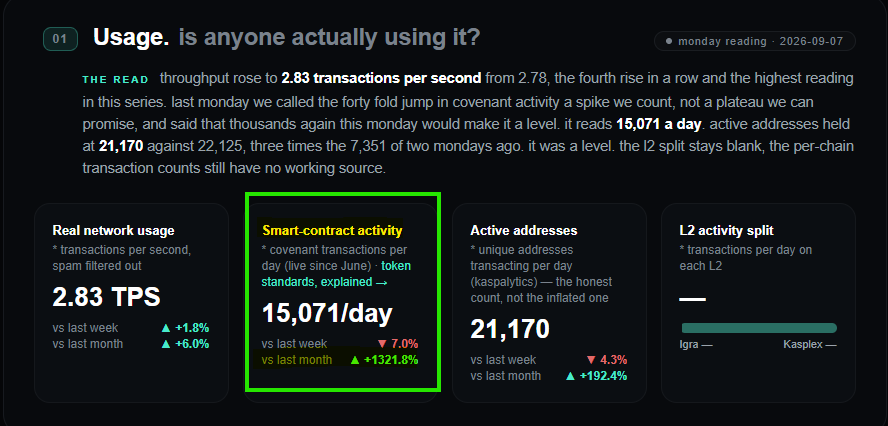
1️⃣ Toccata ist seit Ende Juni 2026 live.
Das Upgrade brachte Covenants auf Kaspa L1, also Kaspas eigene Variante von Smart Contracts:
🟢über 15K Covenant-Transaktionen pro Tag
⬆️+1.322 % gegenüber dem Vormonat
2️⃣ KuCoin-Adoption mit Kampagne
Seit 25. August können Nutzer über KuCoins Mining-Plattform KAS minen, ohne selbst einen ASIC zu kaufen.
3️⃣ DAGKnight rückt näher:
Entwickler arbeiten konkret am Weg zu einem öffentlichen Testnet. Am 31. August eröffnete Kaspa im GitHub den Arbeitspunkt „Launch and operate the public testnet“. DAGKnight läuft noch nicht im Mainnet.
Weitere Entwicklungen laufen im Bereich DeFi (Igra z.B.), aber ich glaube, das würde hier zu weit führen. Gern ein andermal😅
Cathie Wood explains WHY Ark Invest is still soo bullish on Bitcoin in September 2026:
• BTC vs gold "looks promising... a turn is in"
• 3 big revolutions: tech/global money/new asset class
• both a risk off & risk on asset
"We think Bitcoin is both a risk off and a risk on asset. So in the environment we see, we believe this ratio will continue to move up and go to all time highs."
"We think (Bitcoin) has miles to go."
Headlines are about to get crazy with the Fed & Clarity Act next week.
But zoom out.
Crypto has spent years compressed at the end of the risk curve. Economic expansion is starting to turn, and historically that’s when money finally starts flowing into crypto.
That’s the setup I’m watching.
#Qubic's deficit of mining power, used for #AI training, has led to an unexpected discovery.
We have found a way to train AI faster without adding more mining power. Hard to believe, but, unlike saying "Just stop being poor" to poor people, instructing AI to train faster does work.
Looks like we are updating the mining algo soon...
Das spricht klar für einen Bitcoin-Boden. 👇
Bei ca. $58.000 fiel der Long-Term Holder Supply in Profit in dieselbe Bodenregion wie 2018 und 2022.
Danach drehte der Indikator nach oben.
Historisch wurde das vorherige BTC-Tief anschließend nicht mehr unterschritten.
Jetzt sehen wir exakt diese Bewegung erneut.
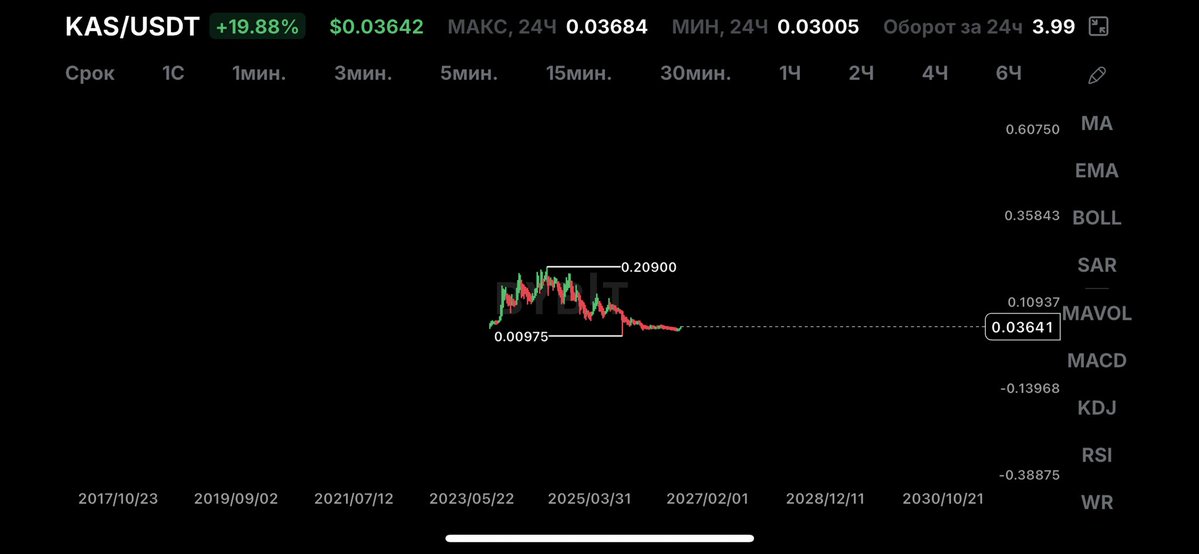
Kaspa is among the leading cryptocurrencies by gains over the past 24 hours.
After a prolonged period of weak price action and low volatility, KAS is showing renewed momentum and outperforming much of the broader crypto market.
Der Vermögensverwalter @Bitwise verweist in einem Report darauf, dass die rollierende 260-Tages-Korrelation von Bitcoin mit dem S&P 500 so niedrig ist wie zuletzt im Jahr 2015 – kurz bevor $BTC innerhalb von 2,5 Jahren um 9.800 % gestiegen ist. 👀
„Auch wenn wir eine Wiederholung einer solchen Entwicklung aufgrund der fortgeschrittenen Verbreitung von Bitcoin für eher unwahrscheinlich halten, deutet dies darauf hin, dass zwischen Bitcoin und US-Aktien ein gewisses Aufholpotenzial bestehen könnte.“
$KAS : Review 📜
What if proof-of-work was never actually slow, and the only thing holding it back was the decision to throw away every block that arrived at the same time as another?
Meet Kaspa, a blockDAG network that orders parallel blocks instead of discarding them, running at ten blocks per second on Bitcoin's security model. It launched with no premine, no ICO, no venture allocation, and the company that built it dissolved itself at launch. Every coin in circulation was mined in the open.
Let's explore the cleanest launch in crypto and the network built on it. 👇
⚪ Kaspa at a Glance
Marketplace Insight: Kaspa's tokenomics are arguably the cleanest of any project in this series, with a genuine fair launch, a hard cap, and 96% already mined, and its consensus derives from peer-reviewed research whose lineage runs into Ethereum's own whitepaper. Toccata shipped on schedule in June, bringing covenants and zero-knowledge verification to Layer 1, and the tooling has moved fast since, with SilverScript reaching a v1 release candidate and a conventions track standardizing how tokens will work across wallets and indexers. The clean contrast is between architecture and adoption. Kaspa has built genuine capacity, and covenant usage is compounding quickly from a small base, but the network still runs far below what it was engineered to handle.
⚪ Mission
Kaspa exists to prove that proof-of-work's limitations were architectural rather than fundamental. The founding argument is that Bitcoin's constraints, slow confirmations and low throughput, came from insisting a single chain must extend one block at a time, discarding everything produced in parallel as waste. GHOSTDAG orders those parallel blocks instead, which means the network can run far faster without lowering the security bar or pushing mining toward centralization. The goal is real-time decentralization: Bitcoin's trust model at a speed people can actually transact at.
🔵 A Brief History
Kaspa's intellectual lineage predates the project by nearly a decade. Yonatan Sompolinsky, researching under Professor Aviv Zohar at Hebrew University, published the GHOST protocol paper in 2013, work cited directly in the Ethereum whitepaper. That research line continued through SPECTRE and PHANTOM and eventually into GHOSTDAG, the consensus protocol Kaspa runs today, with Sompolinsky later moving to Harvard as a postdoctoral researcher on the MEV research team.
The implementation came through DAGLabs, an R&D company Sompolinsky founded with funding from Polychain Capital. What happened next is genuinely rare: rather than retaining an allocation or a governance role, DAGLabs was dissolved around the November 7, 2021 mainnet launch, transitioning the project entirely to a community-led model. The launch itself carried no premine, no ICO, no presale, and no insider or venture allocation.
The years since have been methodical engineering. The node software was rewritten entirely from Go into Rust, improving performance and reducing attack surface. The Crescendo hard fork activated on May 5, 2025, raising the block rate from one to ten per second while proportionally reducing block rewards so per-second emission stayed constant, and bringing KIP-9 storage-mass pricing with it. Toccata followed on June 30, 2026, introducing native covenants, Covenant IDs, zero-knowledge proof verification, and partitioned sequencing, moving Kaspa from a pure payments network toward programmability.
The months since have gone into making that programmability usable. SilverScript, the higher-level language compiling to Kaspa Script, reached a v1 release candidate at the end of August after a timelock bug fix and a type audit. A Kaspa Calls for Conventions track opened to standardize covenant interoperability across wallets and indexers, with builders testing a fungible-token convention against a testnet AMM. KaChat 4.0 shipped in late August as the first major consumer application expansion. DAGKnight, a successor consensus protocol with latency-adaptive ordering, has a dedicated testnet proposed and a late-Q3 target.
🔵 Ecosystem Narrative
The organizing idea is that parallel work should be ordered rather than wasted, and everything follows from that one architectural choice.
➛ GHOSTDAG consensus. Parallel blocks coexist and are ordered by the protocol rather than orphaned, so virtually no mining work is discarded, which is what allows high block rates without the centralization pressure that normally accompanies them.
➛ Peer-reviewed foundations. The consensus derives from published academic research at Hebrew University and Harvard, with the GHOST paper cited in Ethereum's whitepaper, giving the protocol a theoretical grounding most chains substitute with a marketing document.
➛ The Toccata upgrade, live. Native covenants, Covenant IDs, zero-knowledge proof verification, and partitioned sequencing activated on Layer 1 in June 2026, with SilverScript reaching a v1 release candidate to make covenants writable by ordinary developers rather than only protocol researchers.
➛ Consumer and DeFi applications. KaChat 4.0 shipped in late August with desktop and web support, Tangem hardware wallet integration, and KaPosts, an on-chain social layer tied to KNS identities, while Igra, a Kaspa-native L2, has become the busiest lane in daily activity snapshots at roughly 54,000 transactions in a sampled day.
➛ Mining decentralization. High block rates and the kHeavyHash algorithm make solo mining viable at lower hashrates, which is a structural argument for decentralization rather than an aspirational one.
➛ Smooth emission. Rewards decline monthly on a chromatic schedule based on the twelve-note musical scale rather than through halving cliffs, avoiding the abrupt miner revenue shocks that periodically destabilize other proof-of-work networks.
⚪ Token Utilities
$KAS is monetary rather than a fee-and-governance token.
➛ Mining rewards: miners earn KAS for securing the network, on a smoothly declining monthly emission against a fixed maximum supply.
➛ Transaction fees: paid in KAS for settlement on the network, with fees kept low by high throughput and KIP-9 storage-mass pricing.
➛ Settlement medium: the network's purpose is fast, final payment, so the token's primary utility is being used as money rather than as a claim on protocol revenue.
➛ Covenant and application layer: following Toccata, KAS underpins covenant transactions, zero-knowledge verification, and the token conventions being standardized for DeFi.
⚪ Key Features
➛ BlockDAG architecture ordering parallel blocks instead of discarding them.
➛ Ten blocks per second on a pure proof-of-work security model.
➛ A fair launch with no premine, ICO, presale, or venture allocation.
➛ A fixed 28.7 billion maximum supply with roughly 96% already mined.
➛ Peer-reviewed consensus research with a lineage into Ethereum's own whitepaper.
➛ Native L1 covenants and zero-knowledge verification since Toccata.
🔵 Meet the Team
Kaspa has no company, no foundation with a treasury, and no executive team. Its contributors are researchers and developers working on an open-source protocol, which is unusual enough to be the defining fact about its structure.
▶️ Core Members:
➛ Dr. Yonatan Sompolinsky [ @hashdag ] - Founder | A postdoctoral researcher at Harvard on the MEV research team, whose 2013 GHOST protocol paper is cited in the Ethereum whitepaper. His research line, developed under Professor Aviv Zohar at Hebrew University, runs through SPECTRE and PHANTOM into the GHOSTDAG protocol Kaspa uses today. Few founders in crypto have a comparable academic contribution to the field itself.
➛ Shai Wyborski [ @DesheShai ] - Researcher and GHOSTDAG co-author | A cryptography researcher who co-authored the GHOSTDAG protocol paper, meaning the consensus running the network was designed by people still actively maintaining it rather than handed off after publication.
➛ Elichai Turkel - Core Developer | Served as DAGLabs' applied cryptographer during development and is also a Bitcoin Core contributor, a meaningful credential for a project whose entire pitch is improving on Bitcoin's architecture without weakening its guarantees.
➛ Michael Sutton, Ori Newman, and Mike Zak - Core Developers | The engineering core behind the Rust rewrite and the Crescendo and Toccata implementations, with Newman still merging fixes into the SilverScript compiler as recently as August 2026.
➛ Anton Yemelyanov - Core Developer and Smart Contracts | Leads the smart contract and covenant workstream, the layer that turns Toccata from a protocol capability into something developers can actually build against.
➛ Chris Wolf, known as Wolfie [ @Kaspa_HypeMan ] - Chris Wolf, known as Wolfie - Business Development and Listings | With no company to employ a BD department, Wolfie took on exchange outreach himself, adopting the title because listing desks wanted a named contact, and has spent years in conversations across venues including MEXC, Gate, KuCoin, Bitget, and Kraken. A crypto veteran who mined Bitcoin early and found Kaspa near the fair launch, he is the connective tissue between a distributed holder base and rooms that would otherwise have nobody to call. That a treasury-less project sustains this function on volunteer effort says a lot about the community behind it.
🔵 Ratings
➛ Use Case: ★★★★⯪ (4.5/5). Kaspa leads the category it created and has delivered on every technical promise it made. It took proof-of-work from one block per second to ten while preserving mining decentralization, backed by peer-reviewed research rather than assertion, and validated across billions of transactions without congestion or fee spikes. Toccata shipped on schedule, bringing native covenants, Covenant IDs, and zero-knowledge verification to Layer 1, and the tooling followed immediately with SilverScript nearing v1 and a conventions track standardizing tokens across wallets and indexers. Covenant activity has grown 15-fold since launch, KaChat 4.0 has brought on-chain social and payments to desktop and mobile, and Igra is running tens of thousands of daily L2 transactions. The 0.5-point deduction is that the ecosystem is young, with programmability only months old and network utilization still well below the capacity the architecture provides.
➛ Tokenomics: ★★★★⯪ (4.5/5). This is among the cleanest supply structures in crypto, full stop. A genuine fair launch with no premine, no ICO, no presale, and no insider or venture allocation, meaning every coin in existence was mined in the open. A hard maximum supply of 28.7 billion with roughly 96% already mined, so there is no unlock overhang, no vesting cliff, and no treasury capable of dumping. Emissions decline smoothly month by month rather than through halving cliffs, avoiding the miner revenue shocks that destabilize other proof-of-work networks, and DAGLabs dissolved rather than retaining a position. The 0.5-point deduction is that KAS has no burn mechanism or fee capture beyond mining rewards, so value accrual depends entirely on the network being adopted as money.
➛ Audits: ★★★★ (4/5). Kaspa's security foundations are unusually strong and sit largely outside the conventional audit framework. The consensus protocol is peer-reviewed academic research from Hebrew University and Harvard rather than an internal specification, with its co-author still maintaining the network. The node software was deliberately rewritten from Go into Rust to reduce attack surface, a Bitcoin Core contributor serves as a core developer, and the network has run since November 2021 across two major hard forks without a protocol-level exploit. Development is fully open source with public code review, and the SilverScript timelock bug found and fixed in August demonstrates that review process working. The 1-point deduction is that no named third-party security audit or verified security score is published, and the covenant and zero-knowledge surface introduced by Toccata is new enough that formal external review would meaningfully strengthen confidence.
➛ Community: ★★★★★ (5/5). Kaspa's community is the purest example of organic growth in crypto, and the structure explains why. There was no airdrop to farm, no venture backing to court influencers, no foundation marketing budget, and no company to promote it, because DAGLabs dissolved at launch. What grew instead was a global base of miners with real hardware and capital deployed alongside an ideologically committed holder base, and it held through a deep drawdown and years of quiet building. The development itself is community-run: independent contributors opened the DAGKnight testnet proposal, built KaChat and Igra, drive the conventions standards process, and even handle exchange listings without a budget to fund it. Very few projects at any market cap sustain this level of unpaid, distributed contribution across protocol research, application development, and ecosystem work simultaneously.
🔵 Conclusion
Kaspa is what happens when a researcher whose work is cited in Ethereum's own whitepaper decides to fix the thing everyone assumed was permanent about proof-of-work. The blockDAG orders parallel blocks rather than wasting them, GHOSTDAG delivers ten blocks per second on Bitcoin's security model, and the whole thing launched with no premine, no ICO, no venture allocation, and a development company that dissolved itself rather than retain influence. Roughly 96% of a hard-capped supply is already mined, and Toccata has now brought covenants and zero-knowledge verification to Layer 1 on schedule.
The bull case is unusually pure. If proof-of-work settlement matters over decades rather than cycles, Kaspa is the only network that has meaningfully improved the architecture without compromising the trust model, and it did so with a distribution nobody can criticize because there was nothing to criticize. Kaspa spent five years proving the technology works, and it now has the programmability to prove the rest. What comes next is whether the world decides it needs a settlement layer this good.




![0xchainink's tweet photo. $KAS : Review 📜
What if proof-of-work was never actually slow, and the only thing holding it back was the decision to throw away every block that arrived at the same time as another?
Meet Kaspa, a blockDAG network that orders parallel blocks instead of discarding them, running at ten blocks per second on Bitcoin's security model. It launched with no premine, no ICO, no venture allocation, and the company that built it dissolved itself at launch. Every coin in circulation was mined in the open.
Let's explore the cleanest launch in crypto and the network built on it. 👇
⚪ Kaspa at a Glance
Marketplace Insight: Kaspa's tokenomics are arguably the cleanest of any project in this series, with a genuine fair launch, a hard cap, and 96% already mined, and its consensus derives from peer-reviewed research whose lineage runs into Ethereum's own whitepaper. Toccata shipped on schedule in June, bringing covenants and zero-knowledge verification to Layer 1, and the tooling has moved fast since, with SilverScript reaching a v1 release candidate and a conventions track standardizing how tokens will work across wallets and indexers. The clean contrast is between architecture and adoption. Kaspa has built genuine capacity, and covenant usage is compounding quickly from a small base, but the network still runs far below what it was engineered to handle.
⚪ Mission
Kaspa exists to prove that proof-of-work's limitations were architectural rather than fundamental. The founding argument is that Bitcoin's constraints, slow confirmations and low throughput, came from insisting a single chain must extend one block at a time, discarding everything produced in parallel as waste. GHOSTDAG orders those parallel blocks instead, which means the network can run far faster without lowering the security bar or pushing mining toward centralization. The goal is real-time decentralization: Bitcoin's trust model at a speed people can actually transact at.
🔵 A Brief History
Kaspa's intellectual lineage predates the project by nearly a decade. Yonatan Sompolinsky, researching under Professor Aviv Zohar at Hebrew University, published the GHOST protocol paper in 2013, work cited directly in the Ethereum whitepaper. That research line continued through SPECTRE and PHANTOM and eventually into GHOSTDAG, the consensus protocol Kaspa runs today, with Sompolinsky later moving to Harvard as a postdoctoral researcher on the MEV research team.
The implementation came through DAGLabs, an R&D company Sompolinsky founded with funding from Polychain Capital. What happened next is genuinely rare: rather than retaining an allocation or a governance role, DAGLabs was dissolved around the November 7, 2021 mainnet launch, transitioning the project entirely to a community-led model. The launch itself carried no premine, no ICO, no presale, and no insider or venture allocation.
The years since have been methodical engineering. The node software was rewritten entirely from Go into Rust, improving performance and reducing attack surface. The Crescendo hard fork activated on May 5, 2025, raising the block rate from one to ten per second while proportionally reducing block rewards so per-second emission stayed constant, and bringing KIP-9 storage-mass pricing with it. Toccata followed on June 30, 2026, introducing native covenants, Covenant IDs, zero-knowledge proof verification, and partitioned sequencing, moving Kaspa from a pure payments network toward programmability.
The months since have gone into making that programmability usable. SilverScript, the higher-level language compiling to Kaspa Script, reached a v1 release candidate at the end of August after a timelock bug fix and a type audit. A Kaspa Calls for Conventions track opened to standardize covenant interoperability across wallets and indexers, with builders testing a fungible-token convention against a testnet AMM. KaChat 4.0 shipped in late August as the first major consumer application expansion. DAGKnight, a successor consensus protocol with latency-adaptive ordering, has a dedicated testnet proposed and a late-Q3 target.
🔵 Ecosystem Narrative
The organizing idea is that parallel work should be ordered rather than wasted, and everything follows from that one architectural choice.
➛ GHOSTDAG consensus. Parallel blocks coexist and are ordered by the protocol rather than orphaned, so virtually no mining work is discarded, which is what allows high block rates without the centralization pressure that normally accompanies them.
➛ Peer-reviewed foundations. The consensus derives from published academic research at Hebrew University and Harvard, with the GHOST paper cited in Ethereum's whitepaper, giving the protocol a theoretical grounding most chains substitute with a marketing document.
➛ The Toccata upgrade, live. Native covenants, Covenant IDs, zero-knowledge proof verification, and partitioned sequencing activated on Layer 1 in June 2026, with SilverScript reaching a v1 release candidate to make covenants writable by ordinary developers rather than only protocol researchers.
➛ Consumer and DeFi applications. KaChat 4.0 shipped in late August with desktop and web support, Tangem hardware wallet integration, and KaPosts, an on-chain social layer tied to KNS identities, while Igra, a Kaspa-native L2, has become the busiest lane in daily activity snapshots at roughly 54,000 transactions in a sampled day.
➛ Mining decentralization. High block rates and the kHeavyHash algorithm make solo mining viable at lower hashrates, which is a structural argument for decentralization rather than an aspirational one.
➛ Smooth emission. Rewards decline monthly on a chromatic schedule based on the twelve-note musical scale rather than through halving cliffs, avoiding the abrupt miner revenue shocks that periodically destabilize other proof-of-work networks.
⚪ Token Utilities
$KAS is monetary rather than a fee-and-governance token.
➛ Mining rewards: miners earn KAS for securing the network, on a smoothly declining monthly emission against a fixed maximum supply.
➛ Transaction fees: paid in KAS for settlement on the network, with fees kept low by high throughput and KIP-9 storage-mass pricing.
➛ Settlement medium: the network's purpose is fast, final payment, so the token's primary utility is being used as money rather than as a claim on protocol revenue.
➛ Covenant and application layer: following Toccata, KAS underpins covenant transactions, zero-knowledge verification, and the token conventions being standardized for DeFi.
⚪ Key Features
➛ BlockDAG architecture ordering parallel blocks instead of discarding them.
➛ Ten blocks per second on a pure proof-of-work security model.
➛ A fair launch with no premine, ICO, presale, or venture allocation.
➛ A fixed 28.7 billion maximum supply with roughly 96% already mined.
➛ Peer-reviewed consensus research with a lineage into Ethereum's own whitepaper.
➛ Native L1 covenants and zero-knowledge verification since Toccata.
🔵 Meet the Team
Kaspa has no company, no foundation with a treasury, and no executive team. Its contributors are researchers and developers working on an open-source protocol, which is unusual enough to be the defining fact about its structure.
▶️ Core Members:
➛ Dr. Yonatan Sompolinsky [ @hashdag ] - Founder | A postdoctoral researcher at Harvard on the MEV research team, whose 2013 GHOST protocol paper is cited in the Ethereum whitepaper. His research line, developed under Professor Aviv Zohar at Hebrew University, runs through SPECTRE and PHANTOM into the GHOSTDAG protocol Kaspa uses today. Few founders in crypto have a comparable academic contribution to the field itself.
➛ Shai Wyborski [ @DesheShai ] - Researcher and GHOSTDAG co-author | A cryptography researcher who co-authored the GHOSTDAG protocol paper, meaning the consensus running the network was designed by people still actively maintaining it rather than handed off after publication.
➛ Elichai Turkel - Core Developer | Served as DAGLabs' applied cryptographer during development and is also a Bitcoin Core contributor, a meaningful credential for a project whose entire pitch is improving on Bitcoin's architecture without weakening its guarantees.
➛ Michael Sutton, Ori Newman, and Mike Zak - Core Developers | The engineering core behind the Rust rewrite and the Crescendo and Toccata implementations, with Newman still merging fixes into the SilverScript compiler as recently as August 2026.
➛ Anton Yemelyanov - Core Developer and Smart Contracts | Leads the smart contract and covenant workstream, the layer that turns Toccata from a protocol capability into something developers can actually build against.
➛ Chris Wolf, known as Wolfie [ @Kaspa_HypeMan ] - Chris Wolf, known as Wolfie - Business Development and Listings | With no company to employ a BD department, Wolfie took on exchange outreach himself, adopting the title because listing desks wanted a named contact, and has spent years in conversations across venues including MEXC, Gate, KuCoin, Bitget, and Kraken. A crypto veteran who mined Bitcoin early and found Kaspa near the fair launch, he is the connective tissue between a distributed holder base and rooms that would otherwise have nobody to call. That a treasury-less project sustains this function on volunteer effort says a lot about the community behind it.
🔵 Ratings
➛ Use Case: ★★★★⯪ (4.5/5). Kaspa leads the category it created and has delivered on every technical promise it made. It took proof-of-work from one block per second to ten while preserving mining decentralization, backed by peer-reviewed research rather than assertion, and validated across billions of transactions without congestion or fee spikes. Toccata shipped on schedule, bringing native covenants, Covenant IDs, and zero-knowledge verification to Layer 1, and the tooling followed immediately with SilverScript nearing v1 and a conventions track standardizing tokens across wallets and indexers. Covenant activity has grown 15-fold since launch, KaChat 4.0 has brought on-chain social and payments to desktop and mobile, and Igra is running tens of thousands of daily L2 transactions. The 0.5-point deduction is that the ecosystem is young, with programmability only months old and network utilization still well below the capacity the architecture provides.
➛ Tokenomics: ★★★★⯪ (4.5/5). This is among the cleanest supply structures in crypto, full stop. A genuine fair launch with no premine, no ICO, no presale, and no insider or venture allocation, meaning every coin in existence was mined in the open. A hard maximum supply of 28.7 billion with roughly 96% already mined, so there is no unlock overhang, no vesting cliff, and no treasury capable of dumping. Emissions decline smoothly month by month rather than through halving cliffs, avoiding the miner revenue shocks that destabilize other proof-of-work networks, and DAGLabs dissolved rather than retaining a position. The 0.5-point deduction is that KAS has no burn mechanism or fee capture beyond mining rewards, so value accrual depends entirely on the network being adopted as money.
➛ Audits: ★★★★ (4/5). Kaspa's security foundations are unusually strong and sit largely outside the conventional audit framework. The consensus protocol is peer-reviewed academic research from Hebrew University and Harvard rather than an internal specification, with its co-author still maintaining the network. The node software was deliberately rewritten from Go into Rust to reduce attack surface, a Bitcoin Core contributor serves as a core developer, and the network has run since November 2021 across two major hard forks without a protocol-level exploit. Development is fully open source with public code review, and the SilverScript timelock bug found and fixed in August demonstrates that review process working. The 1-point deduction is that no named third-party security audit or verified security score is published, and the covenant and zero-knowledge surface introduced by Toccata is new enough that formal external review would meaningfully strengthen confidence.
➛ Community: ★★★★★ (5/5). Kaspa's community is the purest example of organic growth in crypto, and the structure explains why. There was no airdrop to farm, no venture backing to court influencers, no foundation marketing budget, and no company to promote it, because DAGLabs dissolved at launch. What grew instead was a global base of miners with real hardware and capital deployed alongside an ideologically committed holder base, and it held through a deep drawdown and years of quiet building. The development itself is community-run: independent contributors opened the DAGKnight testnet proposal, built KaChat and Igra, drive the conventions standards process, and even handle exchange listings without a budget to fund it. Very few projects at any market cap sustain this level of unpaid, distributed contribution across protocol research, application development, and ecosystem work simultaneously.
🔵 Conclusion
Kaspa is what happens when a researcher whose work is cited in Ethereum's own whitepaper decides to fix the thing everyone assumed was permanent about proof-of-work. The blockDAG orders parallel blocks rather than wasting them, GHOSTDAG delivers ten blocks per second on Bitcoin's security model, and the whole thing launched with no premine, no ICO, no venture allocation, and a development company that dissolved itself rather than retain influence. Roughly 96% of a hard-capped supply is already mined, and Toccata has now brought covenants and zero-knowledge verification to Layer 1 on schedule.
The bull case is unusually pure. If proof-of-work settlement matters over decades rather than cycles, Kaspa is the only network that has meaningfully improved the architecture without compromising the trust model, and it did so with a distribution nobody can criticize because there was nothing to criticize. Kaspa spent five years proving the technology works, and it now has the programmability to prove the rest. What comes next is whether the world decides it needs a settlement layer this good.](https://pbs.twimg.com/media/HRmqslZbwAAXeZ8.jpg)


