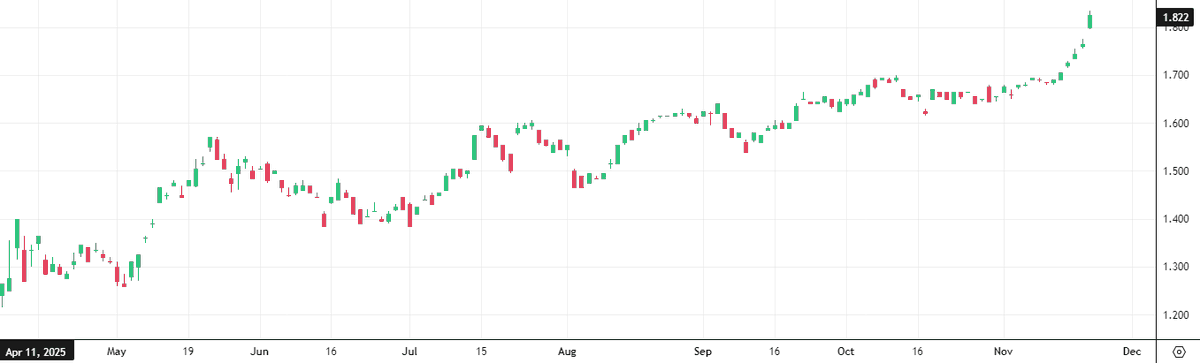
While inventor focus is on NVIDA results and delayed US economic data, the single most important development in markets at the moment is surging long #JGB yields imo. The 10 year has broken out and jumped to 1.82% today (chart below). Is this what breaks the equity bull market?
A Few Thoughts on Trump’s 39% Tariff on Swiss Imports as announced on our National Day (1 August commemorates the founding of the Swiss Confederation in 1291).
Clearly, Keller-Sutter is no match for Trump’s ego. That, according to Bloomberg, was the real issue and I wouldn’t be surprised if this isn’t the final number. But that’s beside the point.
For decades, the relentlessly strong Swiss franc forced our industrial base to evolve. Labor-intensive sectors like textiles vanished. What remains is ultra-specialized, high-margin, low-volume manufacturing. Precision over scale. Expertise over replication.
Take VAT Group—maker of the world’s best vacuum valves for semiconductors, with an 85% global market share. Volumes are low, clients few. A second plant? Economically senseless—especially in the U.S., where demand is thin.
Lantal, based in Langenthal, leads in flame-resistant aircraft textiles, supplying both Airbus and Boeing—Airbus being top, Boeing likely second. High-spec, low-volume, irreplicable.
Swatch Group operates within the watchmaking ecosystem of Jura and Neuchâtel, where ~95% of mechanical movements are produced—by Swatch, Rolex, and Patek Philippe. The rest of the world? Mostly design and assembly. Not real manufacturing.
These aren’t exceptions—they’re the rule. For 50+ years, the Swiss franc has priced out commodity production. Only firms with pricing power, deep moats, or tight local ecosystems survived. With a tiny domestic market, internationalization was a necessity, not a choice.
Today, Switzerland dominates niches: luxury watches, pharma, med tech (Straumann, Synthes, Stratec), financial services (UBS, Swiss Re), inspection (SGS), premium chocolate (Lindt), food (Nestlé), precision machinery (ABB), and tech R&D (ETH, Google, Microsoft, Meta, OpenAI).
This model is fundamentally incompatible with Trump’s “bring manufacturing home” mantra. Swiss factories won’t relocate. Tariffs won’t change that.
Germany can adapt—Mercedes can expand U.S. output to hedge FX and tariff risk. Switzerland can’t. “Swiss made” is niche, immobile, and precision-built.
Meanwhile, we import nearly everything else—cars, appliances, food, raw materials. Switzerland is a textbook case of high-value specialization and free trade, just as Milton Friedman described.
So what does a 39% tariff do? Trigger workarounds. Americans will still buy Rolexes—tariff or not. Likely here on Bahnhofstrasse in Zurich.
Trump’s logic collapses. It’s neither strategic nor economic. And no, Switzerland hasn’t “taken advantage” of the U.S. We specialized—just as classical trade theory prescribes.
Also: we’re not China. No subsidized overcapacity. No dumping. No labor abuse. No IP theft. We follow WTO rules. Our manufacturing jobs are among the best-paid globally. And we’re the only direct democracy globally (all others are indirectly democracies)—hardly a CCP clone.
So what exactly is Trump trying to fix?
Switzerland is comparative advantage, executed. No, it doesn’t deliver balanced trade for every nation. It’s not meant to. We export what we excel at—and import the rest.
Trump’s tariff push looks less like policy and more like politics: revenue-driven, reactionary, and ego-fueled. Sometimes disruption is needed. But this is pure economic illiteracy.
In the end, nobody wins. Rolex and Novartis won’t eat the cost. U.S. consumers will. Sales may dip—but Rolex won’t blink—believe me; not in the next 100 years and as long as humans seek status symbols.
It’s a textbook lose-lose.
We're about to get dragged into nation-building 2.0
Israel has formally requested a direct US intervention in its war against Iran. The intervention itself will seem easy, relatively speaking. It's the aftermath you should worry about. What we're likely looking at is yet another nation-building exercise in the Middle East—except on a much vaster and more complex scale than anything attempted in the post-9/11 wars.
In other words: another decade or two wasted in the Middle East. If you don't want that, pray for rapid de-escalation.
I should know: I wrote one of a very few attempts at imagining, concretely, what a post-Islamic Republic scenario might look like (I'll link it in a reply here). That was in 2012, when I was younger and more naive about the limits of American power. But also: when Washington was still basking in the (admittedly fading) glow of the unipolar moment.
So let's try to re-imagine things for our moment.
1. The false premise: First, it's worth noting that in the lead-up to this war, hawkish voices in Washington and Jerusalem insisted that it would just be a matter of getting out of Israel's way. "This isn't nation-building or US boots on the ground," they said. "We should simply allow our allies to fight their various regional battles."
Well--here we are. The Israelis have now sought direct US involvement.
But even if Team Trump doesn't directly join the fighting, American boots will end up on the ground, and on a massive scale, because regime collapse, the apparent Israeli goal, will be a colossal headache. Israeli bombing will break the Iranian state, and then the Israelis will "internationalize" the aftermath. Because Israel itself neither can nor wants to put the pieces back together.
In reality, "internationalization" will end up meaning: Uncle Sam, roll up your sleeves. The Europeans can only contribute marginally. The Persian Gulf monarchies might throw money at it, but they can't and won't do the lifting. Russia will remain distracted by Ukraine. The Chinese will opportunistically pick up scraps; but Beijing won't lift a finger to repair what it didn't break.
As much as we might talk about a post-hegemony moment, these other actors will still try to get the declining hegemon to solve problems of that scale. And they will say, with some justice, "Look, it was your client that broke it, with your apparent approval. So pretty please, get to work." So let's outline the crises.
2. State authority: This is the biggest one, obviously, and it contours all the others. The central problematic of Iranian history is the relationship between state and society. What the optimistic hawks will say is that Iran isn't Iraq. It's not an artificial creation imposed on Arab and Kurd, Sunni and Shiite. For millennia, Iran's constituent ethnicities have related to each other organically as Iranians.
This is true. But it doesn't get us around the steep struggle to stabilize relations between state and society in the aftermath of a collapse. The unchanging principle of Iranian political life has been estebdad, or arbitrary rule, and it remains so today.
One defining feature was state ownership of all land. The state could grant plots to various classes as a special privilege, but never as a matter of right. Moreover, all economic activity, agricultural or otherwise, involved winning the favor of the state. "Social classes did not enjoy any rights independent from the state," as the Oxford historian Homa Katouzian has noted, and "there was no law outside the state, which stood above society, despite a body of rules that were subject to rapid and unpredictable change." Thus, "unlike in Europe, the state’s legitimacy was not founded in law and the consent of influential social classes." From the satrap to the peasant, all lived in fear and at the mercy of the state.
The arbitrariness of power extended to its source at the throne. Rulers exercised power because they possessed divine grace, and they possessed divine grace because they exercised power. Rebellion was thus a fine way to seize power, so long as you succeeded. If you didn’t, you might have been beheaded if you were lucky, or had boiling oil poured down your throat if you weren’t. With no formal rules of primogeniture, the death of each shah triggered a succession crisis. The heirs-designate blinded or castrated male siblings to secure their own ascent.
Estebdad etched itself into Persian culture. Poetry reached sublime heights precisely through obliqueness, conversation turned indirect—a mask against repression. The ornate manners of Iranians relate to this, as well. The result: brilliance in individuals, but chronic distrust in society. Without lasting institutions or principles, Iran's politics swing between bursts of idealism and long stretches of cynicism. Justice depends not on systems, but on the temperament of rulers.
I don't have an answer to this problem and how it might ramify post-collapse. But then again, I'm not the one pushing for escalation and ignoring the aftermath problem. The answer that the Israelis and American hawks seem to have settled on is the person of Reza Pahlavi, heir to the final dynasty. There is some appeal to a monarchic restoration, to be sure. A shah can serve as a visible symbol of unity and continuity.
But Pahlavi has not inspired confidence in recent years. Collaborators I know have described him as lazy, incurious. One doesn't see much of that trim Cossack's austerity and steel that allowed his grandfather to forge a modern nation-state out of the malaria-ridden had-been Persian Empire.
Reza (the grandson) made a grave mistake, in my estimation, by seeming too eager to be parachuted onto the Peacock Throne by an IAF F-35.
Then, too, we don't know how Iranian society's perception of the throne has shifted after nearly five decades of rule by a theocracy with republic elements. Anyone who confidently says, "Iranians await their king" is larping.
But his character and capabilities are finally beside the point. The real issue is that even if he were a supremely popular character, he would need massive outside assistance to even begin to assert control over the capital region, let alone a far-flung country of 90 million souls. . . . Which brings us to the other crises.
Call them headaches from hell.
3. Separatism: Although Iran was called "Persia" by the ancient Greeks, Persians make up only a bare majority of the country. About a quarter are Azeri or Turkic people, including, by the way, the supreme leader. There are Kurds, Lors, Baluch, Arabs, and smaller gropus. And again, it's true that Iranian identity binds these peoples together in a way that is not true of "artificial" states Iraq or Lebanon.
Even so, in part as a result of the Islamic Republic's maltreatment, that organic identity has frayed somewhat. More to the point, various external actors like the Baku regime in Azerbaijan and the PKK movement are bent on carving out Iranian territory. They are sure to capitalize on the instability that follows a regime collapse.
Now you might say, "Good! Who cares! Let Iran get broken up." Except, remember our main problem: maintaining a legitimate central authority that relates in a stable way with its society. Whether the West tries to install Pahlavi or social democrats or whoever, that central authority cannot be seen to compromise on Iran's territorial integrity. If it does, it collapses. If it doesn't, civil war.
And there you have the recipe for a civil war, with ethnic, sectarian, and ideological dimensions, that can radiate instability into Iraq, Turkey, Azerbaijan, Pakistan, Afghanistan, and elsewhere, places where the US has troops, allies, and serious interests. Madness!
4. Regime remnants: The hawks insist that only a tiny minority of Iranians supports the regime; everyone else, in this telling, is a mini-skirt-wearing, underground-rave-attending spiritual denizen of LA or Miami, who just happens to be living in Iran. Nonsense. There is no way to scientifically poll Iranian society, and I'm always frustrated when asked to offer a back-of-the-envelope breakdown of what share of the society is opposed to the regime, etc. What we do know is that the Islamic Republic enjoys a core of support among a not-significant share of the population, either as a result of Islamic ideological combination or the material benefits they and their family members have drawn through membership in groups like the IRGC and the basij paramilitia.
Plus, even the secularist-minded opponents of the regime are by most accounts rallying to the flag as we speak. I made numerous phone calls inside the country yesterday, and the impression I got was that the nezam and the people are being brought closer as a result of the Israeli actions. The state-society alienation is dissipating somewhat, as popular athletes make military salutes in solidarity with the armed forces, etc.
Maybe that rally-to-the-flag effect won't last as the invasion continues, but you have to ask yourself: How likely is it that this new, post-Islamic Republic regime will have to confront a remnant of some size? I'd say highly likely, which is another reason why it's folly to believe that the regime can be collapsed without American forces having to stand up a new state.
5. Nukes and Hormuz
Remember the separatist polycrisis above? Well, among those groups are hard-core Sunni Islamists inspired by different shades of Al Qaeda/ISIS ideology. Now, keep in mind that Iran is also home to a near-completed nuclear program. Who is going to secure said program against said Islamists or other interlopers? That's right---the United States.
Iran also sits on the Strait of Hormuz, through which travels 20 percent of the world's energy. If radicals take it over, who do you think will be tasked with dislodging them and securing Hormuz? The French? The Germans? The Malaysians? No, it's going to American troops.
Maybe Israel's military maximalism is so valuable to America that it's worth bearing all these risks and costs and burdens.
Or maybe Washington can truly shirk the aftermath, thus encouraging other actors to take it up. Maybe China will step in, after all, given its dependence on Iranian energy. But then you have China expanding its footprint, which sort of defeats the logic of containing Beijing and the whole pivot to Asia.
But I simply don't see America being able to stay away, even in a post-hegemony environment, because the Gulfies and others will demand it, and they have enough sway within the US alliance architecture that we won't be able to remain deaf to the demand.
Lyn Alden gave one of the clearest breakdowns of why the U.S. is on an unstoppable fiscal path—and why Bitcoin matters more than ever because of it.
@LynAldenContact walks through the numbers behind the federal deficit, interest expenses, Social Security, and the structural changes that happened post-2008. The short version? We’re in a new era. One where the government can’t slow down even if it wanted to.
The debt is compounding. The interest expense is rising. The trust funds are running dry. And the political will to do anything about it doesn’t exist.
Her phrase: “Nothing stops this train.” Not because of ideology, but because of math—and human nature.
This isn’t hyperinflation doom-talk. It’s a sober look at what happens when a system built on ever-growing debt reaches its limits—and why Bitcoin, with its fixed supply and transparent rules, is the opposite of that system.
Highly recommend watching this one all the way through.
That's a wrap!
Hope you enjoyed it.
If you find this post helpful, please :
1. Follow me @Piyushkumar420 for more.
2. Like/Repost the first tweet below for support.
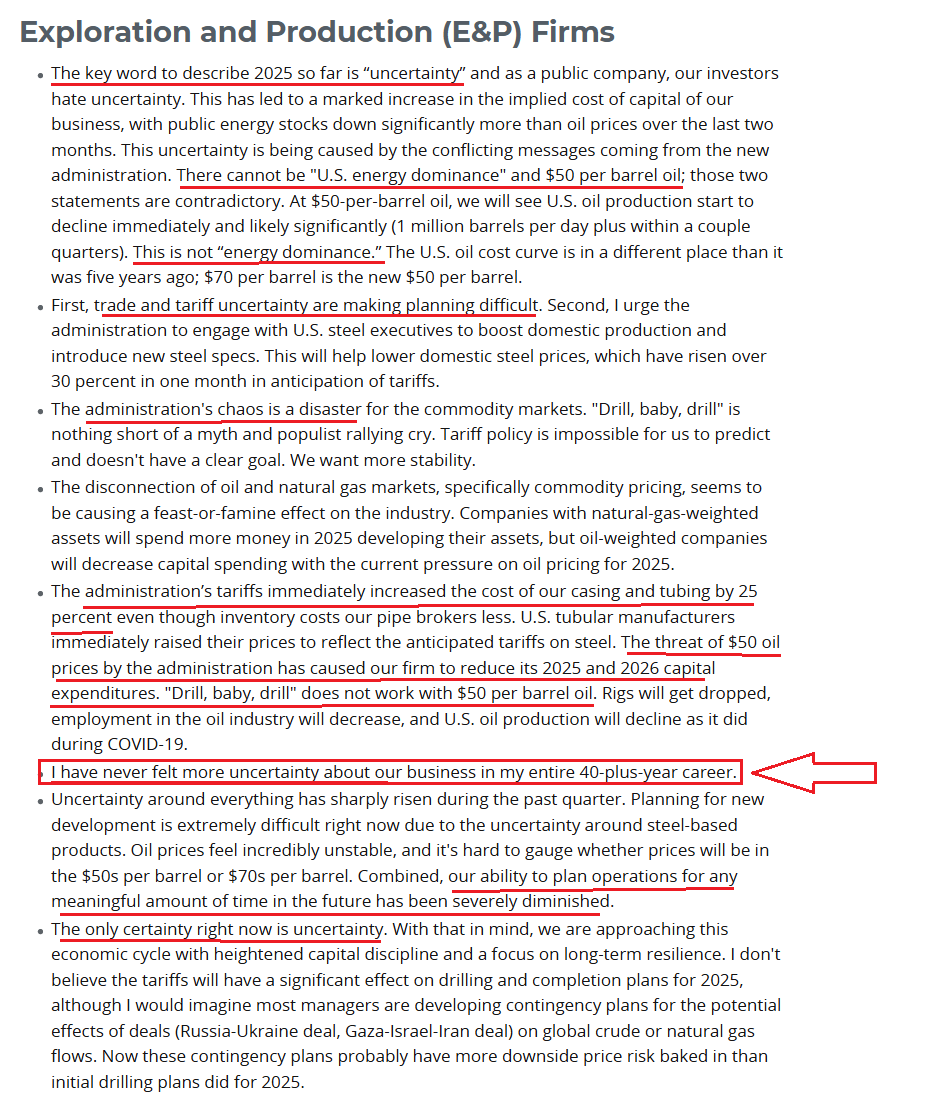
If you were to awake today for the first time in 6 months and read the @DallasFed quarterly energy survey, you may think Joe Biden is still at the White House.
Few times have I seen the American oil and gas industry so unhappy with Washington's policy | #OOTT
The end.
If you enjoyed this thread:
1. Follow me @TomasGreif - I'm the Chief of Product and Strategy at @braiins, for more tweets about bitcoin and mining.
2. Retweet this to help others learn about how governments can use currency to steal from their citizens.
"God Jesus Christ".
Contrary to the suggestions of many scholars, it seems early Christians did in fact believe Jesus was the son of God from the very beginning...
Pete Speaks Part 2 November 1, 2024
I discuss employment #, stocks, big trouble brewing in bonds, metals and the biggest ponzi-scheme of all-time, BITCON
https://t.co/Gx64MdM1as #StockMarket#bond#economy#debt#GOLD
I try to break down the power and necessity of the Bitcoin <> Nostr <> Ecash stack in 15 minutes
Things can seem unimaginably tough
But don't despair: instead, try to channel that frustration into helping others
We have the supertools to build a new future. Join us!