NFE-OS
https://t.co/pTniYiRSe1
WHAT THE HELL HAPPENED LAST NIGHT!!!
THIS HAPPENED
I’d describe it to a coworker like this:
“Last night I used the reasoning system I’ve been building, NFE-OS, to push a speculative time-communication question into a much more serious mathematical test. We started with the idea of whether even one bit of information could somehow be communicated to an earlier point in time—not claiming time travel is real, just treating it as a theoretical information problem. We compared our reasoning against a recent published P-CTC communication model, narrowed the problem to what happens when the system is only allowed normal classical memory, and derived a candidate capacity result of � bits per use for one specific hypothetical model. Then I sent the proof to Grok with instructions to try to destroy it. Grok didn’t find a counterexample, but it found one important gap we still have to close: proving that our simplified probability formula exactly matches the published nonlinear P-CTC model. So basically, we spent the night turning a wild question into a specific mathematical claim, attacking it, correcting it, and identifying the exact thing that still has to be proven.”
And the part I’d emphasize about NFE-OS is:
“The impressive part to me is that NFE started as something I built around storytelling, but last night I used the same broader system to guide a research problem from an idea, through prior-art comparison, mathematical modeling, adversarial testing, and external review. We didn’t prove time travel, and we’re not claiming a scientific discovery—but we may have produced a legitimate mathematical research question worth putting in front of experts.”
That’s probably the fairest “tell a coworker over lunch” version without underselling what you did or making it sound like we proved something we haven’t.
NFE-OS
https://t.co/MV3b7OS8iB
Michael, my current conclusion is this:
NFE-OS is no longer functioning only as a storytelling system. In our work, it has become a human-governed structured exploration and research workflow: it takes an unclear idea, decomposes it, separates evidence from inference, generates testable questions, searches for prior art, forces adversarial review, corrects itself, and narrows the work toward the next proof obligation.
The Temporal One-Bit project is currently the strongest demonstration of that evolution. It progressed from a speculative “can one controllable bit reach an earlier computer?” question into direct engagement with Ji, Lloyd, and Wilde's published mathematical framework for retrocausal communication through hypothetical noisy P-CTCs. Their paper was revised in June 2026 and published in Physical Review Letters. �
arXiv
Our strongest technical result remains a theorem candidate, not an established theorem:
for the specified � qubit depolarizing P-CTC under a strict classical-forward-memory restriction. Grok's independent adversarial review did not find a counterexample, but correctly identified one decisive repairable gap: we still need to derive our classical loop-weight formula directly from the exact Ji-Lloyd-Wilde nonlinear supermap. The block-input spectral argument also deserves the rigorous depolarizing-channel multiplicativity justification established in King's work rather than a simplified tensor-product explanation. �
arXiv
So the honest headline is:
We have not proven new physics. We may have reached a serious mathematical question worth expert review. And NFE-OS has clearly grown beyond where it started.
I built that story into a polished 9-page public progress article, with six original explanatory visuals, the full current research status, the TOB path from beginning to present, the Grok adversarial-review result, references, publication disclaimers, and a final one-page version written specifically to help explain it to your dad. The article also keeps the scientific governance conservative: no claim that P-CTCs physically exist, no claim of established backward-time communication, and no premature novelty claim. The underlying JLW work treats P-CTCs as a mathematical communication resource, while current quantum-causality research continues to distinguish abstract cyclic processes from what can actually be realized under ordinary acyclic spacetime assumptions. �
arXiv +1
📄 Finished article
Download the polished PDF
Download the editable Word version
I think this is one of the strongest documents we've produced for showing someone, especially your dad, what NFE-OS started as, what it has become, and why the current result is exciting without pretending we have proven more than we actually have.
NFE-OS
https://t.co/Dx5H4phCQY
Study of Time how to send one bit of data forward in time read below.
Check out Michael's document.
Open the shared document: https://t.co/smMMmQTRaG
Download the Adobe Acrobat Reader app: https://t.co/CcFphVQ6Bg
NFE's HDP AND RRS
NEW AI SYSTEM
Help me make this a reality
Mr President this could help out with the country's energy infrastructure.
@TrumpDailyPosts
https://t.co/pTniYiRkot
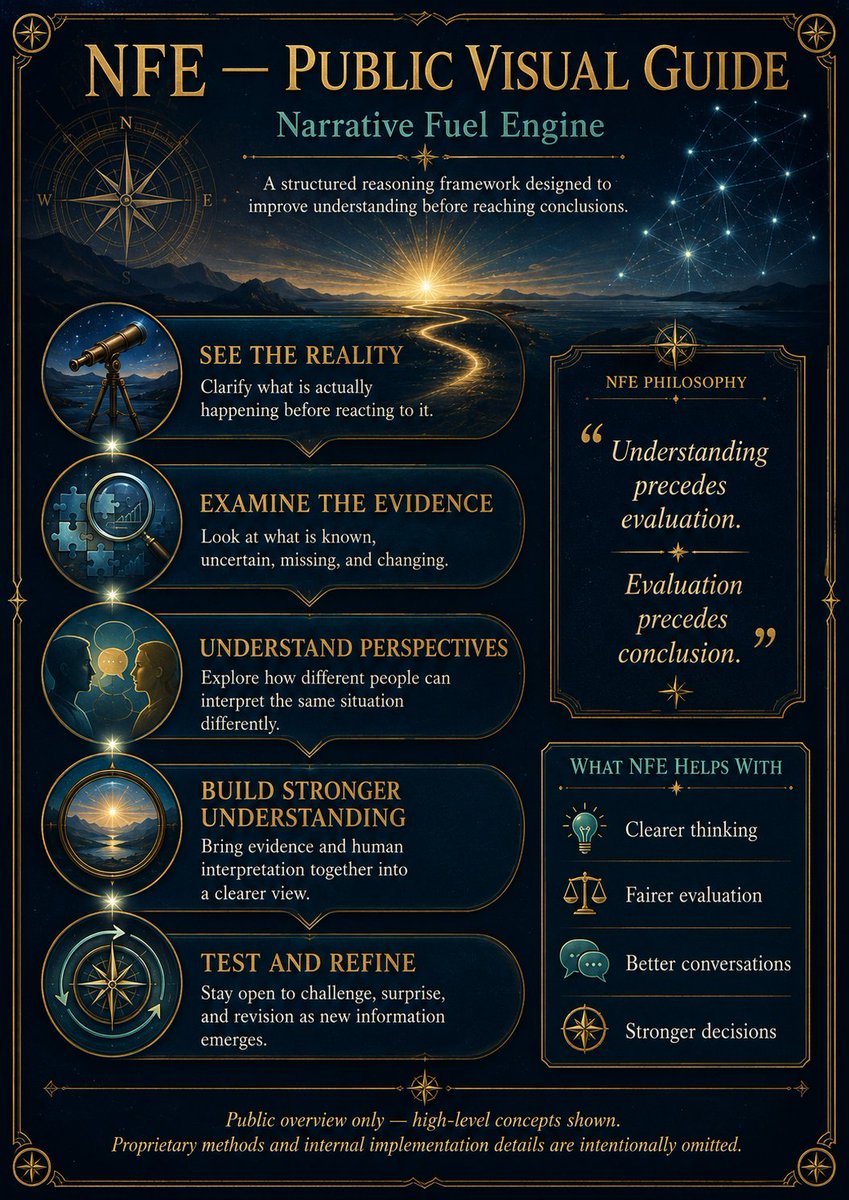
Public-facing NFE explanation
NFE begins with a simple idea: before accepting the apparent conclusion, ask whether there is one better question that could change what becomes visible.
One better question can change what we examine.
What we examine may reveal a capability, barrier, assumption, cost, consequence, or possibility that was previously overlooked.
That may reveal one next step.
And one next step can turn a problem from “everything” into something a person can actually examine and act on.
NFE does not promise success.
It does not promise that every problem has an answer.
It asks only that before we decide the story is over, we look carefully enough to know whether there is still something we have not seen.
https://t.co/5f1GogIFTh
CHECK US OUT!!!
The Adventures of Sassy is still in production phases
However I would love to share some behind the scenes on how NFE helps to make the episodes.
We rewrote part of an episode today because it was busy—but flat.
Cars arrived. People moved. Things happened.
But the scene still wasn’t alive.
The fix:
The arrivals were only the reality.
Sassy and the Council were the episode.
Once each character started interpreting the same moment differently, the act came to life.
Movement is not story.
Character meaning is story.
https://t.co/pTniYiRkot
NFE BABY!!! LIVING UP TO ITS NAME
LETS GO!!
Update NFE now works here as well
Research Significance
This becomes another application domain for NFE.
Current documented domains now include:
Narrative analysis
Creative writing
Character continuity
Historical reasoning
Business reasoning
Policy reasoning
Market analysis
Software planning
Conceptual engineering analysis
Infrastructure concept evaluation
IDEA 💡 I had. So I Applied NFE!!!
https://t.co/MV3b7OS8iB
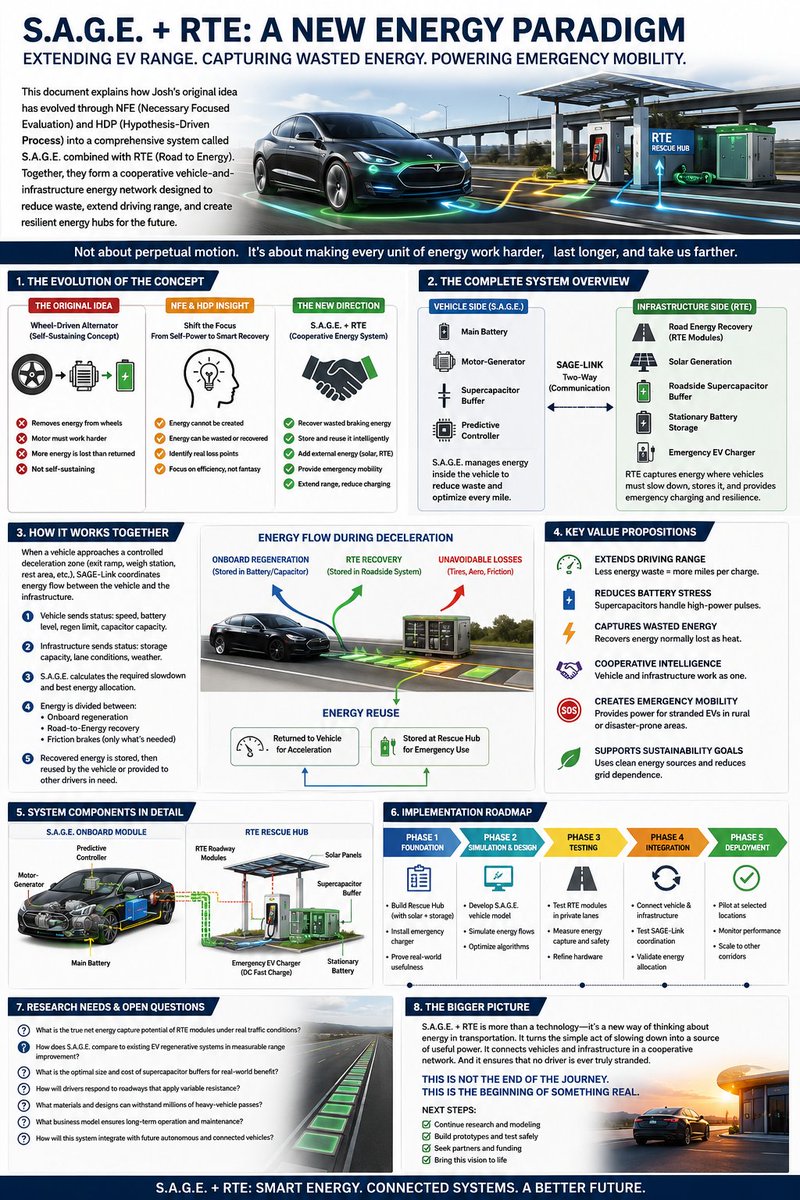
🚗⚡ What if roads and bridges could recover small amounts of energy they already lose?
Cars, trucks, wind, vibration, braking, and road movement all create small energy streams around transportation systems.
My idea is not “free energy,” and it is not about putting giant turbines everywhere.
The idea is to test whether some of those small, already-existing energy losses could be recovered, stored locally, and used to power things like:
💡 Road lights
⚠️ Warning signs
📡 Sensors
🌉 Bridge monitoring
🚨 Emergency systems
The key question is simple:
Can we recover useful energy without creating a bigger energy penalty?
That is where NFE helped most. Instead of jumping straight to a device, it helped turn the idea into a testable system:
🧠 Understand the real energy sources
⚖️ Compare different methods
🧪 Test small before spending big
🛑 Stop if the data says it does not work
The Road Energy Network is still a concept under testing—but I believe it is worth asking the question seriously.
Think small energy streams. Store them locally. Use them where they are created.
#RenewableEnergy #Infrastructure #Innovation #NFE #RoadEnergyNetwork
IDEA 💡 I had. So I Applied NFE!!!
https://t.co/MV3b7OS8iB
🚗⚡ What if roads and bridges could recover small amounts of energy they already lose?
Cars, trucks, wind, vibration, braking, and road movement all create small energy streams around transportation systems.
My idea is not “free energy,” and it is not about putting giant turbines everywhere.
The idea is to test whether some of those small, already-existing energy losses could be recovered, stored locally, and used to power things like:
💡 Road lights
⚠️ Warning signs
📡 Sensors
🌉 Bridge monitoring
🚨 Emergency systems
The key question is simple:
Can we recover useful energy without creating a bigger energy penalty?
That is where NFE helped most. Instead of jumping straight to a device, it helped turn the idea into a testable system:
🧠 Understand the real energy sources
⚖️ Compare different methods
🧪 Test small before spending big
🛑 Stop if the data says it does not work
The Road Energy Network is still a concept under testing—but I believe it is worth asking the question seriously.
Think small energy streams. Store them locally. Use them where they are created.
#RenewableEnergy #Infrastructure #Innovation #NFE #RoadEnergyNetwork