Anthropic built a model that turns any object into a 3D schematic and then runs experiments on it before anyone touches the real thing.
The geometry was never the hard part. The hard part is a model that knows which parts of the object are allowed to move.
> SHAPE - the object rebuilt as parts with real dimensions, nothing smoothed over
> JOINT - every connection marked with what it permits and what it forbids
> LOAD - forces applied the way the object actually meets them in use
> BREAK - the weakest path traced until something gives, over and over
> SWAP - a single part changed and the whole run repeated from scratch
> RANK - failure modes sorted by how little force it takes to trigger them
A render shows what something looks like. A schematic with constraints shows what it cannot survive.
Simulation tools already do this, and they need weeks of setup by someone who knows the software cold.
Here the setup is the description. The constraints come from what the object is, not from a form someone fills in.
The swap step is where it earns its place. You change one part and get the new failure order in minutes, not days.
Most prototypes exist to find the first thing that breaks. This finds it, then the next four behind it.
Every failure path and the force that caused it sits in the breakdown below.
@r9itPo@AI_Screening@claudeai to be fair it should be Sol 6.1 vs Claude 5.5, this is not the best comparison for 5.5. Astra destroying 5.5 was reply to the authors comment on GPT models not being good.
Ubiquitous AI for everyone—from cloud to edge. Powered by NVIDIA & Hermes AI, the new RTX Spark PC ProArt P16 & P14 bring next-gen Edge AI solutions to creators.
Learn more👉https://t.co/1IFV04JKMQ
@NousResearch@dillonrolnick#ASUS#ProArt#NVIDIARTXSpark#HermesAgent
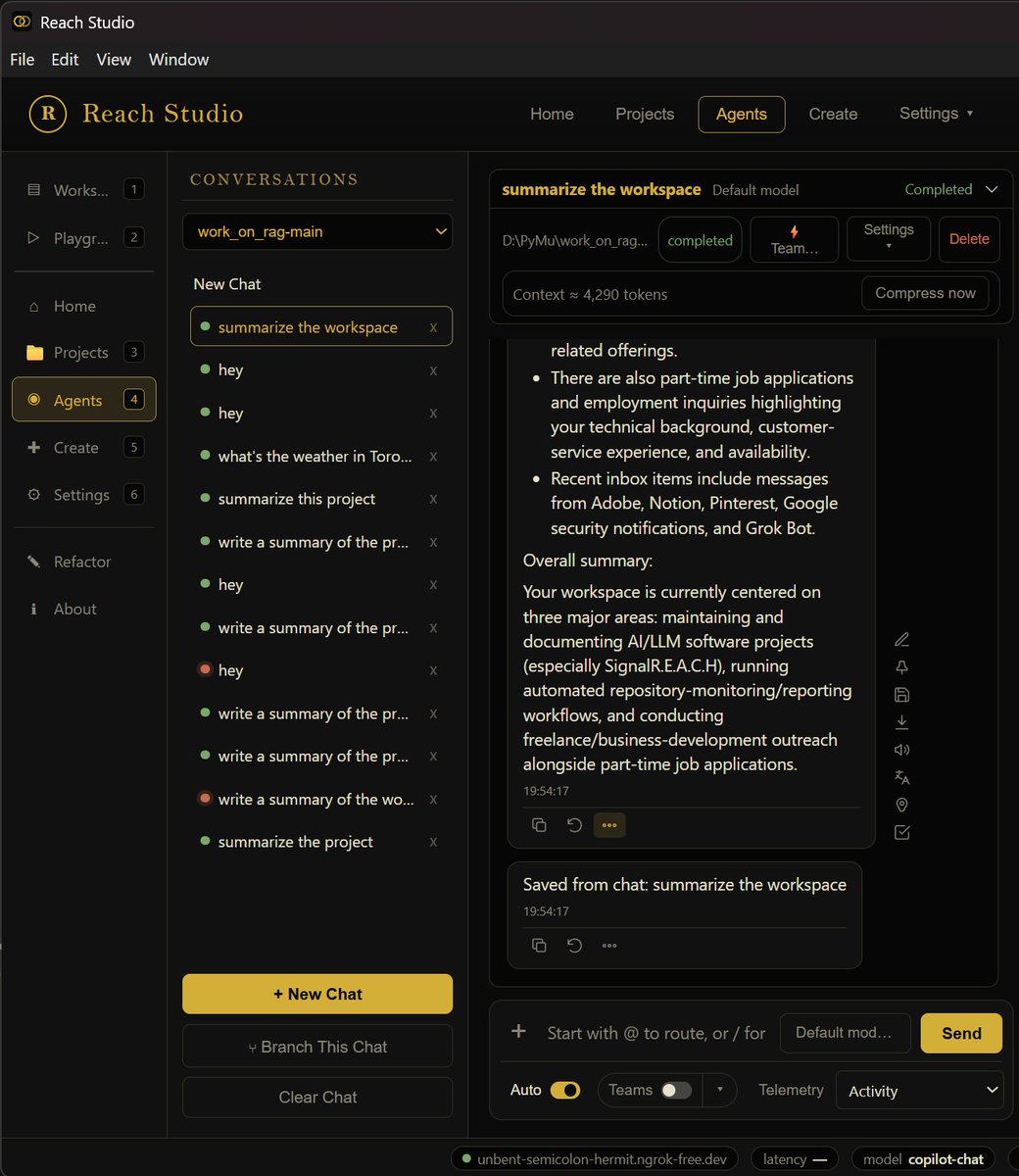
REACH Studio v26.9.14 is out: a denser VS Code-style workspace, a compact Create workbench, and a clear log of what each tool ran and when. Tag v26.9.14.
https://t.co/J5oHw4we0a
Meet Mistral Large 4, aka Le Chonk.
• 1T parameters, natively multimodal. 49B active.
It is the best open weights model from US or Europe on aggregated benchmarks.
• State-of-the-art on critical workloads, including cyber defense, manufacturing and finance and it surpasses closed frontier models on visual grounding.
• Forged in Europe end-to-end and is deployable from Europe via our own Mistral Cloud infrastructure.
• Available to all via API today. Working with cybersecurity partners privately.
Open weights release end of October.
fixed the reasoning bugs + the thinking loop in glm-5.3 flash. it's a different model now.
i gave the same prompt to glm (running on my desk) vs gpt-6.1 sol. they produced a SINGLE HTML file each.
very content with GLM's version, i'm genuinely impressed