What i love most about this app
Having this unfiltered look on peoples life all over the world
When the TV tells you to hate Russians and a girl shows you her grandma's appartement build in sowjet times
We are only trying to get along and live our lives
I just can't take this anymore
We are people, myself I'm German and I don't want to be manipulated into hating anyone
Russia is not my enemy, the politicians who are actively destroying our continent with immigration, warmongering, and made up Climate Armageddon are
Habe ich das richtig verstanden, wird ein Promi "virtuell" vergewaltigt, rastet die Presse komplett aus, Grüne, Linke Spitzenpolitiker feuern in Dauerschleife „Männer sind das Problem“, fordern Gesetzesänderungen, aber wenn sieben Syrer eine 13-Jährige REAL und MONATELANG gruppenvergewaltigen, dann schweigen alle?
This caught my eye $WCO 👀
Several new features are coming to @winitylife and @invoice_now, including:
🔹 Transaction signing on WChain
🔹 WCO staking to unlock exclusive benefits
🔹 On/off-ramp
Transaction signing on @WChainNetwork = on-chain transactions are coming. 👀
🇩🇰“I don't miss Denmark” – this Dane has made his choice. Lars Agerbak moved to Russia, got married and started a family here. Even when the conflict began, they decided not to leave. What made Russia feel like home?🇷🇺
Roy Beck (Gründer von NumbersUSA) hat 1996 in seinem bekannten »Immigration Gumballs«-Vortrag mit Kaugummikugeln sehr anschaulich gezeigt, was Linke in Deutschland und Europa nicht wahrhaben wollen: Eine Million Einwanderer pro Jahr gegenüber Milliarden Armen weltweit ändert an der Armut in den Herkunftsländern praktisch nichts.
Hier wird gerne so getan, als sei offene Zuwanderung praktizierte Entwicklungshilfe. Das ist aber Quatsch, diese Rechnung wird niemals aufgehen. Wer wirklich helfen will, soll das vor Ort tun. Aber selbst das bleibt angesichts der Dimensionen nur ein Tropfen auf den heißen Stein.
4 Jahre alt, aber immer noch aktuell!
Carla Rochel, Klima-Expertin
😂😂😂
„Palau ist EINE Insel, die einfach untergehen wird. MILLIARDEN Menschen sind gestorben schon dort, sind so viele Leben in Gefahr.“
1. Palau besteht aus ca. 340 Inseln, 9 sind davon bewohnt.
2. Es gibt ca. 18.000 Einwohner.
3. Tote durch Hochwasser gab es noch keine.
4. Palau existiert immer noch.
Entweder sie lügen bewusst sie oder sie sind strunzdumm.
Orange Day im Bundestag, aber die unbequeme Wahrheit fehlt. Alice Weidel nennt BKA-Zahlen: laut ihr 150 Sexualdelikte pro Tag im letzten Jahr. Ihr Urteil: Diese Wahrheit nicht auszusprechen, ist verantwortungslos. Frauen schützen heißt Grenzen schützen. #OrangeDay#Grenzschutz
The missionaries aren't celebrated enough.
They contributed more to Africa than most African politicians in the post-colonial era.
Thousands died, so African children could learn to read and live. They gave Africa alphabets, schools, hospitals, and medicine. They fought disease, raised orphans, trained teachers and nurses, and opposed the slave trade. Many came knowing they would not return, and they were buried in Africa.
They left comfort in Britain. They came with a Bible, a schoolbook, and medicine. They built the schools, clinics and hospitals that still stand today.
They taught African children literacy, language, healthcare, religion, and skills. Carpentry. Agriculture. Nursing. Bricklaying. Sewing. The things that build a nation.
In the post-colonial era. Most African politicians contributed slogans, corruption, and collapsed economies. They inherited mission schools and mission hospitals and ran them into the ground.
The missionary came to build, and was buried where he served. The corrupt politician came to power to loot, and flew out for treatment in Singapore and shopping in Dubai.
That is the difference. That is why the missionaries deserve celebration, not silence.
Missionaries were men and women who left everything. They left comfortable homes in England, Scotland, and Wales.
They left warm beds, good food, safe streets, and their own families.
They boarded ships for months, not knowing if they would ever see home again, to come to a land they had never seen, to people they had never met, for a goal greater than themselves.
Many of them died. Not in old age. In their 20s and 30s. They died of malaria. They died of fever. They died of diseases they had no immunity to. They buried their wives here. They buried their children here. They buried themselves here. And they still did not leave, because they genuinely loved Africa.
No sword was used to help African people turn to Christianity. No gunpoint conversion, but only love.
The missionary came with a Bible in one hand and a textbook in the other. He sat under a tree with African children and taught them to read and write. He taught them English, so they could speak to the world. He taught them arithmetic, so they could trade and build. He taught them agriculture, carpentry, bricklaying, sewing, and nursing, so they could feed their families and build their communities.
He taught them healthcare. He taught mothers how to keep babies alive. How to clean wounds. How to prevent disease. Before the missionary, a simple infection was a death sentence. After the missionary, there was a clinic.
That is the difference. The missionary did not conquer, but he convinced. He did not force, but he served.
And what they built is still standing today.
The missionaries built functional clinics, hospitals and schools that are still in existence even up to now. In Kenya, in Malawi, in Zambia, in Zimbabwe, in Uganda, in Ghana, the best schools in the country are still mission schools. The best hospitals in the rural areas are still mission hospitals. Mnene, Chikankata, Kisiizi, Agogo, and hundreds more, still saving lives 100 years later.
They did not build for profit. They did not build for themselves. They built for Africa.
They genuinely helped Africa. They gave Africa literacy. They gave Africa medicine. They gave Africa skills. They gave Africa the Gospel, and they gave it in love.
You can rewrite the textbooks. You can tear down the statues. You can call them colonizers on social media. But you cannot erase what they built, and you cannot erase who they saved.
Their legacy will remain unshaken.
https://t.co/O7jpdQ0E6u
🔥„Ursula von der Leyens Schoßhündchen“: Knallharte Abrechnung mit Peter Magyar und EU-Doppelmoral‼️
„Ein Verfassungsputsch. Der Staatspräsident abgesetzt. Vier Verfassungsrichter entfernt. Viktor Orban darf nie wieder kandidieren. Viele Fidesz-Abgeordnete auch nicht.
Hinzu kommen Vorwürfe von Psychoterror und Erpressung. Das, was Peter Magyar treibt, ist gezielte Ausschaltung der Opposition. Ein persönlicher Rachefeldzug.
Die EU lässt ihm all das durchgehen - schließlich ist er Ursula von der Leyens bravstes Schoßhündchen. Eine Marionette der Globalisten.
Gegen Orban gabs früher Sanktionen und Rechtsstaatlichkeitsverfahren im Wochentakt – für deutlich weniger!
Magyars Machtmissbrauch hingegen wird mit Freigabe von zuvor geblockten 16 Milliarden Euro belohnt. Die EU - ein Sozialkreditsystem auf supranationaler Ebene: Wer spurt, der kriegt.
Und Sie nennen das ,Wiederherstellung der Rechtsstaatlichkeit und der Grundwerte der EU‘.
Vielleicht ist genau das das Problem: Denn die Doppelmoral ist zum wichtigsten Grundwert der EU geworden:
In Deutschland duldet die EU die Repressionen gegen die Opposition.
In Polen unterstützt sie den Staatsstreich von Herrn Tusk.
In Rumänien akzeptiert sie, dass demokratische Wahlen annulliert werden.
Und in Ungarn stützt sie die Errichtung eines autoritären Regimes.
Sie wollen uns etwas über Rechtsstaatlichkeit erzählen? Über Demokratie? Das ist doch lächerlich!
Sie erlauben jeden Rechtsbruch - man muss nur auf Linie sein. So zerstören Sie Ihre eigene Glaubwürdigkeit.“
Chefredakteur der Welt meint: "Wer Frieden will, muss Russland weh tun." Falsch. Richtig ist: Wer Frieden will, muss die Presse austauschen. https://t.co/si0EIWH5U4
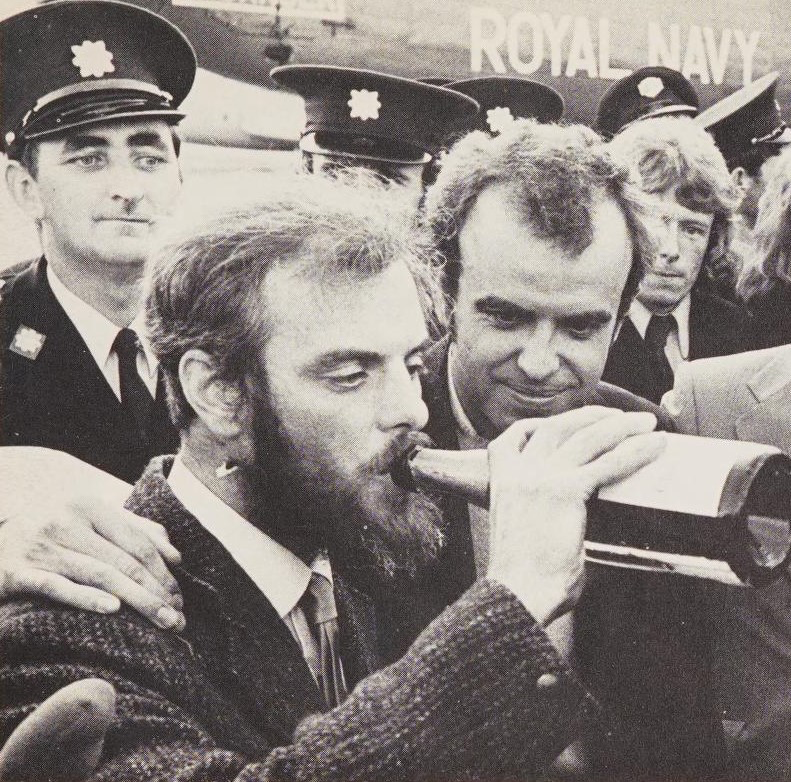
On August 29, 1973, 1,575 feet down on the floor of the Celtic Sea, Roger Mallinson and Roger Chapman lay in pitch darkness inside a steel cabin six feet across with one cheese sandwich and a single can of lemonade.
The night before, about 150 miles off the coast of Ireland, their dive aboard the small submersible Pisces III had started like any routine shift.
Before going into the water, Mallinson, a British engineer, took extra time to install a completely full oxygen cylinder.
All night, he and Chapman, a former Royal Navy submariner, worked along the seabed burying sections of a transatlantic telephone cable.
Shortly after nine in the morning, crews aboard the support ship Vickers Voyager winched Pisces III back up into daylight.
While the craft rolled in rough waves waiting to be lifted onto deck, a towline snagged the hatch of the rear machinery sphere and pulled it open.
Seawater flooded that aft compartment, adding more than a ton of weight in seconds.
Under the sudden strain, the nylon tow rope snapped.
Pisces III dropped beneath the waves and plunged 1,575 feet straight to the bottom of the sea.
During the fall, Mallinson and Chapman released their lead ballast weight, switched off the electrical power to prevent a fire, and pressed cloth cushions against themselves.
The steel hull slammed into a mud trench on the seabed and went still.
With the power off, every light and gauge went dark at once, leaving the two men in pitch darkness and sudden silence on the ocean floor.
Both men survived the impact without broken bones, trapped deeper underwater than anyone had ever been rescued.
Daylight, heat, electrical power, and every link to the ship above had vanished.
All that remained inside their round cabin were that full oxygen cylinder, lithium hydroxide air scrubbers, a small flashlight, one cheese sandwich, and a single can of lemonade.
Measuring six feet across, the steel sphere left barely enough space for two grown men to curl around the cold instruments.
Down there, staying alive came down to a quiet trap: moving or talking burned oxygen, while running the lithium hydroxide scrubbers to clear carbon dioxide drained battery power.
To stretch the oxygen cylinder Mallinson had put in before the dive, both men lay completely still in the dark and spoke only in short whispers when necessary.
Cold ocean water chilled the steel walls around them until damp condensation dripped steadily onto their soaked clothes.
They clicked on the small flashlight for only a few seconds at a time to read the pressure gauges and check the scrubbers.
To save battery power, Mallinson and Chapman deliberately let carbon dioxide build up until pounding headaches forced them to clear the air again.
For more than two days, they left the sandwich and the can of lemonade untouched because eating with dry mouths would make their thirst worse.
Far above them on the Celtic Sea, rescue teams arrived from Britain, Canada, and the United States.
The United States Navy flew an unmanned recovery vehicle named CURV III from California and loaded it aboard the Canadian cable ship John Cabot to work alongside the submersibles Pisces II and Pisces V.
Heavy swells, electrical faults, and snapped lines ruined one attempt after another while the air inside Pisces III grew thin and foul.
Down in the mud, Mallinson and Chapman finally took tiny sips from the single can of lemonade and shared a few bites of the cheese sandwich.
On the third day, Pisces II locked a heavy toggle line into the open rear hatch of Pisces III, and CURV III attached a second recovery cable on the seabed.
On September 1, 1973, surface crews began winching the flooded craft up from 1,575 feet.
Because seawater still filled the rear sphere, Pisces III swung and pitched wildly on the rising cable, throwing both exhausted men against metal edges all the way to the top.
Right below the waves, divers swam into heavy surf and fought the rolling hull to clip on extra stabilizing lines.
When crews finally wrenched open the jammed hatch in the early afternoon, fresh sea air rushed into the cabin, and rescuers looked down to see two shivering men squinting into bright daylight.
Mallinson and Chapman had been trapped for 84 hours, and their tank held only 12 minutes of oxygen.
A helicopter carried both men to a hospital in Cork, Ireland.
That night in a quiet hospital ward, after 84 hours curled around cold metal, Mallinson lay flat on clean sheets and stretched his legs all the way out as warm air filled his lungs.
After recovering, he returned home to Cumbria in northern England, near the shoreline of Lake Windermere.
Over the decades that followed, he spent his free hours restoring and steaming Shamrock, an old wooden steam launch built for peaceful trips across the lake.
On calm afternoons on Windermere, the man who nearly ran out of air on the ocean floor stood at the helm beside a warm brass boiler under open sky, watching green hills reflect across shallow water.
Every year on September 1, at the hour the hatch came open, the two men who once whispered in the dark to save air called each other on the telephone to talk quietly about ordinary life until Chapman passed away in 2020.
Pay close attention 👀 $WCO
"We will be introducing several new features on
@winitylife and @invoice_now such as transaction signing on WChain, staking WCO to unlock benefits, on/off ramp services."
🍁 A time to celebrate, give thanks, and cherish the moments that matter.
Wishing everyone a happy and wonderful Thanksgiving!
#HappyThanksgiving#Thanksgiving2026#WChain