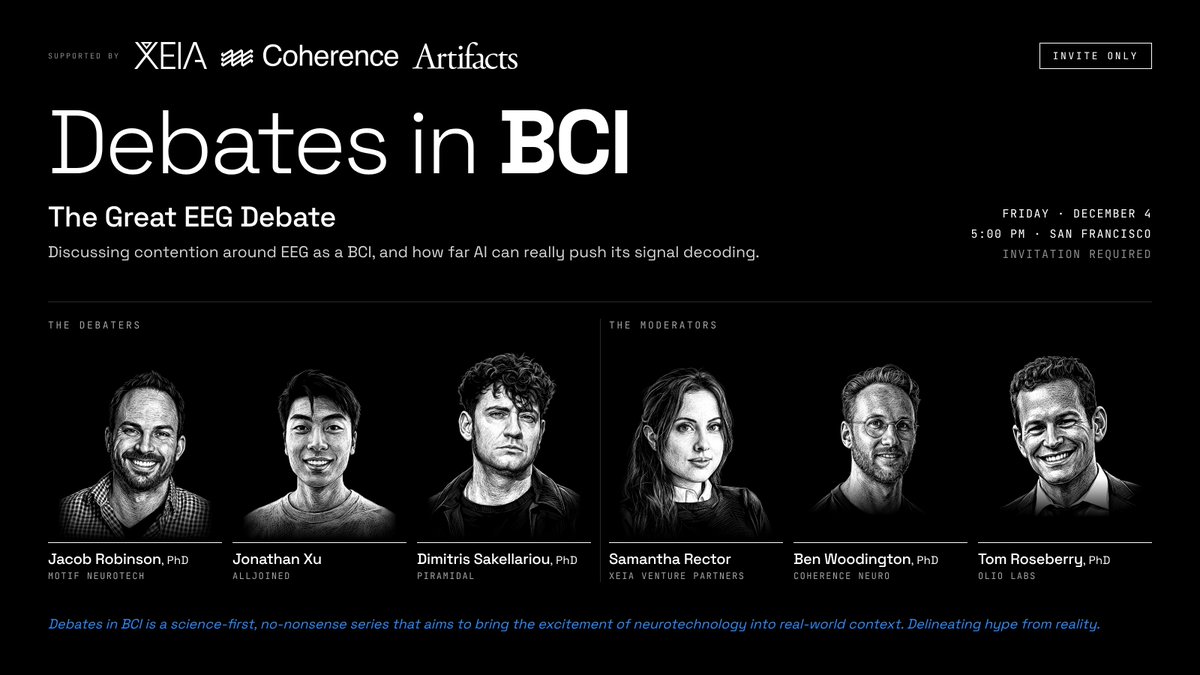
Debates in BCI is a science-first, no-nonsense series that aims to bring the excitement of neurotechnology into real-world context. Delineating hype from reality.
These series will be in person discussions, loosely following a debate style format, and will be recorded. Live streams will not be happening. The live events will be invite-only. At the end of the debates, some or all of us will co-author our takes as Notes on BCI, hoping to also launch the beginning of a series of white papers where the best thinkers in BCI agree on where to disagree, on what opens questions are, and where we need more work.
A rising ride of industry consensus in recorded and in writing, to lift all boats now and into the future.
You can apply to join our kickoff event in San Francisco on 12/4 by contacting me, Samantha Rector, and I'll send you the Luma link.
More to come early next week.
P.S. - We're bringing together top thinkers in BCIs, and specifically top thinkers in non-invasive BCIs for this one - Sabi, Conduit, you in?
I once heard someone say there are two types of founders: warlords and poets.
You could use other words: generals & artists, empire builders & missionaries, conquerors & dreamers.
I think that since Zuckerberg, Bezos, and Travis replaced Steve Jobs as the go-to SV template, we have been short on poets.
To me, the distinction is about whether your goal is conquest or about a deeper belief in something.
This is not to knock conquest. I think the warlords are far more commonly "great" entrepreneurs. But the poets tend to be more likely to create the truly new--more likely to really bend the arc of things. Perhaps poets were/are more commonly artists, scientists, inventors...
In the modern era, it is interesting to look at AI leaders from Altman to Dario to Ilya on this spectrum. I suspect some are easy to place and others might be more hotly debated.
I also think this is the most interesting way to look at the complexity of Elon: he reads as a warlord, and often feels the need to act that way. But my hot take is that I think he is a poet deep down. Perhaps that may be lost, but I hope not.
Some personal news:
I could not be more excited to share that my debut book LEAPFROG: WHAT IT WILL TAKE TO WIN THE GLOBAL INNOVATION WAR will be out Feb. 2, 2027 and is available for preorder now!
LEAPFROG is about the topics I've devoted my professional life to over the past six years: global technology competition, reindustrialization, and America's economic future. It's about why the U.S. has fallen behind China in so many critical technologies from EVs and batteries to synthetic biology and robotics--because we've been blinded by envy and hamstrung by risk aversion, chasing the last generation of technology instead of leapfrogging to the next.
It draws on my time at the White House, where I helped make policy for the most consequential tech competition in a generation...and had a front row seat to some of our blind spots and missteps. And it takes inspiration from my current role as a tech investor where I've gotten to know and work with many of the companies building the technologies that will secure America's future and seen firsthand what they need to succeed.
We're at a delicate moment for America's technological future. The economic and national security stakes of getting our policy right and ensuring we lead the world in the technologies that matter most have never been higher. At the same time, the midterms were driven in part by a wave of anti-tech backlash (in many ways deserved).
Getting this balance right has never mattered more. LEAPFROG is a blueprint for how we do it.
They don't want you to know that LA is a wildly inefficient market for reservation bots. Tennis courts, Aero Theatre screenings, restaurant reservations, etc all have zero competition
The 100 Year Conversation continues with Vlad Tenev.
Vlad was born in Bulgaria and moved to the United States as a child. When he was ten or eleven, he was figuring out investing on dial-up with a pretend portfolio on Yahoo Finance.
At twelve, he made a deal with his father. If he scored above 1300 on the SAT, he’d get his score in dollars to invest. He scored 1370.
You can see the beginnings of Robinhood in that story. Owning stocks felt like collecting to Vlad. He read the shareholder materials he got in the mail and was proud to be an owner. Years later, he helped millions of other people become owners too.
Vlad has a fondness for difficult things. He talks about Robinhood’s toughest moments with a warmth I didn’t expect. “Those are memories I cherish,” he told me. “My only regret was that I didn’t enjoy it more at the time.”
@vladtenev
We’ve raised a $45m Series A, co-led by
@foundersfund and The @OpenAI Startup Fund, to build cancer therapy that learns. Technology is rapidly changing medicine, but data loops and rapid adjustments are still largely missing. When you start cancer treatment, knowing whether what you’re doing is working is too slow. Clearly there is a better way. Build systems to watch cancer in real time, then feed that data into a system that itself can treat the disease. This seeds a future where, unlike drugs, we develop medicine that continuously learns to improve itself. We've been building neurotechnology and BCI platforms to do just that.
@coherenceneuro
Another takeaway after three years of building a company is that the returns to just "being a good person", and not acting transactionally, are higher than I expected.
There are so many transactional, boring, and at times immoral people in the tech industry that if you act with sustained warmth, authenticity, humor, and integrity, great gifts will be laid before you. White pill.