Built on work with @PNNLab, Abaco brings shared, rack-scale memory closer to production. See how it helps #AI and #HPC systems keep active data near compute, scale capacity independently and tackle the memory wall. Learn more: https://t.co/y76HXbdeIo
Over the past week, I’ve been overwhelmed by the love and support of friends, industry colleagues, and people I've never met. Thank you to everyone who has shown kindness to my family and me. It means the world to me.
I came to the United States 53 years ago, and becoming an American citizen is one of the greatest gifts and proudest moments of my life. NVIDIA has been my life’s work. Building it into the company it is today alongside my colleagues has been a privilege and an honor. Nowhere but in America could a company like NVIDIA be possible. I love our country, and I love NVIDIA.
I did not live up to the standards expected of everyone at NVIDIA, and I have made serious mistakes in my personal life. I created problems for the Board that I deeply regret. I own my mistakes completely, and I am committed to cooperating with the Board’s independent investigation.
Since my departure, I’ve seen an outpouring of calls from NVIDIA’s employees, investors, business partners, and customers for me to return as CEO. Many continue to reach out to me directly as the company navigates complex technology, market, competitive, and geopolitical dynamics. NVIDIA is a once-in-a-generation company. If the Board of Directors decides that my return is in the best interest of our shareholders, our employees, the company, and America, I would be honored to answer these calls and return as CEO.
Thank you again to everyone who has shared their good wishes. I am profoundly humbled by your support. To my family: I love you, and I will spend the rest of my life being worthy of yours.
Jensen
On Nov 18, Micron leadership takes the stage for a fireside chat at the #TomorrowX Summit in Austin — memory and storage powering AI from cloud to edge.
We’ll cover the key moments live, right here in this thread.
Watch the full session and add it to your calendar from our IR page → https://t.co/LJv75lELEW
Ask AI one question, and it may plan, search, call tools, check its work and try again. In the cloud, that’s metered. On a device, the cost is largely built in.
The future is hybrid. The cloud can handle frontier-scale reasoning and elastic demand, while the edge can support high-volume, privacy-sensitive and latency-critical experiences closer to where data is created.
Wherever AI runs, memory and storage set the pace: storage determines how quickly #AI starts; memory determines how quickly it thinks.
Learn why AI spans cloud and edge 👉 https://t.co/hxgPpYbot7
#EdgeAI #AgenticAI
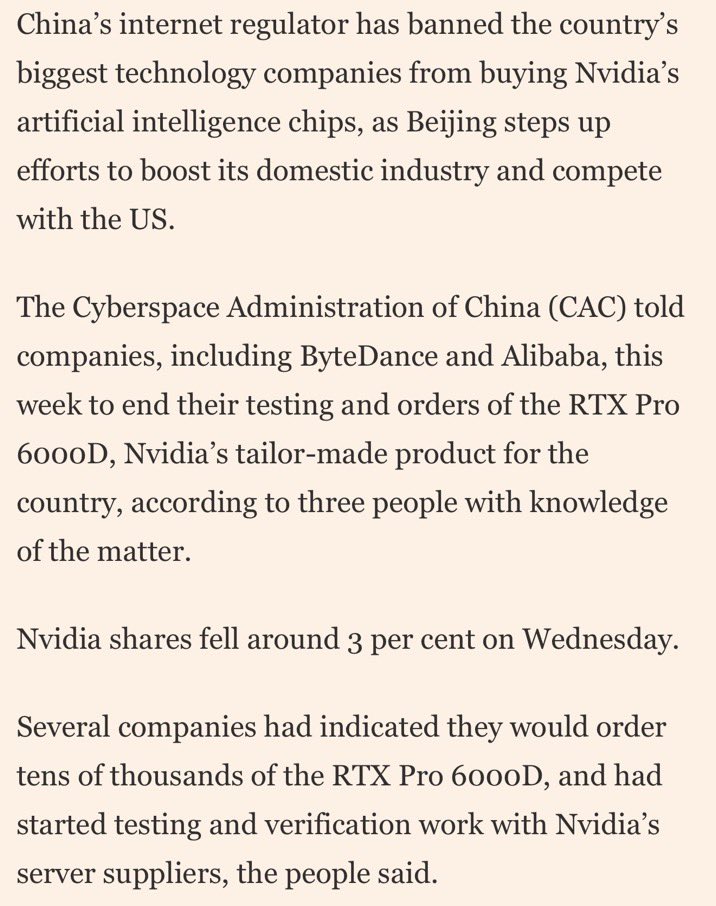
Both the Biden and Trump administrations allowed the export of less powerful GPUs to China while reserving the most advanced chips for America. This has been a clear national security success.
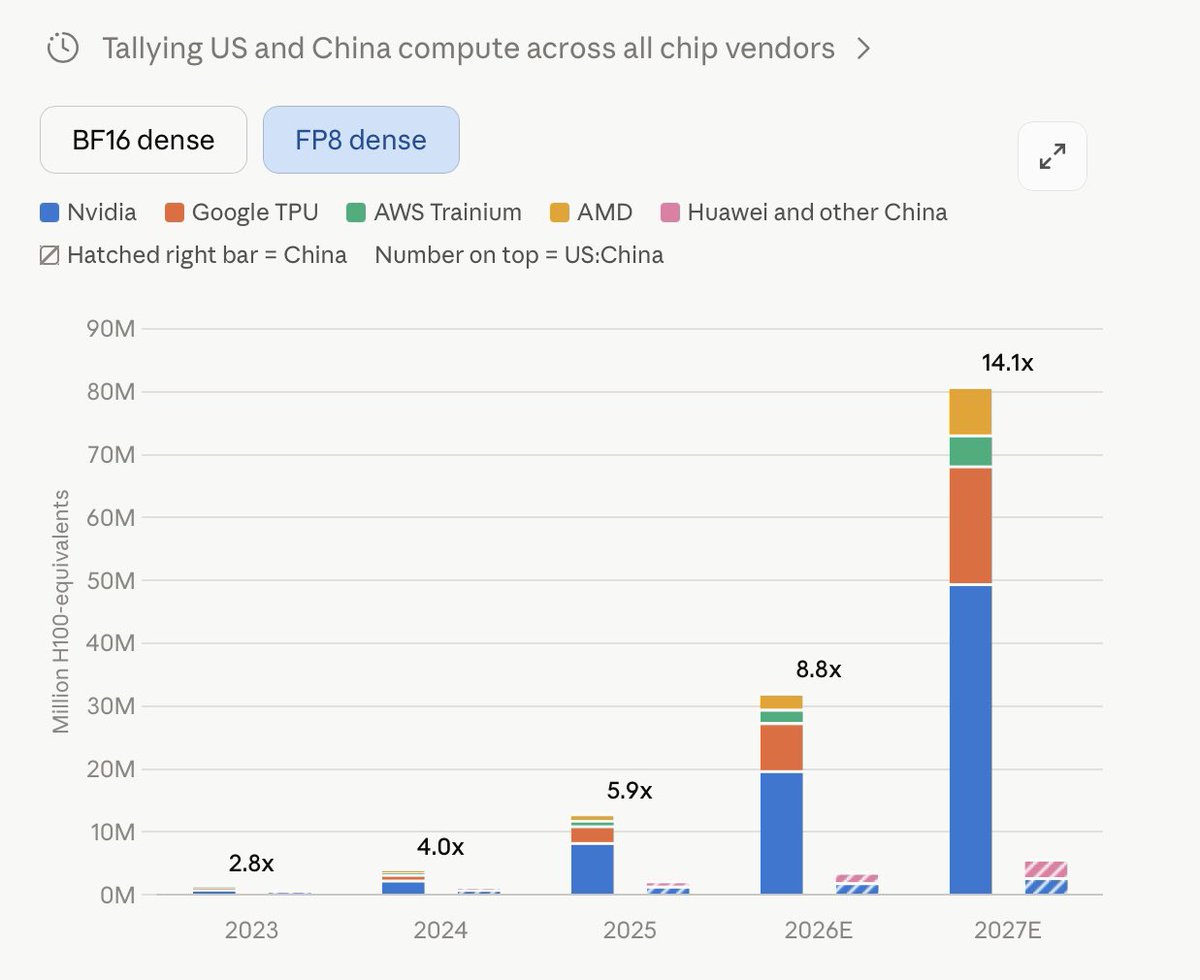
Per Grok and Claude, the US-to-China AI FLOPs ratio has grown from 2.8x in 2023 to 8.8x in 2026 and is modeled to reach 14.1x in 2027. Our advantage in compute has grown dramatically and American AI labs have stayed well ahead of Chinese labs the entire time.
Chinese labs prefer these less powerful American GPUs to domestic accelerators from Huawei and others. That preference has slowed China’s hardware industry: AI chips improve through intensive use by leading labs, and the ready availability of American alternatives has limited that feedback loop for Chinese AI hardware.
Chinese labs can also access capacity in Southeast Asian clouds run by American hyperscalers. Those zones can be shut off instantly in a conflict, giving the US signficant leverage. This dependence is advantageous in every way.
A complete ban on GPU exports and Southeast Asian cloud access might be deeply damaging to long-term American national security. It would force Chinese labs onto the Huawei AI hardware ecosystem. China is not power-constrained, and Huawei is developing extremely power-hungry, large optical scale-up domains that may approach American state-of-the-art systems through brute force rather than architectural elegance and efficiency. And China has a lot of power.
Having Chinese labs optimize models for this different architecture is risky as nothing prevents China from sharing this hardware and associated models with Russia, North Korea, or Iran. We would lose any ability to cut off their AI in a conflict.
Policies now under discussion in Washington carry serious, uncertain risks. Reasonable minds can disagree, but treating this as a simple black-and-white issue does America a disservice.
If China closes the installed FLOPs gap as its domestic hardware matures rapidly as a result of increased Chinese lab usage after stricter export controls, we will know this new policy was a mistake.
If Russia, Iran, or North Korea later field comparable Chinese AI hardware systems that are used to run AI targeting models against Ukrainian or American troops, we will know stricter controls were a *terrible* mistake.
The current reality is one where China is consistently behind America thanks to the export of less powerful GPUs and we have immense leverage over China in any future conflict. We know that the current policy is working. We have no idea what the consequences of stricter controls might be.
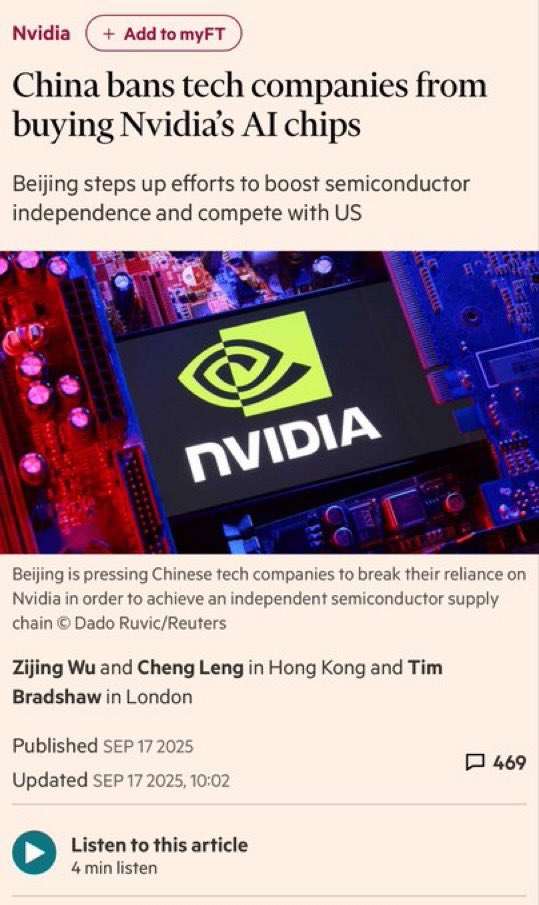
This is why China is currently restricting imports of roughly 600,000 H200s sitting in Hong Kong warehouses. China Hawks should consider why Beijing agrees with them and why China *restricts* the sales American GPUs inside China.
The current policy has worked spectacularly. The alternative is extremely risky with unknown consequences.
For months now, Bill Gates has been sounding the alarm on AI.
His latest warning: AI-powered cyberattacks will be the big story of the next 12 months. Bad actors stripping the safeguards out of models. Self-regulation isn't enough. Governments need to step in.
The diagnosis isn't crazy. Cyberattacks will explode. I build with these models every day, I know exactly what they can do.
But watch where the solution leads.
Oversight. Mandatory safeguards. Monitoring. Then, inevitably: licenses. Approved labs. Compliance bodies. A whole peripheral economy of bureaucrats whose job is to decide who has the right to run intelligence and who doesn't.
"Is your model authorized?"
That's the wrong answer. And a dangerous one.
Here's the thing about cyberattacks: attackers will have the models anyway. Criminal groups and hostile states don't apply for licenses. Regulation doesn't disarm them. It only disarms everyone else.
The only real defense is to go faster. Accelerate open source AI so that every company, every developer, every sysadmin on earth has the best models to audit their code, find vulnerabilities before attackers do, patch at machine speed and harden every system we depend on.
Security has always worked this way. Open source code is more secure, not less, because a million eyes are on it. Same thing for intelligence.
Will there be a phase of chaos? Yes. There will be one no matter what. The only question is whether we go through it with defenses spread across all of humanity, or concentrated in the hands of a few approved actors.
I'd rather take the risk of moving very fast toward an open superintelligence available to everyone than let a small group of enlightened people decide what life with superintelligence will look like for 8 billion humans.
And in my experience, people who see themselves as enlightened are usually enlightened about their own interests.
This is exactly the debate that gave birth to OpenAI.
A couple of years before its founding, Elon Musk had a conversation with Larry Page about the future of AI. Elon defended humanity's place in that future. Page called him a "speciesist." For being pro-human.
Then Google bought DeepMind. Elon realized the most powerful technology ever created was heading into the hands of one company, run by people who weren't particularly attached to humanity.
So in 2015 he co-founded OpenAI. The name said it all: an open AI, for humanity, not owned by a small group.
We know how that story ended.
Today we're back at the crossroads.
Path one: Gates wins. And he pulls the same move he pulled with software.
In 1976, a young Bill Gates wrote his "Open Letter to Hobbyists," attacking people who freely shared software. Twenty-five years later, Microsoft's CEO called Linux a "cancer." The entire Microsoft playbook was taking something that should be a commodity and putting a toll booth on it.
Except this time the toll booth won't be a license key. It'll be the law. Regulation as a moat. Coercion dressed up as safety.
Path two: AI goes fully open. Intelligence becomes infrastructure, like electricity, like the internet, like Linux, which now runs most of the world's servers.
And when intelligence is infrastructure, the winners aren't the ones who lobbied best in Washington or Brussels. They're the best builders.
That's the world I want. Not one where you need permission to think.
Open source won the server. It won the internet. It must win intelligence.
[스페이스X 스타십 IFT-15] 인류 최초 궤도 상단부 '메카질라' 포획 성공: 우주 경제의 게임체인저
스페이스X가 우주 산업의 마지막 퍼즐을 맞췄다. 2026년 11월 14일(현지시간) 스타십 15차 시험비행(IFT-15)에서 궤도 비행을 마친 상단부 우주선(Ship 42)이 발사탑 로봇팔 '메카질라'에 사상 최초로 안착했다.
1. 22.5시간 궤도 비행 후 발사대 귀환
11월 13일 텍사스 스타베이스에서 발사된 스타십은 약 22시간 30분 동안 지구를 14바퀴 돌고 대기권 재진입 불길을 뚫어내며, 출발했던 바로 그 발사탑 젓가락 팔로 정확히 돌아왔다. (발사 직후 1단 부스터는 연료 경고로 멕시코만 착수로 자동 우회했지만, 난도가 비교할 수 없이 높은 궤도 상단부 회수를 단번에 뚫어냈다.)
2. 차세대 스타링크 V3 위성 26기 실전 배치
비행 중 약 260km 고도에서 기존 팔콘9으로는 발사 자체가 불가능한 대형 차세대 '스타링크 V3' 위성 26기를 성공적으로 사출했다. 사출한 위성 카메라로 본체 열차폐 타일 상태까지 점검한 뒤 복귀를 완료했다.
3. 왜 '완전 재사용'의 성배인가: 추격 불가의 우주 독점 체제 완성
지금까지 로켓 산업의 치명적 한계는 비싼 엔진과 첨단 장비가 실린 2단 상단부를 매번 우주에서 태워 버리는 데 있었다. 이번 포획 성공으로 로켓이 '일회용 소모품'에서 연료만 채워 다시 띄우는 '여객기 모델'로 전환되는 결정적 관문이 열렸다.
- 발사 단가 파괴: kg당 궤도 운송 비용이 기존 대비 수십 분의 일로 추락하며 글로벌 발사 시장의 가격 구조를 완전히 다시 쓴다. 경쟁사들이 이제 겨우 1단 착륙을 흉내 내는 사이, 스페이스X는 2단 궤도 회수까지 성공하며 기술 격차를 추격 불가 수준으로 벌렸다.
- 우주 AI 인프라 고속도로 개통: 초대형 스타링크 V3 망의 초고속 확장뿐만 아니라, 전력·냉각 병목을 피하기 위해 구상 중인 '궤도 AI 데이터센터(Orbital Data Centers)'를 실제로 실어 나를 수 있는 유일한 대량 수송 수단이 현실화됐다.
#스페이스X #스타십 #메카질라 #스타링크 #궤도데이터센터 #우주항공 #일론머스크
Today I'm going to connect four things: Milei's success, Bukele's success, the collapse of the system, and Jensen Huang being pushed out of Nvidia.
It looks like four news stories. It's one story.
On September 23, Javier Milei stood at the UN General Assembly and said what nobody in that room wanted to hear: the institution has become a useless organization whose only purpose is to feed "a caste of fatally arrogant parasites disguised as well-intentioned bureaucrats."
He wasn't only talking about the UN. He was talking about an entire system.
And Milei beat that system on the economy first. In November 2023, more than a hundred economists, led by Thomas Piketty, warned that electing him would bring devastation to Argentina. He applied the Austrian school, took a chainsaw to the state, and shut down the printing press. Inflation went from over 200% a year to around 2% a month. Poverty went from nearly 53% at the height of the shock therapy to 28% by the end of 2025, its lowest level since 2018.
The experts were wrong.
Bukele beat it on security. El Salvador was the murder capital of the world. It became one of the safest countries in the Americas. And at the end of October, when four of his soldiers were ambushed in Haiti, he sent 2,000 troops while the international community had spent years managing the problem with conferences.
The institutions were wrong.
Hence the collapse. Not of Argentina or El Salvador. Of the system that lectured them. Its economic predictions were proven false. Its international missions failed. Its experts are no longer believed. For decades it survived on narrative. The narrative no longer survives contact with results.
And a system that loses on the facts doesn't reform. It panics.
Enter Jensen Huang.
Huang isn't just the man who built the infrastructure of the entire AI revolution. He's also one of the biggest champions of open source AI in the world. To him, open innovation is the foundation of AI progress. Nvidia has become one of the largest publishers of open models on the planet, and this year it launched a coalition of labs to build frontier-level open source models.
Now think about what that means.
A closed superintelligence, controlled by a handful of players and supervised by regulators, is the perfect tool for the caste. It can be filtered, steered, licensed.
An open source superintelligence is the opposite. A truth machine in the hands of every citizen. Able to audit a budget, take apart a rigged statistic, trace where every cent of public money goes, and compare promises to results. Corrupt institutions don't survive that. Neither do their lies.
I believe that if open source wins, it's the end of globalism as we know it.
So whatever you think of the Huang affair, look at what happened in the hours after his fall: the people who have dreamed for years of putting AI under supervision rushed in. Scott Wiener, the man behind California's AI regulation bills, immediately called for comprehensive national AI regulation.
This isn't a conspiracy. It's a survival reflex. When the leading champion of open AI stumbles, the system sees an opening and charges through it.
It's no accident that Milei, in that same UN speech, defended the development of AI. He understood it's the one battlefield where the caste can still buy time. And the one where it can lose everything.
That's the logic. Milei proved their economics were wrong. Bukele proved their approach to security was wrong. Reality is collapsing their credibility. And open AI threatens to make their lies impossible. So they panic.
It's too late. The box is open.
We are at the dawn of the total collapse of the empire of corruption.
They had the narrative. We have reality.
At #Electronica, we’re showing how Micron helps enable secure, scalable data movement and storage across vehicles, robots and industrial systems.
As more decisions happen at the edge, these systems need memory and storage that can move, access and process data where it’s created.
For more than 30 years, we’ve advanced memory and storage for automotive and industrial applications. Now, we’re building on that experience to help power the AI-driven future.
If you don’t impeach the corrupt judges, you CANNOT fix the country.
They will form a cartel (a judicial dictatorship) and block all reforms, protecting the systemic corruption that put them in their seats.
No country in the history of the world has ever successfully integrated millions of people from the third world. Literally never been done successfully ever. 0% chance of success.
And legal immigration advocates will tell you it is completely necessary to drive your country off a cliff like this without any evidence to show that it won't invariably lead to the country crashing and burning.
Meanwhile we have decades and decades of proof in this very country of how immigration moratoriums are great for prosperity and also absolutely necessary for any integration to occur.
The topic of immigration has been poisoned down to its foundation with decades of lies and propaganda designed to make you feel like an evil person for just wanting to live a normal peaceful life in the only country you can call home.
This is the winning message on deportations and remigration. You win over hearts and minds by crafting a story that resonates with every American who is struggling right now. Your message needs to be one of future prosperity. Too often even patriots and allies frame immigration restriction as requiring sacrifice and necessary temporary hardship. That entire story is a lie peddled by open borders Chamber of Commerce traitors who want cheap labor. Do not go all in on a losing hand crafted by your enemies.
Once you understand the incentive, the reason for the behavior becomes obvious: they are importing a left-voting bloc that depends on government handouts.
A prominent example of this in America is Ilhan Omar and her Somali voting bloc in Minnesota, an area which used to be primarily Nordic-German.
Importing voters is a CERTAIN path to a single-party supermajority and has ALREADY happened at the state level in California and New York. It also explains why those states have BANNED VOTER ID in order to accelerate a permanent socialist supermajority, destroying any semblance of democracy.
We stand on the precipice of disaster, an end to America.
We were proud to join @sunyjefferson to celebrate the renovated Dulles Building, the new home of its workforce training program focused on mechatronics and advanced manufacturing.
Through a $750,000 Micron grant through the Community Investment Fund (CIF), we’re supporting the program as it creates pathways for students, service members, veterans, military spouses and military-connected families to build skills for careers in #AdvancedManufacturing. The program’s first bootcamp class is underway; participants are building skills while working toward certifications and college credit.
Together, we’re helping expand access to opportunity and strengthen the talent pipeline for the future of #semiconductor manufacturing in New York.
True Super Intelligence requires an extraordinary human touch. Proud of the brilliant teams inside our fabs building the memory foundation that accelerates the future of AI. ⚙️🧠 https://t.co/fDFvlJC2fa
#IntelligenceAccelerated#TeamMicron
You're going to see all sorts of big-brained takes from politco dorks about tonight for the next several weeks, but it's very simple: we started another pointless war with Iran on behalf of Israel, the economy in unbearable for normal people, there have been no mass deportations + Walmart still look like Mumbai, and the GOP ran a bunch of minorities and women instead of White men. This isn't rocket science.
You cannot save America without removing judges. Bukele didn’t save El Salvador by building a prison. He saved it by removing the judges.
The judges are the shield of the revolution.
The Marxist Defector Who Exposed the Deep State 80 Years Before You Felt Its Grip
In 1940, one of the most brilliant Marxist theorists in the Western hemisphere walked into a meeting of the radical Fourth International, looked his fellow revolutionaries in the eye, and severed his ties forever. He had spent years studying alongside Leon Trotsky, organizing communist networks, and drafting revolutionary strategy. Yet when he peered beneath the utopian slogans of the radical left, he uncovered a terrifying political apparatus that neither classical capitalism nor traditional socialism could explain.
That thinker was James Burnham, an Oxford-educated philosophy professor at New York University who would eventually co-found National Review and receive the Presidential Medal of Freedom from Ronald Reagan. A little-known fact about Burnham is that before becoming the intellectual godfather of conservative realism, he helped draft the foundational doctrine of political warfare for the newly formed Office of Strategic Services, the precursor to the CIA. Having mastered both Marxist subversion and cold intelligence tradecraft, Burnham saw the coming century with frightening clarity.
In his 1941 masterpiece, The Managerial Revolution, Burnham predicted that elected representatives would soon become decorative figureheads. Real sovereignty was systematically migrating away from constitutional legislatures into the dark corridors of administrative agencies, corporate boards, regulatory commissions, and academic institutions. He warned that a new ruling caste of credentialed technocrats, an unelected managerial elite, would seize the levers of society. These managers possess zero loyalty to national sovereignty, constitutional tradition, or the working citizen. They view the republic as a giant spreadsheet to be engineered, weaponizing bureaucratic regulations and speech codes to guarantee their permanent control over public life.
Later, observing how self-proclaimed progressives were surrendering Western civilization abroad and dismantling cultural order at home, Burnham delivered his most famous, piercing diagnosis in his 1964 work, Suicide of the West:
"Liberalism is the ideology of Western suicide."
Burnham explained that modern progressivism functions as a psychological mechanism designed to reconcile the West to its own demise. It teaches a prosperous society to feel unearned guilt for its greatest triumphs, apologize for its borders, sacrifice domestic energy production, and abandon its religious roots. When an elite managerial class ceases to believe in its own moral right to preserve its civilization, it cloaks surrender in the vocabulary of compassion, actively punishing the productive citizens who maintain public order.
The modern struggle against the administrative state is precisely the battle James Burnham outlined decades ago. You feel his prophecy every time an unaccountable federal agency bypasses Congress, every time corporate HR departments enforce ideological compliance, and every time legacy institutions lecture hardworking Americans on their supposed privilege. The administrative apparatus relies on ordinary people remaining blind to how managerial power truly functions. Study Burnham, see through the facade of bureaucratic expertise, and demand the uncompromising restoration of your constitutional liberty.
(PHOTO: James Burnham, Left)