I’m so sick of reviewers using ChatGPT to review papers. It’s atrocious having to respond to the same garbage from all 3 reviewers where each comment requests 5 new analyses. Just don’t agree to review papers if it’s too much work 🤷♂️
Even if you used AI to review my paper- at least ensure the asks are genuine and then choose the most pertinent/relevant comments to include in your review? Is that too much work?
I’m sure journal editors recognize that this is a real problem but can’t do much to rectify this issue.
Want to get clean calcium signals from tons of deep-brain neurons in freely moving animals?
Check our paper https://t.co/kSxPgGzYmC !
We show how correcting GRIN lens aberrations transforms MINI2P performance, revealing sparse HD coding in sensory thalamus!
@ScienceAdvances
Autism cannot be reduced to a simple excitation/inhibition imbalance. Inhibition is not one dial: PV, SST and VIP interneurons regulate different compartments, timescales and network states. A circuit can appear globally “balanced” yet remain computationally disorganized.
In 1952, Alan Hodgkin and Andrew Huxley developed a mathematical model describing how neurons generate electrical impulses.
Using the giant axon of a squid, they studied how sodium (Na⁺) and potassium (K⁺) currents influence the electrical activity of nerve cells.
As luck would have it, my PhD advisor Mike Greenberg happened to be in Barcelona at the same time as me.
Like a science-y version of a Whit Stillman movie, we chatted about engrams and enhancers while dining over tapas and strolling through the city.
I presented ASAP voltage indicators, bioluminescent neurotransmitter reporters, and psCas12f photoswitchable gene editors... not optogenetics as defined by the Nobel committee, but still involving photons and genetic tools.
Many thanks to @IBECBarcelona for the invitation!
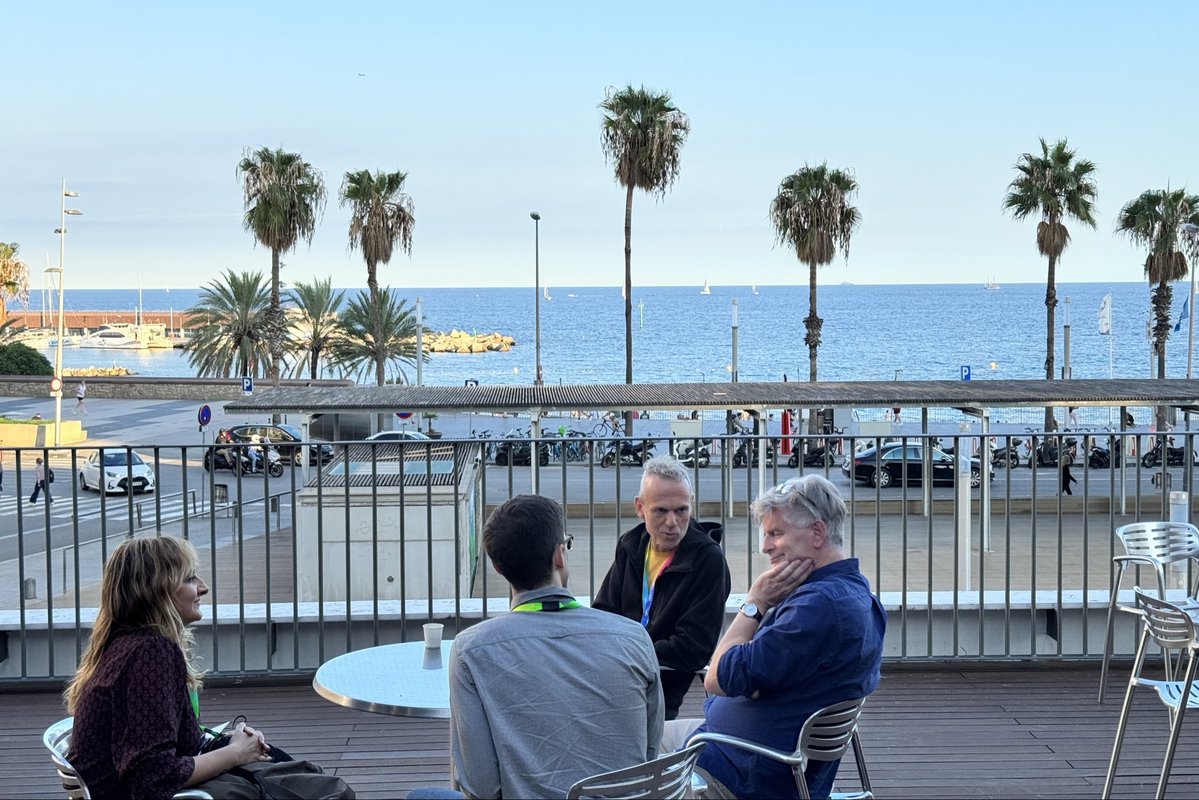
Was fun celebrating the recent Nobel with many of the pioneers in optogenetics at Optogen 2026 in beautiful Barcelona — a great place to reunite with old friends.
The conference brought together wide range of approaches, from optical methods to new indicators to clinical trials
Institute Director Kang Shen shares congratulations to Karl Deisseroth for his recent Nobel Prize. Karl shares that he started out with an interest in developmental neuroscience and is excited to see the frontiers of the field today.
Our new paper in @NatureNeuro!
Psilocybin remodels synapses differently in healthy and stressed brains, promoting new connections and limiting stress-induced loss.
We also identify distinct mechanisms for plasticity and hallucination-like behavior. #Zuolab
https://t.co/JNfPKSlMg3
Our paper is out in Nature, congrats to Qiyu, An et al!
By stimulating ~20 motor cortex neurons carefully selected based on their activity, we could induce learned population activity and, sometimes, the movement itself, depending on the brain's state.
https://t.co/sdVjsSrhtw
@binneystreetbio@AdamRochussen Lowering funding rates for older labs to maintain them for younger ones as the data suggest is consistent with what you have heard
@aif365@AdamRochussen Well it's not new but 5% vs 25% is a real difference. It means 5x more work. It also means some being forced out now are smarter and harder working than some who were able to stay until tenure or retirement 30 years ago
@AdamRochussen Correction: only ~60% of grants were funded up-front, per congressional budget rule. Our new R01 is year-by-year
But agree news is not bad for earlyish-career scientists. TBH: it's never been bad even in the worst times because almost all foundation grants are early-career only.
Here's a cool new drug that just dosed its first patient in China.
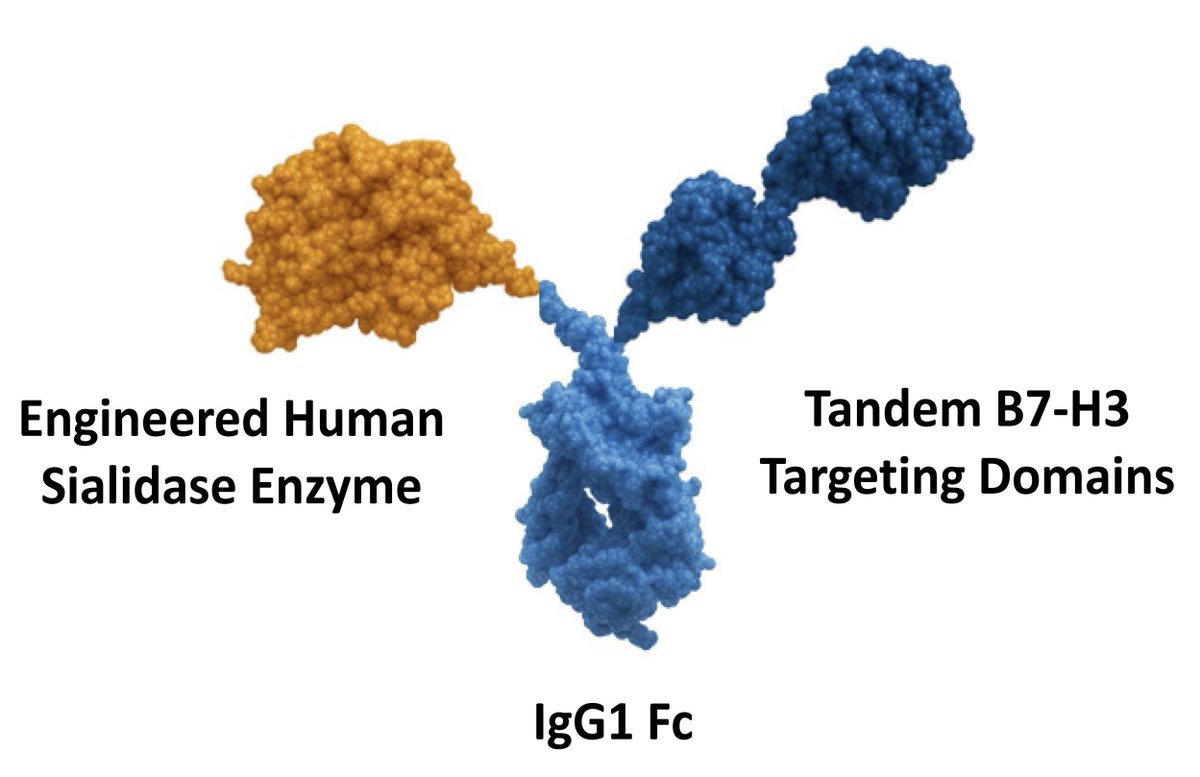
It targets the cancer antigen, B7-H3, and 'desialylates' - removes surface sialic acids that suppress immune responses. In experiments, this activates tumor killing, mainly by NK cells and macrophages.
The trial is in China, run by Shanghai Henlius - the tech itself originated from the US biotech, Palleon Pharma.
This desialylation mechanism is independent of PD1: in other words, a potentially new cancer immunotherapy.
I am pleased to be recognized by Princeton University for the Woodrow Wilson Award. A big year for @Princeton science/engineering alumnae, with Mary Brunkow getting the corresponding graduate award. I wonder if they feel sorry for us...it's not been fun for basic science these days. @caltech@CaltechCCE