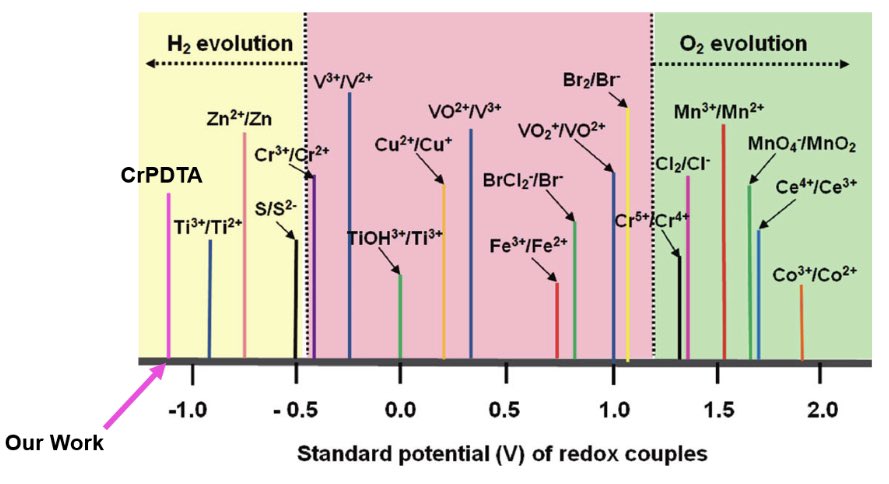
This began as a rebuttal to the question about low volumetric energy density of a #flowbattery vs Lithium. Stationary #EnergyStorage is all about footprint! Lots of satellite data ⤵️
Beyond energy density: flow battery design driven by safety and location https://t.co/CzO44EuLVK
@BMNperspective Ferrocyanide is around +0.5 V on this diagram, but it doesn’t really define stability. V3+/V2+ still evolves some H2, despite what this says. Our chromium chemistry uses neutral pH and organic chelating agents to block H2 evolution at the molecular level.
"The institutions that fund science have become process-oriented, narrow-minded and risk-averse. Wary of failure, they favor established researchers pursuing narrowly focused, incremental ideas over younger scientists with more heterodox agendas."
https://t.co/iJiT52Y1pW via @WSJ
Just posted a preprint on ChemRxiv explaining why Energy Density is NOT important for grid-scale energy storage, showing instead that Area Footprint of flow batteries can be equal to or greater than Li-ion based systems. #batteries#energystorage https://t.co/JGBWrBbCte
@MarshakGroup publication in @J_A_C_S reports how chelating agents more than DOUBLE the #EnergyStorage of a #vanadium#flowbattery, operate at higher voltage, and improve safety with neutral pH electrolyte.🔋🔋⚡️🔌
https://t.co/0rLezt8BJk
😱 Our safe and scalable flow battery chemistry can beat Li-ion even at 4 hour discharge durations. #EnergyStorage@OtoroEnergy#Battery
https://t.co/Fve1MgWyTp
Let's give a big hand for #InternationalLeftHandersDay! I hope all of my fellow lefties have a terrific day. Me? I'll be spending today playing my favorite tunes on my left-handed banjo!
Great collaboration with RTRC to look at the transport or lack thereof of metal coordination complexes through some membranes.
————
Transport of Ligand Coordinated Iron and Chromium through Cation-Exchange Membranes https://t.co/v7xOcu29CQ via @IOPscience
Everything looks worse in black and white: Chrome gives us those nice bright colors. Isolation and Characterization of a Highly Reducing Aqueous Chromium(II) Complex by @MichaelMarshak and colleagues. Please have a look https://t.co/u6xgZCbIMu
Perspective on Aqueous Redox Flow Batteries
by Perry, Rodby, Brushett
"Aq. flow batteries with voltages >1.5 V are possible, and there are significant benefits to operating at these higher potentials, most notably significant capital cost reductions" https://t.co/1Rn1E265sZ
Inert in water but not acetonitrile, and a stronger reducing agent than sodium metal. I hope this encourages researchers to isolate and fully characterize flow battery materials like any other chemical. https://t.co/ys0SGEjVDN