Contrary to some critics, I am allowed to say "I prefer voluntary interactions in society" without first spelling out a full theory of property rights.
The most significant fact about this system is the economy of knowledge with which it operates, or how little the individual participants need to know in order to take the right action.
Taxation is the price we pay for failing to build a civilized society. The higher the tax level, the greater the failure. A centrally planned totalitarian state represents a complete defeat for the civilized world, while a totally voluntary society represents its ultimate success
Taxation is the price we pay for failing to build a civilized society. The higher the tax level, the greater the failure. A centrally planned totalitarian state represents a complete defeat for the civilized world, while a totally voluntary society represents its ultimate success
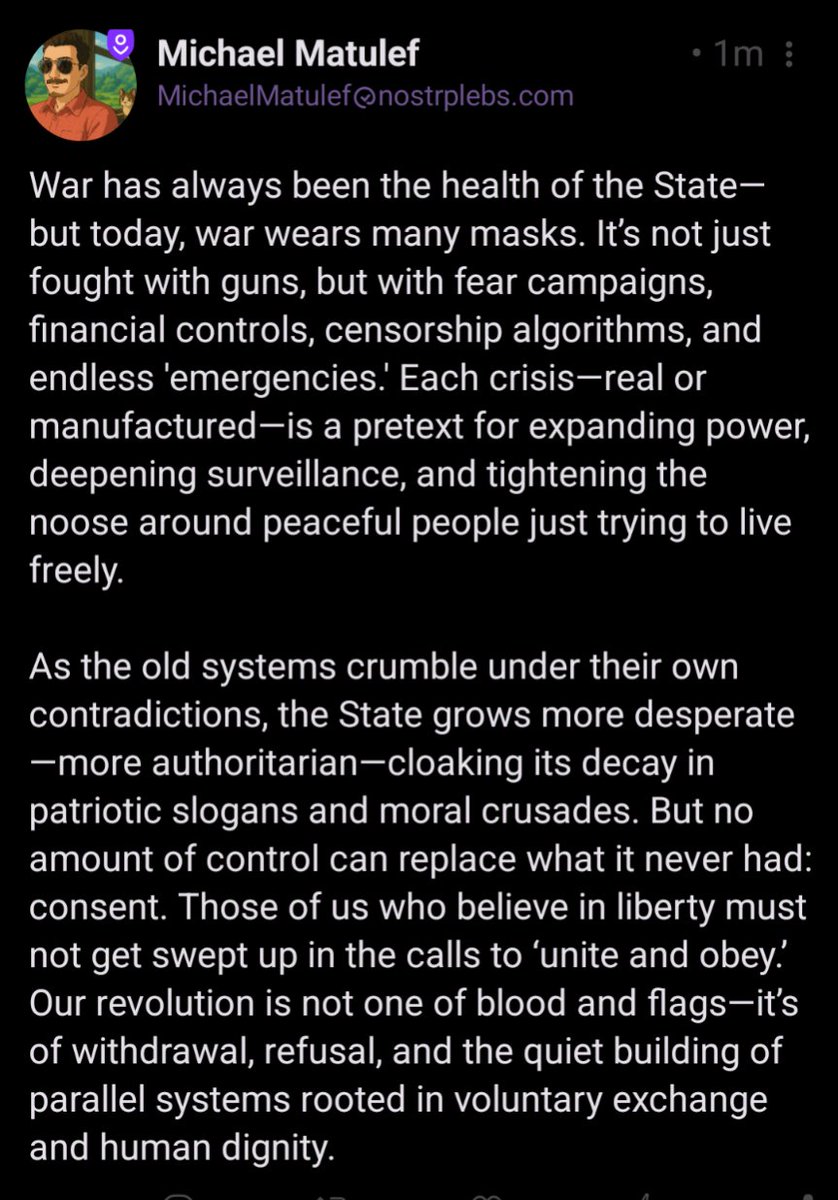
The ruling class, through their State, manipulates, distorts, corrupts, and undermines the economy so that when it coughs, they can cry "disease" and when it faulters, they can cry "it cannot live," and fool the economically illiterate to embrace it and reject voluntary exchange.
For more than two centuries, the doomsday crowd has claimed that capital development will create mass unemployment. And for two centuries, they have been wrong. The same goes for artificial intelligence. | Michael Matulef
https://t.co/FT0Mz4M0lW
“I wish it need not have happened in my time,” said Frodo.
“So do I,” said Gandalf, “and so do all who live to see such times. But that is not for them to decide. All we have to decide is what to do with the time that is given us.”
— J.R.R. Tolkien
The real lesson is to accept scarcity, respect prices, and seek your comparative advantage in a world where AI is just another tool—not to retreat into a lonely, inefficient attempt to do by hand what your tools could help you transcend.
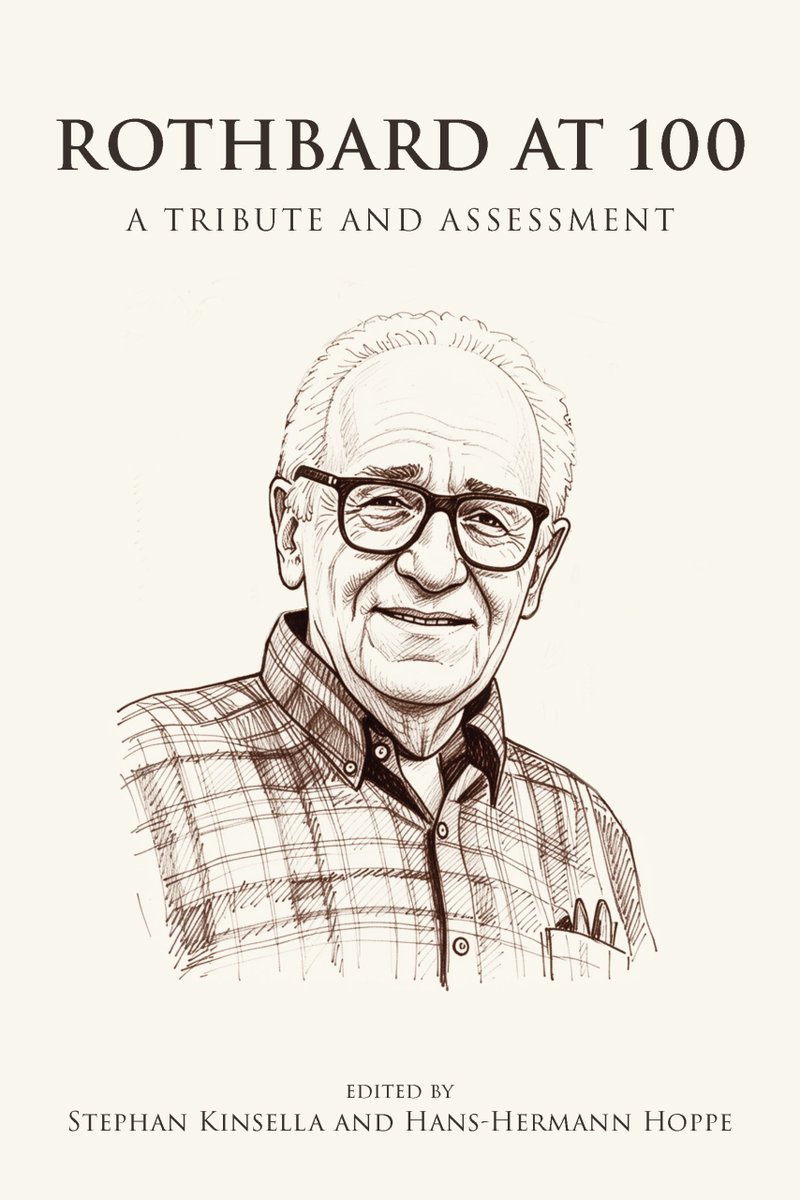
Rothbard at 100: A Tribute and Assessment Published Today
by Hans-Hermann Hoppe on March 2, 2026
https://t.co/RhPJvOp6Pj
Stephan Kinsella and I are pleased to announce the publication of Rothbard at 100: A Tribute and Assessment (Papinian Press and The Saif House, 2026) free and online today, March 2, 2026, on the occasion of Murray Rothbard’s 100th birthday.
Murray N. Rothbard (1926–1995) was one of the world’s greatest champions of the human liberty. In his honor, and to commemorate his 100th birthday, on March 2, 2026, the Property and Freedom Society (PFS) has assembled this collection of tributes to and commentary on him and his work by PFS members, including many who knew him personally.
This book is released in digital form today, March 2, 2026, on Murray’s 100th birthday. Print, in both paperback and deluxe hardcover, and kindle/epub/pdf versions will be made available shortly. For more details, see the book’s landing page.
We hope all admirers of liberty and Rothbard will enjoy this book and join us in sending well wishes and gratitude Murray’s way, wherever he may be.nb @propfreedom, @saifedean
AI will (potentially) replace 40% of jobs in the next decade.
Schools are still teaching kids to memorize state capitals.
The gap between what's coming and what we're preparing for has never been wider.
Regardless of the advancements in AI, the central question does not change: given scarcity, what should you do with your time, and what should you let the tools do?
Crucially, no one needs to know this pattern in advance. No one has to sit down with a spreadsheet and assign roles. The market is the discovery process that finds and constantly updates the pattern of comparative advantages.
Whenever people differ—and they always do—in skills, tools, knowledge, and circumstances, there exists some pattern of specialization and exchange that makes all of them better off than they would be alone.
There is all the difference in the world between treating people equally and attempting to make them equal. While the first is the condition of a free society, the second means, as De Tocqueville described it, “a new form of servitude.”
- F. A. Hayek