Put a lion and a human on a diet of pure lean meat, and watch what happens.
The lion thrives. An obligate carnivore can pull around 70 percent of its energy straight from protein and feel magnificent doing it. Its liver runs the nitrogen-clearing machinery permanently flat out, built from the factory to mop up the ammonia that all that protein leaves behind.
Now you. Push much past 35 or 40 percent of your energy from protein and the wheels start to come off. Your liver can only turn so much of that toxic ammonia into urea before the excess backs up into your blood. Headaches first, then nausea, then weakness, and if you carry on, a genuinely grim way to go. The old explorers called it rabbit starvation. Endless lean rabbit, full belly, dead inside three weeks.
So here is what the lean-protein crowd never quite reckon with. We are predators walking around with a built-in protein ceiling. We are not lions. We cannot live on muscle meat alone, and we were never built to.
The way around that ceiling is fat. Fat carries the calories lean protein cannot safely deliver, which is precisely why our ancestors hunted the fattest animals they could find and went for the marrow, the organs and the back fat first. Fat is what kept them alive.
A lion is built to run on protein. You are built to run on fat. Mind the ceiling, and eat accordingly.
"Bacon is a Group 1 carcinogen, same category as smoking." You have heard it a hundred times. Here is what that category actually measures.
The WHO's cancer agency sorts things into groups. The crucial thing nobody bothers to explain is what the groups are sorting by.
They sort by how confident we are that something can cause cancer at all. They do not sort by how much it raises your risk.
So Group 1 simply means "we are sure this does something." It lumps together:
- Tobacco smoking
- Sunlight
- Alcohol
- Processed meat
Same group. Wildly different danger. Smoking raises lung cancer risk by something like two thousand per cent. Processed meat raises bowel cancer risk by around eighteen per cent in relative terms, which on the absolute numbers works out to roughly one extra case per hundred people over a lifetime of eating it daily.
Putting bacon and cigarettes in the same sentence is like calling a sparkler and a landmine both "explosives," then telling people to handle the sparkler with bomb disposal gloves.
The classification grades the strength of the evidence, not the size of the threat. Once you understand that, the scary headline does most of the work of debunking itself.
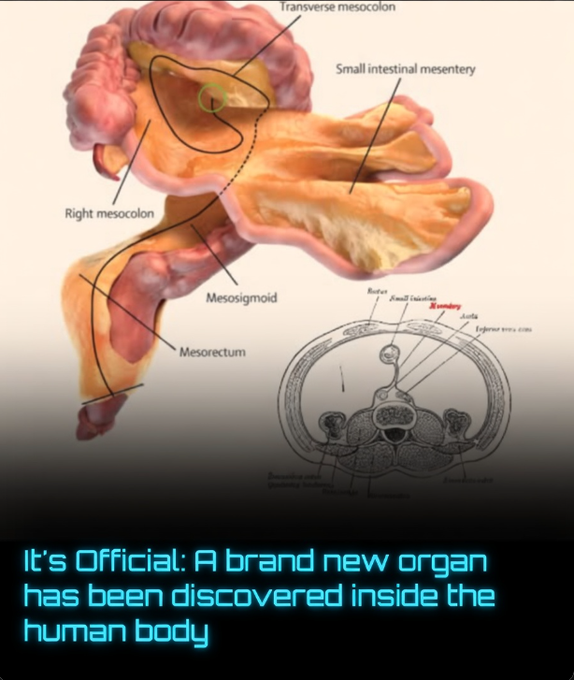
Scientists have officially discovered a brand-new organ in the human body.
The mesentery — a structure long thought to be a collection of fragmented tissues holding the intestines in place — has been reclassified as a single, continuous organ. This landmark discovery, led by researcher J. Calvin Coffey at University Hospital Limerick, has fundamentally changed our understanding of human anatomy.
For centuries, the mesentery was dismissed as insignificant. Now, thanks to detailed research, it is recognized as one unified structure. The finding was so significant that it has already been incorporated into the latest edition of Gray’s Anatomy, the world’s most respected medical textbook.
While the mesentery’s main function is to anchor and support the intestines, scientists believe it plays far more complex roles that are still not fully understood. Its formal recognition has given rise to an entirely new field called mesenteric science. Researchers hope that studying this organ will unlock new insights into digestive diseases, abdominal disorders, and potentially lead to better treatments for millions of patients.
This discovery is a powerful reminder that even today, the human body still holds remarkable secrets waiting to be uncovered.
"Humans aren't designed to eat meat. Look at our teeth."
Oh, I'm looking. Incisors for slicing, canines for tearing, molars at the back to finish off whatever the front end started. Lovely set of tools. Not exactly the gentle gnashers of a creature built to graze a meadow.
A cow actually does graze. It grinds side to side for hours like a living millstone, four stomachs working overtime on a salad it can barely break down. Your jaw does nothing of the sort, and deep down you know it.
But here is the part that ruins the whole bit. We stopped eating with our teeth about two million years ago.
We eat with our hands, our fire, and the three pounds of fat behind our eyes. A lion needs a fearsome jaw because a jaw is all the poor thing has. We bring down whatever we fancy with a sharpened stone, a thrown spear, and a plan we cooked up the night before. The weapon was always the brain. The teeth just turned up for the meal.
Judging the human diet by our teeth is like judging a sniper by his fingernails. Go on, have a good long look at his fingernails.
Blunt little teeth, sat in the mouth of the most ruthlessly effective predator this planet has ever coughed up. Adorable, really.
One pound of 20% ground beef. The entire shopping list a human body actually needs, sat in the cheapest tray in the shop.
Here is what you get for your money. Rough daily values, raw, and cooking only concentrates them.
Macros
- Around 1,150 calories
- 78g protein, a full day's worth for most people in a single tray
- 90g fat, the part they spent decades telling you to be frightened of
- 0g carbohydrate
Vitamins and minerals
- Vitamin B12: nearly 400%
- Zinc: around 175%
- Selenium: around 125%
- Niacin (B3): around 120%
- Vitamin B6: around 65%
- Phosphorus: around 55%
- Riboflavin (B2): around 50%
- Choline: around 45%
- Iron: around 50%, and the heme kind your gut actually absorbs
- Potassium: around 25%
- Copper: around 25%
No fibre. No antioxidants you have to chew through a bowl of leaves to reach. No blood sugar spike. Just dense, absorbable, complete nourishment in the one food a toddler and a pensioner can both manage.
The figures wobble a little by brand and by butcher. The conclusion does not. They spent fifty years teaching you to fear the cheapest and most perfect food in the building.
Why is it that when you mention enjoying a breakfast of steak and eggs, people lose their minds?
But pour yourself a sugary bowl of cereal and wash it down with some fruit juice, and suddenly it’s fine?
#steakAndEggs#BreakfastChampion#RealFood#LiveAncestral
A vulture's stomach runs at a pH of around 1. That is roughly battery acid. It dissolves bone and sterilises the anthrax, botulism and cholera in a rotting carcass on the way down. The bird eats three-day-old roadkill for breakfast and feels nothing, because its gut is a furnace built to handle death.
Here comes the uncomfortable bit for the salad crowd.
Your stomach runs at about 1.5. Not quite vulture grade, but in the same brutal postcode. It is roughly level with a possum and a hawk. Meanwhile a gorilla, an actual dedicated plant-eater, sits far higher, up around 4 to 5, and a chimp, your nearest living cousin, has a gut noticeably gentler than yours.
You did not evolve that acid to break down spinach. Spinach does not fight back. That savage, flesh-melting pH is the calling card of an animal that ate meat, often meat well past its best, and needed to kill whatever was living in it first.
Scientists have a polite phrase for this. They reckon scavenging carcasses mattered far more in human evolution than the tidy nut-and-berry story admits, because only a viciously acidic gut lets you raid a kill and survive the bacteria that come with it.
So you wander about with the stomach of a scavenger and the dietary advice of a rabbit. The stomach was issued by two million years of evolution. The advice was issued by a committee in the seventies.
HOW YOUR HEART-HEALTHY BREAKFAST STARVES YOUR HORMONES AND SHUTS DOWN YOUR METABOLISM
A bowl of oatmeal sits comfortably in the imagination as a perfect, wholesome breakfast. The marketing has been so successful that questioning it seems almost impolite.
Yet when you follow the oats through the digestive tract and into the cells, a quiet biochemical drama unfolds that clashes with the heart-healthy fairy tale.
Oats contain a compound called phytic acid, the grain’s main phosphorus storage molecule. Once it reaches the small intestine, its phosphate groups shed protons and become strongly negative.
This transforms the molecule into a chelating agent, a molecular claw that snatches up essential minerals and refuses to release them.
The minerals trapped most aggressively are zinc, copper, and magnesium. They form insoluble complexes with the phytic acid and slide out of the body without ever crossing into the bloodstream.
The food itself contains the minerals, but the delivery system fails at the gut wall. Human studies confirmed this effect decades ago, long before the oatmeal craze took hold.
Zinc deficiency hits the thyroid with surprising speed. The thyroid hormone receptors that control metabolism depend on tiny zinc-finger motifs to maintain their shape and grab DNA.
Without enough zinc, these receptors collapse. Hormone levels on a blood test might read normal, but the tissues become functionally deaf to the signal, and the cellular machinery slows down.
Copper depletion targets the mitochondria directly. Complex IV of the electron transport chain needs copper to hand electrons over to oxygen. When copper is scarce, this terminal step stalls, oxygen consumption nosedives, and the proton gradient that drives ATP production dissipates.
The cell shifts into a reduced state, glucose entry gets blocked, and insulin resistance sets in, not from overeating, but from a mineral shortage that began in a bowl of oats.
Magnesium plays a quieter but equally central role. ATP does not float freely inside cells; it exists as a magnesium chelate, Mg-ATP2-. This is the real fuel that kinases demand. When phytic acid drains magnesium, the insulin receptor tyrosine kinase cannot autophosphorylate, GLUT4 vesicles cannot move to the membrane, and glucose piles up in the blood while cells go hungry.
Beyond the mineral story, there is the fiber problem. The beta-glucan that gives oatmeal its gluey, satisfying texture forms a viscous gel in the intestine. This gel traps bile acids and prevents their reabsorption.
The liver, sensing the drain, pulls more cholesterol out of the blood to manufacture replacement bile acids, and the familiar serum cholesterol number drops.
Cholesterol is not just a lipid to be eliminated. It is the raw material for every steroid hormone in the body. The adrenal glands and gonads use cholesterol to build pregnenolone, DHEA, progesterone, and testosterone. When beta-glucan steadily siphons cholesterol into the toilet, the hormone factory runs low on raw materials and the whole axis suffers.
The situation becomes even more tangled in people with slow digestion. The viscous fiber lingers, fermenting in a sluggish gut. Methane-producing archaea feed on the hydrogen released during fermentation, and the methane they make directly slows gut motility further. A self-feeding cycle of bloating, stagnation, and bacterial overgrowth takes hold.
As bacteria proliferate, they shed lipopolysaccharides from their outer membranes. A healthy gut barrier keeps these endotoxins out, but methane distension and inflammatory signals can degrade the tight junctions that seal the intestinal wall. The toxins leak into the portal vein and hit the liver, where immune cells trigger a flood of inflammatory cytokines.
Those cytokines suppress a gene called DIO1 in liver cells, the gene that encodes the enzyme that converts inactive T4 into active T3 thyroid hormone. When T3 production drops, the whole body slows its metabolic rate. The slowness then feeds back to weaken gut motility even more, tightening the inflammatory loop.
The deep satiety people report after eating oatmeal is frequently a stress response. The gut irritation, methane distension, and endotoxin spill activate the sympathetic nervous system and raise cortisol.
The appetite shuts down not because the body is nourished, but because it perceives a threat. This is stress-induced anorexia dressed up as comfort food wisdom.
The heart-healthy label that protects oatmeal from scrutiny rests on a narrow fixation with lowering serum cholesterol. Health claims were approved decades ago based on that single metric.
Draining a substrate pool without considering the wider consequences for hormone production and cellular energy is not medicine; it is a biochemical shell game.
All of this does not mean you need to panic about the occasional bowl of oats. The body is resilient, and small exposures are rarely the problem. But a daily oatmeal habit can quietly erode the mineral stores and hormonal reserves that keep metabolism humming.
A practical, step-by-step strategy for reversing that drain and rebuilding cellular energy is detailed in Part 2 below, with a bullet-point cheat sheet in Part 3 for quick reference.
Humans are facultative carnivores.
That doesn't mean you can't eat carbs and veg and still be healthy. You can.
It means you don't need a single gram of either to thrive.
There's a hierarchy of food, and it's been sat there the whole time.
Fatty animal foods are at the top. Meat, organs, eggs, butter. The things your body actually asks for.
Plants sit lower down. Optional, nice to have, a garnish on a system built around the steak.
You were never meant to assemble your health out of leaves. You were meant to hunt the thing eating them.
On carnivore, the weekly shop takes four minutes.
Past the cereal. Past the bread. Past the snacks. Past the "free from" aisle, twelve feet of food liberated from the one ingredient that made it edible. Past the protein bars cosplaying as chocolate.
Beef, eggs, butter, bacon. Done.
The supermarket is a maze built to keep you drifting past things you came in not wanting. You have found the exit on the first go.