For 40 years, mainstream economics had a settled answer for pollution, industrial noise, and every kind of spillover harm: the state must tax the producer to force him to bear the cost.
In 1960, one outsider walked into a Chicago dinner to prove the whole framework was wrong. He converted every economist in the room. 🧵
Shortly after I'd been elected to the chair in 1953, the undergraduates gave me a party and we had a very jolly time. And they said, 'what we want is a book about law -- telling us what law is. Why don't you write one?' So I did.
-- HLA Hart
Ronald Coase reminded the economics profession of something he considered obvious:
If transaction costs are zero, resources will always move to their highest-value uses through voluntary exchange, regardless of who initially owns them.
To see this clearly, imagine a plot of land that is perfect for growing tomatoes. Now imagine two potential owners: Andrea and Bruno.
Suppose Andrea knows how to use the land more profitably. Maybe she has better harvesting equipment or some technology that increases the soil’s productivity.
If Andrea is the initial owner, she will likely keep the land. It is simply more valuable in her hands than in Bruno’s.
If Bruno is the initial owner, the land will likely change hands. Andrea will have an incentive to buy it for a price that reflects the difference between what she can produce with it and what he can.
Either way, the outcome is the same: the land ends up with Andrea.
And this is the fascinating part: when transaction costs are zero or very low, the initial allocation of property rights is irrelevant for economic efficiency—that is, for matching resources to the uses that consumers value most. Tomato consumers, through the price system, “prefer” that Andrea be the owner because she can produce more or better.
Through the price system, resources gravitate toward those who can employ them in higher-value ways—much like gravity pulls physical bodies toward each other.
But here’s the equally interesting twist: even if the initial assignment of property rights does not matter for efficiency, it does matter for wealth distribution.
If Andrea owns the land at the start, she earns the income from using it. She becomes richer first.
If Bruno owns it initially, he becomes richer by selling the land to Andrea.
So the initial allocation produces a wealth effect for whoever starts out as the owner.
My impression is that most socialists focus far more on this initial distribution of property rights than on the dynamic, efficiency-enhancing reallocation that markets generate. In other words, they emphasize who ought to own a resource, rather than the importance of having mechanisms that allow resources to flow to their most productive uses.
Under capitalism, you choose. You can quit, compete, start your own business, change careers, or trade your skills for better value elsewhere. No one owns you, and no one has a claim on your labor except through voluntary exchange. That’s not “exploitation” that’s freedom.
Under communism, you obey. The state owns the jobs, the farms, the factories, and you. You don’t get to “opt out.” If your boss under capitalism doesn’t value you, you can walk away. If your boss under communism doesn’t value you, he’s called the government, and walking away is called a crime.
Capitalism is the only system where “starvation” is rare enough to become a political slogan instead of a daily reality. Every other system that tried to end “exploitation” by abolishing choice ended up producing both, mass starvation and total exploitation.
Freedom doesn’t guarantee comfort. It guarantees opportunity. And that’s all any moral person should ask for: the right to live by one’s own effort, not by anyone else’s permission.
“The price system works so well, so efficiently, that we are not aware of it most of the time. We never realize how well it functions until it is prevented from functioning, and even then we seldom recognize the source of the trouble.”
— Milton Friedman
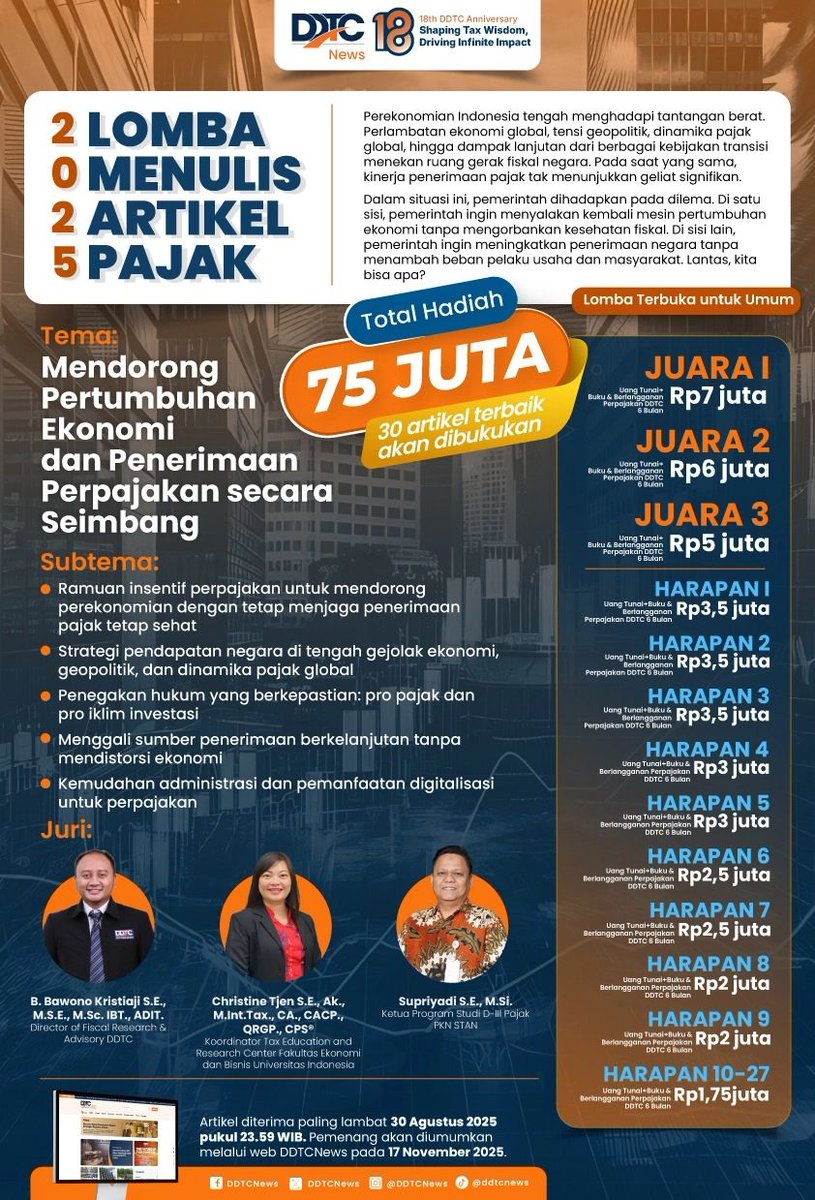
Ikuti! Lomba Menulis Artikel Pajak DDTCNews, Berhadiah Total Rp75 Juta
Pada lomba menulis artikel pajak pada tahun ini, DDTCNews mengambil tema: "Mendorong Pertumbuhan Ekonomi dan Penerimaan Perpajakan secara Seimbang".
https://t.co/1s7clFJELi"
Want to fight fascism? Try libertarianism.
Sounds backwards, right? The leftists on campus say free markets lead to fascism. But the people who actually identified fascism first—decades before it had a name—were libertarians. 🧵