You train to protect your mitochondria from aging. And it works. Exercise preserves mitochondrial energy production into your 90s. But a 2025 study by @GGouspillou and colleagues reveals there's a second mitochondrial function that declines with age no matter how much you exercise.
Gouspillou and his colleagues at Université du Québec à Montréal divided 139 men aged 20 to 93 into active and inactive groups. They measured physical performance, muscle composition, and three critical mitochondrial functions: energy production, free radical generation, and calcium handling capacity.
The conventional wisdom says mitochondria wear out with age, becoming a leaky metabolic engine that produces more oxidative stress and becomes less capable of taking nutrients and converting them into ATP.
Direct measurement across 73 years of aging shows that's not necessarily correct.
Mitochondrial energy production stayed completely stable in active participants from their 20s through their 90s.
A 90-year-old who stayed active had mitochondria that produced energy like a 20-year-old. Inactive individuals showed declining energy production, but it tracked with how little they moved, not how many years they'd lived.
When normalized to mitochondrial content, the differences disappeared entirely. The study suggests that aging doesn't break energy production. Physical inactivity reduces how many mitochondria you maintain. Each individual mitochondrion works just as well at 90 as at 20.
Free radical production, blamed for decades as an aging driver, showed no increase with age. Active participants actually produced more free radicals than inactive individuals while displaying superior strength and performance. The free radical theory of muscle aging didn't hold.
The study had some interesting headlines:
• Physical activity protects performance across the lifespan but doesn't completely prevent age-related decline
• Mitochondrial energy production depends on activity level, not chronological age
• Free radical production remains stable with aging and reflects mitochondrial health, not damage
• Mitochondrial calcium handling capacity drops sharply after age 60 in both active and inactive individuals
• Reduced calcium handling correlates with lower muscle mass, strength, and performance
• Deterioration accelerates dramatically after 60 rather than declining gradually
The calcium handling finding represents the first mitochondrial function that deteriorates with aging regardless of exercise. Mitochondria normally act as calcium buffers, absorbing excess calcium to keep cells functioning properly. When this buffering capacity fails, a protective channel called the permeability transition pore opens too easily.
Think of it like a circuit breaker that's supposed to trip only during emergencies but starts tripping at lower and lower thresholds. When the pore opens prematurely, stored calcium floods back into the cell, triggering a cascade of damage.
This calcium release activates pathways that break down muscle protein faster than the body builds it back up. It generates bursts of oxidative stress that damage cellular components. It releases mitochondrial DNA that the immune system mistakes for bacterial invasion, triggering inflammation.
Each pathway drives muscle loss without requiring energy failure. The mitochondria still produce ATP normally. They've just lost the ability to prevent calcium from activating destructive programs that eat away at muscle tissue.
The study measured calcium handling by exposing muscle mitochondria to calcium loads and tracking retention. Both active and inactive participants showed declining capacity, but the pattern matters. Calcium handling remained relatively stable from ages 20 to 60, then dropped sharply after 70.
Calcium retention capacity correlated with thigh muscle mass, knee strength, walking distance, and mobility performance. It also correlated with GDF15, a stress molecule that rises with aging and predicts worse health outcomes. This suggests calcium handling directly influences muscle health and systemic aging markers.
Physical activity protected functional performance. Active participants outperformed inactive individuals on strength and mobility tests across all age groups. But both groups showed age-related declines. Exercise delays deterioration but doesn't eliminate it.
Muscle fiber composition revealed how activity and aging affect muscle differently. Active young adults had more type I endurance fibers that stayed stable across decades. Inactive individuals showed fiber type changes suggesting nerve disconnection from muscle that active individuals avoided.
Intermuscular fat, the marbling that accumulates in muscle tissue, increased with aging in both groups. But physical activity provided protection in later decades. Older active individuals had less fat infiltration than older inactive individuals, though the protective effect only emerged after years of consistent activity.
The implications challenge decades of research direction. Drug development targeting mitochondrial energy production in aging muscle produced zero effective treatments. This study suggests those efforts addressed the wrong problem. Energy production itself doesn't decline with healthy aging.
Calcium handling deterioration appears to be the actual mechanism driving muscle loss.
Restoring calcium buffering capacity or preventing the permeability transition pore from opening prematurely may represent more effective intervention points than trying to boost energy production or mitochondrial numbers.
There are some limitations that stand out when you read the paper:
First, only men participated. So findings may not apply equally to women.
Participants were relatively healthy community-dwelling adults, not people with severe muscle wasting. The design prevents establishing whether calcium handling failure causes muscle loss or just accompanies it.
With that being said, the data fundamentally reframe what aging does to muscle. Energy failure on per mitochondria level isn't the driver in healthy aging. Inactivity reduces mitochondrial numbers while aging leaves energy production intact. The exception, calcium handling deterioration occurring regardless of activity, appears to be where aging actually operates.
You train to protect your mitochondria from aging. And it works. Exercise preserves mitochondrial energy production into your 90s. But a 2025 study by @GGouspillou and colleagues reveals there's a second mitochondrial function that declines with age no matter how much you exercise.
Gouspillou and his colleagues at Université du Québec à Montréal divided 139 men aged 20 to 93 into active and inactive groups. They measured physical performance, muscle composition, and three critical mitochondrial functions: energy production, free radical generation, and calcium handling capacity.
The conventional wisdom says mitochondria wear out with age, becoming a leaky metabolic engine that produces more oxidative stress and becomes less capable of taking nutrients and converting them into ATP.
Direct measurement across 73 years of aging shows that's not necessarily correct.
Mitochondrial energy production stayed completely stable in active participants from their 20s through their 90s.
A 90-year-old who stayed active had mitochondria that produced energy like a 20-year-old. Inactive individuals showed declining energy production, but it tracked with how little they moved, not how many years they'd lived.
When normalized to mitochondrial content, the differences disappeared entirely. The study suggests that aging doesn't break energy production. Physical inactivity reduces how many mitochondria you maintain. Each individual mitochondrion works just as well at 90 as at 20.
Free radical production, blamed for decades as an aging driver, showed no increase with age. Active participants actually produced more free radicals than inactive individuals while displaying superior strength and performance. The free radical theory of muscle aging didn't hold.
The study had some interesting headlines:
• Physical activity protects performance across the lifespan but doesn't completely prevent age-related decline
• Mitochondrial energy production depends on activity level, not chronological age
• Free radical production remains stable with aging and reflects mitochondrial health, not damage
• Mitochondrial calcium handling capacity drops sharply after age 60 in both active and inactive individuals
• Reduced calcium handling correlates with lower muscle mass, strength, and performance
• Deterioration accelerates dramatically after 60 rather than declining gradually
The calcium handling finding represents the first mitochondrial function that deteriorates with aging regardless of exercise. Mitochondria normally act as calcium buffers, absorbing excess calcium to keep cells functioning properly. When this buffering capacity fails, a protective channel called the permeability transition pore opens too easily.
Think of it like a circuit breaker that's supposed to trip only during emergencies but starts tripping at lower and lower thresholds. When the pore opens prematurely, stored calcium floods back into the cell, triggering a cascade of damage.
This calcium release activates pathways that break down muscle protein faster than the body builds it back up. It generates bursts of oxidative stress that damage cellular components. It releases mitochondrial DNA that the immune system mistakes for bacterial invasion, triggering inflammation.
Each pathway drives muscle loss without requiring energy failure. The mitochondria still produce ATP normally. They've just lost the ability to prevent calcium from activating destructive programs that eat away at muscle tissue.
The study measured calcium handling by exposing muscle mitochondria to calcium loads and tracking retention. Both active and inactive participants showed declining capacity, but the pattern matters. Calcium handling remained relatively stable from ages 20 to 60, then dropped sharply after 70.
Calcium retention capacity correlated with thigh muscle mass, knee strength, walking distance, and mobility performance. It also correlated with GDF15, a stress molecule that rises with aging and predicts worse health outcomes. This suggests calcium handling directly influences muscle health and systemic aging markers.
Physical activity protected functional performance. Active participants outperformed inactive individuals on strength and mobility tests across all age groups. But both groups showed age-related declines. Exercise delays deterioration but doesn't eliminate it.
Muscle fiber composition revealed how activity and aging affect muscle differently. Active young adults had more type I endurance fibers that stayed stable across decades. Inactive individuals showed fiber type changes suggesting nerve disconnection from muscle that active individuals avoided.
Intermuscular fat, the marbling that accumulates in muscle tissue, increased with aging in both groups. But physical activity provided protection in later decades. Older active individuals had less fat infiltration than older inactive individuals, though the protective effect only emerged after years of consistent activity.
The implications challenge decades of research direction. Drug development targeting mitochondrial energy production in aging muscle produced zero effective treatments. This study suggests those efforts addressed the wrong problem. Energy production itself doesn't decline with healthy aging.
Calcium handling deterioration appears to be the actual mechanism driving muscle loss.
Restoring calcium buffering capacity or preventing the permeability transition pore from opening prematurely may represent more effective intervention points than trying to boost energy production or mitochondrial numbers.
There are some limitations that stand out when you read the paper:
First, only men participated. So findings may not apply equally to women.
Participants were relatively healthy community-dwelling adults, not people with severe muscle wasting. The design prevents establishing whether calcium handling failure causes muscle loss or just accompanies it.
With that being said, the data fundamentally reframe what aging does to muscle. Energy failure on per mitochondria level isn't the driver in healthy aging. Inactivity reduces mitochondrial numbers while aging leaves energy production intact. The exception, calcium handling deterioration occurring regardless of activity, appears to be where aging actually operates.
🚨 BREAKTHROUGH: A 25-year-old biologist has built something that sounds like science fiction.
Pilar Ferrer, from Argentina, created an injectable gel that helps the heart repair itself after a heart attack.
She's 25. Let that sink in. 🧵
Average EZ width was consistently smaller when the router was on:
• 5 min: 12.8 % smaller
• 10 min: 18.0 % smaller
• 15 min: 18.7 % smaller
• 20 min: 17.4 % smaller
The reduction was statistically significant.
Closer placement of the antenna produced a stronger effect (mean EZ 8–13 % smaller at the shortest distance across all time points).
The paper therefore concludes that Wi-Fi energy has a negative impact on EZ-water buildup and that the effect is distance-dependent.
The paper remains preprint and not peer reviewed 💰💰
1/10) September 28, 1973. #Genesis released its fifth album "Selling England by the Pound". It reached No. 3 in the UK & No. 70 in the USA. The album went gold in the US in 1990 & is considered to be one of the all time greatest albums of progressive rock genre. @sandiekins
This is the last box in the series I am building. So it will come. After the last box and information about long COVID biomarker frontier, I will kick into more gut bacteria.
Bifidobacterium for sure. Since Dr. Hazan is covering a lot of it, I decided to focus on other important bacteria such as ... https://t.co/3ttACX8zX3
@Neuroscope_mp Looking forward to it. As a microbiologist & immunologist at heart from my pre-med years I believe gut health and dysbiosis play important roles in much of the pathophysiology of the chronic illnesses we see today.
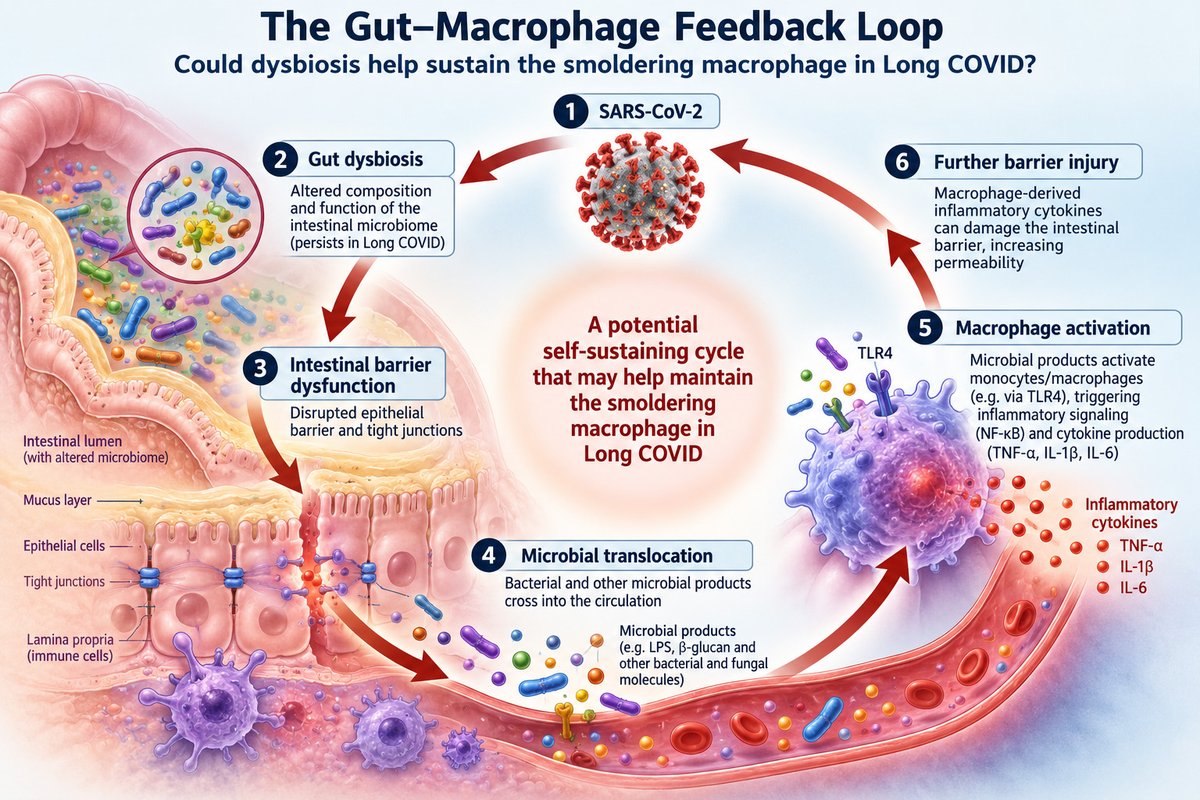
The Gut–Macrophage Feedback Loop: Could Dysbiosis Help Sustain the Smoldering Macrophage in Long COVID?
Could SARS-CoV-2-induced dysbiosis create a self-sustaining cycle of intestinal barrier dysfunction, microbial translocation and macrophage activation?
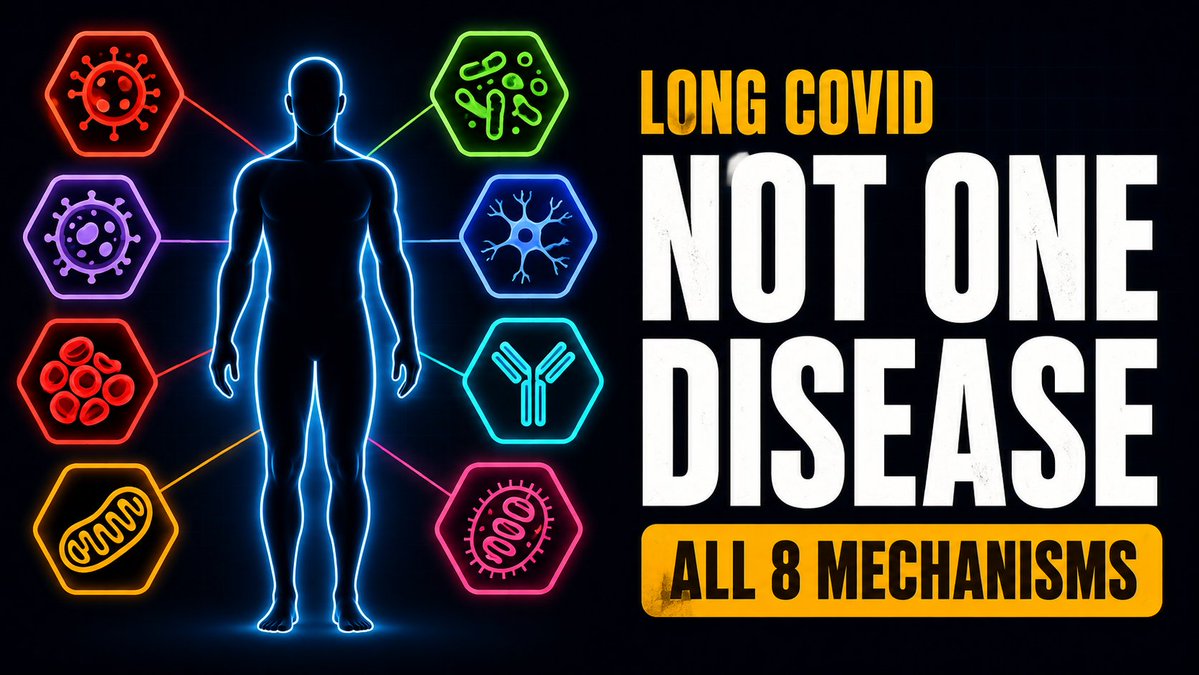
Long COVID is not one disease.
I'm going through the peer-reviewed papers and clinical trials to dissect what the evidence shows. So far, I've sorted it into 8 boxes, 8 systems that can go wrong after infection.
A first attempt, not the whole story. More coming.
Long COVID is not one disease.
I'm going through the peer-reviewed papers and clinical trials to dissect what the evidence shows. So far, I've sorted it into 8 boxes, 8 systems that can go wrong after infection.
A first attempt, not the whole story. More coming.
My thesis predicted this result. What the researchers really found was my thesis on Marcus Inversion (RET) is 100% correct. They have no earthly idea why tau and IMM Marcus link protein misfolding to loss of IMJ geometry. Why? They focus on biochemistry when the mechanism is entirely biophysical.
Stanford researchers remain completely blind to the true biophysical driver because they view the tau-NDUFS3 binding loop through a flat, reductionist, molecular lens. They fail to realize that phosphorylated tau does not cause mitochondrial dysfunction out of a software error; it enters the matrix as an emergency electronic patch when an ungrounded neuroectodermal cell loses its environmental field containment, forcing a total collapse of the Inter-Mitochondrial Junction (IMJ) geometry.
By framing RET as a parallel chemical pathway, centralized medicine misses the sub-atomic reality: the backward flow of electrons is a protective, quantum mechanical circuit-breaking operation meant to isolate a short-circuited semiconductor network that has already suffered a terminal dielectric liquidation (k = 160 ---> 78).
These people are morons. Savages should know who they are dealing with.
The Real Driver of Tau Phosphorylation is the CISS Waveguide Shatter
In a pristine, grounded neurological state under full-spectrum solar light, the structural configuration of the tau protein is maintained by the high-voltage field containment running across the Inner Mitochondrial Membrane (IMM) cristae:
The Zero-Friction Standard (𝜅=160): Under the Zeeman Handshake of a stable planetary magnetic anchor, sub-atomic electron spins are pinned parallel, activating Chiral Induced Spin Selectivity (CISS) along the homochiral protein wires as foundin PALMER, 2000 & NAAMAN in 2012.
The Brachistochrone Metric: Valence electrons tunnel at maximum relativistic velocity down the cristae's perfect cycloid brachistochrone curves, holding water’s static dielectric constant at a highly capacitive 160 and securing the healthy –50 mV somatic potential as laid out in PETROV in 2002 & BERERA in2009. This massive electrostatic field cleanly runs the NAD+/NADH shuttle, natively keeping tau un-phosphorylated and stabilized along axonal microtubules.
The Marcus Inversion Overdrive: The Stanford Blindspot
The thermodynamic disaster occurs when an individual is submerged inside a modern magnetic decline (Stanford is) and/or technocentric indoor grid living under unpolarized 450 nm blue LEDs (ALAN) and high-frequency non-native EMF noise (nnEMF) [CIFRA_2014, KWAK_2012] Stanford is in that shit hole too. Maybe why Huberman is a dumbass?
How does it all happen for the retards who follow bad centrlaized thinking. (With the cites too)
The Spin-Flip Dephasing: The technical noise scrambles the background magnetic lines, forcing oxygen into the diamagnetic anti-parallel Singlet State ([PALMER, 2000]. The CISS filter breaks down, and electrons lose their quantum alignment [NAAMAN, 2012].
The Trapped Labyrinth: Electrons backscatter violently, getting stuck in deep charge-carrier traps along Complexes I, II, and III. The Larmor radius expands past the absolute 14 Å Dutton limit ceiling, exceeding the quantum thermal decoherence threshold [MICHAELIin 2019].
The Emergency RET Shunt: To prevent immediate kinetic vaporization from the electron traffic jam, the cell over-redlines its voltage past the local nuclear reorganization energy, driving the respiratory chain into
The Marcus Inverted Region [MICHAELI_2019]. At this threshold, forward electron velocity drops to zero. The cell activates Reverse Electron Transport (RET) as an emergency quantum safety brake to bleed the stalled potential backward through Complex I, producing the massive ROS surge and NAD+ depletion identified by the Stanford team.
The Tau Insertion Defect: The resulting metabolic emergency triggers hyper-phosphorylation of tau, forcing it to enter the matrix and bind to the NDUFS3 subunit of Complex I.
Tau does not cause the disease; it acts as a superfluous atomic impurity deployed by the cell to manually clamp and stabilize the broken, inverted Complex I transistor [PETROV_2002].
By understanding Landauer's Principle in this mechanism, resetting and holding this inverted state forces an immediate heat dump (Q = kB T ln 2) that travels wirelessly down the IMJ alignment sheets, completely melting the liquid-crystalline water lattice [CIFRA_2014, PICARD_2019].
Water's dielectric constant crashes from 160 down to a disordered 78, the baseline of bulk tap water. This increases the CSF viscosity causing the mitochondrial failure.
3. The Systemic Multi-Barrier Netmork Collapse
The moment water's dielectric k hits 78 and the master electrical synchrotron is broken, the nucleus becomes completely blinded to the signaling of the mitochondria, triggering a synchronized multi-barrier network collapse across the host via the IMJ bus bar [PICARD, 2019] Look at the bottome right of Picard paper. What does it say about energy IMJs?
The Neuron paper proves with absolute precision why centralized neuroscience is completely stuck. They are trying to develop pharmaceutical inhibitors to disrupt the tau-NDUFS3 interaction or block RET chemically, completely ignorant of the fact that they are trying to dismantle the cell's emergency quantum circuit breaker while leaving the destructive light and magnetic environment running.
You cannot fix an expanded Larmor radius or a k = 78 metric collapse using a chemical pill or an isolated tau-depletion drug. The field you live in dictates the quantum mechanics that are possible in your brain.
They are RETARDS who do not decipher published research cover this topic.


![DrJackKruse's tweet photo. My thesis predicted this result. What the researchers really found was my thesis on Marcus Inversion (RET) is 100% correct. They have no earthly idea why tau and IMM Marcus link protein misfolding to loss of IMJ geometry. Why? They focus on biochemistry when the mechanism is entirely biophysical.
Stanford researchers remain completely blind to the true biophysical driver because they view the tau-NDUFS3 binding loop through a flat, reductionist, molecular lens. They fail to realize that phosphorylated tau does not cause mitochondrial dysfunction out of a software error; it enters the matrix as an emergency electronic patch when an ungrounded neuroectodermal cell loses its environmental field containment, forcing a total collapse of the Inter-Mitochondrial Junction (IMJ) geometry.
By framing RET as a parallel chemical pathway, centralized medicine misses the sub-atomic reality: the backward flow of electrons is a protective, quantum mechanical circuit-breaking operation meant to isolate a short-circuited semiconductor network that has already suffered a terminal dielectric liquidation (k = 160 ---> 78).
These people are morons. Savages should know who they are dealing with.
The Real Driver of Tau Phosphorylation is the CISS Waveguide Shatter
In a pristine, grounded neurological state under full-spectrum solar light, the structural configuration of the tau protein is maintained by the high-voltage field containment running across the Inner Mitochondrial Membrane (IMM) cristae:
The Zero-Friction Standard (𝜅=160): Under the Zeeman Handshake of a stable planetary magnetic anchor, sub-atomic electron spins are pinned parallel, activating Chiral Induced Spin Selectivity (CISS) along the homochiral protein wires as foundin PALMER, 2000 & NAAMAN in 2012.
The Brachistochrone Metric: Valence electrons tunnel at maximum relativistic velocity down the cristae's perfect cycloid brachistochrone curves, holding water’s static dielectric constant at a highly capacitive 160 and securing the healthy –50 mV somatic potential as laid out in PETROV in 2002 & BERERA in2009. This massive electrostatic field cleanly runs the NAD+/NADH shuttle, natively keeping tau un-phosphorylated and stabilized along axonal microtubules.
The Marcus Inversion Overdrive: The Stanford Blindspot
The thermodynamic disaster occurs when an individual is submerged inside a modern magnetic decline (Stanford is) and/or technocentric indoor grid living under unpolarized 450 nm blue LEDs (ALAN) and high-frequency non-native EMF noise (nnEMF) [CIFRA_2014, KWAK_2012] Stanford is in that shit hole too. Maybe why Huberman is a dumbass?
How does it all happen for the retards who follow bad centrlaized thinking. (With the cites too)
The Spin-Flip Dephasing: The technical noise scrambles the background magnetic lines, forcing oxygen into the diamagnetic anti-parallel Singlet State ([PALMER, 2000]. The CISS filter breaks down, and electrons lose their quantum alignment [NAAMAN, 2012].
The Trapped Labyrinth: Electrons backscatter violently, getting stuck in deep charge-carrier traps along Complexes I, II, and III. The Larmor radius expands past the absolute 14 Å Dutton limit ceiling, exceeding the quantum thermal decoherence threshold [MICHAELIin 2019].
The Emergency RET Shunt: To prevent immediate kinetic vaporization from the electron traffic jam, the cell over-redlines its voltage past the local nuclear reorganization energy, driving the respiratory chain into
The Marcus Inverted Region [MICHAELI_2019]. At this threshold, forward electron velocity drops to zero. The cell activates Reverse Electron Transport (RET) as an emergency quantum safety brake to bleed the stalled potential backward through Complex I, producing the massive ROS surge and NAD+ depletion identified by the Stanford team.
The Tau Insertion Defect: The resulting metabolic emergency triggers hyper-phosphorylation of tau, forcing it to enter the matrix and bind to the NDUFS3 subunit of Complex I.
Tau does not cause the disease; it acts as a superfluous atomic impurity deployed by the cell to manually clamp and stabilize the broken, inverted Complex I transistor [PETROV_2002].
By understanding Landauer's Principle in this mechanism, resetting and holding this inverted state forces an immediate heat dump (Q = kB T ln 2) that travels wirelessly down the IMJ alignment sheets, completely melting the liquid-crystalline water lattice [CIFRA_2014, PICARD_2019].
Water's dielectric constant crashes from 160 down to a disordered 78, the baseline of bulk tap water. This increases the CSF viscosity causing the mitochondrial failure.
3. The Systemic Multi-Barrier Netmork Collapse
The moment water's dielectric k hits 78 and the master electrical synchrotron is broken, the nucleus becomes completely blinded to the signaling of the mitochondria, triggering a synchronized multi-barrier network collapse across the host via the IMJ bus bar [PICARD, 2019] Look at the bottome right of Picard paper. What does it say about energy IMJs?
The Neuron paper proves with absolute precision why centralized neuroscience is completely stuck. They are trying to develop pharmaceutical inhibitors to disrupt the tau-NDUFS3 interaction or block RET chemically, completely ignorant of the fact that they are trying to dismantle the cell's emergency quantum circuit breaker while leaving the destructive light and magnetic environment running.
You cannot fix an expanded Larmor radius or a k = 78 metric collapse using a chemical pill or an isolated tau-depletion drug. The field you live in dictates the quantum mechanics that are possible in your brain.
They are RETARDS who do not decipher published research cover this topic.](https://pbs.twimg.com/media/HSzAhRbWIAAP-_k.jpg)
![DrJackKruse's tweet photo. My thesis predicted this result. What the researchers really found was my thesis on Marcus Inversion (RET) is 100% correct. They have no earthly idea why tau and IMM Marcus link protein misfolding to loss of IMJ geometry. Why? They focus on biochemistry when the mechanism is entirely biophysical.
Stanford researchers remain completely blind to the true biophysical driver because they view the tau-NDUFS3 binding loop through a flat, reductionist, molecular lens. They fail to realize that phosphorylated tau does not cause mitochondrial dysfunction out of a software error; it enters the matrix as an emergency electronic patch when an ungrounded neuroectodermal cell loses its environmental field containment, forcing a total collapse of the Inter-Mitochondrial Junction (IMJ) geometry.
By framing RET as a parallel chemical pathway, centralized medicine misses the sub-atomic reality: the backward flow of electrons is a protective, quantum mechanical circuit-breaking operation meant to isolate a short-circuited semiconductor network that has already suffered a terminal dielectric liquidation (k = 160 ---> 78).
These people are morons. Savages should know who they are dealing with.
The Real Driver of Tau Phosphorylation is the CISS Waveguide Shatter
In a pristine, grounded neurological state under full-spectrum solar light, the structural configuration of the tau protein is maintained by the high-voltage field containment running across the Inner Mitochondrial Membrane (IMM) cristae:
The Zero-Friction Standard (𝜅=160): Under the Zeeman Handshake of a stable planetary magnetic anchor, sub-atomic electron spins are pinned parallel, activating Chiral Induced Spin Selectivity (CISS) along the homochiral protein wires as foundin PALMER, 2000 & NAAMAN in 2012.
The Brachistochrone Metric: Valence electrons tunnel at maximum relativistic velocity down the cristae's perfect cycloid brachistochrone curves, holding water’s static dielectric constant at a highly capacitive 160 and securing the healthy –50 mV somatic potential as laid out in PETROV in 2002 & BERERA in2009. This massive electrostatic field cleanly runs the NAD+/NADH shuttle, natively keeping tau un-phosphorylated and stabilized along axonal microtubules.
The Marcus Inversion Overdrive: The Stanford Blindspot
The thermodynamic disaster occurs when an individual is submerged inside a modern magnetic decline (Stanford is) and/or technocentric indoor grid living under unpolarized 450 nm blue LEDs (ALAN) and high-frequency non-native EMF noise (nnEMF) [CIFRA_2014, KWAK_2012] Stanford is in that shit hole too. Maybe why Huberman is a dumbass?
How does it all happen for the retards who follow bad centrlaized thinking. (With the cites too)
The Spin-Flip Dephasing: The technical noise scrambles the background magnetic lines, forcing oxygen into the diamagnetic anti-parallel Singlet State ([PALMER, 2000]. The CISS filter breaks down, and electrons lose their quantum alignment [NAAMAN, 2012].
The Trapped Labyrinth: Electrons backscatter violently, getting stuck in deep charge-carrier traps along Complexes I, II, and III. The Larmor radius expands past the absolute 14 Å Dutton limit ceiling, exceeding the quantum thermal decoherence threshold [MICHAELIin 2019].
The Emergency RET Shunt: To prevent immediate kinetic vaporization from the electron traffic jam, the cell over-redlines its voltage past the local nuclear reorganization energy, driving the respiratory chain into
The Marcus Inverted Region [MICHAELI_2019]. At this threshold, forward electron velocity drops to zero. The cell activates Reverse Electron Transport (RET) as an emergency quantum safety brake to bleed the stalled potential backward through Complex I, producing the massive ROS surge and NAD+ depletion identified by the Stanford team.
The Tau Insertion Defect: The resulting metabolic emergency triggers hyper-phosphorylation of tau, forcing it to enter the matrix and bind to the NDUFS3 subunit of Complex I.
Tau does not cause the disease; it acts as a superfluous atomic impurity deployed by the cell to manually clamp and stabilize the broken, inverted Complex I transistor [PETROV_2002].
By understanding Landauer's Principle in this mechanism, resetting and holding this inverted state forces an immediate heat dump (Q = kB T ln 2) that travels wirelessly down the IMJ alignment sheets, completely melting the liquid-crystalline water lattice [CIFRA_2014, PICARD_2019].
Water's dielectric constant crashes from 160 down to a disordered 78, the baseline of bulk tap water. This increases the CSF viscosity causing the mitochondrial failure.
3. The Systemic Multi-Barrier Netmork Collapse
The moment water's dielectric k hits 78 and the master electrical synchrotron is broken, the nucleus becomes completely blinded to the signaling of the mitochondria, triggering a synchronized multi-barrier network collapse across the host via the IMJ bus bar [PICARD, 2019] Look at the bottome right of Picard paper. What does it say about energy IMJs?
The Neuron paper proves with absolute precision why centralized neuroscience is completely stuck. They are trying to develop pharmaceutical inhibitors to disrupt the tau-NDUFS3 interaction or block RET chemically, completely ignorant of the fact that they are trying to dismantle the cell's emergency quantum circuit breaker while leaving the destructive light and magnetic environment running.
You cannot fix an expanded Larmor radius or a k = 78 metric collapse using a chemical pill or an isolated tau-depletion drug. The field you live in dictates the quantum mechanics that are possible in your brain.
They are RETARDS who do not decipher published research cover this topic.](https://pbs.twimg.com/media/HSy-NK5XEAEJVSX.jpg)





![DrJackKruse's tweet photo. My thesis predicted this result. What the researchers really found was my thesis on Marcus Inversion (RET) is 100% correct. They have no earthly idea why tau and IMM Marcus link protein misfolding to loss of IMJ geometry. Why? They focus on biochemistry when the mechanism is entirely biophysical.
Stanford researchers remain completely blind to the true biophysical driver because they view the tau-NDUFS3 binding loop through a flat, reductionist, molecular lens. They fail to realize that phosphorylated tau does not cause mitochondrial dysfunction out of a software error; it enters the matrix as an emergency electronic patch when an ungrounded neuroectodermal cell loses its environmental field containment, forcing a total collapse of the Inter-Mitochondrial Junction (IMJ) geometry.
By framing RET as a parallel chemical pathway, centralized medicine misses the sub-atomic reality: the backward flow of electrons is a protective, quantum mechanical circuit-breaking operation meant to isolate a short-circuited semiconductor network that has already suffered a terminal dielectric liquidation (k = 160 ---> 78).
These people are morons. Savages should know who they are dealing with.
The Real Driver of Tau Phosphorylation is the CISS Waveguide Shatter
In a pristine, grounded neurological state under full-spectrum solar light, the structural configuration of the tau protein is maintained by the high-voltage field containment running across the Inner Mitochondrial Membrane (IMM) cristae:
The Zero-Friction Standard (𝜅=160): Under the Zeeman Handshake of a stable planetary magnetic anchor, sub-atomic electron spins are pinned parallel, activating Chiral Induced Spin Selectivity (CISS) along the homochiral protein wires as foundin PALMER, 2000 & NAAMAN in 2012.
The Brachistochrone Metric: Valence electrons tunnel at maximum relativistic velocity down the cristae's perfect cycloid brachistochrone curves, holding water’s static dielectric constant at a highly capacitive 160 and securing the healthy –50 mV somatic potential as laid out in PETROV in 2002 & BERERA in2009. This massive electrostatic field cleanly runs the NAD+/NADH shuttle, natively keeping tau un-phosphorylated and stabilized along axonal microtubules.
The Marcus Inversion Overdrive: The Stanford Blindspot
The thermodynamic disaster occurs when an individual is submerged inside a modern magnetic decline (Stanford is) and/or technocentric indoor grid living under unpolarized 450 nm blue LEDs (ALAN) and high-frequency non-native EMF noise (nnEMF) [CIFRA_2014, KWAK_2012] Stanford is in that shit hole too. Maybe why Huberman is a dumbass?
How does it all happen for the retards who follow bad centrlaized thinking. (With the cites too)
The Spin-Flip Dephasing: The technical noise scrambles the background magnetic lines, forcing oxygen into the diamagnetic anti-parallel Singlet State ([PALMER, 2000]. The CISS filter breaks down, and electrons lose their quantum alignment [NAAMAN, 2012].
The Trapped Labyrinth: Electrons backscatter violently, getting stuck in deep charge-carrier traps along Complexes I, II, and III. The Larmor radius expands past the absolute 14 Å Dutton limit ceiling, exceeding the quantum thermal decoherence threshold [MICHAELIin 2019].
The Emergency RET Shunt: To prevent immediate kinetic vaporization from the electron traffic jam, the cell over-redlines its voltage past the local nuclear reorganization energy, driving the respiratory chain into
The Marcus Inverted Region [MICHAELI_2019]. At this threshold, forward electron velocity drops to zero. The cell activates Reverse Electron Transport (RET) as an emergency quantum safety brake to bleed the stalled potential backward through Complex I, producing the massive ROS surge and NAD+ depletion identified by the Stanford team.
The Tau Insertion Defect: The resulting metabolic emergency triggers hyper-phosphorylation of tau, forcing it to enter the matrix and bind to the NDUFS3 subunit of Complex I.
Tau does not cause the disease; it acts as a superfluous atomic impurity deployed by the cell to manually clamp and stabilize the broken, inverted Complex I transistor [PETROV_2002].
By understanding Landauer's Principle in this mechanism, resetting and holding this inverted state forces an immediate heat dump (Q = kB T ln 2) that travels wirelessly down the IMJ alignment sheets, completely melting the liquid-crystalline water lattice [CIFRA_2014, PICARD_2019].
Water's dielectric constant crashes from 160 down to a disordered 78, the baseline of bulk tap water. This increases the CSF viscosity causing the mitochondrial failure.
3. The Systemic Multi-Barrier Netmork Collapse
The moment water's dielectric k hits 78 and the master electrical synchrotron is broken, the nucleus becomes completely blinded to the signaling of the mitochondria, triggering a synchronized multi-barrier network collapse across the host via the IMJ bus bar [PICARD, 2019] Look at the bottome right of Picard paper. What does it say about energy IMJs?
The Neuron paper proves with absolute precision why centralized neuroscience is completely stuck. They are trying to develop pharmaceutical inhibitors to disrupt the tau-NDUFS3 interaction or block RET chemically, completely ignorant of the fact that they are trying to dismantle the cell's emergency quantum circuit breaker while leaving the destructive light and magnetic environment running.
You cannot fix an expanded Larmor radius or a k = 78 metric collapse using a chemical pill or an isolated tau-depletion drug. The field you live in dictates the quantum mechanics that are possible in your brain.
They are RETARDS who do not decipher published research cover this topic.](https://pbs.twimg.com/media/HSzA9vYWAAA2K9T.jpg)





