I was studying something related to how a new class of fuel trading companies (OMCs) in Ghana now prefer to own all outlets directly rather than build franchises, when Zen's IPO came into focus (after a friend had mentioned it.) Zen was founded between 2008 & 2013 by a former high-flying international business and finance professional.
I am puzzled by several things and wonder if anyone knows the business well enough to answer some questions.
Examples:
1. The newly incorporated listed holding company had virtually no history of its own so it used a "specially combined" group history that PwC used for a "limited assurance" without an audit opinion. Pretty standard in those places where stuff like even SPACs are celebrated but somewhat uncommon in these parts. For e.g. what happened to the exchange's "three years of audited accounts" rule?
2. The real confusion for me is that the December 2025 restructuring is not accompanied by an audited post-reorganisation balance sheet or a proper pro forma "capital bridge".
3. The Zen that was listed said it had GHS40,000 in cash and assets; GHS40,000 in equity; and, naturally, no material liabilities or operating history.
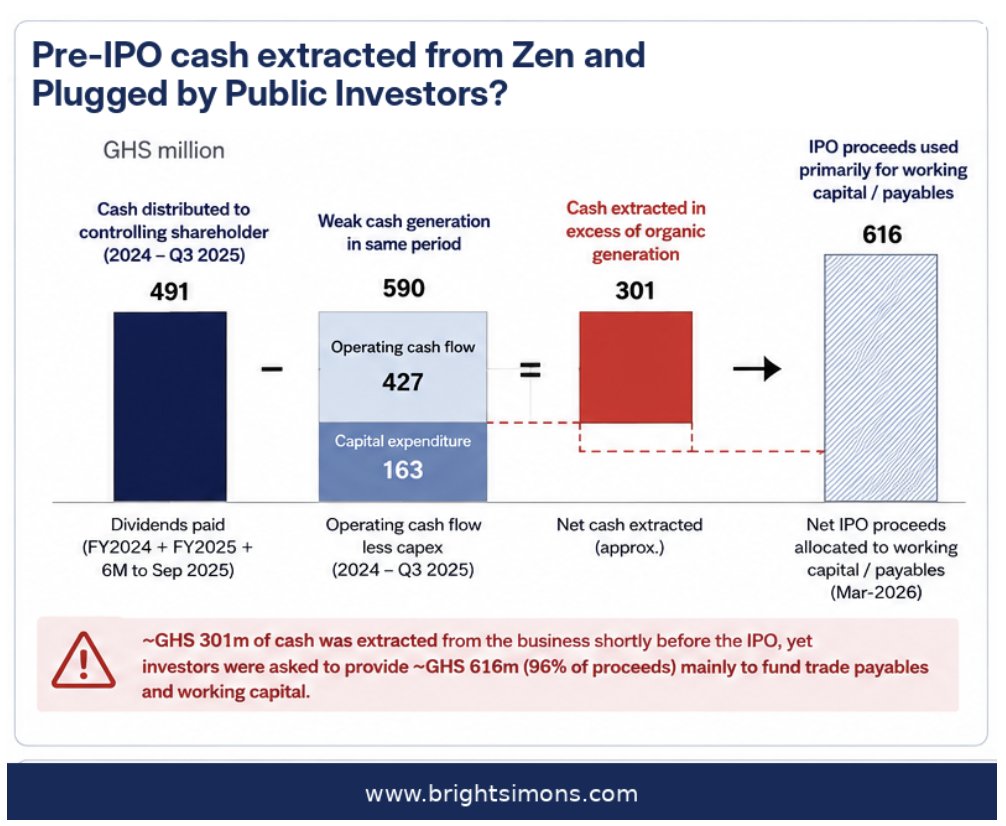
4. The founder kept 80% of the company and offered investors 20% through the IPO generating GHS 640 million in proceeds from institutional investors (mostly from the pensions world.) 96%+ of the proceeds was earmarked for working capital ("trade payables".)
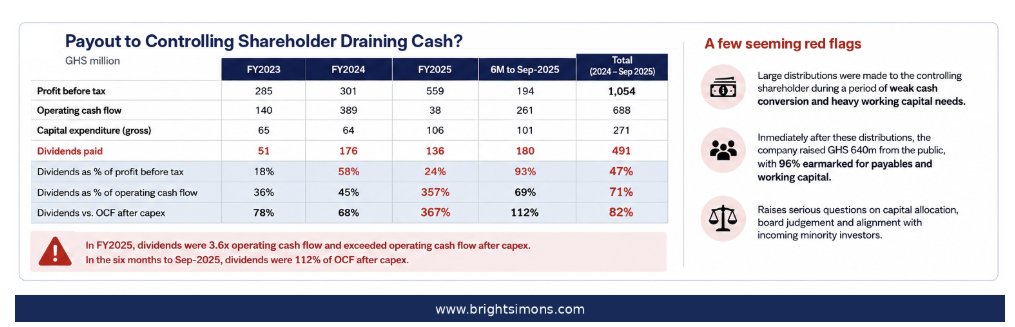
5. The prospectus’s dividend narrative is difficult to reconcile with Zen’s recent cash flows. The prospectus records dividends of approximately:
GHS51.3 million in FY2023;
GHS175.6 million in FY2024;
GHS135.9 million in FY2025;
GHS179.5 million in the six months to September 2025.
6. That is about GHS542.3 million over the disclosed periods, of which approximately GHS491 million was distributed from FY2024 through September 2025. Basically, the Founder had massive cashouts before bringing the institutional investors in.
7. No biggie. Institutional investors are savvy and sophisticated and if they are fine, then it means they think it is deserving. But secondary trading could leave retail investors holding the can so it is still worth a closer look.
8. In that regard, the concerning dividend in the record is the 2025 one because it occurred shortly before the December 2025 reorganisation and the March 2026 public offer. Those FY2025 dividends were approximately 3.6 times operating cash flow;
operating cash flow less capital expenditure was negative by approximately GHS68 million. A bit hard for me to fathom.
9. The post-listing accounts show:
- cash of only GHS112.6 million;
- substantially larger inventories;
- substantially larger trade and other payables; &
- no accessible proceeds-reconciliation statement.
10. This has me scratching my head a bit because the money was intended to fund trade payables and working capital. Yet, trade and other payables reportedly rose to approximately GHS806 million, rather than visibly falling.
11. The financial forecasts apparently omit the IPO proceeds and their deployment. The forecast cash-flow statement begins with approximately GHS147 million of cash and then proceeds to projects operating activity, investment and dividends. Why no IPO proceeds net costs?
12. Zen says it had no related-party transactions as at the prospectus date, yet forecasts hundreds of millions of cedis of related-party balances. Who are these "related parties." Are they owned by the Founder?
13. The first post-listing accounts contain a very large and unexplained “other income” line.
14. Zen’s official share-capital and share-count figures do not reconcile cleanly across the prospectus, GSE database and first post-listing accounts. Could be minor arithmetic issues but surprised that top accounting firms cleared that.
15. And least concerning: the valuation methodology is described but not disclosed with enough detail to reproduce or stress-test the GHS5 offer price.
Why is any of this of public interest when most of the IPO buyers are sophisticated institutional investors? Well, now that the shares are on the public markets, investor protection (especially of secondary retail buyers) makes this a public policy matter to a degree.
We may return to the issue.