Happy 80th birthday to my friend George W. Bush!
Your friendship—and that of your father and your entire family—has been one of the great gifts of my life. It has always reminded me that long before we’re politicians, we’re fellow Americans and, above all, human beings.
And for the next month, I’m especially grateful to finally have someone older than me! Wishing you many more years of good health, happiness, and friendship.
Our country is stronger when we remember that what unites us is greater than what divides us.
“There’s a certain level of wealth and accumulation that is unearned. You can’t earn a billion dollars. You just can’t earn that.”
So claimed Representative Alexandria Ocasio-Cortez, the progressive superstar from New York who is attracting presidential buzz. Her fellow New York progressive, Mayor Zohran Mamdani, would agree. He seems to think that billionaires with second homes in New York City aren’t pulling their weight. Meanwhile, a proposed wealth tax in California seems to be motivated by a similar mindset.
How to explain this sense that billionaires are taking from society rather than contributing to it?
Rep. Ocasio-Cortez and Mayor Mamdani — and Bernie Sanders, and Elizabeth Warren, and many more — seem to assume that the economy is a zero-sum game, in which the only way for your income to rise is for mine to fall.
This is dangerous nonsense. The game is not rigged. In the US economy, people receive their just rewards. Compensation is primarily determined by productivity—effort, risk-taking, skills, and choices. Billionaires have outsize wealth primarily because the market value of their economic contributions to society warrants it.
We should celebrate their success as a message to young people. We should want more billionaires, not fewer—certain in the knowledge that they give much more to society than they take from it.
My @ProSyn column: https://t.co/fY7fUxr2p3
On this Veterans Day, we should all give thanks for those who have served this country and defended our freedoms. A special remembrance for my grandfather, James Joyce (WWI), my uncles, Eugene Joyce (WWII), Jack Joyce (WWII) and Bob Joyce (WWII) and my father, Joe Joyce (Korea).
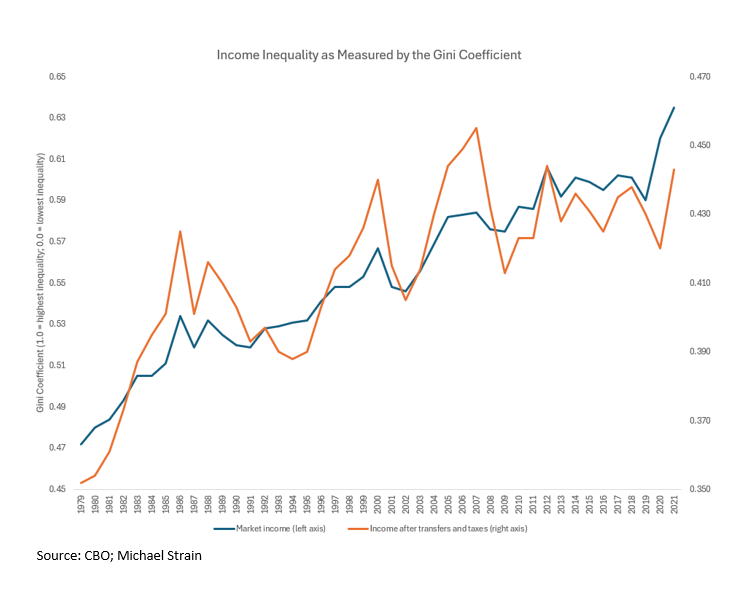
Friends, income inequality increased a lot in the 1980s and 1990s. But for nearly two decades, broadly-measured income inequality growth has been slow, or even negative. This is particularly true of post-tax-and-transfer income, which is the income that matters most to household consumption.
Regarding the "robust middle class" that we used to have, real median personal income was 38% higher in 2023 than in 1994. We can get back to the robust middle class of 1994 by subtracting nearly $12,000 a year from the median American's income.
Trump’s tariff war is raising uncertainty & scaring investors, which could reduce the trade deficit by slowing US growth & depreciating $. But that risks longstanding US ability to finance external debt at low cost, increasing burden on future generations.https://t.co/ZoG7lnvEIE
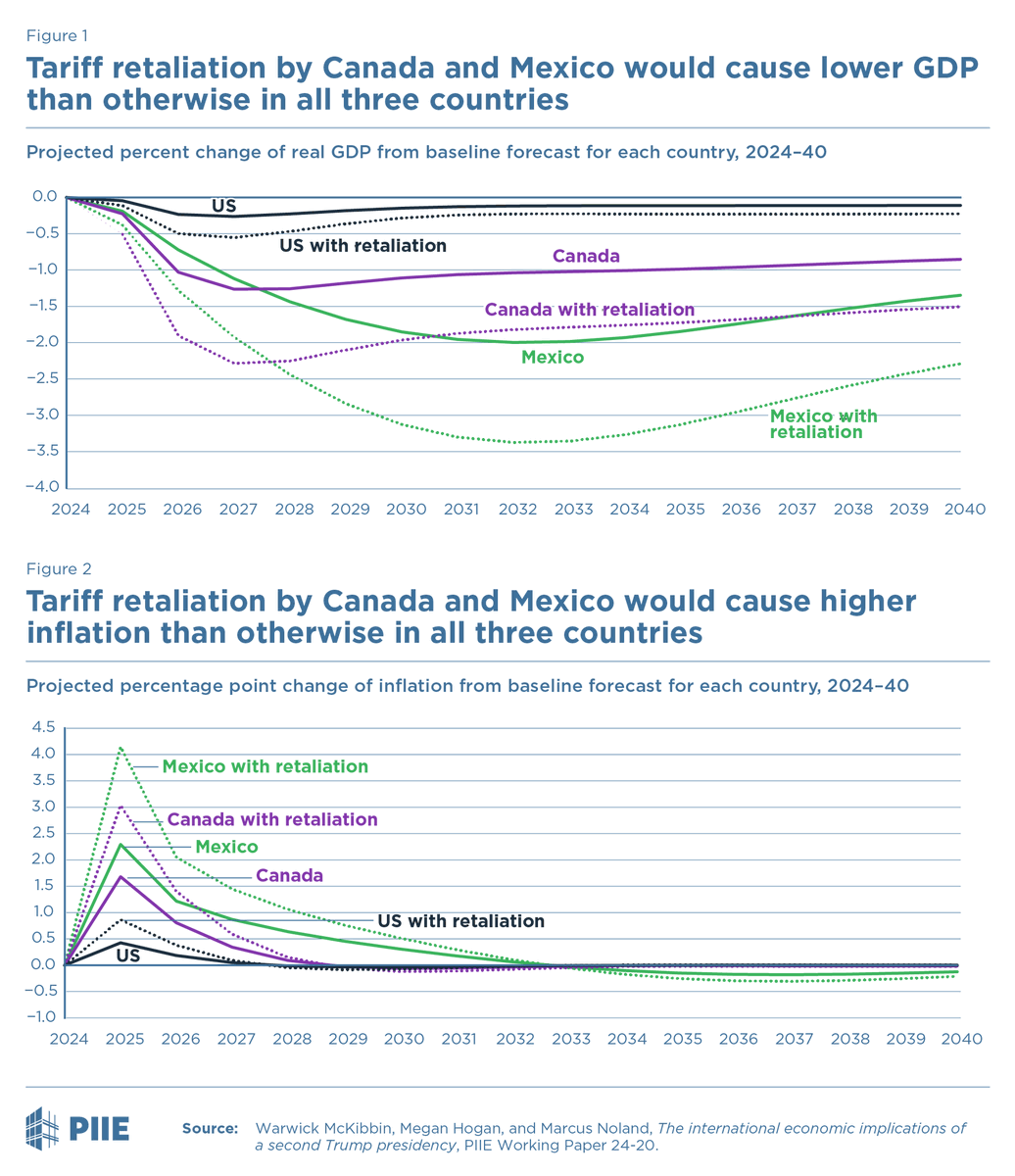
Adding retaliatory tariffs from Mexico & Canada on top of US tariffs on those two countries compounds the losses for all involved—including the US.
Learn more here: https://t.co/XuSWijqlfX
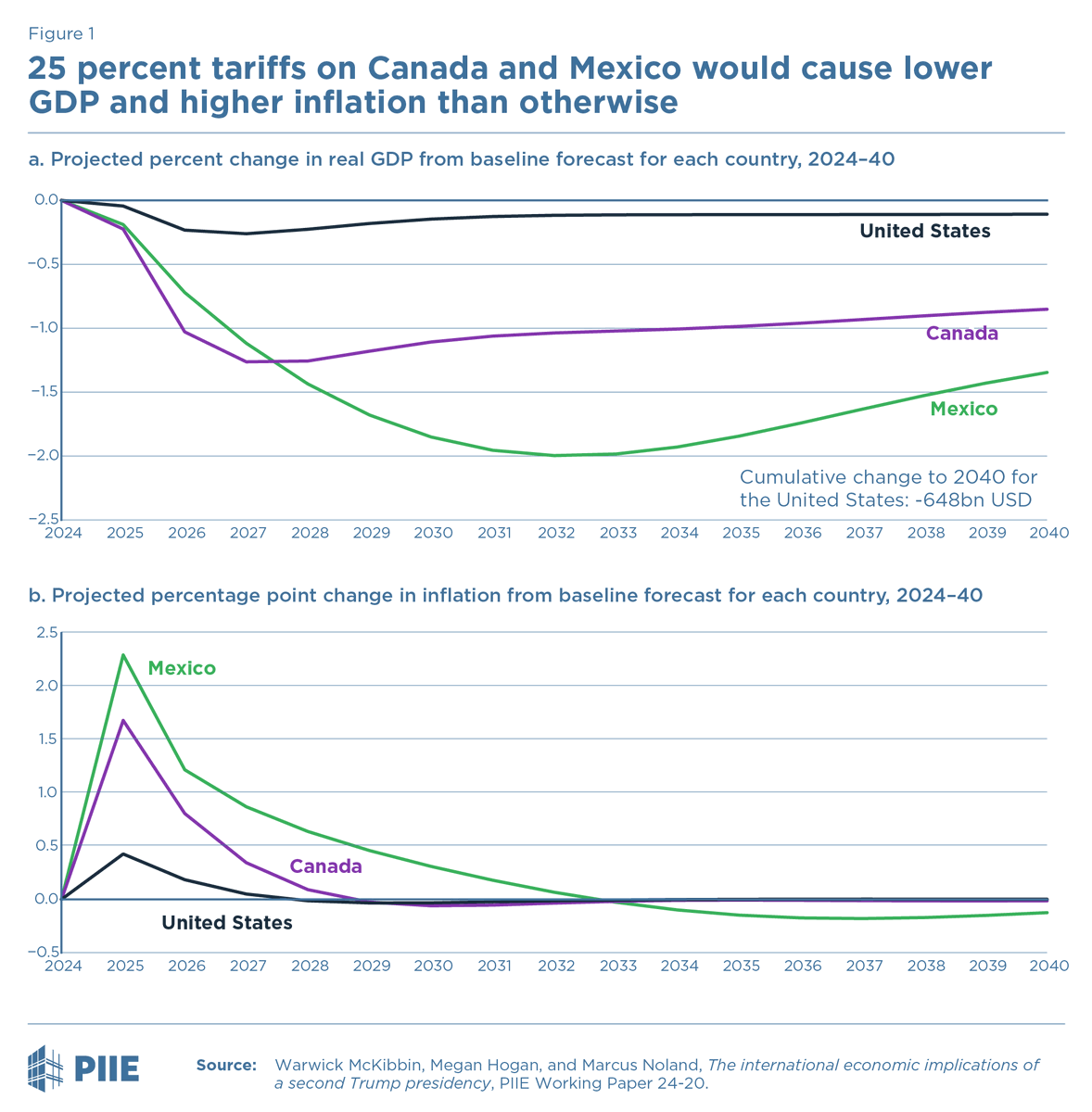
Canada & Mexico are the two largest trading partners of the US. Our new guide to the USMCA explains the trade agreement, what's at stake as President Trump threatens tariffs, & more. Stay tuned for updates as the situation develops.
https://t.co/8Bq7qM3GLd
From the @business election night live blog.
Whether the debt reckoning comes in three years, five years, or 15 years, “there is no argument” that the current fiscal path is unsustainable, Summers says. The risk is that “fear does the work of reason,” and at some point there’s a spike in interest rates as investors telegraph their concerns about the US fiscal path, he says. But it would be better for the new president and Congress to be proactive and address US borrowing.
Friends, don’t believe the hype: free trade does not cost jobs.
It also does not create jobs.
Trade is not about jobs. It is about productivity growth and higher wages.
Continuing to spend massively more than we take in each year—adding on to our public debt—cannot go on forever. The United States is on the path to financial catastrophe unless we put partisanship aside and produce constructive and honest solutions to stabilize our debt.
The costs from Trump’s proposed new tariffs will be nearly *five times* those caused by the first Trump tariff shocks through late 2019, generating additional costs to consumers from this channel alone of about $500 billion per year.
https://t.co/ZTgMfLJozY