Loved talking teaming with @ruthadewuyamd@StanfordCME -- especially: if most people in healthcare understand the need for psychological safety and teaming, why is it still so hard to generate
Feeling heard at work matters. But when do people feel heard (or not)? We conducted interviews with nurses to find out. Two different types of issues:
-->walls (outright dismissal)
-->voids (ideas get lost in the system).
Both can be overcome, but with different tactics
Your next opportunity to join @AmyCEdmondson and me in our latest course with @Harvard Online is here! Apply by Monday, Feb 26 to learn how to create strategic approaches for improving team performance and outcomes in health care: https://t.co/X2meRaFJOm
We are hiring a Research Assistant to join our team 🤸♂️ Projects focused on teamwork and process improvement in healthcare delivery. Looking for someone who is organized, eager, communicative and curious. Will fill quickly -- apply today! @HarvardHPM
https://t.co/ZTYvgD2Zdb
How can you get varied experts to generate value together -- even when time is tight and work complex? This large sample study (26k+ workers) suggests that joint problem-solving orientations differentiate high performing units. With @zhanna_novikov :)
https://t.co/v5nwXRSIoy
Really proud of this paper with Pat Satterstrom (@nyuwagner) @_ojung@MichaelaJuneK in @HCMRonline. In it we build a process model of how to get voiced ideas that are blocked or flagging to implementation. Check the link below.
New article published in @HCMRonline provides senior leaders with evidence-based strategies for bolstering rejected or ignored ideas from teammates and colleagues: https://t.co/wmqNdpUeSt #HCLDR@Owen4Aidan@NYUWagner@_ojung@MichaelaJuneK
Enjoyed doing this study with @SianTsuei
The devil with ACOs and performance is apparently in the details. Here we look at: Where should care coordinators be located? Does it matter? Here the signs point to yes...and with tradeoffs worth considering.
Why do we still use pagers in medicine?
@npr's Planet Money did an episode based on a case I wrote on this. Following 2 doctors who attempted (unsuccessfully) to kill the pager in their hospital 🧐
A fascinating and fun listen: https://t.co/kAH67oUnI3
@HarvardHPM
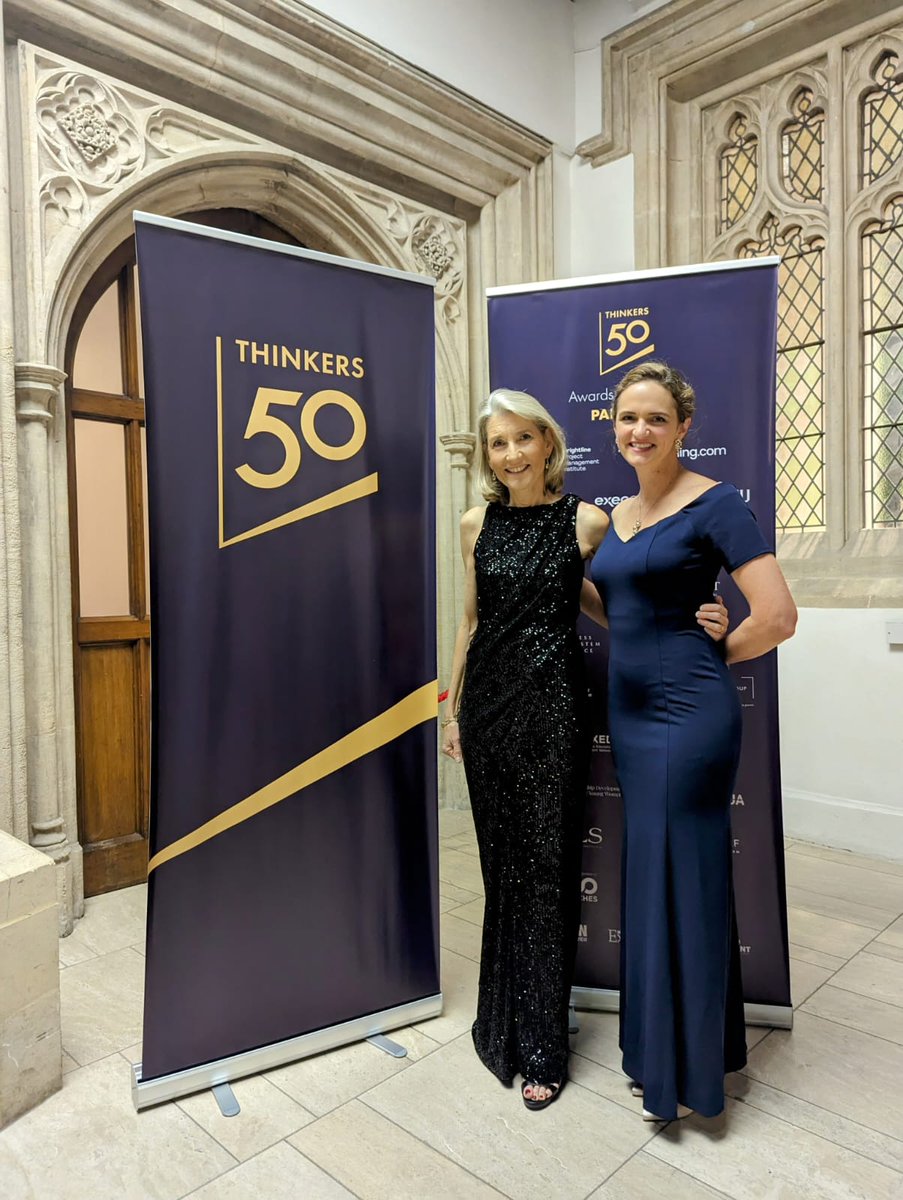
A great few days in London @thinkers50. It was an honor to be on the Radar Award Shortlist -- and a treat to be see @AmyCEdmondson rank #1 in the world (AGAIN). Plus who doesn't love a fancy party!
Helpful paper and thread. Notably, "Productivity impact of hybrid WFH about zero. Productivity impact of fully-remote varied, dependent on how well managed this is."
Our paper the "Evolution of Working from Home" just published https://t.co/UxN2nv8h9l overviewing the latest WFH data, trends, and research. Summary points:
1) WFH levels dropped in 2020-2022, then stabilized in 2023
2) Self-employed and gig workers are 3x more likely to be fully remote than salary workers (if you are your own boss you WFH a lot more)
3) Huge variation by industry, with IT having 5x WFH level of food service
4) WFH rises with density, and is 2x higher in cities than rural areas
5) WFH levels peak for folks in their 30s and early 40s (kids at home), those in their 20s have lower levels (mentoring, socializing and small living spaces)
6) Similar WFH levels by gender pre, during and post-pandemic
7) Much higher levels of WFH for graduates with kids under 14 at home
8) Productivity impact of hybrid WFH about zero. Productivity impact of fully-remote varied, dependent on how well managed this is.
9) Future will see rising levels of fully remote (the Nike Swoosh).