🚨 DON'T BECOME EXIT LIQUIDITY
SpaceX and OpenAI IPOs are being hyped as the next Amazon in 1997.
But almost nobody sees the massive problem.
Amazon went public at just $438M with huge upside ahead.
SpaceX and OpenAI are already multi-billion mega‑cap monsters.
They've been traded privately for years.
Insiders are sitting on massive paper gains.
But paper gains don't buy yachts.
They need your money to cash out.
Remember Rivian in 2021.
Hyped as the "Next Tesla."
Went public at $150B+ valuation.
Insiders dumped and retail lost over 90%.
The same playbook is repeating right now:
Pump public AI (Nvidia, Microsoft) to historic highs to create maximum FOMO.
Then flood the market with the biggest private tech IPOs in history.
Use retail euphoria as an exit door for new IPOs, while bleeding the current AI giants for cash.
This won't be the start of a new bull run.
This is the grand finale of the AI cash-out.
Retail will buy the top.
Insiders lock in 100x gains and step aside.
Don’t be their exit liquidity.
Remember, I've called every major turn for the last 10 years, including the exact $16K bottom three years ago and the $111K top in October.
Turn on notifications. When the data shows the dumping is over, I'll call the real bottom here.
🚨 BREAKING:
THE MAN WHO PREDICTED THE 2008 CRASH OPENED A SHORT POSITION ON THE AI BUBBLE
MICHAEL BURRY NOW HOLDS A $1 BILLION SHORT: $912M IN $PLTR AND $187M IN $NVDA
LAST TIME, HE DID THIS RIGHT BEFORE THE GREAT RECESSION IN 2008
HE KNOWS SOMETHING BAD IS COMING...
Donald trump wanted to paint the White House. He called three contractors for quotes.
The Chinese guy quoted $3 million. The European guy quoted $7 million. The Indian guy quoted $10 million.
Trump asked the Chinese guy “How did you quote $3 million?” The Chinese guy replied “$1 million for paint, $1 million for labor and $1 million profit.”
Trump asked the European guy. He replied: “$3 million for paint, $2 million for labor and $2 million profit.”
Trump asked the Indian guy. He replied: “$4 million for you. $3 million for me. And we will give $3 million to the Chinese guy and ask him to paint it.”
The Indian guy got the contract. 😄
Almost no one in school teaches this…
But it explains why the U.S. dollar dominates the world.
In 1971, America abandoned the gold standard.
That meant the dollar was no longer backed by gold.
Which created a huge problem.
Why would the world continue trusting the dollar?
The solution changed global power forever.
Oil.
In the 1970s, the United States made a strategic agreement with major oil-producing nations in the Middle East.
The deal was simple:
Oil would be sold in U.S. dollars.
Not euros.
Not yuan.
Not gold.
Dollars.
And because every country on earth needs oil…
Every country now needed U.S. dollars to buy it.
That system became known as the Petrodollar.
And it quietly helped build the modern American economy.
Think about the implications.
Countries around the world must hold huge reserves of U.S. dollars.
Oil profits get reinvested into U.S. banks and Treasury bonds.
Global demand for the dollar stays incredibly high.
Which gives the United States something almost no country has ever had.
Financial dominance.
It allows the U.S. to:
Borrow cheaper
Run massive financial markets
And remain the center of global finance
But here’s the part most people don’t talk about.
Some countries want to break the system.
Iran.
Russia.
China.
They’ve all pushed to sell oil without using the U.S. dollar.
Why?
Because if oil stops being priced in dollars…
The demand for dollars drops.
And one of the biggest pillars of American economic power weakens.
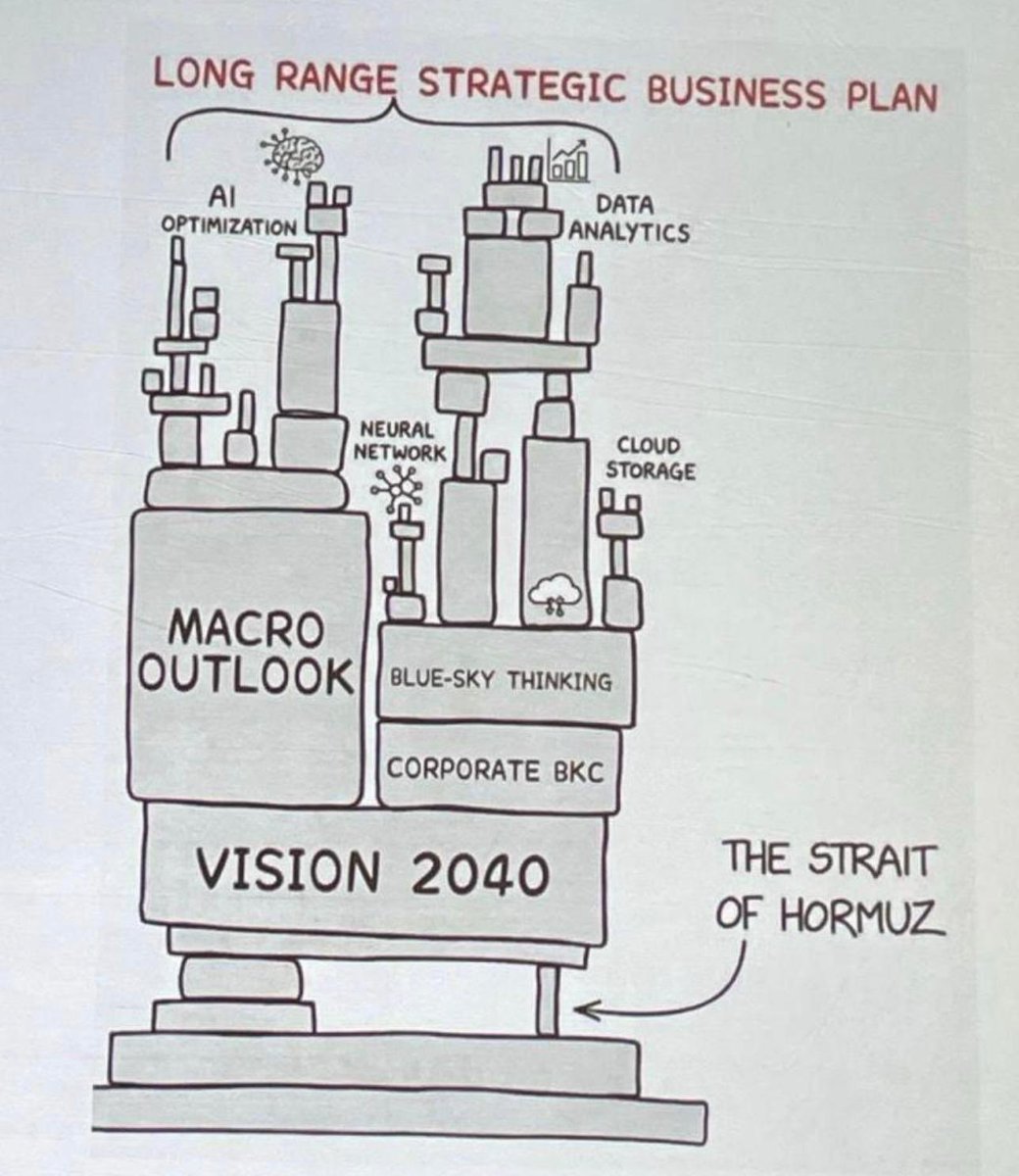
This is why the Middle East matters far beyond energy.
It’s about:
Oil
Trade routes
Currency power
And global influence.
The Petrodollar system has helped anchor the U.S. economy for decades.
Most Americans have never heard of it.
But once you understand it…
You start to see the global chessboard very differently.
I’ll keep you updated on everything. Turn on notifications, this is extremely important.
A lot of people will wish they followed me sooner.
🚨BREAKING: Anthropic just dropped free courses to master AI with certificates.
No tuition. No waitlist. No BS.
Here're 10 courses that will replace a $50K degree👇
BREAKING: Claude can now analyze stocks like a senior Wall Street analyst for free.
Here are 7 prompts to research, pick, and manage winning stocks like a pro:
⚡️ TronDealer V2 — Acepta pagos en USDT y USDC hoy mismo.
¿Tu negocio necesita recibir pagos en stablecoins de forma automática, segura y sin depender de terceros? TronDealer es la pasarela que estabas buscando.
Cómo funciona:
Tu cliente deposita USDT o USDC → TronDealer lo detecta on-chain → Tu servidor recibe un webhook instantáneo → Los fondos llegan directo a tu wallet.
Lo que incluye:
— Wallets únicas por cliente/transacción
— Soporte para BSC, Ethereum y Polygon simultáneamente. (BASE, AVAX, SOL pronto)
— Consolidación automática a tu wallet de destino
— Webhooks firmados con HMAC-SHA256 para máxima seguridad
— Dashboard en tiempo real + API completa
— Reintentos automáticos si tu endpoint falla
Integración en minutos:
Regístrate en https://t.co/PlcudIUlW4, obtén tu API Key y empieza a recibir pagos. Sin instalaciones complejas, sin código extra, sin intermediarios.
🎁 TODO MARZO ES GRATIS.
Cero comisiones, cero restricciones. Úsalo sin límites durante todo el mes.
A partir de abril, el servicio tendrá un fee de apenas 0.4% por transacción completada — uno de los más competitivos del mercado para una solución de este nivel.
📖 Documentación completa → https://t.co/ILwDVcn0Ea
🚀 Regístrate ahora → https://t.co/PlcudIUlW4
1898-1902: ¿Tuvo Cuba ventajas bajo la bandera de los Estados Unidos?
El 1 de enero de 1899, comenzó formalmente el gobierno militar de Estados Unidos en Cuba tras la entrada en vigor del Tratado de París (firmado el 10 de diciembre de 1898), por el cual España renunció a la soberanía sobre la Isla. Ese día asumió como gobernador militar el general John R. Brooke, sucedido en diciembre de 1899 por Leonard Wood.
La Habana de 1899 era una ciudad exhausta tras la Guerra de Independencia (1895-1898) y la intervención estadounidense. Aún circulaban tranvías de tracción animal; el tranvía eléctrico habanero comenzó a operar en enero de 1901, como parte de un proceso más amplio de modernización urbana.
Infraestructura y obras públicas
🔹Tranvía eléctrico (1901): sustituyó progresivamente la tracción animal, mejorando la movilidad y los tiempos de traslado en la capital.
🔹 Vialidad y puertos: se repararon caminos estratégicos y se reorganizaron servicios portuarios en La Habana, clave para la exportación azucarera.
🔹Saneamiento urbano: ampliación de redes de alcantarillado y limpieza pública, especialmente en la capital.
Reforma sanitaria y erradicación de la fiebre amarilla
La campaña contra la fiebre amarilla fue uno de los hitos del período. Las investigaciones de Carlos J. Finlay (quien desde 1881 había propuesto la transmisión por mosquito) fueron confirmadas experimentalmente por la comisión dirigida por Walter Reed en 1900. Bajo el gobierno militar se aplicaron medidas sistemáticas de saneamiento y control del Aedes aegypti, lo que llevó a la eliminación de la fiebre amarilla en La Habana en 1901.
Este avance redujo drásticamente la mortalidad urbana y tuvo efectos económicos al facilitar comercio, inversión y tránsito internacional.
Educación pública
🔹Reorganización del sistema escolar: se estructuró una red de escuelas públicas con nuevos programas y manuales.
🔹Expansión de la primaria: aumento del número de planteles y matrícula en áreas urbanas.
🔹Formación docente: envío de maestros cubanos a cursos en Estados Unidos (1900) y adopción de métodos pedagógicos contemporáneos.
La escolarización mejoró respecto al escenario de la guerra, pero el analfabetismo siguió siendo elevado en zonas rurales; la cobertura fue limitada fuera de ciudades principales.
Organización institucional y Constitución
🔹Reformas administrativas y judiciales: reordenamiento de tribunales y códigos vigentes.
🔹Convención Constituyente (1900-1901): redactó la Constitución de 1901, que entró en vigor con la proclamación de la República el 20 de mayo de 1902.
🔹Enmienda Platt (1901): condicionó la soberanía cubana al otorgar a EUA derecho de intervención y la cesión de bases navales (incluida Guantánamo).
La Constitución fue obra de delegados cubanos, pero su vigencia quedó supeditada a la aceptación de la Enmienda Platt, incorporada como apéndice constitucional.
Economía y comercio
🔹Reactivación azucarera: recuperación paulatina tras la devastación bélica.
🔹Normalización fiscal y aduanera: ordenamiento de ingresos públicos.
🔹Comercio con EUA: crecimiento notable, con dependencia creciente del mercado estadounidense.
Hubo estabilización inicial, pero también consolidación de una estructura económica fuertemente orientada a un solo mercado y a capitales externos.
Si Cuba hubiese seguido con la tutela de los Estados Unidos, estas son algunas de las posibles consecuencias:
- Mayor alineación al mercado estadounidense, reforzando la concentración azucarera y la exposición a ciclos externos.
- Reglas fiscales y de deuda más rígidas.
- Menor volatilidad política a corto plazo.
- Integración preferente con Estados Unidos y mayor inversión externa.
- Continuidad en educación pública y gestión civil.
- Tribunales federales, ciudadanía, estándares regulatorios y presupuestarios.
- Acceso a programas y capital federal.
Market Wizard Linda Raschke’s 12 Technical Trading Rules:
1. Buy the first pullback after a new high. Sell the first rally after a new low.
2. Afternoon strength or weakness should have follow through the next day.
3. The best trading reversals occur in the morning, not the afternoon.
4. The larger the market gaps, the greater the odds of continuation and a trend.
5. The way the market trades around the previous day’s high or low is a good indicator of the market’s technical strength or weakness.
6. The previous day’s high and low are two very important “pivot” points, for this was the definitive point where buyers or sellers came in the day before. Look for the market to either test and reverse off these points, or push through and show signs of continuation.
7. The last hour often tells the truth about how strong a trend truly is. “Smart” money shows their hand in the last hour, continuing to mark positions in their favor. As long as a market is having consecutive strong closes, look for up-trend to continue. The up trend is most likely to end when there is a morning rally first, followed by a weak close.
8. High volume on the close implies continuity the next morning in the direction of the last half-hour. In a strongly trending market, look for resumption of the trend in the last hour.
9. The first hour’s range establishes the framework for the rest of the trading day.
10. A greater percentage of the day’s range occurs in the first hour then was the case in the past, and thus it has become increasingly important to trade aggressively if there are early signs of a strong trend for the day.
11. There are four basic principles of price behavior which have held up over time. Confidence that a type of price action is a true principle is what allows a trader to develop a systematic approach.
NOT BREAKING ANYMORE 🇷🇺🪆🇺🇸:
Trump and Putin will sign economic cooperation worth $12 trillion — Zelensky, citing intelligence.
Trump was, and always will be a Russian puppet and subnothing.
🚨 HERE’S WHY BITCOIN IS NONSTOP DUMPING RIGHT NOW
If you still think $BTC trades like a supply-and-demand asset, you MUST read this carefully.
Because that market no longer exists.
What you’re watching right now is not normal price action.
It’s not “weak hands.”
It’s not sentiment.
And it’s definitely not retail selling.
Most people are completely unaware what’s happening.
And by the time it becomes obvious, the damage is already done.
This move didn’t start today.
It’s been building quietly under the surface for months.
And now it’s accelerating.
Here’s the truth:
The moment supply can be synthetically created, scarcity is gone.
And when scarcity is gone, price stops being discovered on-chain and starts being set in derivatives.
That is exactly what happened to Bitcoin.
And it’s the same structural break that already happened to:
→ Gold
→ Silver
→ Oil
→ Equities
Once derivatives took over.
The original Bitcoin thesis is broken.
Bitcoin’s valuation was built on two ideas:
→ A hard cap of 21 million
→ No rehypothecation
That framework died the moment Wall Street layered this on top of the chain:
→ Cash-settled futures
→ Perpetual swaps
→ Options
→ ETFs
→ Prime broker lending
→ Wrapped BTC
→ Total return swaps
From that point forward Bitcoin supply became theoretically INFINITE.
Not on-chain.
But in price discovery, which is what actually matters.
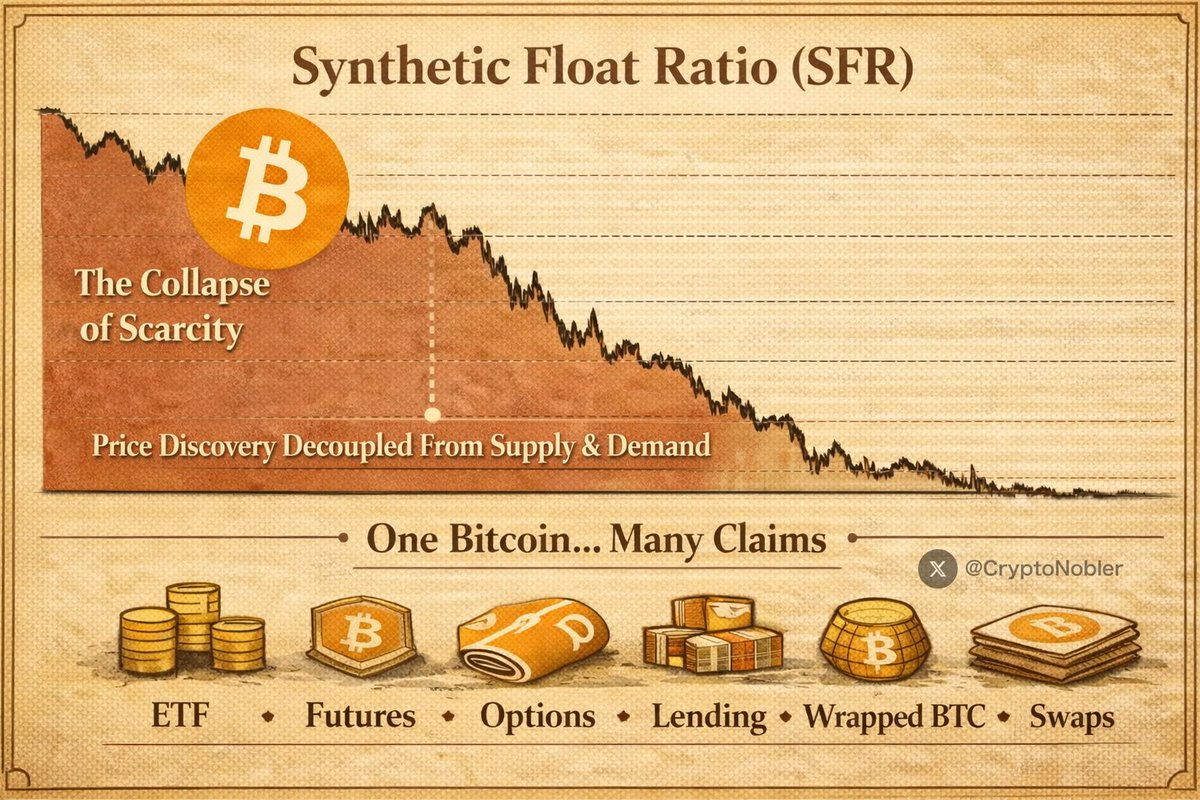
Synthetic Float Ratio (SFR).
The metric that explains everything.
Once synthetic supply overwhelms real supply, price no longer responds to demand.
It responds to positioning, hedging, and liquidation flows.
Wall Street can now trade against Bitcoin.
They’re not guessing direction.
They’re doing what they do in every derivatives-dominated market:
1⃣ Create unlimited paper BTC
2⃣ Short into rallies
3⃣ Force liquidations
4⃣ Cover lower
5⃣ Repeat
This isn’t “betting.”
It’s inventory manufacturing.
One real BTC can now simultaneously back:
→ An ETF share
→ A futures contract
→ A perpetual swap
→ An options delta
→ A broker loan
→ A structured note
All at THE SAME TIME.
That’s six claims on one coin.
That is not a free market.
That is a fractional-reserve price system wearing a Bitcoin mask.
Ignore it if you want, but don’t pretend you weren’t warned.
I’ve been calling Bitcoin tops and bottoms for over a decade now, and I’ll do it again in 2026.
Follow and turn on notifications before it's too late.
While everyone is focused on oil:
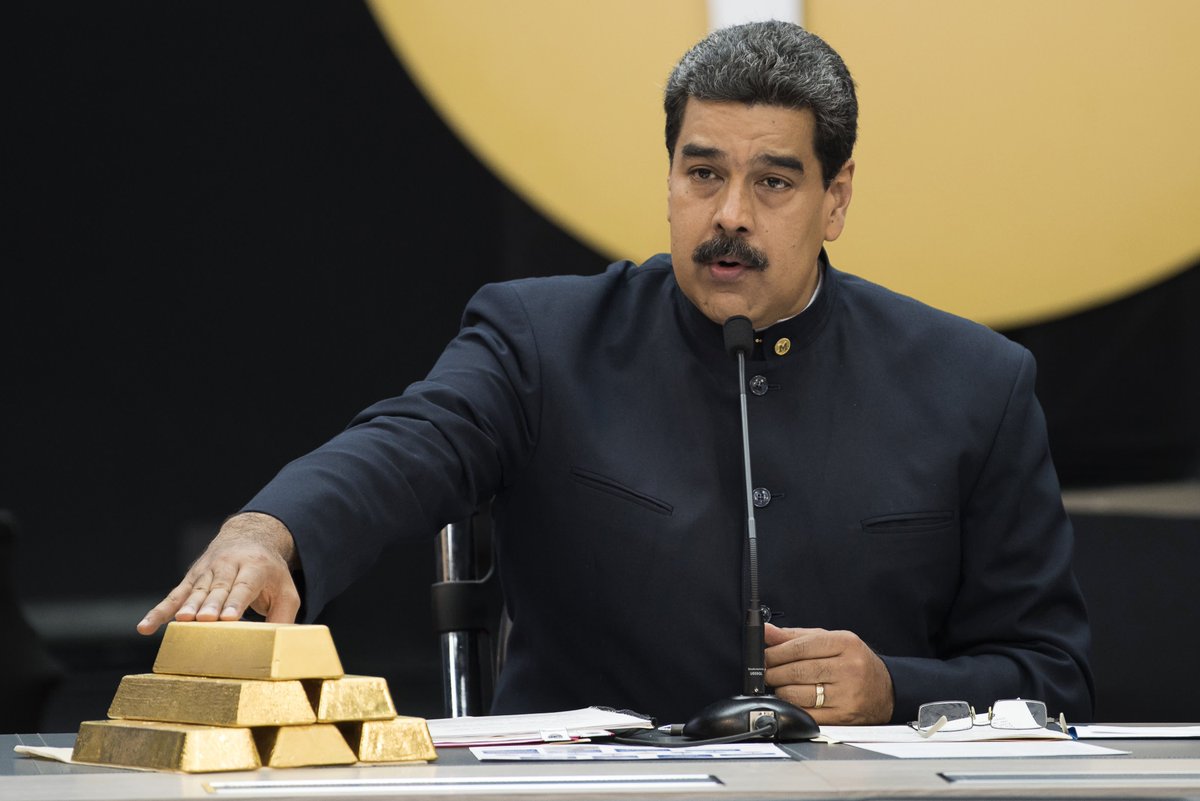
Venezuela currently holds 161 metric TONS of gold reserves.
161 metric tons is roughly 5.18 million troy ounces, worth ~$22 BILLION at $4,300/oz.
This makes Venezuela the Latin American country with the largest gold holdings.
Every $100 that gold rises, these holdings gain +$518 million of value.
Controlling Venezuela is set to produce hundreds of billions of revenue for the US.
Will the US take control of these gold reserves?