GO GREEN, GET ASBESTOS
Asbestos from China discovered in 1,000 UK wind turbines
Massive cover up as industry known for many months; scandalous
Secretly replacing components, hoping would go undiscovered
https://t.co/1cErDRuB2H
It genuinely amused me that people think replacing Starmer will make things better.
From Boris Johnson's election onwards, we've been shuffling the bollards on the Titanic.
You have to actually change direction if you want to avoid crashing into the iceberg:
- End Net Zero
- Make business viable again
- Get welfare under control
- Fund defence
- Ensure equality under the law
- Arrest criminals and keep them in jail
- Deport illegal immigrants and close the border
- Bring the civil service to heel
Burnham will become as unpopular as Starmer within months since he isn't going to do any of that.
🚨BREAKING: The Green party-led Bristol City Council, which banned St George's flags flying during the World Cup as it was "divisive and makes migrants feel uncomfortable", has now been COVERED in St George's flags by locals
F*ck the Greens, this is England! 🏴
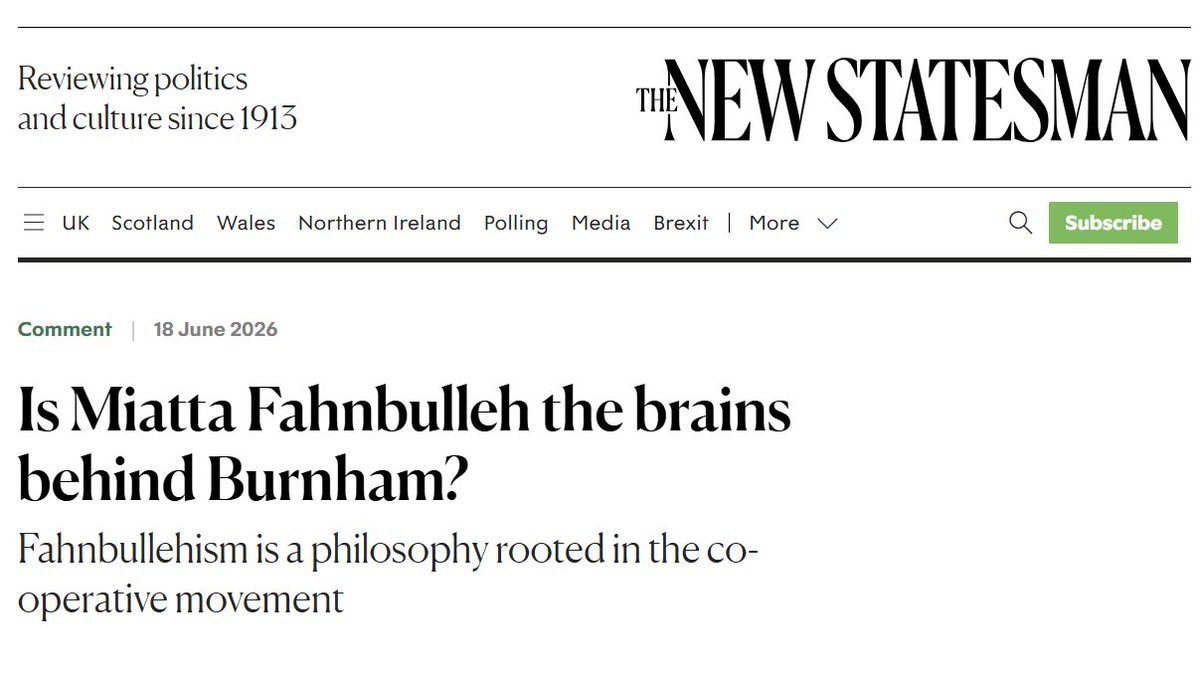
There are two worrying aspects to this New Statesman article:
1. Andy Burnham apparently doesn't have many brains.
2. Miatta Fahnbulleh is filling the gap.
Quasi-Marxist Miatta Fahnbulleh, who wants a wealth tax, widespread nationalisation inc. banks, land, transport & energy & the forced sale of existing firms to employees, is one of the worst people to put in charge of economic policy.
She's a high tax fanatic tax who wants there to be 'free basic energy' & for state owned companies to flood the energy market.
1/3
Appalling attack on innocent people in Scotland. Genuinely sickening.
Are we:
Identifying skin colour.
Calling it a terror attack.
Being angry.
Or:
Not looking back in anger.
Ignoring skin colour.
One Love.
The hills are alive with the sound of music.
And:
Is the main concern the attack itself or the potential for a backlash against white people?
Just checking I strike the appropriate tone for sectarian Britain.
Andrew Neil paints an understandably gloomy picture of Britain's future under yet another third-rate PM.
Burnham was never a shining light in Westminster and is now only back there as a protest vote against the useless Starmer.
We're in for a rough ride.
https://t.co/TnIvruD7mK
A Japanese immunologist spent 20 years proving that the chemicals trees release into the air walk into your bloodstream, hunt down your stress hormones, and arm your immune system in ways no therapist or pharmaceutical has ever matched, and most of the data has been sitting in Japanese medical journals for two decades waiting to be translated.
His name is Qing Li.
He is a clinical professor at Nippon Medical School in Tokyo and the president of the Japanese Society of Forest Medicine. The Japanese government has been funding his research since 2004, and the body of work he has produced is the reason forest bathing is now an officially prescribed clinical therapy in Japan and Korea.
The story actually starts in 1982, when the Japanese Ministry of Agriculture, Forestry and Fisheries coined the term shinrin-yoku to describe the practice of slow, mindful walking in a forest. They did it for a practical reason.
Japan was urbanizing fast, stress-related illness was climbing, and the country had thousands of square kilometers of forest sitting unused. The idea was to give people a reason to walk into the trees... They had no idea what was actually happening to the human body during those walks until Qing Li ran the first proper experiment in 2005.
He took twelve healthy adult men on a three-day, two-night trip to a forest park. They walked for a few hours each day. Nothing strenuous. No prescribed routes or breathing exercises. They simply walked slowly through the trees, breathing the air, looking at the forest.
Li drew blood and urine samples before the trip, on the second day, on the third day, on day seven after returning home, and again on day thirty.
The numbers that came back from the lab were not what anyone expected.
The activity of a specific type of immune cell called the natural killer cell, which is the cell your body uses to hunt down cancer cells and virus-infected cells before they can spread, had jumped by roughly 50 percent during the forest trip. The actual number of natural killer cells circulating in the bloodstream had increased significantly.
Three different anti-cancer proteins that those cells produce, called perforin, granzymes, and granulysin, had all risen sharply. And the effect did not disappear when the men went home. The immune boost was still measurable on day seven and was still partially present on day thirty.
Two hours a day in a forest had upgraded the immune system for a full month.
Li ran the same experiment with women a year later and found nearly identical results. Then he ran it with a control group who took a three-day trip through an urban area with the same amount of walking, the same hotel quality, and the same diet.
The urban group showed no measurable change in natural killer cell activity at all. The forest was doing the work, not the vacation.
The mechanism turned out to be a class of airborne molecules called phytoncides. Trees produce these compounds to defend themselves against insects, bacteria, and fungi. Pine, cedar, oak, and cypress trees release them in particularly large amounts, especially in warmer weather and after rainfall.
When you walk through a forest, you are inhaling those molecules into your lungs and absorbing them through your skin, and once inside your body they appear to directly stimulate the production and activity of the very immune cells Li was measuring in his lab.
Roughly 50 percent of the health benefit of a forest walk, according to Li's data, comes from the chemistry of the air itself. The other half comes from what the forest is doing to your nervous system.
This is where it stops being only about the immune system and starts being about stress.
A separate Japanese research team measured cortisol, the body's main stress hormone, in 84 participants across 35 different forest sites. They drew samples before and after a 30-minute walk in each forest and compared them to control walks in matched urban environments. The cortisol levels of the people who walked in the forest were lower than the cortisol levels of the people who walked in the city by a significant margin. Their heart rates were lower. Their blood pressure was lower.
The activity of their parasympathetic nervous system, which is the part responsible for rest and recovery, had gone up. The activity of their sympathetic nervous system, which is the part that drives fight or flight, had gone down.
Then a researcher at the University of Michigan named MaryCarol Hunter ran the cleanest version of this experiment ever done. She recruited participants from a city and told them to take a nature pill three times a week for eight weeks.
They were free to choose the time, the place, and the duration of the nature experience, as long as it was outside, in daylight, and free of phones, conversations, and aerobic exercise. They sent her saliva samples before and after each session so she could measure cortisol changes accurately and rule out the normal daily drop in stress hormones that happens to everyone.
The result was that participants experienced a 21.3 percent drop in cortisol per hour spent in nature, with the biggest payoff happening between minutes 20 and 30 of the walk.
After that, the cortisol kept dropping, but more slowly. The threshold dose for measurable stress relief was just 20 minutes outside in something that looked and felt like nature.
What none of this means is that nature is a substitute for therapy or for medication when someone genuinely needs them. Therapy treats different things than a walk does, and Li himself has been careful in interviews to call forest bathing a complementary intervention rather than a replacement for clinical care.
But what the research has settled is that the human body has a physiological response to being among trees that operates on the same biological systems modern medicine is trying to reach with drugs and clinical protocols, and that response is fast, measurable, and free.
The strangest part of Li's work is the implication he keeps repeating in interviews. The average person now spends more than 90 percent of their life indoors. Their cortisol stays elevated. Their natural killer cells stay sluggish.
Their parasympathetic nervous system rarely gets a chance to take over. The system that was tuned by millions of years of life under a canopy of trees is being asked to run permanently inside a box made of drywall and screens.
Your body has not forgotten what it is supposed to do in a forest. It is waiting for you to walk into one.
The BBC Fabricated Trump's Words. Starmer Wants It Boosted For Fighting Disinformation.
This week, the same government that announced it would ban under-16s from most social media platforms confirmed a second policy. Force Facebook, YouTube and every major platform to algorithmically boost content from the BBC, ITV and Channel 4. The stated reason is fighting disinformation. The timing makes that justification impossible to take at face value.
The BBC spliced together two separate parts of a Donald Trump speech, delivered an hour apart, to make it appear he had directly told his supporters to march on the Capitol and fight, while cutting the part where he told them to protest peacefully. This was not sloppy editing. It was a constructed sequence designed to produce a false impression of what was said. Trump is now suing the BBC for ten billion dollars. The corporation's own internal memo, leaked to the Telegraph last autumn, documented the edit alongside a pattern of other failures. Extensive uncritical airtime given to Hamas on BBC Arabic. A rogue unit of activist reporters censoring coverage of the trans debate to fit a predetermined narrative. A report calling car insurers racist that was found to be, in the BBC's own words, thoroughly wrong. This week it emerged the corporation sacked a presenter for criticising its Gaza coverage while taking no action against reporters who appeared to celebrate the October 7th attacks.
This is the organisation that Starmer wants boosted in the name of trusted information. Not a minor broadcaster with an isolated error. An institution funded by £3.7 billion a year in compulsory licence fees, facing a billion dollar lawsuit for fabricating a world leader's words, accused of one sided reporting on the most contested conflicts of our time, and now positioned by law to be placed ahead of every independent voice on every major platform in the country.
Put this alongside the under-16s ban and the pattern stops looking like coincidence. One policy restricts what young people can access. The other restructures what everyone sees first, adults included, engineering visibility in favour of the state broadcaster and against the independent platforms where this government's record, on Belfast, on Makerfield, on the asylum backlog and on every other documented failure, gets challenged daily by people it cannot easily silence. Bluesky escaped the social media ban despite its own documented child safety failures. The BBC gets promoted despite a documented record of fabrication. Both decisions share the same logic. Visibility for institutions the government finds comfortable. Restriction for the platforms where it does not.
Lord Young of Acton, the human rights lawyer who founded the Free Speech Union, put it with the right amount of contempt. The Prime Minister has apparently decided that censoring social media should be his legacy, which is strange territory for a former human rights lawyer to choose. It is strange only if you assume the goal was ever free expression rather than managed expression. Nothing in this government's conduct this month supports that assumption.
A government that needs to legislate prominence for its preferred broadcaster is not protecting the public from disinformation. It is admitting that its preferred broadcaster cannot earn that prominence on the evidence of its own reporting, and has decided to mandate by law what trust no longer provides voluntarily. That is not journalism policy. It is state media privilege written into platform regulation, arriving in the same fortnight as a ban on what sixteen year olds may read, from a government that is rapidly running out of ways to disguise what it is actually doing.
"The BBC spliced together two separate parts of a Donald Trump speech, delivered an hour apart, to make it appear he had directly told his supporters to march on the Capitol and fight"
Former Ofcom chairman Lord Grade has accused critics of GB News of belonging to a “liberal Islington consensus” hostile to freedom of expression.
Speaking to The Guardian, Lord Grade said he welcomed the launch of GB News five years ago in the interests of media “plurality” and warned that failing to give “the white majority a voice in the debate” risked undermining social cohesion.
He said: “What people don’t like is the fact that there is a television station giving voice to a strong body of opinion in this country which has been ignored for years.”
He added: “They just don’t like the idea that there’s any voice, or any news agenda, which is different from the kind of liberal Islington consensus.”
Read more below 👇
When You Can't Beat Reform, Change The Rules. Labour Just Did.
There is a line in a democracy that, once crossed, changes everything. When those in power begin adjusting the rules of the game to determine its outcome, the game is no longer democracy. It is managed succession. That line was crossed again on Tuesday night.
Two days before the Makerfield by-election, Labour rushed a change to the mayoral voting system through the House of Lords. Regional mayors will now be elected using the supplementary vote system rather than first past the post. The change applies immediately. It will govern whoever replaces Andy Burnham as Mayor of Greater Manchester if he wins on Thursday and stands down.
The government's defence is that it is simply restoring the system used before Boris Johnson changed it in 2021. That argument requires the public to believe that a change Labour could have introduced at any point in two years of government became urgent on Tuesday evening, forty eight hours before the vote that triggers the election it is designed to affect.
Lord Hayward, a Conservative peer and experienced pollster, was precise in the Lords. There is no other justification for the haste, he said, other than that it solves the Labour Party's problems and prevents Reform winning a mayoralty. Not clumsy. Not rushed. Designed.
The mechanics explain why. Under first past the post, Reform could win the Greater Manchester mayoralty on a plurality of votes in a fragmented field, precisely as it won all eight council wards in May's local elections with around fifty percent of the vote. Under the supplementary vote system, voters express a first and second preference. Lib Dem and Green voters, given a second preference, will direct those votes to Labour overwhelmingly. The change does not affect Thursday's by-election. It affects the mayoral contest that follows it, constructing an anti-Reform coalition from the second preferences of smaller parties that Reform itself cannot access.
Lord Jackson identified the wider implication. This is potentially a strategy for a progressive alliance being rolled out ahead of a general election, he said, with the aim of locking out the Conservatives and Reform from power. Burnham's allies have already confirmed he would scrap first past the post nationally in favour of proportional representation. The supplementary vote is the local pilot for a national project. Pool second preferences, lock out the right, govern indefinitely on a minority of first preference votes.
This is not the first time. Earlier this year Labour delayed local elections after the Electoral Commission stated explicitly that the justification was not legitimate, that extending mandates damages public confidence and creates a conflict of interest by allowing those in power to decide how long they may remain there without consent. The Commission's objection was noted and ignored. Reform demolished Labour anyway.
Now the same instinct has been applied to a different mechanism. Not cancellation this time. Electoral system change, deployed with surgical precision forty eight hours before the vote that triggers the election it is designed to affect.
Governments confident in their mandate do not need to change the rules two days before the ballot. They face the electorate and take their chances. The timing of Tuesday night's Lords motion is not a coincidence. It is a confession.
The voters of Makerfield vote on Thursday. The question of who governs Greater Manchester after that, and under what rules, was settled in the Lords on Tuesday. Nobody voted for that.
"Burnham's allies have already confirmed he would scrap first past the post nationally in favour of proportional representation."
If Vladimir Putin changed the voting system days before an election to stop his opponents winning, every British journalist would call it what it is: rigging the rules.
Tonight, Labour rammed through a last‑minute switch in the Lords so that if Andy Burnham wins Makerfield and quits as Greater Manchester Mayor, his replacement won’t be chosen on a simple first‑past‑the‑post ballot, but on the supplementary vote system instead.
Why now?
Because Labour knows the race to replace Burnham would be a straight two‑horse fight with Reform UK – and under FPTP, the candidate with the most votes wins, no second chances, no back‑room redistributions, no “stop Reform” stitch‑ups.
Under SV, Labour gets a second bite of the cherry: if their candidate can limp into the top two, they can hoover up second preferences from every other party and magic a “majority” on the second count, even if Reform tops the poll on first preferences.
This isn’t “modernising democracy”. It’s the governing party using its Commons majority and the unelected Lords to hurriedly doctor the rules of one specific contest because it’s terrified the voters might choose someone else.
When the establishment preached to the world about “rules‑based order”, they forgot to mention one thing: in Britain, the rules are “based” on whether Labour thinks it might lose.
There are serious and legitimate questions about the authenticity of the footage released by the MOD of the interdiction of the Russian Shadow Fleet vessel this morning.
How is the cameraman ahead of the Marines clearing the stairwell to be able to film them coming towards him.
How has the cameraman gone past the open doors of rooms that haven’t yet been cleared?
How much of this has been staged for the cameras?
I don’t doubt that a Russian tanker was seized and that the operation carried significant risk. I do question the PR and the desperate need for a win by the Government at the Royal Marines’ expense.
Why is Sir Keir Starmer’s Government set to ban under-16s from accessing 10 major social media platforms — including X — but not left-wing platforms like Bluesky?
Since coming to power, this Government has been openly hostile to X, a forum for debate that prides itself on free speech. Ministers have even floated the idea of blocking UK citizens’ access to the platform altogether.
Starmer can no longer pretend this is solely about protecting children.
Crawling past Stonehenge in the inevitable traffic on the A303 I just finished listening to this, which I earnestly and soberly recommend. https://t.co/e1vChJ3Hmx
It’s the story of the fork in the road Europe faces on AI, and it applies to Britain just as well. The wrong path - the almost-too-late acceptance that AI is going to change everything, and then the simplistic pursuit of tech sovereignty interpreted as anti-Americanism - leads to irrelevance, economic collapse and then vassal status under US or Chinese hegemony.
The right path means we rapidly adjust and meaningfully enter the AI race. As the story says, the only way to safety is through AI; you can’t go round it.
So, yes, that means a massive focus on sovereignty in the form of native energy, skills, capital, and a far more nationalist approach to scaling up good home grown companies.
But it also means working with the Americans to build our resilience; sovereignty cannot be autarky. We need their help, and we can help in return because we still have the assets (mostly human assets ie the talent) that the tech revolution values. Thank God that the leaders of this revolution are Western and mostly pro British. For now.
We are at a fork in the road. Continental Europe is heading down the wrong path. Britain needs to make the right choice, right now.
And while we’re at it, build a flipping dual carriageway on the A303. It’s been discussed for 50 years and the country that can’t do that simple thing isn’t going to survive this century.
It is totally unthinkable that an elected politician from a nation as close to us as Poland - a close ally and NATO partner - from the same party as the Polish President, is denied entry to our country for what appears to be nothing more than political reasons.
In a free democracy, we do not silence those with whom we disagree and political censorship has no place in Britain. The decision to bar @D_Tarczynski sets a deeply disturbing precedent and raises serious questions about freedom of speech in the country where that principle first thrived.