Mom, Cajun, Gigi to two grandsons, disillusioned yogini, intermittent faster, autonomous soul, dog-lover, gf to my hot bf. Love to cook. Alpha when necessary.
They did not take cursive from the schools because children no longer needed it. They took it because of what it was quietly building in them.
Consider what the exercise actually is. A child, six years old, is handed a pen and asked to draw a single unbroken line that becomes a word. The wrist must float. The fingers must hold a living pressure, never quite the same twice, always correcting. The eye must follow the ink forward and trust the hand to finish what it has begun. There is no lifting, no stopping, no starting over mid-word. The loop must close. The ascender must rise and return. The sentence must travel from one margin to the other as a single continuous gesture, and at the end of it the hand must still be steady.
Twelve years of this. Every day. Ten thousand small acts of sustained, self-correcting attention, carried out below the level of conscious thought, until the motion belongs to the body and the body belongs to the motion.
This is not penmanship. It is the slow construction of an interior form.
The hand that has learned to carry a line without breaking it is the hand of a mind that has learned to carry a thought without breaking it. The two are not metaphors for one another. They are the same faculty, trained in the same child, by the same daily discipline. Continuity of the stroke becomes continuity of the reasoning. The patience of the loop becomes the patience of the argument. The commitment to finish a word one has started becomes the commitment to finish a sentence, a paragraph, a life's idea, without reaching for the nearest distraction halfway through.
Print is a different creature entirely. Print lifts. Print stops. Print assembles a word out of separate, stamped, interchangeable pieces, each one beginning and ending in isolation. A mind raised only on print learns to think the way print is made, in discrete tokens, in replaceable units, in fragments that can be recombined by any outside hand without the owner noticing the substitution. It is precisely the shape of thought a language model produces. It is precisely the shape of thought a language model can steer.
Cursive is kata. This is the whole of it. A form repeated daily, for years, not for the sake of the form but for what the repetition lays down in the practitioner beneath the form. The swordsman does not train kata so that one day he may fight in kata. He trains it so that when the moment comes and there is no time to think, the movement is already inside him, older and deeper than thought, and it rises on its own. Cursive was the kata of the literate mind, the daily quiet drilling of continuity, of patience, of a line held steady under the long pressure of its own length. And the signature it produced at the end, that small flourished mark unique to a single human being on earth, was only the outward proof of an inward form no machine and no other hand could ever reproduce.
Take the kata away and the practitioner is left with vocabulary in place of faculty. He can recognise a whole thought when he encounters one. He cannot carry one himself. He can admire a finished argument. He cannot sustain one long enough to close its loop. He begins books he does not finish, sentences he does not end, ideas he abandons the moment the screen in his palm offers him a brighter one. And when the machine begins feeding him tokens in the exact shape his schooling taught him to receive, he meets it with no interior resistance at all, because no interior form was ever built in him to push back with.
They removed it quietly, across a generation, and they removed it in the last years before the machines arrived. Twelve years of daily practice in unbroken, embodied, self-authored thought, gone from the curriculum of almost every child in the Western world, just as the instruments designed to complete their sentences for them came online.
The hand forgets. The mind, having never been taught the kata, forgets a thing it never knew it had.
That is what cursive was. That is what was taken. And that is why the thought of anyone who still writes by hand, in long unlifted lines, remains, quietly, stubbornly, and without their ever needing to announce it, their own.
Now the question stands open. What else has been banned, phased out, quietly retired from the curriculum and from common life over these same decades, under the same soft excuses? Mental arithmetic. Memorisation of poetry. Latin. Logic as a formal subject. Map reading. Knot work. The keeping of a commonplace book. The reading aloud of long passages in class. Singing in parts.
What was each of those actually building in the child, beneath the surface of the lesson, and whose interest was served by its disappearance?
🚨 Doctors used to deworm you before treating ANYTHING else.
It was standard practice. Historical medical books were full of powerful deworming remedies because parasites were recognized as a silent killer that stole nutrients, wrecked organs, and destroyed lives for decades.
Today in America? Doctors are barely taught about parasites in medical school. Routine testing is almost nonexistent.
So millions walk around with hidden invaders — tapeworms that can grow over 30 feet long and live 30 years inside your body, flukes that hide for 10–20 years while attacking your liver, lungs, and nervous system.
Most infections go completely unnoticed… until you’re dealing with:
Brain fog & headaches
Anxiety, depression & insomnia
Skin rashes, eczema or psoriasis
Joint pain, teeth grinding, dark circles & anemia
Constant bloating, gut issues & never feeling satisfied after eating
I personally deworm at least 3 times a year using strong herbal tinctures in between — and I make sure to get regular sun exposure. The symptoms you’ve been told are “just stress” or “aging” might actually be parasites quietly draining you.
If 3 or more of these hit home… you’re not crazy. Drop a comment.
🚨 JUST IN: This German World Cup fan has gone famous for CRYING ON-AIR after he realized the anti-USA propaganda he was fed is WRONG — after an American man named Bob RESCUED him when he got stranded
"I was scared of the US...shootings, criminals."
"I've FALLEN IN LOVE with this country. This was so emotional. I even cried in the stadium." ❤️
Sebastian thought Americans were rude, mean and COLD
"Strangers offered him a ride to his hotel," after he was stranded with no way to get back!
"I LOVE USA...I had tears in my eyes."
The man even got more sad about having to GO BACK to Germany than his team, Germany, losing in the World Cup!
🇺🇸🇩🇪
PERFECT TIMING with America 250!
Every week, these strange white crates leave a high-security Tesla compound in Lathrop, California.
They’re showing up near the Hoover Dam. At an Air Force base in Georgia. In the heart of New York City…
An estimated 4,000 of them are now spread across 48 locations in 14 states. And more roll out every week.
But you won’t see this on CNBC, and you won’t read about it in the Wall Street Journal.
Because these mystery Elon crates have nothing to do with electric vehicles, space, social media, crypto, biotech, robots, or AI…
The “mystery Elon crates” are Tesla Megapacks — grid-scale battery storage units being deployed across the country for utility, military, and commercial energy projects. Tesla is quietly building the backbone of America’s grid-storage infrastructure while everyone’s distracted by culture-war bullshit — but it is the actual story worth paying attention to.
No secret technology. No hidden invention. Just the most boring, most profitable, and arguably most important thing Tesla does — hidden in plain sight.
🚨 President Trump just DROPPED this bombshell:
FBI whistleblower says thousands of hours of Jan. 6 footage was hidden because federal "human sources" were in the crowd, and Deep State agents were ordered to make up charges against Jan. 6ers
Anyone who called it out from inside was "retaliated" against
SCANDALOUS COVERUP!
@drawandstrike Imagine the books that will be written in the future to teach us REAL history, instead of the carefully crafted fairy tale they had us living in.
There were a bunch of people who moved here to America in the 1800s from Europe, and the more I study, the more it becomes apparent these very super-duper wealthy families moved here with an agenda.
And that agenda DID NOT involve their actually becoming real AMERICANS. They kept their higher loyalties in the families.
[some of these families moved to the UK also]
By 1901, when McKinley is shot, they were already striving to get a central banking system in place.
They never gave up. The doggedly kept going, and in 1913, they finally got it done.
@drawandstrike@xformed Do me a solid and look at Anthony Bourdain's "Suicide". He was married to an Epstein victim, had a 4 year old child, and had everything to live for. But less than a week after he pledged millions to hunting down child predators, he's found dead. Coincidence???
We live in a strange age.
We seem to be 'snapping out of it'.
But there are STILL plenty of people out there who can't 'see' anything until a very popular news or entertainment media figure 'endorses' it for them.
They need to see it playing inside the Matrix, from one of their authority figures.
Until that happens, they will not look.
It is what it is.
MS-13 killed Seth Rich.
Anons know.
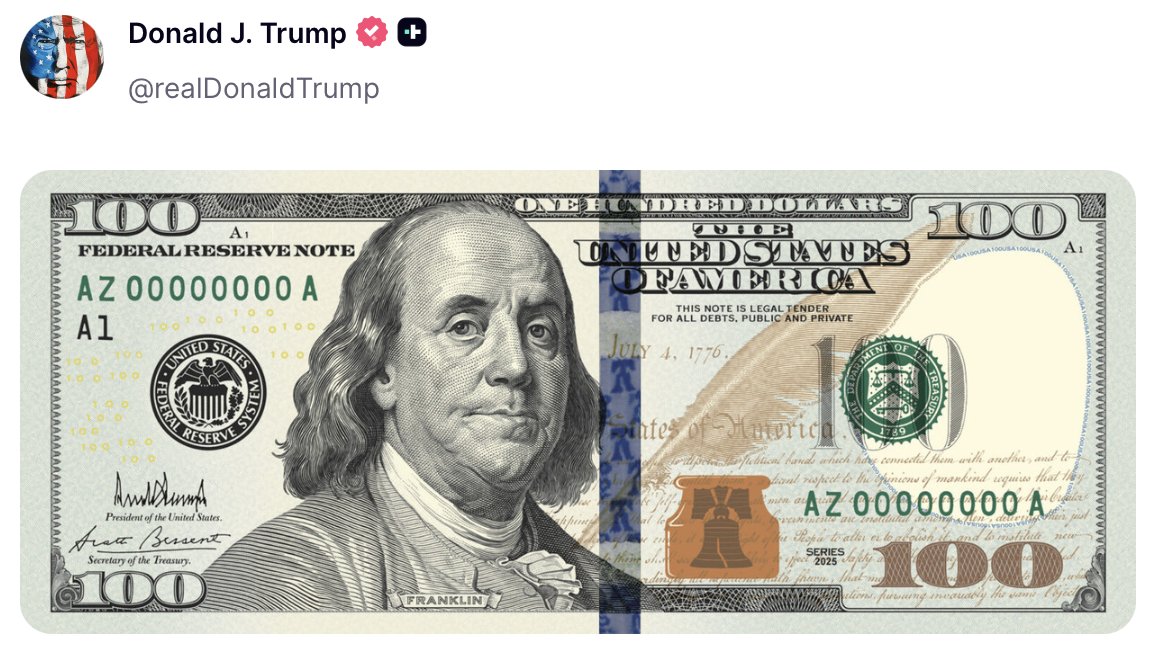
Under President Trump’s leadership, we are on a path toward unprecedented economic growth, lasting dollar dominance, and fiscal strength and stability. There is no more powerful way to recognize the historic achievements of our great country and President Donald J. Trump than U.S dollar bills bearing his signature, and it is only appropriate that this historic currency be issued at the Semiquincentennial.
McKinley championed tariffs and American industry. In 1901 he was assassinated. Susan Kokinda argues that's the moment the American System got erased from our history — until now. https://t.co/F17dL0M667
“I had a young cousin who was about six months pregnant and she showed me her belly had these like purple lightning streak patterns, half an inch wide and brilliant color with a zigzag shiny pattern and it was just the most vivid stretch marks I'd ever seen and I suggested eggs, milk, and oysters, which she ate for two or three days. I think it was just about three days later she came back and showed me her belly, no marks at all.”
Ray Peat responding to a question about foods that can increases progesterone and lower aldosterone.
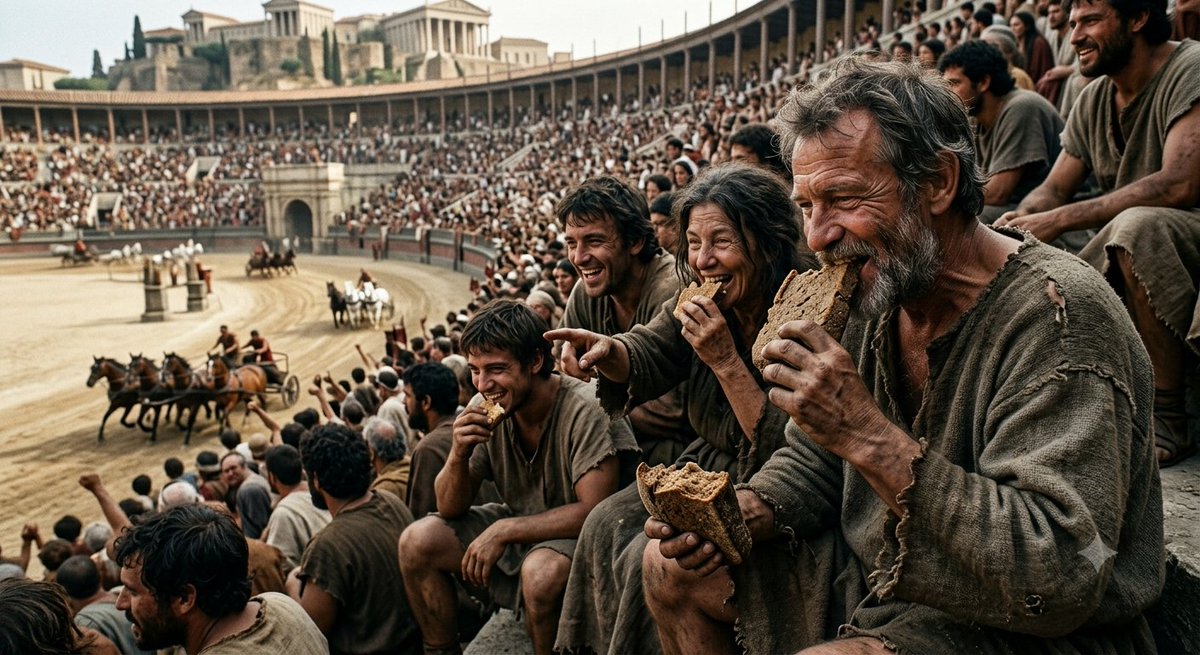
The Romans understood something about cheap carbohydrate that we pretend not to.
Panem et circenses. Bread and circuses. The emperors kept the vast restless population of Rome quiet with two things. Free grain, and entertainment. Fill the belly with cheap bread and fill the day with spectacle, and a mob that might otherwise turn on you stays docile and manageable.
They knew, instinctively, that a people kept full of cheap starch and distraction is a people who do not make trouble.
It is not a conspiracy to notice that the modern arrangement rhymes with it rather neatly. The cheapest calories on every high street are the refined carbohydrates, the bread and the sugar, subsidised, everywhere, filling. And the circuses now fit in your pocket and glow at you all evening.
A population fed on cheap starch and endless spectacle is sluggish, docile, and too tired to ask difficult questions. The Romans did it on purpose and wrote it down.
We drifted into the same thing and call it convenience.
You are MORE likely to die from the VACCINE than from the DISEASE, this is true for EVERY single vaccine on the childhood schedule.
~Dr Paul Thomas, MD
There Is No Safe Vaccine On The Childhood Schedule... Period.
The statistical analysis of each vaccine...
The risk of death from Polio is 1 in 1 trillion
The risk of death from the Polio vaccine is 1 in 215K
The risk of death from Diphtheria is 1 in 42.5 million
The risk of death from the Diphtheria vaccine 1 in 76K
The risk of death from Tetanus is 1 in 1.5 million
The risk of death from the Tetanus Vaccine is 1 in 76K
The risk of death from Pertussis is 1 in 2.3 million
The risk of death from the Pertussis vaccine is 1 in 76K
The risk of death from Measles is 1 in 106.5 million
The risk of death from the Measles vaccine is 1 in 108K
The risk of death from Mumps is 1 in 40.3 million
The risk of death from the Mumps vaccine is 1 in 108K
The risk of death from Rubella is 1 in 0/negligible
The risk of death from the Rubella vaccine is 1 in 108K
The risk of death from Chickenpox is 1 in 32.3 million
The risk of death from Chickenpox vaccine is 1 in 202K
The risk of death from Hepatitis-A is 1 in 1.6 million
The risk of death from the Hep-A vaccine is 1 in 73K
The risk of death from Hepatitis-B is 1 in 305K
The risk of death from the Hep-B vaccine is 1 in 96K
The risk of death from HIB is 1 in 1.5 million
The risk of death from the HIB vaccine is 1 in 46K
The risk of death from Pneumonia is 1 in 236K
The risk of death from Pneumonia vaccine is 1 in 50K
The risk of death from Meningitis is 1 in 822K
The risk of death from Meningitis vaccine is 1 in 141K
The risk of death from Influenza is 1 in 136K
The risk of death from the Influenza Vaccine is 1 in 15K
**Statistical Facts From Dr. Paul Thomas' Book: "Vax Facts."**
Unfortunately, more and more people think handwriting is outdated.
But your brain may disagree.
A 2024 EEG study shows that handwriting activates far more connected brain activity than typing.
When you write by hand, your brain coordinates fine motor movement, vision, spatial planning, sensory feedback, and memory all at once.
It’s slower, ofc, but that’s the point. The extra effort seems to help your brain process and remember more deeply.
Typing is efficient. Handwriting is immersive.
And in a world built for speed, that kind of slow, connected thinking might be worth keeping.
They did not take cursive from the schools because children no longer needed it. They took it because of what it was quietly building in them.
Consider what the exercise actually is. A child, six years old, is handed a pen and asked to draw a single unbroken line that becomes a word. The wrist must float. The fingers must hold a living pressure, never quite the same twice, always correcting. The eye must follow the ink forward and trust the hand to finish what it has begun. There is no lifting, no stopping, no starting over mid-word. The loop must close. The ascender must rise and return. The sentence must travel from one margin to the other as a single continuous gesture, and at the end of it the hand must still be steady.
Twelve years of this. Every day. Ten thousand small acts of sustained, self-correcting attention, carried out below the level of conscious thought, until the motion belongs to the body and the body belongs to the motion.
This is not penmanship. It is the slow construction of an interior form.
The hand that has learned to carry a line without breaking it is the hand of a mind that has learned to carry a thought without breaking it. The two are not metaphors for one another. They are the same faculty, trained in the same child, by the same daily discipline. Continuity of the stroke becomes continuity of the reasoning. The patience of the loop becomes the patience of the argument. The commitment to finish a word one has started becomes the commitment to finish a sentence, a paragraph, a life's idea, without reaching for the nearest distraction halfway through.
Print is a different creature entirely. Print lifts. Print stops. Print assembles a word out of separate, stamped, interchangeable pieces, each one beginning and ending in isolation. A mind raised only on print learns to think the way print is made, in discrete tokens, in replaceable units, in fragments that can be recombined by any outside hand without the owner noticing the substitution. It is precisely the shape of thought a language model produces. It is precisely the shape of thought a language model can steer.
Cursive is kata. This is the whole of it. A form repeated daily, for years, not for the sake of the form but for what the repetition lays down in the practitioner beneath the form. The swordsman does not train kata so that one day he may fight in kata. He trains it so that when the moment comes and there is no time to think, the movement is already inside him, older and deeper than thought, and it rises on its own. Cursive was the kata of the literate mind, the daily quiet drilling of continuity, of patience, of a line held steady under the long pressure of its own length. And the signature it produced at the end, that small flourished mark unique to a single human being on earth, was only the outward proof of an inward form no machine and no other hand could ever reproduce.
Take the kata away and the practitioner is left with vocabulary in place of faculty. He can recognise a whole thought when he encounters one. He cannot carry one himself. He can admire a finished argument. He cannot sustain one long enough to close its loop. He begins books he does not finish, sentences he does not end, ideas he abandons the moment the screen in his palm offers him a brighter one. And when the machine begins feeding him tokens in the exact shape his schooling taught him to receive, he meets it with no interior resistance at all, because no interior form was ever built in him to push back with.
They removed it quietly, across a generation, and they removed it in the last years before the machines arrived. Twelve years of daily practice in unbroken, embodied, self-authored thought, gone from the curriculum of almost every child in the Western world, just as the instruments designed to complete their sentences for them came online.
The hand forgets. The mind, having never been taught the kata, forgets a thing it never knew it had.
That is what cursive was. That is what was taken. And that is why the thought of anyone who still writes by hand, in long unlifted lines, remains, quietly, stubbornly, and without their ever needing to announce it, their own.
Now the question stands open. What else has been banned, phased out, quietly retired from the curriculum and from common life over these same decades, under the same soft excuses? Mental arithmetic. Memorisation of poetry. Latin. Logic as a formal subject. Map reading. Knot work. The keeping of a commonplace book. The reading aloud of long passages in class. Singing in parts.
What was each of those actually building in the child, beneath the surface of the lesson, and whose interest was served by its disappearance?
Unfortunately, more and more people think handwriting is outdated.
But your brain may disagree.
A 2024 EEG study shows that handwriting activates far more connected brain activity than typing.
When you write by hand, your brain coordinates fine motor movement, vision, spatial planning, sensory feedback, and memory all at once.
It’s slower, ofc, but that’s the point. The extra effort seems to help your brain process and remember more deeply.
Typing is efficient. Handwriting is immersive.
And in a world built for speed, that kind of slow, connected thinking might be worth keeping.
According to their own rules (in the U.S. Code) ONLY people living in the United States (defined as ONLY Washington DC) are to pay income tax.
The rest do not need to file a 1040. That means everyone living outside of and is not working for the U.S. government does have to file a 1040 to pay income tax.
You can choose to opt in or opt out of donating a portion of your income to the federal government's for profit agency (the I.R.S.) which then sends it the IMF.
I highly recommend watching this interview.
It all seems to be tying together.
Everything is pointing to Amyloid and spike protein.
Surely there is more to it, but ignoring the issues doesn't help.
I truly believe that the white fibrous clots that I have been seeing since early 2021 are connected to this research.
What we morticians are seeing is simply the result of this.
Though we are not pathologists, it's still an important observation that needed investigation and not be ignored and called a conspiracy.
Eventually everyone will know the truth.
The image below is recent taken this month of July, 2026.
Seek the truth and God 🙏
Be kind 🙏
Strive to do what is right 🙏
🚨 DMSO is healing “incurable” nerve damage — including the brain and spinal cord.
DMSO’s nerve-healing properties also extend to the brain. One person talked about having terminal ALS and had already ordered a wheelchair.
After using DMSO: His breathing crisis stopped in just 3 days and his brain fog completely cleared.
Another ALS patient, Carrie, regained her ability to speak and has decided to stay on DMSO for life.
A physician who recently started treating patients with DMSO said: “It is now my impression that roughly 80% of everything people see neurologists for goes away with DMSO.”
One of the most remarkable examples is Jackson, who suffered the exact same spinal break as Christopher Reeve. Doctors said he would never walk, breathe, or move again.
His mom secretly rubbed DMSO on him in the hospital. The side she could reach recovered much faster.
Today Jackson is walking with arm crutches and hasn’t used his wheelchair in weeks.