Are you a health/care professional working with older people?
Our award winning Frailty Academy is running another of our successful Frailty for Professionals 2 day courses in November.
We still have a few spaces left for you to join us to find out more about ....1/4
I beg medics to read this article by Fred Rossi. I have just cried reading it.
It is everything I have wanted to say about developing long covid and ME in my daughters case as a consequence, when you know medicine and psychological stuff and people tell you (and your 10yr old child) that it’s in your/their head and they just need to try harder.
At seventy-nine, I live alone.
And for the first time in my life, I feel completely at peace.
When people hear that, I notice the look in their eyes. A softness. A kind of pity.
They ask gently:
“Don’t you get lonely?”
“Isn’t the silence hard?”
I always smile.
Because living alone is not the same as being lonely.
My name is Angela. I’m seventy-nine years old, and I live in the same apartment that once overflowed with noise — children running through the hallway, doors slamming, laughter from the kitchen, voices talking over one another at dinner.
I was a wife.
I was a mother.
I was the person who remembered everything.
Appointments.
Birthdays.
Groceries.
Medicines.
The small invisible tasks that quietly hold a family together.
I gave my life to the people I loved, and I do not regret it. But I also carried a tiredness I never spoke about.
Then my husband died.
After that, everyone worried about me.
“You shouldn’t live alone.”
“You need someone to take care of you.”
“You should stay with your children.”
I know those words came from love.
But hidden inside them was another idea:
that a woman my age could not possibly enjoy solitude.
That silence must mean sadness.
At first, even I wondered if something was wrong with me for liking the quiet.
Then one morning, standing by the window with a cup of coffee in my hands, watching strangers hurry through an ordinary gray morning, I realized something that changed me completely:
I had not been abandoned by life.
I had finally been returned to myself.
Now I wake when my body is ready.
I cook what I want.
I rest when I’m tired.
Some days I speak to no one at all — and yet I feel full, not empty.
I read.
I walk.
I watch old films.
I sit with my thoughts without rushing to escape them.
The silence no longer frightens me.
It comforts me.
My children have their own lives now, and that is exactly how it should be. I raised them to become independent adults, not lifelong caretakers of my happiness.
Of course I still feel nostalgia sometimes.
I miss certain voices.
Certain moments.
Certain versions of life that no longer exist.
But nostalgia is not the same thing as regret.
What I feel most now is peace.
The peace of no longer needing to prove anything.
The peace of having spent decades caring for others and finally learning how to care for myself.
The peace of understanding that solitude can be a gift instead of a punishment.
So when people still ask me,
“Angela… doesn’t the night scare you?”
I answer honestly:
No.
Silence is not my enemy.
It is my home.
And here, at last, I feel free.
A new study found that stigma is a common and often overlooked problem for children and adolescents living with #LongCOVID.
➡️ More than two-thirds of caregivers reported that affected children felt different from others, while many experienced shame, social isolation, disbelief, or discrimination because of their illness. 1/
New @wecrunchme visual looking at the two peaks of incidence in ME/CFS🏔️🏔️
First in adolescence (10-19) and the second in the thirties (30-39)
Both an epidemiological clue, and a demonstration that this disease wipes out many with full lives ahead
Hey, I know somebody who has mecfs/mcas and is going through radiation treatment for cancer and looking to connect with other people who have gone through the same. If you're interested in connecting for some peer support /sharing, please drop me your info! TY
Some nursing homes struggle to attract visitors. One in the Netherlands chose to invite roommates instead.
In the Dutch city of Deventer, a retirement home called Humanitas introduced an idea that would eventually gain attention around the world.
Rather than accepting loneliness as a normal part of aging, they approached it as something that could actually be solved.
For over ten years, Humanitas has allowed university students to live inside the nursing home rent free.
In return, the students spend about thirty hours each month connecting with residents. Sometimes that means sharing meals, having conversations, helping with technology, joining activities, or simply keeping someone company during a quiet afternoon.
They are not nurses or employees. They are simply part of the community.
At first, the idea sounded like a smart response to expensive student housing.
But the real impact appeared in the lives of the residents. Reports from outlets such as PBS NewsHour and AARP described seniors becoming more social, more active, and less isolated once younger people became part of everyday life.
What makes the story even more meaningful is that many students chose to spend far more time there than the agreement required.
Some even stayed connected after graduating. Over time, casual interactions turned into genuine friendships.
Humanitas didn’t really create something new. It brought back something many societies once had naturally: different generations living side by side instead of separately.
Maybe the issue was never aging itself. Maybe it was the distance we created between generations.
Sometimes the most powerful ideas are simply old human connections rediscovered.
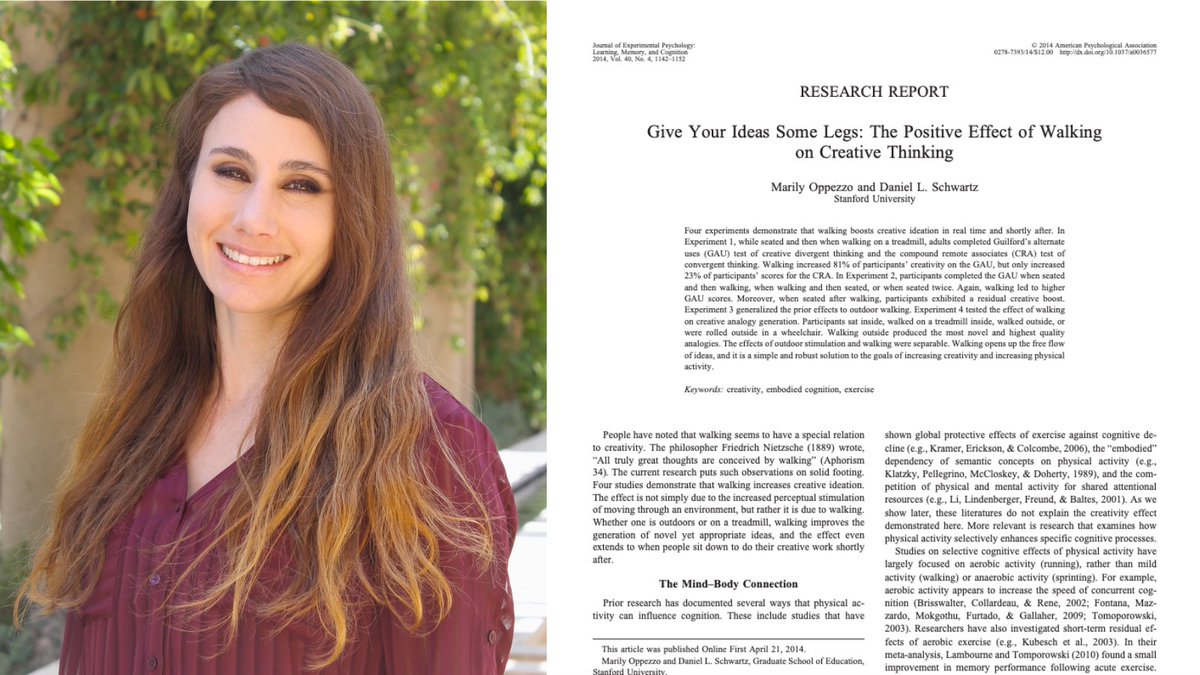
A Stanford psychologist spent 4 years proving that the simple act of walking generates 60% more creative ideas than sitting, and the experiment she designed to kill every alternative explanation is one of the most decisive findings in modern psychology.
Her name is Marily Oppezzo.
She got the idea for the study while walking with her advisor at Stanford to discuss her thesis topic, and the paper she eventually published in the Journal of Experimental Psychology in 2014 is sharp enough that it should have ended the seated meeting on the day it came out.
She ran 4 experiments on 176 people. Same person tested twice. Once sitting, once walking. The creativity tasks were the standard ones psychologists have used for decades to measure how good a brain is at generating novel useful ideas.
The result was almost too clean to publish.
81% of participants in the first experiment produced more creative ideas while walking than while sitting. In the second experiment, 88%. In the third, 100%. Every single person walked into a more creative version of themselves.
On average, people generated 60% more novel useful ideas the moment their legs started moving.
The skeptical question is the obvious one. Maybe it was the fresh air. Maybe it was the scenery passing by. Maybe it was the change of environment doing the work, not the walking itself.
Oppezzo killed every one of those explanations with one experimental decision.
She put people on a treadmill facing a blank wall. No scenery. No fresh air. No environmental change. Just legs moving in place while staring at white drywall. The 60% boost held.
Then she ran the experiment that closed the case completely. She took participants outside in two conditions. Half of them walked through a Stanford courtyard. The other half were pushed through the exact same courtyard in a wheelchair. Same outdoor stimulation. Same scenery passing at the same speed. The only difference was whether the legs were moving.
The walkers produced dramatically more novel high-quality ideas than the wheelchair group. The outdoors did almost nothing on its own. The walking did everything.
This is the part of the study that hit hardest when I read it the first time.
She also tested the opposite kind of thinking. Convergent thinking. The kind where there is one right answer and you have to narrow down to it.
Word puzzles where 3 words share a hidden fourth word that connects them. The seated participants did slightly better on these. Walkers got slightly worse.
Walking is not a general intelligence enhancer. It does one specific thing. It opens up the divergent search inside your brain. The part that generates options. The part that produces unexpected connections. The part that takes a problem and finds five ways into it instead of one.
When you need to converge on the single right answer, sit down. When you need to find the answer in the first place, get up.
The mechanism is now well understood. Walking selectively activates what neuroscientists call the default mode network, the system inside your brain that runs when you are not consciously focused on anything. The DMN is where mind-wandering happens. Where memories cross-reference each other. Where ideas that have been sitting in separate folders inside your head finally bump into each other.
When you sit at a desk and force yourself to concentrate, you suppress the DMN. When you walk at a natural pace, the executive part of your brain gets just busy enough handling the walking that the DMN comes online and starts doing the work that focus was blocking.
The most useful finding in the entire paper is the one almost nobody quotes.
The boost did not turn off the moment people stopped walking. Participants who walked first and then sat back down stayed elevated. Their next round of seated creativity work was still significantly better than people who had been sitting the whole time. The rest lingered for at least several minutes after the legs stopped moving.
You do not need to do creative work while walking. You need to walk before the creative work. The brain holds the state.
The history of this is the part that should haunt anyone who still does meetings in chairs.
Charles Darwin built a gravel loop behind his house in Kent called the Sandwalk and walked it 3 times a day for the rest of his life. The theory of evolution was developed one lap at a time on that path.
Nietzsche walked up to 10 hours a day during the years he wrote his most important books and openly said the work was conceived on his feet.
Beethoven composed for the morning and walked for 5 hours every afternoon with a pencil in his pocket for when something landed.
Kahneman said the best thinking of his Nobel Prize-winning career happened on leisurely walks with Amos Tversky. Steve Jobs refused to take important conversations sitting down. He held them on foot.
Every one of them was using the system Oppezzo would not measure until 2014. They just did not know what to call it.
The question worth sitting with is the one almost nobody asks.
Every meeting you have ever attended sitting around a table was a meeting held at a fraction of the brain power that was actually available to the people in the room. Every brainstorm that got stuck inside a conference room. Every problem you tried to solve at a desk and gave up on. Every idea you could not quite get to.
The intervention is the easiest one in modern science. No supplement. No app. No subscription. No training program. Just a pair of legs and 15 minutes.
The Stanford lab proved it. The philosophers knew it. The neuroscience explains it.
And almost everyone reading this is still trying to think their way out of problems sitting completely still.
@ajdc123 I love your purple Brompton- are they comfortable to ride? I've always wondered if they feel a bit like a circus bike with the tiny wheels and long seat post!
ABSTRACT DEADLINE EXTENDED UNTIL 28TH MAY!
We have received over 125 abstracts related to #LongCOVID and Post-Acute Infection Syndromes (#PAIS) for the ISLC-PAIS Conference 2026 (26-29 August) in Amsterdam. Register at https://t.co/SHD33RV9dR for the largest PAIS conference?!
Another powerful film by @AnilvanderZee featuring interviews with men living with #MECFS.
It’s important to see men speaking about the isolation, loss and stigma that many men struggle to talk about. I know I don’t talk about it enough. (23 mins)
https://t.co/cyDCqvPN8n
@WoollerEmma@ClagueNjc36 Oh I know! I had to look at it several times. I've been in touch with them and they should be amending it today . Thank you again for flagging
“To all those of you, struggling with your own demons…”
Martin Lewis’ acceptance speech as he received the Special Award on 10 May at this year's BAFTA TV awards.
Today marks the start of #MEAwarenessWeek (11-17 May). More people are aware of #MECFS but work is still needed to counter misinformation and share medical information. Here are 6 myths and facts everyone should know about #MyalgicEncephalomyelitis.
https://t.co/RBnUDwE9Gv
2 day virtual course designed for all health or care professionals covering all tier 2 core capabilities for frailty.
Learn using real world cases through mdt working. If you’re a health or care professional working with adults in a healthcare setting this course is for you !