| MFA at Sewanee | therapist | works in @Common_mag, @Still_journal, etc. | reader with @April_Gloaming and Waxing and Waning mag | same handle at Bluesky
Water is not a commodity. It is a birthright. It belongs to the earth, to other species, and to future generations. No corporation has the right to control it.
People are beginning to wake up to the fact that making the technological *products* of the "free" market our only God will result in the destruction of us all.
GenAI is entirely driven by financial interests. Saying that GenAI's ubiquity in our lives is "inevitable" is surrendering to the idea that money is the greatest and most determining force in our lives. It is buying into the greatest lie of consumerism: that what makes money is always a virtue, and that we have to get on board with superfluous monetary "progress" or be left behind, backwards, even "wrong."
In this way, money conditions our ethical thinking, anointing monetary "progress" as a virtue and everything that disagrees with it as a vice, even as something shameful, morally erroneous. The feeling of guilt has always been that which accompanies a person's banishment from the tribe—in ancient times, a mortal danger—and modern markets hijack that ancient fear to make us feel "bad" about not buying the collective madness.
Every "advance" in technology *requires* at least as great an advance in our self-awareness and ethical thinking.
There is absolutely no reason monetary greed has to be a stronger force in this world than love, than humanity.
That part is entirely up to us.
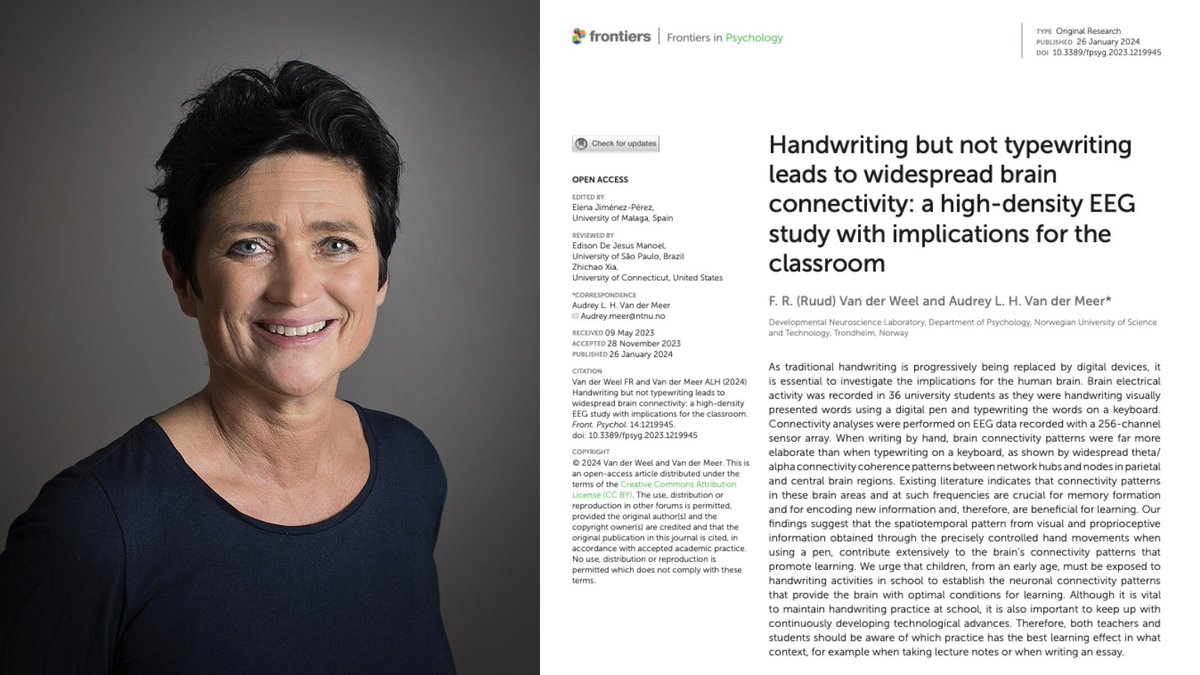
A Norwegian neuroscientist spent 20 years proving that the act of writing by hand changes the human brain in ways typing physically cannot, and almost nobody outside her field has read the paper.
Her name is Audrey van der Meer.
She runs a brain research lab in Trondheim, and the paper that closed the argument was published in 2024 in a journal called Frontiers in Psychology. The finding is brutal enough that it should have changed every classroom on Earth.
The experiment was simple. She recruited 36 university students and put each one in a cap with 256 sensors pressed against their scalp to record brain activity. Words flashed on a screen one at a time.
Sometimes the students wrote the word by hand on a touchscreen using a digital pen, and sometimes they typed the same word on a keyboard. Every neural response was recorded for the full five seconds the word stayed on screen.
Then her team looked at the part of the data most researchers had ignored for years, which is how different parts of the brain were communicating with each other during the task.
When the students wrote by hand, the brain lit up everywhere at once.
The regions responsible for memory, sensory integration, and the encoding of new information were all firing together in a coordinated pattern that spread across the entire cortex. The whole network was awake and connected.
When the same students typed the same word, that pattern collapsed almost completely.
Most of the brain went quiet, and the connections between regions that had been alive seconds earlier were nowhere to be found on the EEG.
Same word, same brain, same person, and two completely different neurological events.
The reason turned out to be something nobody had really paid attention to before her work. Writing by hand is not one motion but a sequence of thousands of tiny micro-movements coordinated with your eyes in real time, where each letter is a different shape that requires the brain to solve a slightly different spatial problem.
Your fingers, wrist, vision, and the parts of your brain that track position in space are all working together to produce one letter, then the next, then the next.
Typing throws all of that away. Every key on a keyboard requires the exact same finger motion regardless of which letter you are pressing, which means the brain has almost nothing to integrate and almost no problem to solve.
Van der Meer said it plainly in her interviews.
Pressing the same key with the same finger over and over does not stimulate the brain in any meaningful way, and she pointed out something that should scare every parent who handed their kid an iPad.
Children who learn to read and write on tablets often cannot tell letters like b and d apart, because they have never physically felt with their bodies what it takes to actually produce those letters on a page.
A decade before her, two researchers at Princeton ran the same fight using a completely different method and ended up at the same answer. Pam Mueller and Daniel Oppenheimer tested 327 students across three experiments, where half took notes on laptops with the internet disabled and half took notes by hand, before testing everyone on what they actually understood from the lectures they had watched.
The handwriting group won by a wide margin on every question that required real understanding rather than surface recall.
The reason was hiding in the transcripts of what the two groups had actually written down.
The laptop students typed almost word for word, capturing more total content but processing almost none of it as they went, while the handwriting students physically could not write fast enough to transcribe a lecture in real time, which forced them to listen carefully, decide what actually mattered, and put it in their own words on the page.
That single act of choosing what to keep was the learning itself, and the keyboard had quietly skipped the choosing and skipped the learning along with it.
Two studies. Two countries. Same answer.
Handwriting makes the brain work. Typing lets it coast.
Every note you have ever typed instead of written went into your brain through a thinner pipe. Every meeting, every book highlight, every idea you captured on your phone instead of on paper was processed at half depth.
You did not forget those things because your memory is bad. You forgot them because typing never woke the part of the brain that would have made them stick.
The fix is the thing your grandmother already knew.
Pick up a pen. Write the thing down. The slower road is the faster one.
Breaking news: Multiple scientists who serve on an independent board established to guide the nation’s nearly $9 billion basic science funding agency were terminated from their positions Friday by President Trump. https://t.co/mDTvgns6N8
“All of us need to make significant changes that may feel, at first, like sacrifices, yet in the end are only the surrender of privileges that were never ours in the first place.”
—Victoria Loorz https://t.co/CIDTZ5E6pm
In the end, the world belongs not to the hedge-fund managers and vulture capitalists and tech moguls but to the lovers & scholars, the preservers of lost things, the stewards of the natural world, the human artists, the poets and mystics, the child just learning to read.
Family annihilation is disciplinary violence that serves to maintain patriarchy. It is a response to real or perceived threats to the family unit and its goal is to affirm the patriarch as the ultimate authority over the fate of the family.
What will be left after we’ve felled the last forest and closed the last college? What will remain in a world without wilderness or winters, where the old tales & poems are forgotten? A world where illiterate people sit on their phones and gamble is the definition of dystopian.
There's still time to fight back against FOFA! Send a letter to your senators and encourage them to value our forests over logging industry profits: https://t.co/Q5WoojwrqZ
The arts funding debate misses something crucial: you can't gut state school music and drama, then wonder why working-class voices aren't reaching our stages. I've watched it happen. Training, access, networks-these aren't optional extras.
🚨 The consequences of Trump’s illegal war are already hitting your wallet.
Iran threatens to close the strait. Energy prices soar. And Delta just raised baggage fees.
Here’s what they won’t tell you:
Corporations never lower prices after a crisis ends.
The pandemic proved it. The supply chain shock proved it. Every economic disruption in modern history proved it.
They raise fees citing the emergency. The emergency eventually passes. The fees stay — permanently baked into the new normal.