What really predicts happy relationships?
Our new paper on this topic just got accepted to a leading journal, Archives of Sexual Behavior. This has been a 6-year project with 36 collaborators from 14 countries, involving 4 international studies (total N=4,719). (See post below from @justin_mogilski for details and link).
The focus was on 9 key 'relationship maintenance strategies' -- specific ways that people try to maintain good relationships, in both monogamy and consensual non-monogamy -- and analyzing what actually predicts happy relationships, good sex, and successful cooperation.
For me, the big takeaway was that people in strictly monogamous marriages can still learn some useful strategies from people doing consensual non-monogamy (CNM, e.g. polyamory, swinging, open relationships), in terms of specific ways to handle jealousy, improve communication, clarify expectations, share time and resources, etc.
Conversely, in some cases, the CNM people have re-invented and re-affirmed the value of certain practices that monogamous people have been doing for centuries (e.g. having a clear 'hierarchy' of which relationship is the most important, & socially signaling a strong commitment to that primary relationships -- rather than trying 'relationship anarchy' without any clear roles, expectations, or commitments).
So, no matter how you view 'alternative relationships' from an ethical, cultural, or religious viewpoint, there can still be some useful insights from people who have spent years doing those kinds of alt-relationships -- just as people doing CNM can learn a lot from the civilizational norms & practices that sustain monogamous marriages.
It’s taken a while, but I’m proud to announce that our manuscript...
“How do people maintain consensual non-monogamy? An international development and validation of the Multiple Relationships Maintenance Scale (MRMS)”
...has been accepted for publication in @ArchSexBehav.
If you’ve been following my work, you know that this is a big deal. I’ve talked about this data a lot. My best public interview was probably with @ChrisWillx, but I only had an incomplete and unreviewed preprint to support my claims.
Well, here’s the full thing: https://t.co/ST0jdU6Iuh
--
We collected data from ~5000 people across sixty-two countries who reported either only one (i.e., monogamous) or more than one (i.e., non-monogamous) romantic, sexual, or otherwise intimate relationship(s). Our aim was to characterize how people “do” consensual non-monogamy (CNM), where all partners are aware of and agree to have multiple relationships.
If you look at the majority of published scientific research on people who have multiple relationships (regardless of whether partners consent), you see a fairly ugly landscape: having multiple partners is related to relationship instability, competitiveness and conflict among partners, poor mental health, and worse family functioning.
However, the last two decades of research on CNM paints a different picture: one where partners are highly communicative, committed, intimate, and passionate, they encourage autonomy and agency in one another, they precaution against sexually transmitted infection, and they form supportive and enduring families to raise children.
Before I started this project, this paradox in the data confused me. My training in evolutionary psychology (and my personal experience) led me to expect that negative experiences, like jealousy and competition, were unavoidable. Sure, you could ignore them, but at what torture to yourself?
I first attempted to address this paradox by testing some evolutionary predictions in CNM samples. I was partially successful (and in some cases, not at all!).
Here, I looked at mate retention in these relationships: https://t.co/yElteLgOdY
And here, I looked at jealousy (and replicated the mate retention findings): https://t.co/QJiX3Fqilq
Still, I didn’t have a clear sense of why or how people in CNM relationships appear to make it work (though, in these first papers I outlined theorywork that has followed me to this day).
Then, in 2020 I published an article attempting to thread a needle: https://t.co/PCyy3spK2Z
My hypothesis was: compared to just anybody who wants to have multiple relationships, people practicing CNM are handling multiple relationships in a particular manner; one that reduces at least some of the usual risks and challenges. That is, maybe people in these relationships are doing things to precaution against threats like partner abandonment, competitive rivalry, sexual health risk, conflict over childcare, and damage to reputation. I wrote about this in the chapter I published in my handbook: https://t.co/Jn65NQG1zi
Well, the reason that this current paper is a big deal? It presents the data and logic to support this explanation, summarized into ~90 pages :)
This is the flagship manuscript, and so it is very detailed about the full dataset. Which is huge! There are many other manuscripts being written using this data. So, keep your eyes open.
I’m glad this is out of my hands now. Thank you to my immense and brilliant team. This was only possible through their combined efforts.
Critique is welcome, and expect more soon.
@gmiller, Peter Jonason, Katarzyna Grunt-Mejer, @jarkaVarella, @RhondaBalzarini, @DLRodrigues, @DrEliSheff, @LaithAlShawaf, @CsajbokZsofia, @DrThomasAG, @tamasdb, Cezar Giosan, Daniel Kruger, @DrDavidLey, @JustinLehmiller, @DrSchechinger, Amy Moors, @StefanoCiaffoni, Leif Edward Ottesen Kennair, Stephen Whyte, @zuzansterbova, Klara Bártová, Ryan Witherspoon, Magdalena Żemojtel-Piotrowska, Pavol Prokop, Virgil Zeigler-Hill, @PsychoSchmitt, Adil Saribay, Magdalena Lipnicka, Ivana Goláňová, Ezra Hampikian, @CostelloWilliam, @thatgirlevolved, Cory Cascalheira, and @MichelleLarva.
Ehdottomasti kaikkien vanhempien ja kasvattajien must-read nykyisessä kasvatuskulttuurissa: Tahkokallion Uskalla olla lapsellesi aikuinen 🙌 https://t.co/WYNUMwvuUZ
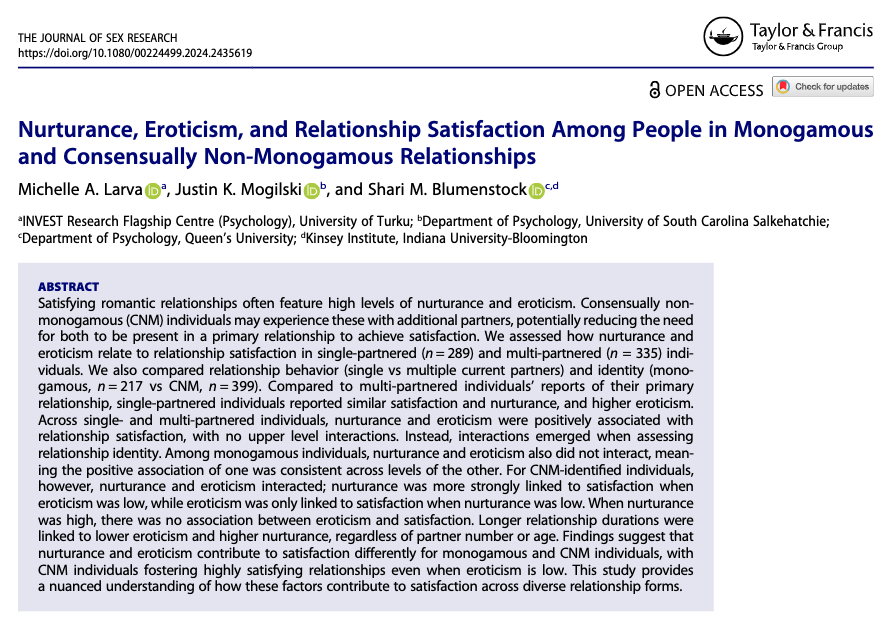
First manuscript from the international Multiple Relationships Maintenance project was accepted @ Journal of Sex Research with first author @MichelleLarva, and @smblumenstock.
Do you need a relationship to be highly nurturant AND erotic if you have several partners?
🤫👂🏻soon
People in happy multi-partner relationships have strategies in place to ensure good communication, overcome challenges, and reduce risk.
To date, there has been no formal cataloguing of such strategies or evaluation of their effectiveness—until now.
https://t.co/RBT1awuMFk
Compared to single men, partnered men reported higher scores on 4 domains of male sexual functioning—while sociosexuality and sexual orientation only weakly predicted sexual functioning.
Very cool study, de Souza, Silva, @jarkaVarella@M_SilvaJunior !!
https://t.co/AI0jivMBhx
The Family Federation of Finland @Vaestoliitto published some fascinating findings yesterday regarding Finn's intimate relationships. 🧵
https://t.co/o07vQuTBqG
The prevalence rates are similar to what have been reported from the US & Norway [1,2]. I often see figures around 20-25% also thrown out when it comes to CNM prevalence; it’s good to keep in mind that these come from “lifetime estimates,” i.e. having *ever* practiced CNM [1,3].


![SteveStuWill's tweet photo. New research suggest that the "woke" worldview is associated with depression and anxiety.
[Link below.] https://t.co/gcR1JW5guE](https://pbs.twimg.com/media/GfKOikraEAARM9t.jpg)





