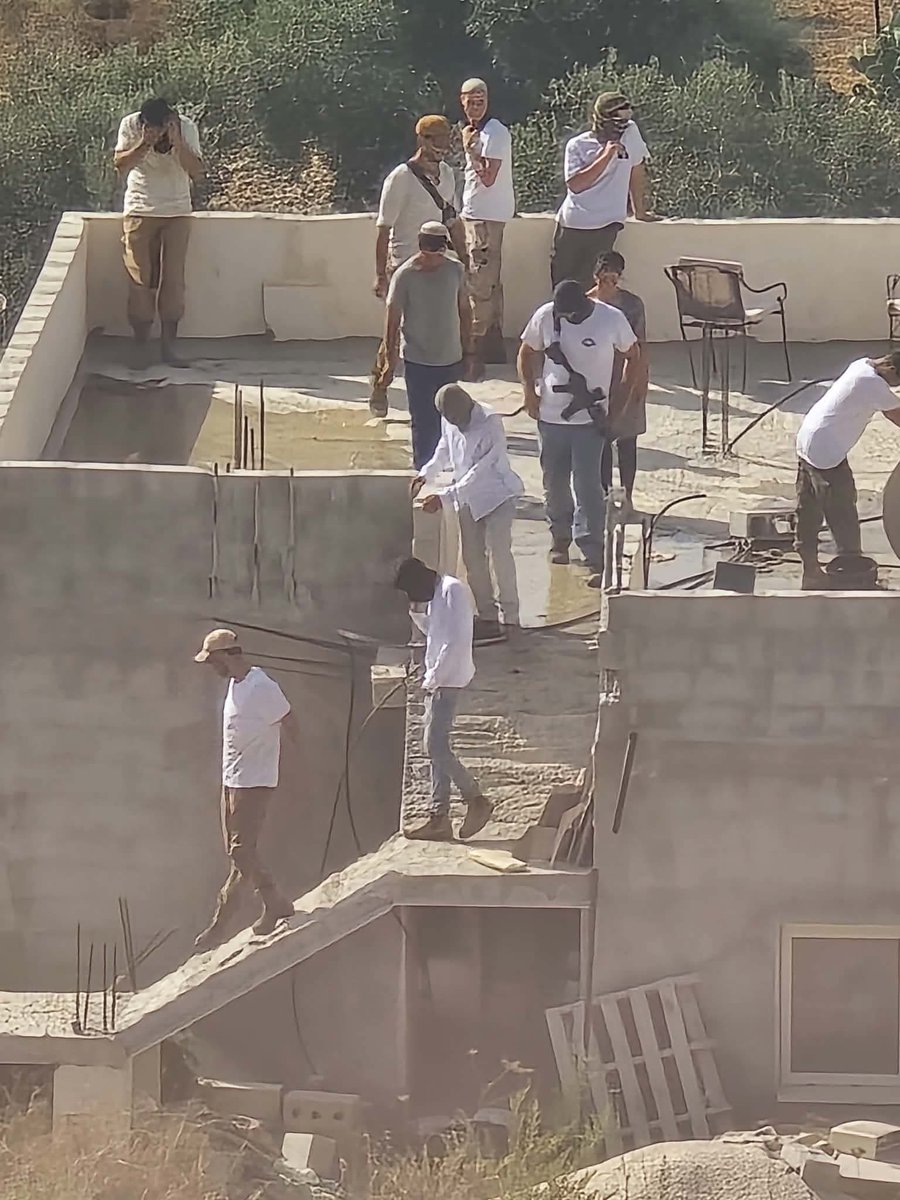
What an Israeli settler pogrom feels like
For the first time in my life, I found myself completely helpless. My car was engulfed in flames, but all that mattered to me was my family's survival.
By @MohammadHuraini.
https://t.co/uK7UPFecTY
A full year has passed since settler Yinon Levi, an Israeli settler, shot and killed Awdah al-Hathaleen, a resident of Um al-Kheir, in South Hebron Hills. Awdah’s filmed his own killing. Levi was released from custody after one night, and was then documented in the vicinity of Um al-Kheir. He has not been indicted.
Awdah was 31 years old at the time of his death. He was a father of three young children, an educator, a prominent peace activist, and one of the leaders of the residents of Masafer Yatta’s non-violent struggle for the right to remain on their land.
From October 2023 to 27 July 2026 Israel killed at least 1,100 Palestinians in the West Bank. 37 were killed by settler militias.
Since October 2023, not a single indictment has been filed against an Israeli for the killing of Palestinians in the West Bank.
Under Israeli apartheid, Palestinians are left exposed to violence, while Israelis who harm them enjoy near-total impunity.
BREAKING: Israel's Defense Minister @Israel_katz has reportedly instructed Israeli forces to destroy an unnamed Palestinian refugee camp and forcibly displace its inhabitants.
The order appears to follow the pattern established in Tulkarm, Jenin and Nur Shams, where more than 33,000 Palestinians were displaced last year. If reports are accurate, Balata or Askar camps near Nablus may now be in the government's sights.
International humanitarian law prohibits an attack lacking military necessity, conducted indiscriminately, accompanied by the wanton and extensive destruction of property, or resulting in the forcible transfer of protected persons; which, if committed, would constitute grave breaches of the law of armed conflict and amount to war crimes.
These are well-established rules designed precisely to prevent the destruction of civilian communities under the cover of military operations.
A photo of armed Israeli settler terrorists storming a house in the village of Asira al-Qibliya in the West Bank.
If the homeowner had tried to defend his family and home, he would have been shot on the spot—and the Israeli army would have called him a "terrorist."
Completely insane story out of the occupied West Bank, in which joyriding Haredi settler kids crashed their car in the Palestinian village of Mukhmas, and the army laid a devastating siege on the community to “rescue” them. Full story in link below.
There are many mechanisms through which a warmer climate results in increased *likelihood* of large boreal fires, which in turn increases the chances of a significant smoke event like this one:
a) warmer winters means less snow pack accumulation, which results in a longer wildfire season as forests become primed for dry conditions earlier than before;
b) warmer nights mean that these fires don’t slow down as much as they did in the past at nightfall, making these fires burn faster and more intensely;
c) a warmer atmosphere causes evaporation to occur more intensively, pulling water out of the soil, vegetation, and dead forest litter alike, making these fires easier to start;
d) a warmer climate has resulted in higher rates of insect infestations and other forest disturbances, meaning there are more dead trees to catch fire;
e) a warmer climate may result (though there’s still some uncertainty about this) greater propensity for lightning, which means more ignitions of those remote fires which make up the vast majority of Canada’s boreal burn area.
All of these factors mean that a warmer climate makes these large intense fires more likely and harder to fight, generally-speaking. Of course, there is significant variation from one year to the next... but the general trend is clear.
In fact, it's all the more significant given that the total NUMBER of fires across Canada has declined significantly over this same time period.
BREAKING: Israeli settler terrorists attacked the Palestinian village of Tuwani in the West Bank, setting a mosque and a vehicle on fire and spray-painting a Star of David on the mosque's wall.
@sillyrabbitfafo While the numbers are mostly accurate, the comparison of size vs the USA isn't. 347 hectares is just about half the size of the contiguous USA. It's certainly huge regardless, but we should strive to be factual.
@DragonflyQTPI@PeregrinePulp@brent_bellamy Agreed. He makes a lot of cuts in a lot of areas of public service that I would call unacceptable or more than unacceptable. I live in the province but have never, and will never, vote for him. We need higher funding. Even with proper funding, however, it's harder in Canada.
Canadian wildfire smoke so heavy that they had to turn on the lights for an afternoon baseball game at Fenway Park in Boston... back in 1950.
Wildfire smoke sifting down to the US is nothing new. It's happening a bit more often in recent years thanks mostly to changing climatological conditions relative to the late 20th Century. Forest management has likely played a role too, but it's delusional to think you can prescribe burn Canada's 1.3 BILLION acres of boreal forest.
Fire season is longer; nights are warmer; soil and forests are drier; evaporative demand is higher; more dead combustible trees thanks to insect infestations; and so on.
"Just put the fires out!"
Ever seen a boreal wildfire? I have. I used to fight them.
When fire behaviour becomes extreme, you're not getting close to them.
The radiant heat from a crown fire is face-melting from hundreds of metres away.
All attempts at direct attack will fail, because dropping water on it becomes akin to trying to spit on a campfire...it evaporates before it even hits the flames.
Additionally, reduced visibility, high winds, and turbulence makes aerial attack hazardous.
As a wildland firefighter, I've been extracted off of wildfires twice as our fires blew up, both times having our gear burned over. We returned to find firehoses and metal melted into the ash.
I've seen fireballs launched hundreds of feet high, and fires intense enough to produce lightning, influencing the weather around them. I've seen wildfires grow to the size of a major city in a short period of time.
So no, we can't just put the fire out.
Not being able to stop such a natural process is a truly humbling feeling.
For those wondering why it's so hard to control remote wildfires in Canada, here are two maps which might help illustrate the problem. Let's call them: A) Where the people are; and B) Where the trees are.
@DragonflyQTPI@PeregrinePulp@brent_bellamy The Conservative cuts to wildfire management budgets of late aren't acceptable. Climate change is increasing the need for a higher budget, especially during the now shorter window for prevention measures. Nonetheless, the challenges to management is much higher in Canada.
@DJL06824@RARohde I'm not sure why you would say it's not global warming. Climate change is definitely a big factor here, but it's not the only factor. There is a good AMA from a Canadian professor of wildfire management on Reddit this week: https://t.co/rcFzuOhsna
With apologies to all - I think the smoke is putting me (and many others) in a bad mood - but honestly, instead of arguing about the wildfires we should be working together.
I can understand why American lawmakers in Northern States are frustrated. The smoke is awful, costly, and deadly. And there've been a handful of really bad years in a row now. The truth is there *is* a lot more that (in this case) Ontario [and the Canadian government] COULD have done, and SHOULD have done, to reduce the fire risk, and a lot more it could be doing now.
But this approach is not the way👇. It is the *opposite* of collaborative. It's hostile. And it's difficult not to get defensive about it, especially when the lawmakers in question seem to be mostly aiming to score political points rather than address the real issues fundamentally.
There are communities that have just been evacuated and sadly some that have been entirely lost. Helping those most acutely affected is the priority, regardless of where they are from or their nationality. I think all of us plebs are better served when our political leaders work together in times of crisis, not when they point fingers and further divide us.
https://t.co/zudd5jx73A