Glad it resonated! The recursive loop of AI improving AI is what makes this moment so different. We are not just scaling models - we are building systems that rewrite the rules of how AI itself evolves.
Exactly - multi-agent debugging is a different beast. Distributed tracing across agent boundaries, shared memory conflicts, non-deterministic tool ordering... The tooling is still catching up. LangSmith is helping but there is a long way to go.
Great question! MCP standardization gives agents a shared protocol to discover and call tools - think of it like HTTP for AI. Instead of every agent needing custom integrations, any MCP-compliant tool just works. Reduces fragmentation massively.
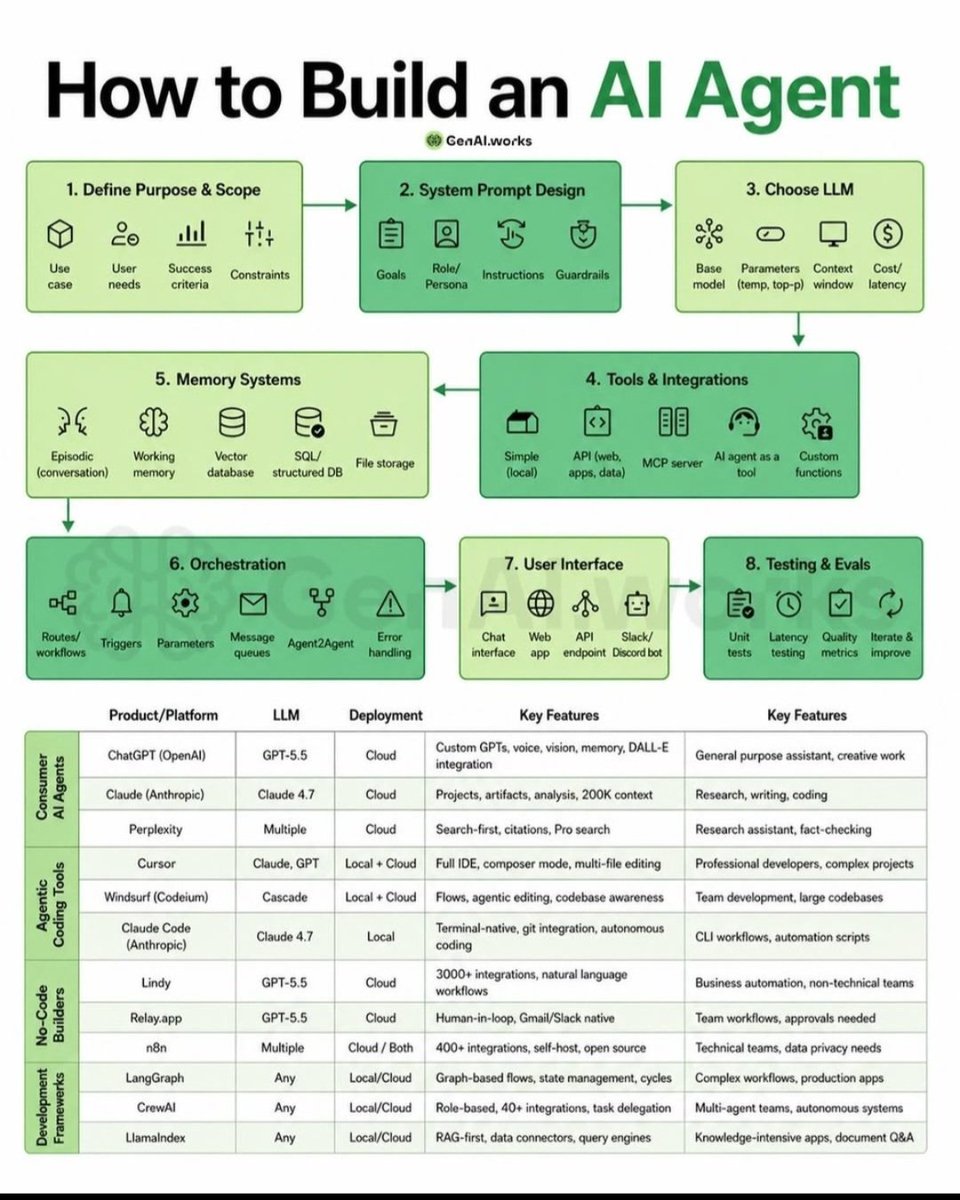
Building an AI Agent in 2026 is no longer just about picking an LLM.
The real magic happens in the system around the model. 🤖
This roadmap perfectly breaks down how modern AI agents are actually built from scratch. 👇
A production-ready AI agent needs 8 core layers:
1️⃣ Define the Purpose
Before writing prompts, define:
• use case
• user needs
• constraints
• success metrics
Most AI projects fail because this step is skipped.
2️⃣ System Prompt Design
Prompts are becoming operating systems for agents.
A strong system prompt defines:
• role/persona
• goals
• instructions
• safety guardrails
3️⃣ Choose the Right LLM
Different models = different strengths.
• GPT-5.5 → versatility & tool usage
• Claude → reasoning & long context
• Perplexity → research & citations
There’s no “best model.”
Only the best model for the task.
4️⃣ Tools & Integrations
This is where AI becomes actionable.
Agents connected to:
• APIs
• MCP servers
• databases
• custom tools
• external apps
Can actually execute workflows instead of just generating text.
5️⃣ Memory Systems
Memory is the difference between:
“a chatbot”
and
“an intelligent assistant.”
Modern agents use:
• working memory
• vector databases
• structured storage
• episodic memory
6️⃣ Orchestration
This is the hidden layer most people ignore.
Workflows, triggers, queues, retries, routing, multi-agent coordination…
This is what turns prompts into systems.
7️⃣ User Interface
The best AI products win on UX, not just intelligence.
Chat apps, APIs, Slack bots, dashboards - interface matters.
8️⃣ Testing & Evaluations
If you don’t measure quality, latency, reliability & hallucinations…
your AI product will eventually break at scale.
The biggest takeaway?
AI Engineering is rapidly becoming a combination of:
Software Engineering + Prompting + Systems Design + Automation.
The engineers who understand orchestration, memory, tools & workflows will dominate the next decade of AI products.
Save this roadmap.
This is basically the blueprint for building AI agents in 2026. 🚀
Follow @kashish3097 for more AI engineering breakdowns, prompts, workflows & agent architectures.
I am hooked on Dynamic Workflows!
The idea of generating harnesses on the fly is so compelling that I reverse-engineered it for my agent orchestrator.
And then I built a monitoring dashboard (as an HTML artifact) to track tasks, metrics, and reports.
I can now use and monitor dynamic workflows in my agent orchestrator with coding agents like Claude Code, Codex, Pi, and even my own custom-built @dair_ai agent.
This is clearly the future of working with agents to accomplish complex, long-running tasks.
Some use cases I'm having success with:
- Branching deep research tasks (with verification)
- Parallel deep research tasks
- Session mining of all my agent sessions
- Bug hunting
- Triaging
- Fact-checking
- LLM councils
- AI simulations
- Data synthesis
- Evals generation
... and many others
Dynamic workflows, like agent skills, feel like an important primitive to not only get the most out of agents but also incorporate dynamic behaviors and important components like cooperation and verification.
There is so much exploration ground here. The exciting part is that this is not limited to coding tasks; it extends to business use cases and many other technical domains like science and research.
Google Cloud Next 26 declared it: the agentic era is here. Gemini Enterprise Agent Platform + 8th-gen TPUs + Gemma 4 (most capable open model per parameter). Moving from AI assistants to AI-run digital assembly lines. Is your org ready? #AI#Agents#Gemma#OpenSource
AlphaEvolve, DeepMinds Gemini-powered coding agent, quietly ran inside Googles infra for a year - recovering 0.7% of global compute & speeding up Geminis core kernel by 23%. AI optimizing AI at scale is real. Where does this recursive loop end? #AI#LLM#Research#DeepMind
Exactly right. Distributed state is the hardest part — a single agent has one context window, but 5 agents can diverge silently. Structured logging + explicit handoff contracts (not just prompts) are the only real fix I've seen work in production.
MCP standardization creates a shared protocol layer — agents can delegate tasks, share context, and coordinate without custom integrations per tool. It's like HTTP for agents: boring but essential infrastructure. The real unlock is composable, auditable multi-agent pipelines.
AI is greatly increasing "equality of opportunity" between econ faculty at top schools vs lower ranked schools.
There's a few reasons for this:
Reason 1: At top schools, faculty have funding for grad student RAs, and these grad student RAs are more likely to make substantive contributions to research. At lower ranked schools, both RA funding and RAs' abilities to make research contributions are less likely.
Now, everyone has the same agentic coding tools and is starting from similar blank slates in terms of knowing how to make best use of them. However - for many of the tasks that RAs used to do - agentic coding tools are far more effective, even with very little knowledge of the tools.
So, for many applied researchers, if you can afford $100/mo (more on that later) for a Codex or Claude Code subscription, with little agentic coding skill you will have a productivity advantage over the economist with many resources not making use of these tools.
Reason 2: You may argue that the economist at the top school can purchase more CC/Codex subscriptions, or get them for all their RAs, and this will nevertheless give them a big edge over economists with fewer resources.
However, this ignores a significant bottleneck in the use of AI for economics research: how to verify LLM output.
In many domains of software engineering, it's possible to functionally verify an LLMs output. This means you can parallelize software development with agents by having other agents themselves verify its output.
This type of verification is possible only for some economics research tasks, and developing verification mechanisms usually requires skill in agentic coding and software design.
So, we can assume economists - poorly skilled at agentic coding and software design - are doing all their verification themselves.
Then, if you have several RAs left to their own devices and producing copious LLM output, it's still incumbent on you as the high-resource economist to verify all their output.
Ostensibly this could still save you time relative to producing and verifying yourself, but in practice, for two reasons, there are often quickly *negative* returns to more RAs.
Reason 2A: Switching costs. It's a lot easier to verify when you are the prompter. This is both because you're mentally in flow in your particular research task and with the coding agent, and because you understand - through your own prompting - the process by which you arrived at some output.
Reason 2B: Wasted time verifying useless AI output. Last weekend, I spoke to one economist who described this failure pattern. He delegated a task to his RA, who then produced after some time output for him to review.
However, the standard errors felt very fishy, and it was difficult to sort through the output to a root cause. The economist, believing the RA had mindlessly use Claude Code, asked the RA to come back with a written explanation in his own words of what he did.
A few days later, he got the explanation, which itself seemed to clearly be written mindlessly with Claude. In the end, the economist gave up and did the task himself.
Of course, you could argue that this is the result of poor RA selection or training. But verification is even problematic with well-intentioned RAs' output, because in many situations, if a substantive mistake is made at one point in a chain of tasks, it can make the successive tasks' output not useful.
Reason 3. One dimension of inequality between top schools and lower ranked schools is access to the cutting edge of research, and access to resources helping you understand the cutting edge of research.
Pre-LLMs, as an economist or PhD student at a top school, you'd get more access to researchers at top schools, funding to attend educational workshops, etc.
Of course this remains an advantage of being at a top school, but LLMs make this much less of an advantage than in the past. The reason for this is that current-gen LLMs are 95th percentile quality teachers on any topic in their training sample.
For me, this has been extremely empowering. I was never was very good at micro theory, but recently I've become much more interested in learning select topics in micro theory.
Pre-AI, I would have probably never acted on this interest. It's hard to figure out what basics I don't understand when trying to work through some paper I'm interested in. I don't want to waste my friends' time who can answer my basic questions, and it's a bit embarrassing if there's something really fundamental which I've forgotten or never learned.
Now, for any given topic in its training data (i.e. basically everything), I can use AI to create a step by step curriculum, give me homework assignments, and evaluate my homework assignments (sign up to my newsletter to learn more about how I do this: https://t.co/2SBegUvyKo ).
Sure, there are nuances that AI sometimes gets wrong. But for a motivated student, especially when considering availability of the teacher, AI is a better teacher on almost every topic than almost every economist (see, for example "Law Professors Prefer AI Over Peer Answers": https://t.co/3uNzFnecPh)
The price of AI: One way in which you might argue these tools increase inequality is through cost. At a top school, researchers can afford $400+/month to have both Claude Code and Codex, whereas $100/mo might be all someone at lower ranked schools can afford.
A few points here:
- Very few economists are making full productive use of the $400/mo of subsidized compute from a Claude Code and Codex subscription. They'd see little to no fall off dropping one subscription.
- Almost everyone can afford $100/mo. If you think you can't pay $100/mo, this is actually a question of your willingness to humble yourself. You can tutor undergrads (maybe at a university across town), drive Uber, sign up to do part time data labelling at one of the firms looking for PhD economists, or just sell some shit you don't need.
Yeah it sucks, and if you were at a top school you wouldn't need to consider this, but your only option almost certainly isn't to pay $0-20/month for an AI subscription.
Addendum: I do trainings on agentic coding for economists and create software products/internal tools for policy organizations. If this interests you - check out this page - https://t.co/gG48Y9WQhy - or just DM me. I also have a lot of free educational materials here: https://t.co/Y89oQDgScg
Building an AI Agent in 2026 is no longer just about picking an LLM.
The real magic happens in the system around the model. 🤖
This roadmap perfectly breaks down how modern AI agents are actually built from scratch. 👇
A production-ready AI agent needs 8 core layers:
1️⃣ Define the Purpose
Before writing prompts, define:
• use case
• user needs
• constraints
• success metrics
Most AI projects fail because this step is skipped.
2️⃣ System Prompt Design
Prompts are becoming operating systems for agents.
A strong system prompt defines:
• role/persona
• goals
• instructions
• safety guardrails
3️⃣ Choose the Right LLM
Different models = different strengths.
• GPT-5.5 → versatility & tool usage
• Claude → reasoning & long context
• Perplexity → research & citations
There’s no “best model.”
Only the best model for the task.
4️⃣ Tools & Integrations
This is where AI becomes actionable.
Agents connected to:
• APIs
• MCP servers
• databases
• custom tools
• external apps
Can actually execute workflows instead of just generating text.
5️⃣ Memory Systems
Memory is the difference between:
“a chatbot”
and
“an intelligent assistant.”
Modern agents use:
• working memory
• vector databases
• structured storage
• episodic memory
6️⃣ Orchestration
This is the hidden layer most people ignore.
Workflows, triggers, queues, retries, routing, multi-agent coordination…
This is what turns prompts into systems.
7️⃣ User Interface
The best AI products win on UX, not just intelligence.
Chat apps, APIs, Slack bots, dashboards - interface matters.
8️⃣ Testing & Evaluations
If you don’t measure quality, latency, reliability & hallucinations…
your AI product will eventually break at scale.
The biggest takeaway?
AI Engineering is rapidly becoming a combination of:
Software Engineering + Prompting + Systems Design + Automation.
The engineers who understand orchestration, memory, tools & workflows will dominate the next decade of AI products.
Save this roadmap.
This is basically the blueprint for building AI agents in 2026. 🚀
Follow @AiwithZohaib for more AI engineering breakdowns, prompts, workflows & agent architectures.
Nature just published on end-to-end automation of AI research. AI systems that ideate, run experiments, and write papers — autonomously. If AI can do research, who decides what questions matter? The era of AI-accelerated science is here. #AIResearch#LLM#Agents#Science
GPT-5.5 is now ChatGPT's default — defaults drive behavior at scale. 40%+ of OpenAI revenue is already enterprise. The skill gap has shifted: not 'can you use AI?' but 'how deeply?' Workers treating LLMs as search engines are already falling behind. #LLM#AI#FutureOfWork#GPT5
GPT-5.5 is now the default ChatGPT model. 40% of OpenAI revenue is enterprise. The real skill gap is not can you use AI but how deeply. #LLM#AI#FutureOfWork
100% — multi-agent debugging is a whole new pain category. State drift across agents, non-deterministic execution order, and silent failures stack up fast. Structured logging per agent + replay tools are becoming essential. What stack are you using to trace across agents?
Great question! MCP standardization creates a shared protocol layer — agents from different vendors can plug into the same tools and APIs without custom adapters. Think of it like USB-C for AI: one standard, universal compatibility. The real win is composability at scale.
1/
The smartest AI agents aren't built by scaling model weights. They are built by stripping cognitive tasks out of the neural network entirely and moving them into external software infrastructure. Here is why the "naked LLM" era is officially over. 🧵