@VigourTech, we believe the best technology is the kind that works effortlessly in the background…simplifying processes, improving productivity and creating seamless experiences without disruption.
Innovation isn’t just about advanced systems;
Happy Birthday to an exceptional team leader!
Your dedication, guidance and unwavering support continue to inspire everyone around you. Thank you for leading with wisdom, patience and excellence.
May this new year bring you greater success, good health, happiness —
Around ikeja today, some policemen stopped me to question me. they asked what i do for a living, i told them i’m an influencer and i showed them my X page.
They were shocked to see it was me😂😂
“is it really you? whakee herself”
i just laughed, sent them 100k to buy drinks.
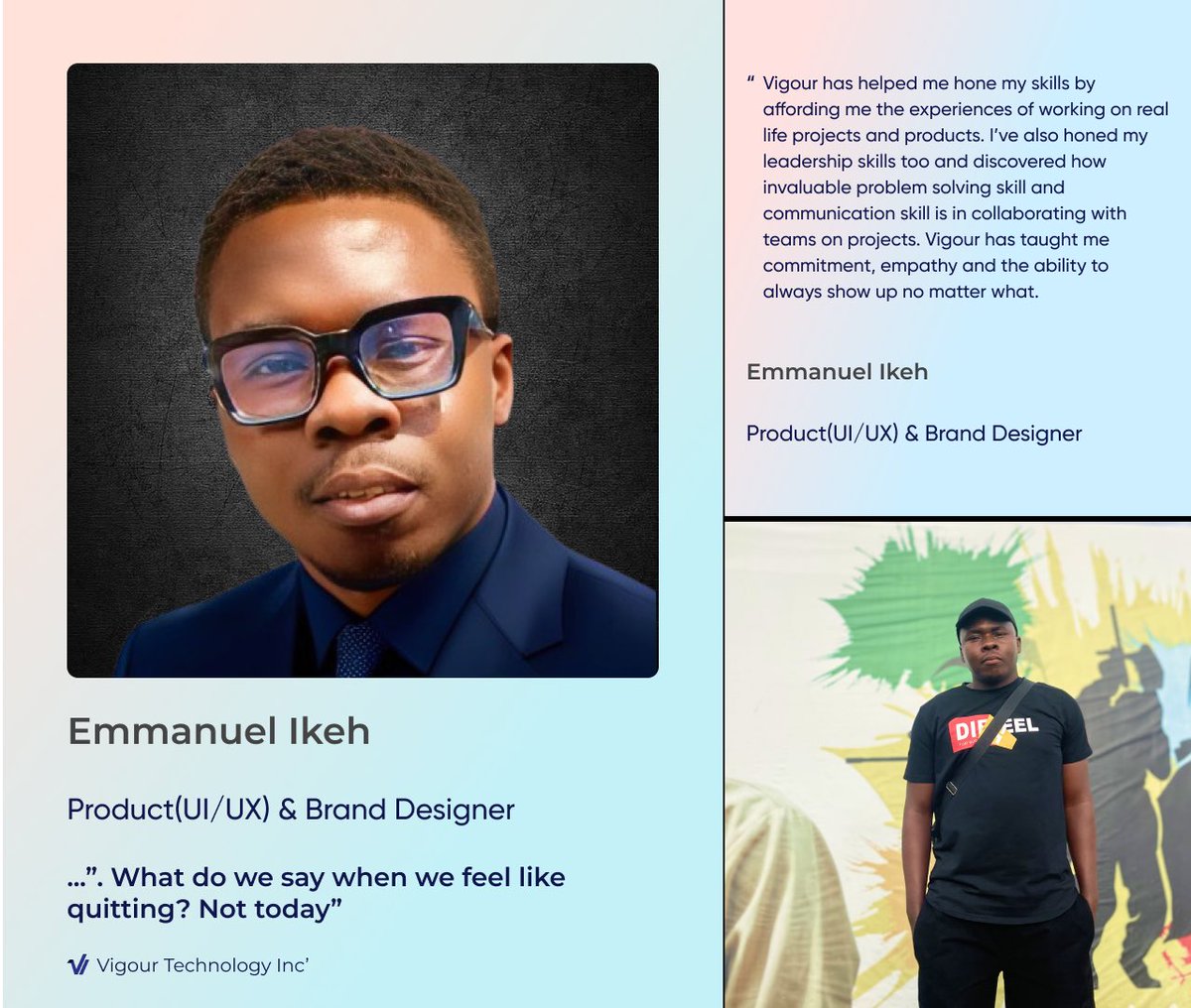
🌟TEAM SPOTLIGHT🌟
At @VigourTech, we celebrate the people whose creativity, leadership and teamwork continue to drive innovation forward.
Today, we’re spotlighting one of our exceptional team members with expertise in Product Design, Graphic Design and Branding—
Today, we celebrate an exceptional leader, visionary and driving force behind our growth. 🎉
Your dedication, innovation and passion continue to inspire excellence and push boundaries every day.
There’s a better way to run a school without the chaos, without the constant stress, and without things falling apart behind the scenes.
That’s exactly what Teachsavy is here to deliver.
MODERN LLMs MASTERY CHECKLIST FOR 2026
1 → Understand what Large Language Models (LLMs) are
2 → Learn how transformers work (attention mechanism basics)
3 → Understand tokens, embeddings, and context windows
4 → Learn how LLMs are trained (pretraining vs fine-tuning)
5 → Understand inference vs training
6 → Learn common LLM architectures (GPT, BERT, etc.)
7 → Understand prompt-response behavior
8 → Learn limitations of LLMs (hallucinations, bias)
9 → Explore real-world LLM use cases
10 → Use an LLM API for the first time
11 → Master prompt engineering fundamentals
12 → Write clear, structured prompts
13 → Use role-based prompting effectively
14 → Apply few-shot and zero-shot prompting
15 → Control tone, format, and output style
16 → Use system prompts for consistency
17 → Handle long context with chunking
18 → Debug and refine prompts iteratively
19 → Build reusable prompt templates
20 → Evaluate prompt performance
21 → Learn embeddings and vector databases
22 → Store and search embeddings (Pinecone, Weaviate, FAISS)
23 → Build semantic search systems
24 → Understand cosine similarity
25 → Implement Retrieval-Augmented Generation (RAG)
26 → Connect LLMs to external data sources
27 → Handle document chunking strategies
28 → Optimize retrieval pipelines
29 → Reduce hallucinations using RAG
30 → Build a document Q&A system
31 → Learn LLM frameworks (LangChain, LlamaIndex)
32 → Build AI agents and workflows
33 → Implement tool/function calling
34 → Connect LLMs to APIs and databases
35 → Build chatbots with memory
36 → Manage conversation state
37 → Implement multi-step reasoning workflows
38 → Handle structured outputs (JSON mode)
39 → Integrate LLMs into web apps
40 → Build full-stack AI applications
41 → Optimize performance and cost
42 → Use streaming responses
43 → Cache LLM responses
44 → Choose the right model for the task
45 → Monitor token usage and latency
46 → Evaluate outputs using benchmarks
47 → Implement guardrails and safety checks
48 → Secure LLM applications (rate limits, validation)
49 → Deploy scalable LLM-powered systems
50 → Think in AI systems, not just prompts
Grab the LLMs Ebook:
https://t.co/ljEMt0UNUI
If you want to learn more, follow me @e_opore
Before learning programming: Clear skin, full sleep, happiness.
After C++ and Java: Dark circles, talking to your laptop like “Why are you behaving like this?”
Then Python enters the chat like: “Calm down my brother, life no suppose hard like this.” 😁
#Tgif#TechHumour#Vigour
My bro @MusawirRaji has been telling me to learn Webflow since last year.
I locked in recently.
Last month, I secured my first Webflow redesign client ⚡️⚡️
Skill stacking works.