A pipeline of 40 targets is neither good nor bad until you know your coverage ratio. How many names do you need at the top to land one deal at the bottom? Most teams have never calculated it, then wonder why the year came up short.
AP McColgan spends his week building the dashboards corp dev teams actually look at. Vil Audinis has spent close to a decade building M&A software.
They're walking through the sourcing scorecard live on Nov 11. https://t.co/tQBapYKOPQ
Your close rate is a lagging indicator.Your stage-by-stage conversion rate is the one that tells you what to fix.Nov 11, 11:30 ET: sourcing & pipeline KPIs, with live numbers and a scorecard you can build in 30 min.https://t.co/tQBapYKh0i
"We convert 4% of pipeline" is a number that can't be acted on.
Screen → first conversation: 22%
First conversation → IOI: 31%
IOI → LOI: 58%
Now you know which stage to work on.
How many targets do you need to see to close the deals your mandate calls for?
Part 4 of our KPI series covers the metrics behind that answer: origination volume, pipeline conversion rates, stage-by-stage velocity, and conversion benchmarks.
Register here: https://t.co/tQBapYKh0i
You can buy an accounting or IT services firm. You can't buy the partners staying.
A new guide on professional services roll-ups — and why retention, not capital, is the real constraint.
https://t.co/toT9Q4409s
Why does synergy tracking so often get deferred?
What does a workable first version actually require?
How do you start without waiting for perfect systems?
Look no further:
https://t.co/AVDuXHjoLc
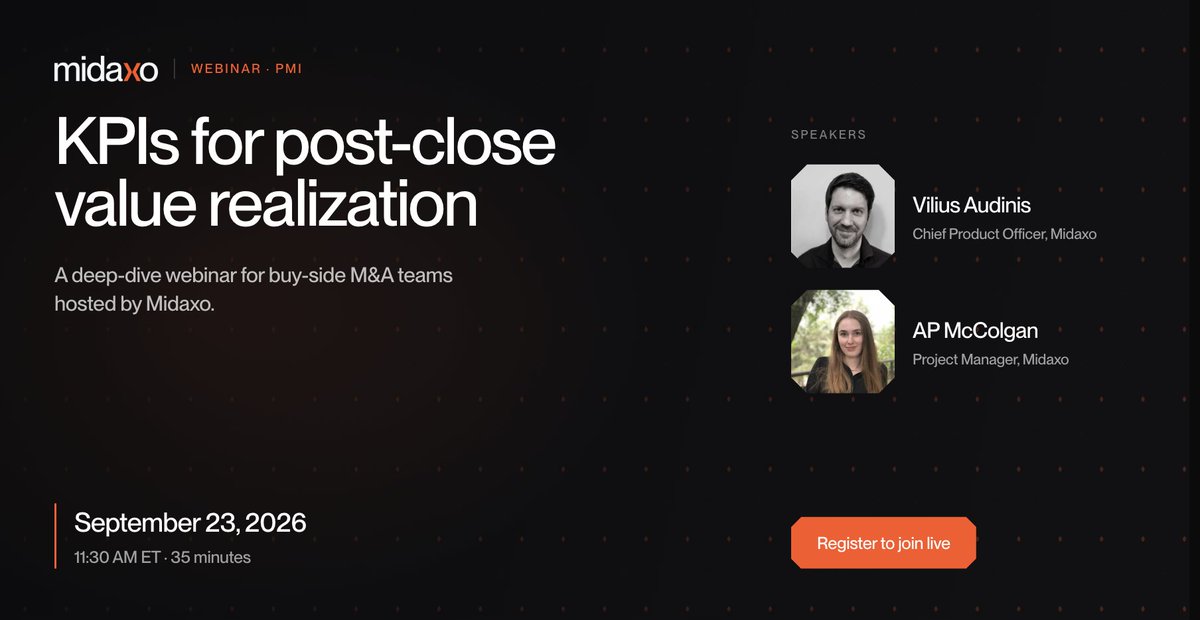
On Wednesday, we're breaking down the KPIs that should definitely be on your post-close dashboard.
This is the third session in our KPI series. You don't need to have caught the first two to get something out of this one!
Save your seat: https://t.co/GUZcZIGIpK
Healthcare M&A has a constraint no other roll-up does: every deal touches protected patient data and that maps to heavy compliance needs.
The full playbook for these consolidations is here👇https://t.co/1zyTK2YheA
Home services is the hottest roll-up sector in the US.
The teams winning aren't the best-funded. They're the ones with a repeatable process. Deal cadence beats deal volume.
Full playbook: https://t.co/ZoAyhdhHQq
~75% of deals fail to deliver the value they promised.
~50% of acquirers never review past year one.
Those two facts are related.
Sept 23, 11:30am ET — post-close KPIs that prove a deal actually worked. Live, with Q&A.
https://t.co/GUZcZIGIpK
Deal flow is down this year. Scrutiny isn't.
Boards and LPs are asking harder questions about the assets firms already own, not just how many new ones they're closing.
Most M&A tools stop tracking a deal the second it closes. That's a problem now: https://t.co/vFnX5PIPvS
The M&A pipeline fundamentals haven't changed in a decade, but the tools have.
Archive dead deals. Automate reporting. Filter ruthlessly. Organize every doc. Run multiple pipelines at once.
The 5 essentials, refreshed for 2026 👇
https://t.co/VI5T5RH77t
Due diligence is one of the oldest disciplines in M&A; the fundamentals haven't changed much, but one can always use a refresher.
Teams that get burned between LOI & close usually aren't the ones who miss something exotic: https://t.co/fobS0W7X7C
Visibility into every stage of the deal process, plus a reason to revisit the workflows themselves.
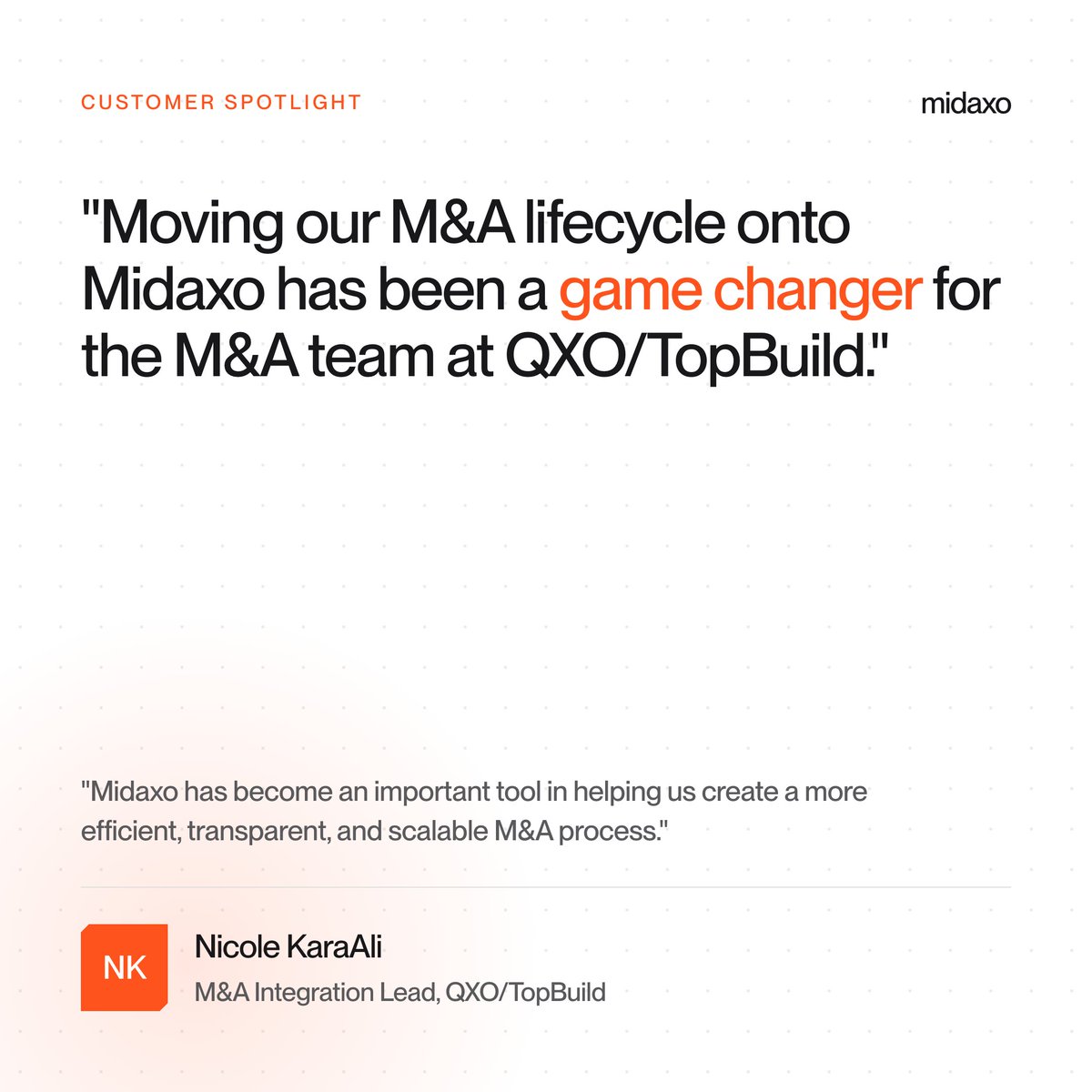
That's what the M&A team at QXO/TopBuild reported a few months into Midaxo. https://t.co/pDoWJrDuvj
The deal closes. Now the real work starts.
Guide to running PMI without losing the value you underwrote: Day One structure, governance, synergy tracking, functional checklists. https://t.co/DfnSM3VHvy